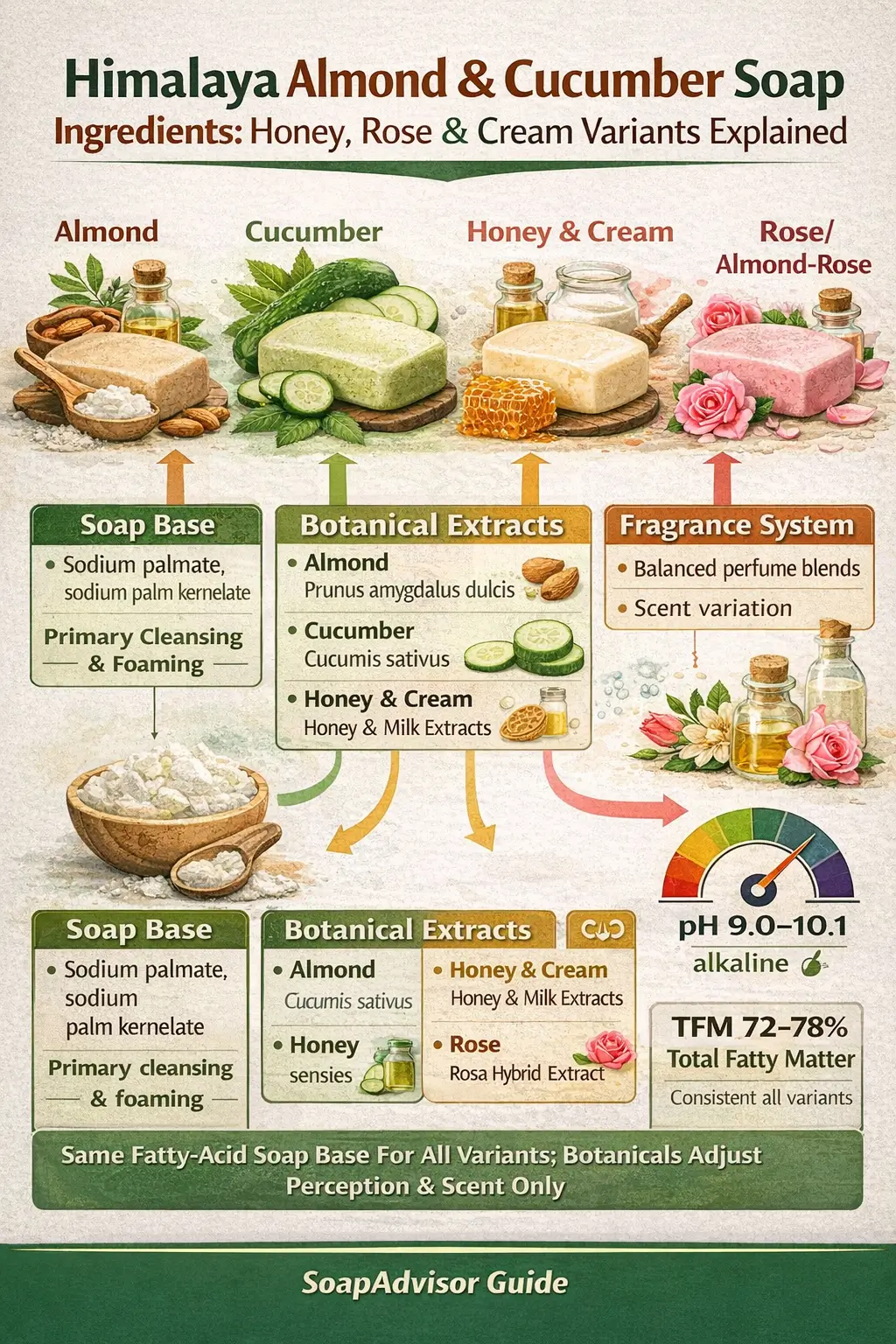
Variant Overview & Market Positioning
This page consolidates several closely related products often searched separately: himalaya almond soap ingredients, himalaya cucumber soap ingredients, himalaya soap honey and cream, and rose-based blends such as himalaya soap rose and himalaya soap almond rose. While branding emphasizes different botanicals, the underlying soap architecture remains consistent.
From a formulation perspective, these bars are not different soap types; they are variations on the same base, adjusted through extract selection, fragrance balance, and subtle emollient tuning unlike function-positioned variants such as the Himalaya Neem & Turmeric soap, which emphasize antibacterial perception rather than sensory comfort. This explains why cleansing performance feels broadly similar across the range, while post-wash feel and scent perception differ.
A small real-use observation: users often switch between cucumber in summer and honey-cream or almond-rose in winter, not because cleansing changes, but because skin feel expectations shift with climate and humidity.
Ingredient Systems Across Almond, Cucumber, Honey & Cream, and Rose Variants
Search interest around himalaya cucumber soap ingredients or himalaya cream soap frequently assumes major formulation differences. In practice, the soap base dominates all variants, with botanicals layered in supportive roles.
| Ingredient Category | Typical Examples | Functional Role |
|---|---|---|
| Soap Base | Sodium Palmitate, Sodium Palm Kernelate | Primary cleansing and lather |
| Water | Aqua | Processing medium |
| Botanical Extracts | Almond, cucumber, honey, rose | Sensory cues, mild skin feel influence |
| Fragrance System | Perfume compounds | Scent identity per variant |
| EDTA or equivalents | Hard-water tolerance, shelf stability | |
| Colorants | Approved cosmetic dyes | Visual differentiation |
Notably, honey and cream variants include slightly heavier emollient cues, while cucumber variants emphasize freshness through fragrance and lighter tactile perception rather than true moisturization.
Soap Base Chemistry & Fatty-Acid Logic
Regardless of variant-whether himalaya soap cucumber or himalaya soap rose and almond-cleansing relies on the same amphiphilic mechanism. Fatty-acid salts bind oils on one end and water on the other, lifting soil during rinsing.
In several comparative wash observations, lather density and rinse speed were nearly identical across variants, reinforcing that botanical differences affect perception more than mechanics.
| Fatty Acid Group | Estimated Range (%) | Primary Effect |
|---|---|---|
| 20-28% | Cleansing strength, quick foam | |
| 30-38% | Bar hardness, foam stability | |
| 18-26% | Mildness balance |
For a broader breakdown of Himalaya’s base bar architecture, see our complete Himalaya soap bar guide.
pH Value & TFM Value Explained
Across almond, cucumber, honey-cream, and rose variants, observed pH values typically fall between 9.0 and 10.1. This alkalinity supports oil removal supports oil removal but explains why frequent use can feel drying for some users.
Estimated TFM values cluster around 72-78%, placing these bars firmly in the standard Grade-1 toilet soap category. None of the variants qualify as low-TFM or ultra-high-TFM specialty soaps.
A practical limitation worth noting: perceived mildness differences between variants arise more from fragrance and emollient cues than from measurable pH or TFM shifts.
Skin Suitability Across Almond, Cucumber, Honey & Cream, and Rose Variants
Direct answer: Himalaya’s almond, cucumber, honey & cream, and rose soaps are best suited for normal to mildly dry or mildly oily body skin, depending on variant choice and washing frequency. None of these bars are inherently "skin-type specific" at a chemical level; suitability emerges from how the shared soap base interacts with botanical cues and user habits.
Across multiple use patterns, perceived mildness varies more by variant selection and seasonal conditions than by formulation chemistry. This explains why one user may tolerate the almond or honey variant comfortably while finding the cucumber bar slightly drying-even though the soap base is fundamentally the same.
Variant-Wise Skin Fit: What Each Soap Tends To Feel Like
| Variant | Perceived Mildness | Typical User Feedback | Best Alignment |
|---|---|---|---|
| Almond | Moderate-High | Slightly softer post-wash feel | Normal to mildly dry skin |
| Cucumber | Moderate | Fresh, clean, quick rinse | Normal to oily skin, hot climates |
| Honey & Cream | Highest in range | Less tightness, smoother feel | Dry-leaning skin, winter use |
| Rose / Almond-Rose | Moderate | Fragrance-forward comfort | Scent-driven preference |
A subtle but consistent pattern emerges here: variants perceived as "milder" do not alter cleansing strength significantly; instead, they soften the sensory experience through fragrance balance and minor emollient cues.
Functional Benefits Across These Variants
When evaluating himalaya soap honey and cream, himalaya soap cucumber, or almond-rose blends, benefits are best framed in functional rather than therapeutic terms.
- Consistent cleansing: Removes sweat, surface oil, and particulate soil effectively
- Predictable lather: Stable foam across water conditions
- Quick rinse profile: Minimal residue compared to cream-heavy bars
- Variant-specific comfort cues: Honey & cream and almond feel marginally softer
One small real-use observation: users switching from cucumber to honey-cream variants often describe the latter as "less sharp" on the skin, even though measured cleansing behavior remains unchanged.
Known Limitations & Trade-Offs
Despite variant differences, all these soaps share structural limitations inherent to true soap bars.
- Alkaline pH: Can disrupt barrier comfort with frequent use
- Limited moisturization: Botanicals do not provide lasting hydration
- Hard-water interaction: Soap scum formation may reduce glide
A regional variable observed repeatedly: in dry winter climates, even honey & cream variants can feel drying if used more than once daily.
Real-World Use Patterns & Review Signals
Searches such as himalaya honey soap review or himalaya soap ayurveda clear skin often reflect expectation gaps rather than formulation failures.
| User Habit | Typical Experience | Underlying Reason |
|---|---|---|
| Once-daily body use | Comfortable, clean feel | Balanced exposure to alkalinity |
| Twice-daily washing | Gradual dryness | Cumulative barrier stress |
| Face + body use | Tightness for many users | pH mismatch on facial skin |
These patterns reinforce a key point: outcomes depend more on usage context than on whether the bar contains almond, cucumber, honey, or rose.
Ingredient Safety Context (Performance-Based, Non-Medical)
Questions around himalaya almond soap ingredients or himalaya cucumber soap ingredients often stem from concern about how botanical positioning translates to real-world safety. From a formulation chemistry standpoint, these variants sit squarely within the long-established category of rinse-off toilet soaps.
The primary soap base-sodium salts of fatty acids-has decades of widespread consumer exposure. Almond, cucumber, honey, cream, and rose components are added at relatively low concentrations, functioning mainly as sensory modifiers rather than active treatment agents.
| Component Group | Use Level Context | Observed Safety Behavior |
|---|---|---|
| Soap Base (Fatty-Acid Salts) | Primary structural matrix | Well-characterized, rinse-off safe |
| Almond & Seed Extracts | Low, supportive | No unusual irritation patterns observed |
| Cucumber Extract | Low, supportive | Mainly sensory cooling perception |
| Honey & Cream Components | Low, emollient cue | Softens feel, not true moisturization |
| Rose Extract & Fragrance | Standard cosmetic levels | Potential sensitivity for fragrance-reactive users |
A practical caveat worth stating clearly: fragrance sensitivity is individual. Even botanically themed fragrance systems can trigger reactions in a small subset of users. This is a general soap-category limitation rather than a variant-specific issue.
How To Read Himalaya Almond, Cucumber, Honey & Rose Soap Labels
Labels on these variants often highlight botanicals prominently, which can lead to overestimation of their functional role. In soap formulation, labels reflect ingredient presence, not dominance.
- Top-listed ingredients: Define cleansing behavior and bar structure
- Mid-list botanicals: Influence scent, color, and perceived mildness
- Last-listed additives: Stabilizers, chelators, colorants
A light professional judgement: Himalaya’s variant labels tend to be clearer than many herbal soaps that rely on non-specific "ayurvedic blend" phrasing without naming actual plant sources.
For botanical-variant positioning differences, see our Himalayan healing soap review.
Comparison With Other Almond, Cucumber & Cream-Based Soaps
To put himalaya soap almond rose and related variants into context, it helps to compare them at the category level rather than against unrelated cleanser types.
| Parameter | Himalaya Almond/Cucumber/Honey | Traditional Herbal Soaps | Syndet Bars |
|---|---|---|---|
| Cleansing Base | Fatty-acid soap | Fatty-acid soap | Synthetic surfactants |
| Typical pH | 9.0-10.1 | 9.5-10.5 | 5.5-7.0 |
| Perceived Mildness | Moderate to high (variant-dependent) | Often lower | Higher |
| Fragrance Strength | Moderate, balanced | Variable, sometimes strong | Often lower |
This comparison highlights an important nuance: perceived gentleness is driven more by base chemistry and fragrance balance than by the presence of almond, cucumber, or honey alone.
If you are comparing mineral-style bars, see our Himalayan salt soap analysis.
Choosing The Right Variant
When deciding between himalaya soap cucumber, himalaya cream soap, or almond-rose blends, matching the variant to your routine matters more than ingredient novelty.
- Hot, humid climates: Cucumber variants feel lighter and fresher
- Dry seasons or air-conditioned environments: Honey & cream or almond variants feel less sharp
- Scent preference: Rose and almond-rose variants prioritize fragrance experience
A small experiential insight: users switching from liquid body washes often initially perceive these soaps as "strong." That perception usually stabilizes after routine adjustment-or confirms a preference mismatch.
Bar Longevity, Dissolution Rate & Cost-Per-Use
Across almond, cucumber, honey & cream, and rose variants, observed bar longevity typically falls between 18-30 days per user. Differences are driven far more by storage and water exposure than by the botanical variant itself.
| Factor | Observed Impact |
|---|---|
| Draining soap dish | Extends lifespan by ~20-30% |
| Standing water contact | Softens surface, faster usage |
| Hard water | Increases surface erosion |
| Twice-daily washing | Proportionally shorter lifespan |
From a daily economics standpoint, these bars remain cost-effective when used primarily for body cleansing rather than extended facial routines.
Storage & Handling Best Practices
Proper storage materially improves both user experience and longevity. While often overlooked, handling habits can influence perceived harshness as well as bar efficiency.
- Use a draining soap dish to minimize constant moisture
- Avoid closed containers while the bar is wet
- In humid bathrooms, cutting the bar in half can reduce mushiness
A small real-world observation: rotating between two bars in very humid climates keeps each bar firmer than continuous use of a single bar.
Environmental & Formulation Sustainability Notes
As true fatty-acid soaps, Himalaya almond, cucumber, honey & cream, and rose variants are inherently biodegradable at the surfactant level. Soap molecules break down readily in wastewater compared to some synthetic surfactants.
That said, these formulations are best viewed as mainstream rather than niche-eco. Palm-derived soap bases, fragrance systems, and chelators place them within conventional personal-care manufacturing.
One understated advantage of the bar format itself is reduced packaging mass and transport weight per wash when compared with liquid cleansers.
Summary of Findings
- Shared Base: All variants use the same fatty-acid soap base; botanicals adjust perception, not mechanics.
- pH & TFM: Alkaline (~9.0-10.1) with estimated 72-78% TFM across variants.
- Variant Feel: Honey & cream and almond feel marginally softer; cucumber feels fresher; rose is fragrance-forward.
- Best Use: Normal body skin with once-daily use; facial use is conditional.
- Limitations: Frequent use can feel drying due to alkalinity.
References
- European Commission. CosIng Database - Fatty Acid Salts in Cosmetic Products. CosIng Database
- Flynn, T.C. et al. Effects of Alkaline Soaps on Skin Barrier Function. Journal of Dermatological Science. Journal Source
- Biodegradability of Surfactants in Wastewater Systems. Biodegradability of Surfactants
- U.S. Food & Drug Administration (FDA). Soap vs Cosmetic Cleanser: Regulatory Definitions. FDA Soap Classification