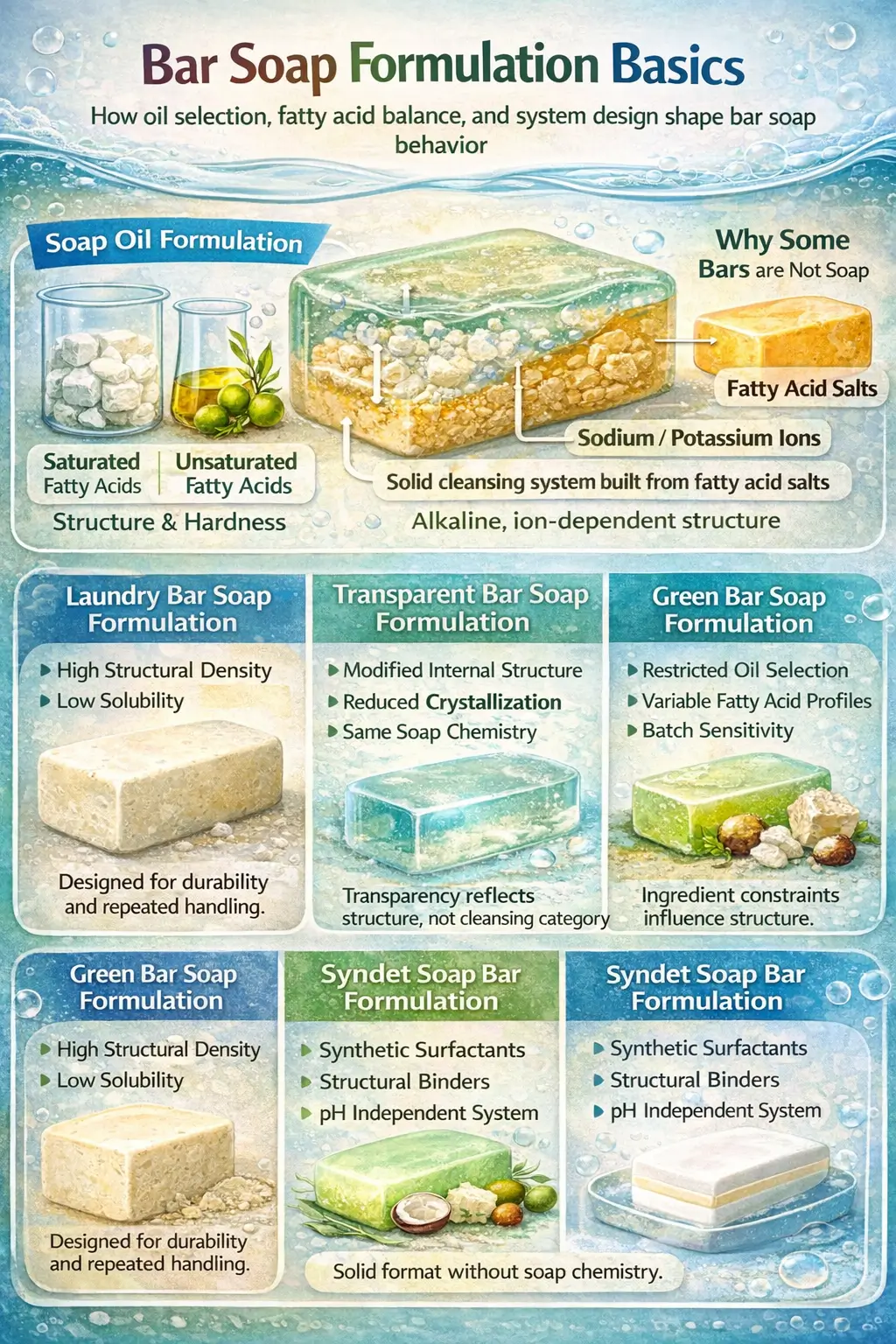
What Defines A Bar Soap System
A bar soap is a solid cleansing system formed through the reaction of fats or oils with an alkali, producing fatty acid salts that organize into a structured matrix, using ingredient systems characteristic of traditional methods outlined in the Cold Process Soap Ingredients Guide and observed in practice in traditionally formulated bars such as ABC Soap Reen Naturals. Unlike liquid cleansers, bar soaps rely on physical solidity rather than dilution to control delivery and concentration during use.
The system is inherently alkaline and ion dependent. Sodium or potassium ions stabilize the fatty acid salts, while water content, crystallization, and curing time determine hardness and dissolution rate. These characteristics emerge from formulation structure rather than from individual ingredients alone.
For deeper explanation of skin interaction and pH effects, see Skin Safety 101.
Many usage misunderstandings stem from assuming bar soap behavior mirrors that of liquid or syndet systems, an assumption clarified when examining classic tallow-based formulations such as those detailed in Ivory soap ingredient disclosures. In reality, bar soaps respond differently to water hardness, contact time, and storage due to their solid-state design.
How Soap Oil Formulation Shapes Bar Behavior
Soap oil formulation refers to the selection and proportioning of fats used as the raw material for saponification. Each oil contributes a characteristic fatty acid profile, influencing hardness, solubility, and lather structure in the finished bar.
Oils rich in saturated fatty acids tend to produce firmer bars with slower dissolution, while oils higher in unsaturated fatty acids increase solubility and softness. These effects are structural rather than qualitative and remain consistent across formulations.
Differences between laundry bar soap formulation and personal cleansing bars often arise at this stage. Laundry bars typically prioritize hardness and longevity, while other bar types may balance dissolution and surface contact differently.
Bar Soap Formulation Structure Summary
Bar soap formulations vary primarily in structural design rather than cleansing intent. Differences in oil selection, internal matrix formation, and surfactant type influence hardness, dissolution behavior, and environmental sensitivity. The table below summarizes these system-level differences without implying performance ranking or usage guidance.
| Formulation Type | Primary Surfactant System | Structural Focus | Typical System Behavior | Key Constraint |
|---|---|---|---|---|
| Traditional Bar Soap | Fatty Acid Salts | Crystalline Soap Matrix | Alkaline, mineral sensitive, solid wear-based release | Water hardness interaction |
| Laundry Bar Soap Formulation | Fatty Acid Salts | High Density Solid Structure | Slow dissolution, extended physical durability | Lower responsiveness in short contact |
| Transparent Bar Soap Formulation | Fatty Acid Salts | Reduced Crystal Scatter | Light transmission with unchanged soap chemistry | Structural sensitivity to moisture balance |
| Green Bar Soap Formulation | Fatty Acid Salts | Restricted Oil Profile | Variable hardness and wear across batches | Raw material variability |
| Syndet Soap Bar Formulation | Synthetic Surfactants | Binder-Based Solid System | pH independent, reduced mineral sensitivity | Reliance on structural additives |
This structural overview highlights why bars that appear similar can behave differently under identical conditions. Physical form alone does not determine formulation behavior; internal system architecture does.
Why Fatty Acid Balance Determines Performance
The relative proportions of fatty acids within a bar soap formulation govern how the system behaves when exposed to water, including the effects of deliberate excess oils examined in the Superfatting Bar Soap Systems Guide. Shorter chain fatty acids dissolve more readily, while longer chain acids contribute structural rigidity.
A compound-level breakdown of surfactant systems is available in the Ingredient Library.
This balance affects how quickly a bar releases surfactant during use and how readily it rinses away. In hard water environments, fatty acid composition also influences the likelihood of mineral interaction and residue formation.
Hard water interaction is explained further in our regulatory and labeling analysis.
Transparent bar soap formulation, for example, often reflects adjustments to fatty acid balance and solvent systems to reduce crystallization, altering how light passes through the bar without changing the underlying soap chemistry.
Why Curing And Solid Structure Matter
After saponification, a bar soap formulation continues to evolve as water redistributes and crystalline domains form within the solid matrix, a process that differs depending on manufacturing approach as explained in Cold Process vs Hot Process Soap. This curing phase is not a finishing detail but a structural stage that influences hardness, rate of wear, and surfactant release during use.
Bars with higher initial water content or higher proportions of soluble fatty acids tend to change more noticeably over time. As moisture migrates outward, the bar becomes denser and dissolves more slowly when reintroduced to water.
Differences observed between freshly produced bars and aged bars often lead to assumptions about formulation inconsistency. In most cases, the formulation is unchanged; the physical structure has simply stabilized.
How Laundry Bar Soap Formulation Prioritizes Structure
Laundry bar soap formulation emphasizes durability, abrasion resistance, and sustained surfactant release over extended contact. These bars are typically designed to withstand repeated wetting and drying cycles without rapid deformation.
This structural emphasis often results in higher proportions of long chain saturated fatty acids and lower overall solubility. The resulting bar may feel less responsive during brief contact but maintains integrity during prolonged use.
These characteristics are sometimes misinterpreted as reduced cleansing ability, when they instead reflect a formulation tuned for mechanical handling and surface interaction rather than rapid dissolution.
What Makes Transparent Bar Soap Formulation Different
Transparent bar soap formulation modifies the internal structure of the soap matrix to limit crystal formation that scatters light. This is achieved by altering solvent balance and fatty acid organization rather than changing the fundamental soap chemistry.
The resulting bar allows light transmission through a more uniform internal phase. While visually distinct, the underlying surfactant remains a fatty acid salt and retains the same mineral sensitivity and pH behavior as opaque soaps.
Transparency is therefore a physical property of the solid matrix, not an indicator of altered cleansing chemistry or functional category.
Green Bar Soap Formulation And Ingredient Constraints
Green bar soap formulation typically refers to formulations that restrict raw material selection based on sourcing, processing, or environmental criteria. These constraints influence which oils and additives are available to the formulator.
Limiting oil choices can shift fatty acid balance, affecting hardness, solubility, and residue behavior. These changes are structural outcomes of ingredient availability rather than intentional performance modification.
As a result, green bar soaps often display greater variability between batches or regions, especially when raw material profiles fluctuate seasonally, a pattern documented in regionally constrained formulations such as Ackee soap.
Why Dove Bar Soap Formulation Sits Outside Traditional Soap
Dove bar soap formulation is frequently assumed to follow conventional bar soap chemistry due to its solid format and usage context. Structurally, however, it represents a boundary case where the cleansing system is no longer built primarily from fatty acid salts.
Instead, the formulation relies on synthetic surfactants combined with structuring agents that allow the system to exist as a solid bar. The resulting product behaves differently from true soap in terms of pH stability, mineral sensitivity, and residue formation.
This distinction is often overlooked because physical form is mistaken for formulation category. The difference lies in the surfactant architecture, not the shape of the finished product.
How Syndet Soap Bar Formulation Changes System Behavior
Syndet soap bar formulation replaces fatty acid salts with synthetic or semi-synthetic surfactants while retaining the solid bar format. This shift decouples cleansing behavior from alkalinity and reduces sensitivity to water hardness.
Structurally, these bars rely on binders and fillers to maintain solidity rather than crystalline soap matrices. As a result, dissolution and wear patterns differ noticeably from traditional bar soaps.
The presence of syndet bars within the same physical category as soap bars often leads to confusion when interpreting performance differences. These outcomes are system driven rather than formulation errors. System-level differences between soap and syndet formats are examined in our comparative system analysis.
Common Interpretation Errors In Bar Soap Labeling
One of the most persistent misunderstandings involves equating ingredient lists across bar formats without considering system type. A shorter ingredient list does not imply a simpler system, nor does a longer list indicate increased complexity in cleansing action.
Terms such as soap, syndet, or cleansing bar are frequently interpreted as interchangeable, despite describing materially different formulation architectures. This conflation obscures why bars behave differently under the same usage conditions.
Clear system identification requires understanding the role of the primary surfactant rather than relying on naming conventions or physical appearance.
System Limitations And Boundary Conditions
Traditional bar soap formulations remain constrained by alkalinity and mineral interaction. These characteristics cannot be fully engineered away without transitioning to a different cleansing system.
Syndet and hybrid bars reduce some of these constraints but introduce others, such as reliance on binders, sensitivity to humidity, or altered wear patterns. Each system trades one set of limitations for another.
These boundary conditions explain why no single bar formulation behaves consistently across all environments, water qualities, and storage conditions.
Fatty Acid Role And Observable Bar Behavior
Fatty acids within a bar soap formulation do not act as isolated ingredients. Their chain length and saturation influence how the solid matrix forms, how the bar interacts with water, and how surfactant release occurs during use. The table below links common fatty acid roles to system-level behavior without implying formulation targets or optimization.
| Fatty Acid Characteristic | Primary Structural Role | Observable Bar Behavior |
|---|---|---|
| Long Chain Saturated | Matrix rigidity and bar cohesion | Firmer feel, slower wear, delayed dissolution |
| Shorter Chain Saturated | Surface activity contribution | Quicker lather release, faster initial response |
| Unsaturated | Disruption of crystal packing | Softer structure, increased solubility |
| Mixed Saturation Profiles | Balanced matrix formation | Moderated wear with variable tactile response |
These behaviors are influenced by the overall formulation context, curing state, and environmental conditions. Individual fatty acid contributions should be interpreted as directional tendencies rather than deterministic outcomes.
Summary of Findings
- System Definition: Bar soap formulations are structured cleansing systems, not just solid liquids.
- Oil Selection: Soap oil formulation determines hardness, solubility, and wear behavior.
- Formulation Diversity: Laundry, transparent, and green bar soaps reflect different structural priorities.
- System Boundaries: Dove bar soap formulation and syndet soap bar formulation represent non-soap systems.
- Interpretation: Physical form does not define formulation chemistry or behavior.
References
- Rosen, M. J. Surfactants and Interfacial Phenomena. Wiley-Interscience. Publisher Link
- Schramm, L. L. Surfactants: Fundamentals and Applications in the Petroleum Industry. Cambridge University Press. Publisher Link
- OECD Screening Information Data Set (SIDS): Fatty Acid Salts Assessment Reports. OECD Archive
- European Commission CosIng Database – Cosmetic Ingredient Regulatory Listings. Official Database