Ingredient Definition and Role
Sodium Olivate is a sodium salt of fatty acids derived from olive oil, classified as a soap-base ingredient formed through the reaction of triglycerides with sodium hydroxide.
It functions as a primary cleansing agent in traditional soap systems, where it contributes to the formation of a solid or semi-solid soap matrix responsible for surface-active cleaning.
Chemically, it belongs to the broader class of alkali-derived fatty acid salts, which define the structural and functional core of conventional soap formulations.
In practical formulation terms, Sodium Olivate produces a milder, lower-lather soap profile compared to shorter-chain fatty acid salts, influencing how the soap spreads, rinses, and interacts with water during use.
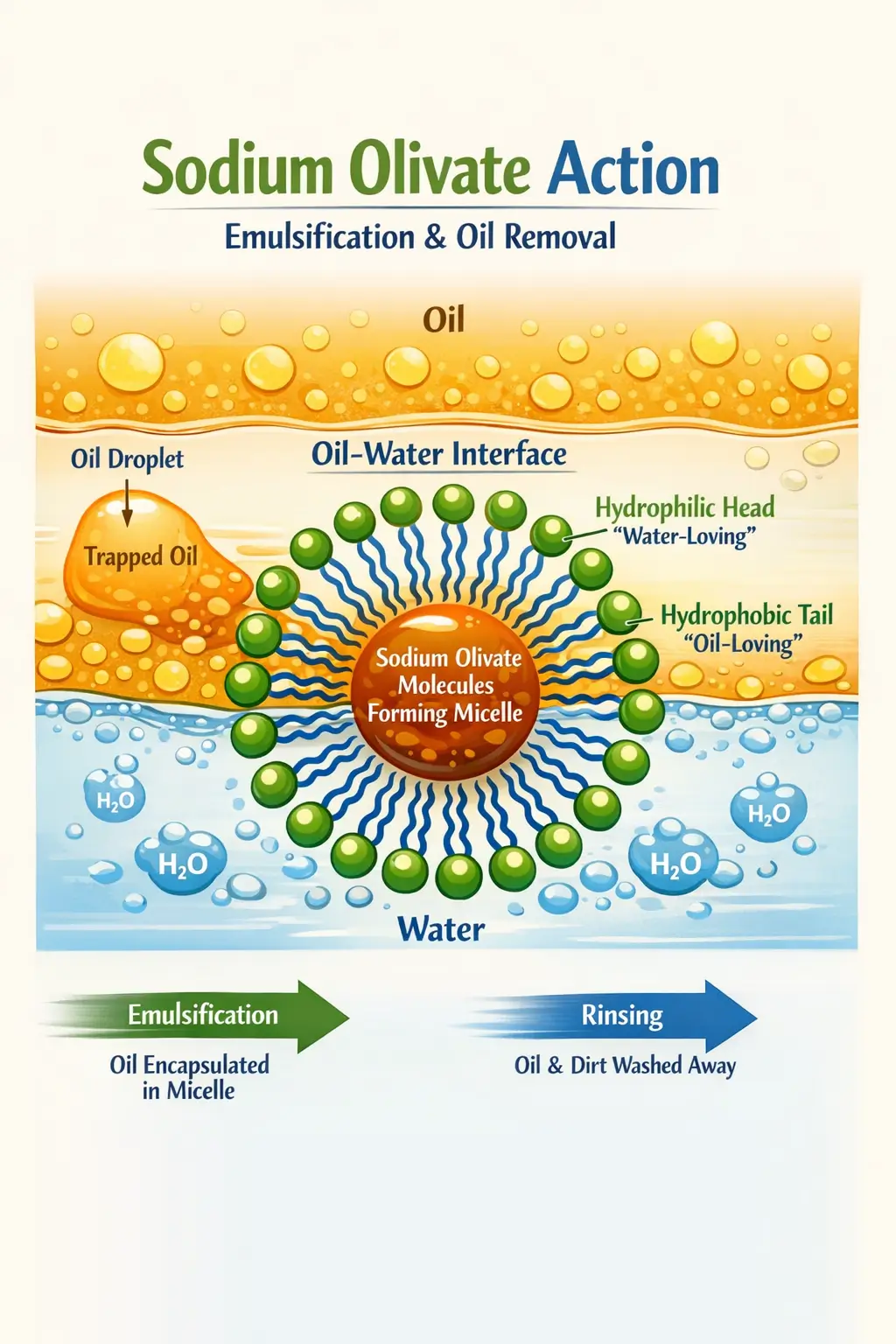
Quick Facts
| Property | Description |
|---|---|
| INCI Name | Sodium Olivate |
| Source Material | Olive oil (dominantly oleic acid ~70–80%) |
| Saponification Reaction | Triglyceride + 3NaOH → Glycerin + 3R–COONa |
| pH (1% Solution) | 9.0 – 10.5 |
| Solubility | Moderately soluble; slower dissolution than laurate soaps |
| Critical Micelle Concentration (CMC) | ~0.5 – 1.0 g/L |
| Foaming Profile | Low, creamy foam with fine bubble structure |
| Foam Stability | High stability; persists longer than coconut-based soaps |
| Cleansing Strength | Mild lipid removal due to high oleate content |
| Skin Interaction | Lower barrier disruption; supports skin feel vs high-laurate soaps |
| Hard Water Sensitivity | Forms insoluble salts (2R–COO⁻ + Ca²⁺ → (R–COO)₂Ca↓) |
| Typical Usage Level | 40 – 100% in olive-based soap systems |
| Curing Requirement | Requires extended cure (4–8 weeks) for hardness development |
| Bar Hardness Profile | Initially soft; increases with water loss and crystal structuring |
| Biodegradability | Readily biodegradable under aerobic conditions (>90%) |
| Compatibility | Incompatible with cationic surfactants; precipitate formation likely |
Why This Ingredient Appears on Labels
Sodium Olivate appears on ingredient labels because it represents the final soap salt formed after saponification, rather than the original olive oil used during formulation.
Modern labeling systems require ingredients to be declared using standardized naming conventions, which is explained in the ingredient list interpretation guide. As a result, oils are listed in their converted form when they function as cleansing agents.
This naming approach reflects the actual chemical structure present in the finished product, not the raw material used at the beginning of processing.
From a formulation perspective, this means the label communicates the functional cleansing structure rather than the original triglyceride source.
Chemical Identity and Classification
Sodium Olivate is the sodium salt mixture of fatty acids derived from olive oil triglycerides. It is not a single molecule but a composition of multiple fatty acid salts, primarily dominated by oleic acid derivatives.
During saponification, olive oil reacts with sodium hydroxide, breaking triglycerides into glycerol and free fatty acids, which are immediately neutralized into sodium salts. This transformation shifts the material from a non-surface-active oil into an anionic surfactant system.
The dominant fatty acid component is oleic acid, accompanied by smaller fractions of palmitic and linoleic acids. This composition defines the physicochemical behavior of the final soap.
Within the broader classification system, Sodium Olivate belongs to:
- Ingredient Category: Soap base ingredient
- Chemical Family: Fatty acid sodium salts
- Functional Class: Anionic surfactant (soap type)
- Origin Type: Vegetable oil-derived system
This classification distinguishes it from synthetic surfactants such as those discussed in sodium lauryl sulfate formulation analysis, which are structurally engineered rather than derived from triglycerides.
Functional Role in Soap Systems
Sodium Olivate operates as a primary surfactant and structural base, meaning it simultaneously defines both the cleansing action and the physical integrity of the soap.
Its cleansing mechanism follows the typical behavior of soap salts: hydrophobic fatty chains interact with oils and soils, while the hydrophilic sodium carboxylate groups interact with water, enabling removal through rinsing.
However, due to its high oleic acid content, its performance differs from more saturated soap systems:
- Cleansing Profile: Lower stripping effect compared to high lauric systems
- Lather Behavior: Creamy but less voluminous foam
- Bar Structure: Softer matrix with slower hardening
- Solubility: Higher solubility leading to faster dissolution in water
In comparison, soaps rich in lauric acid generate more rapid foam and stronger degreasing behavior, highlighting how fatty acid composition directly alters system performance.
From a formulation standpoint, Sodium Olivate often requires structural balancing through blending with other fatty acid salts or additives to improve hardness and longevity.
Observed behavior at usage level: soaps containing higher proportions of this ingredient tend to feel smoother during application but may soften more quickly when exposed to water.
Ingredient Interaction Logic
Sodium Olivate does not function in isolation. Its performance depends heavily on interactions with other formulation components that modify solubility, stability, and cleansing efficiency.
Within a typical soap system, key interactions include:
- Water Phase: Interaction with water (aqua) enables ionization and surfactant activity, allowing the soap to dissolve and function during use.
- Humectants: Components such as glycerin influence moisture retention and modify how the soap interacts with skin and air exposure.
- Chelating Agents: Materials like tetrasodium EDTA reduce interference from metal ions, improving performance in hard water environments.
- Fragrance Systems: Interaction with fragrance (parfum) affects scent retention and volatility, particularly due to the relatively soft and porous soap matrix.
- Colorants: Additives such as colorants are physically dispersed within the matrix without affecting the primary surfactant function.
These interactions define the overall formulation behavior rather than the ingredient alone. For example, in hard water conditions, calcium ions can react with sodium olivate to form insoluble residues, which alters both cleansing efficiency and surface feel.
This system-level dependency is why ingredient behavior cannot be interpreted in isolation, a concept further explored in the soap cleansing mechanism explanation.
Observed behavior at usage level: interaction with water hardness and formulation additives significantly changes lather formation, residue formation, and rinse characteristics.
Phase Behavior and Physical Structure
Sodium Olivate exists as a semi-crystalline solid matrix in bar soaps, where fatty acid salts form an organized network that defines both structural integrity and dissolution behavior.
Due to its high oleic acid content, this matrix is less tightly packed compared to soaps dominated by saturated fatty acids. This results in a softer structure and increased flexibility within the bar.
Upon contact with water, the outer layer hydrates and partially dissolves, allowing surfactant molecules to become active at the surface. This transition from solid to hydrated phase governs real-world usage behavior.
Temperature and humidity further influence this phase system, with higher moisture environments accelerating softening and dissolution.
Comparison With Related Soap Base Ingredients
| Feature | Sodium Olivate | Sodium Cocoate |
|---|---|---|
| Primary Fatty Acid | Oleic acid | Lauric acid |
| Lather Type | Creamy, low-volume foam | Fast, high-volume foam |
| Cleansing Strength | Moderate | Strong |
| Bar Hardness | Softer structure | Firmer structure |
| Solubility | Higher | Moderate |
| Wear Rate | Faster | Moderate |
This comparison highlights how fatty acid composition directly influences formulation behavior, even within the same class of soap-base ingredients.
Regulatory and Labeling Context
Sodium Olivate is listed under standardized INCI (International Nomenclature of Cosmetic Ingredients) naming conventions used in cosmetic labeling systems globally.
Its classification as a soap ingredient rather than a cosmetic surfactant depends on formulation and product claims, as outlined in the soap regulatory classification system.
Labeling reflects the final chemical structure present after processing, rather than the original raw material, which is why olive oil is not listed directly when it has been fully saponified.
Common Misunderstanding
A common misconception is that Sodium Olivate represents unprocessed olive oil within the formulation. In reality, the original triglyceride structure is completely altered during saponification.
The resulting material is chemically distinct from olive oil and functions as a surfactant rather than an emollient oil.
This distinction is important when interpreting ingredient lists and is further explained in the natural vs synthetic ingredient classification discussion.
Formulation Limitations
Sodium Olivate-based systems exhibit several inherent limitations due to their fatty acid composition and soap chemistry.
- Structural Softness: Lower saturated fatty acid content reduces bar hardness
- High Solubility: Accelerates wear during repeated use
- Hard Water Sensitivity: Reacts with mineral ions, forming insoluble residues
- Limited pH Control: Soap systems remain inherently alkaline
To address these limitations, formulations often incorporate additional fatty acid salts or supporting additives to modify structural and performance characteristics.
Formulation References Using This Ingredient
Summary of Findings
- Classification: Sodium Olivate is a fatty acid sodium salt derived from olive oil
- Function: Acts as a primary surfactant and structural base in soap systems
- Behavior: Produces creamy lather with moderate cleansing strength
- Limitation: Softer structure and higher solubility affect durability
- System Role: Performance depends on interaction with water, additives, and environmental conditions