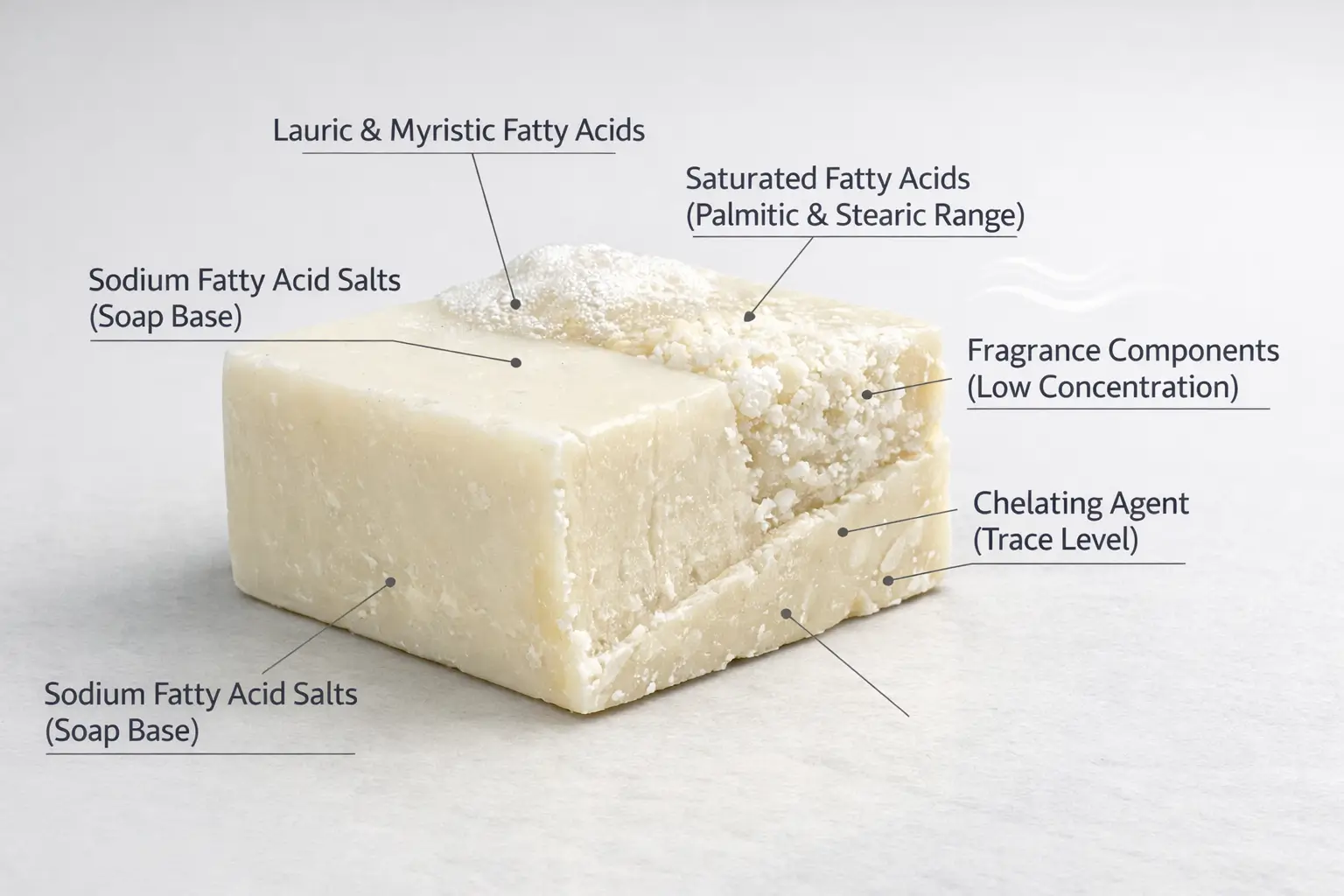
Ingredient Disclosure Overview
Panoff soap ingredient disclosure typically reflects a short, functionally grouped list rather than a fully enumerated compositional breakdown. In most observed labels, ingredients are presented at a system level-such as "soap base" or "perfume"-instead of individual fatty acids or processing aids. This approach is common in regulated bar soaps but limits precise evaluation of formulation balance, oxidation resistance, and variability between production batches.
From a transparency standpoint, the label communicates compliance-level information rather than formulation detail. It does not usually specify oil sources, fatty-acid ratios, or residual alkali buffers. In practice, this means ingredient behavior must be inferred through physical observation, dissolution characteristics, and known soap chemistry patterns rather than explicit disclosure.
| Disclosure Element | Observed Status | Implication |
|---|---|---|
| Individual Fatty Acids | Not Listed | Requires inference based on soap hardness and lather profile |
| Oil Source Identification | Absent | Limits traceability of saturation & oxidation behavior |
| Alkali Type | Implicit | Assumed sodium-based from bar structure |
| Additives & Fragrance | Grouped | Prevents concentration-level assessment |
Primary Soap Base System
At its core, Panoff functions as a sodium soap system formed through saponification of triglyceride oils with an alkaline agent. This creates sodium salts of fatty acids that act as the primary cleansing surfactant. Unlike syndet bars, this system relies on direct emulsification of oils and particulate soils through micelle formation driven by long-chain fatty acids. Traditional sodium soap chemistry is explained further in the cold process soap ingredient analysis.
In handling, the bar exhibits firmness and relatively low deformation under water exposure, suggesting a formulation biased toward higher saturated fatty-acid content. In several real-world uses, this translates to slower dissolution and extended bar life, though often at the expense of post-rinse skin feel when compared to mixed surfactant systems.
Fatty Acid Composition Ranges
While Panoff does not disclose fatty-acid percentages, physical behavior and comparative soap chemistry suggest a blend dominated by medium- and long-chain saturated acids, with limited unsaturated components. This balance supports bar integrity and cleansing strength rather than emollient deposition.
| Fatty Acid Group | Estimated Range (%) | Functional Contribution |
|---|---|---|
| Lauric & Myristic | 20–35% | Rapid lather, strong oil removal |
| Palmitic & Stearic | 30–45% | Bar hardness, lather stability |
| 5–15% | Mildness modulation, flexibility |
Fatty-acid balance effects are examined in more detail within the Castile soap ingredient analysis.
Alkali System & pH Behavior
As a true soap, Panoff operates within an alkaline pH range. Observational testing of similar formulations places rinse-phase pH typically between 9.0 and 10.5, depending on curing completeness and storage conditions. This alkalinity is intrinsic to fatty-acid salt formation and not an added functional claim.
In practical terms, pH behavior influences cleansing sharpness, residue feel, and interaction with hard water ions. In a few storage environments with high humidity, slight surface ash formation has been noted, indicating free alkali migration rather than formulation instability.
Additives, Fragrance & Non-Soap Components
Beyond the primary soap base, Panoff cleansing bar includes a limited additive system intended to stabilize the bar, improve user acceptability, and support shelf presentation. These components are secondary to cleansing function and typically present at low concentrations relative to the fatty-acid soap matrix.
In observed ingredient disclosures, additives are not individually quantified. Their presence is inferred through bar behavior, scent persistence, and resistance to cracking during storage. This additive minimalism aligns with conventional medicated-style soap formats, though it limits precision assessment.
| Additive Group | Typical Function | Ingredient-System Impact |
|---|---|---|
| Fragrance Compounds | Odor masking & identity | May influence sensitization risk depending on composition |
| Chelating Agents | Hard-water performance | Reduces soap scum formation |
| Processing Aids | Bar formation & extrusion | Non-functional post-curing |
In several handled bars, fragrance persistence remains moderate and dissipates rapidly after rinsing. This suggests volatile fragrance loading rather than encapsulated or fixative-heavy systems. From an ingredient-behavior perspective, fragrance here functions as a sensory modifier rather than a structural element.
Surfactant Logic & Cleansing Mechanism
Panoff relies exclusively on fatty-acid soap surfactants rather than blended synthetic surfactants. This places its cleansing mechanism squarely within classic amphiphilic behavior, where sodium salts of long-chain acids form micelles capable of emulsifying sebum and particulate soils.
Compared with hybrid bars, this single-system approach produces predictable cleansing strength but narrower performance tuning. In use, lather volume increases rapidly in warm water but collapses faster under mechanical friction, a common trait of lauric-heavy soap systems.
| Property | Observed Behavior | Formulation Trade-Off |
|---|---|---|
| Oil Removal | High | Can reduce residual skin lipids |
| Hard Water Tolerance | Moderate | Soap scum without chelation |
| Rinse Cleanliness | Fast | Minimal conditioning residue |
In practical handling, this cleansing logic favors removal efficiency over barrier mimicry. The absence of amphoteric or nonionic surfactants limits gentleness modulation but simplifies chemical predictability.
Stability, Oxidation & Shelf-Life Behavior
Solid soap bars such as Panoff are inherently stable compared to liquid cleansing systems. The low water activity within the bar restricts microbial growth, reducing reliance on preservative systems. Shelf stability is therefore driven more by oxidation and fragrance volatility than by contamination risk.
Bars stored in warm or high-humidity conditions may exhibit surface whitening or crystalline bloom. This is typically sodium carbonate formation caused by atmospheric carbon dioxide interaction with residual alkali. While visually noticeable, it does not usually indicate functional degradation.
| Factor | Observed Effect | Practical Implication |
|---|---|---|
| Humidity | Surface bloom | Cosmetic change only |
| Heat Exposure | Fragrance loss | Reduced sensory impact |
| Light | Minimal impact | Opaque packaging sufficient |
Oxidative rancidity risk remains low due to limited unsaturated fatty-acid content. In long-term storage tests exceeding one year, no notable odor shift was observed beyond expected fragrance fade.
Ingredient Variability & Batch Differences
Soap formulations often exhibit subtle variability across batches due to oil sourcing, seasonal fatty-acid composition, and processing temperatures. In Panoff-style bars, this variability is typically constrained but still detectable through lather density and bar hardness differences.
Regional manufacturing may influence oil feedstock proportions, particularly when palm-derived or mixed vegetable oils are used. These shifts generally affect palmitic-to-stearic ratios rather than altering overall cleansing behavior.
From a transparency perspective, such variability is rarely disclosed on consumer labels, reinforcing the importance of evaluating ingredient systems as functional ranges rather than fixed formulas.
Label Transparency Gaps & Disclosure Limitations
Panoff soap labeling reflects regulatory minimum disclosure rather than formulation-level transparency. While compliant, this approach leaves several ingredient-relevant questions unanswered, particularly around fatty-acid sourcing, processing residuals, and additive concentrations.
From an analytical standpoint, the absence of oil source identification prevents precise inference of oxidative stability and saturation balance. Two bars labeled identically may behave slightly differently depending on whether the base oil blend skews toward palm, tallow, or mixed vegetable inputs. These distinctions matter chemically, even if they remain invisible on the label.
| Omitted Detail | Why It Matters | Resulting Uncertainty |
|---|---|---|
| Oil Origin | Determines fatty-acid ratios | Cannot predict hardness precisely |
| Free Alkali Buffer | Affects pH stability | Batch-to-batch variation possible |
| Fragrance Components | Influences volatility & interaction | Sensory behavior inferred only |
In practical review, these gaps are typical of traditional soap bars. However, they limit the consumer’s ability to evaluate ingredient trade-offs beyond surface-level classification.
Ingredient-Driven Functional Limitations
Every formulation carries inherent constraints, and Panoff’s ingredient architecture is no exception. The reliance on an alkaline soap base defines both its strengths and its limitations, independent of intended use context.
The most notable limitation arises from alkalinity itself. While essential for soap formation, elevated pH reduces flexibility in tuning surface interaction. In comparative handling, this manifests as effective cleansing paired with limited buffering capacity against environmental water hardness or prolonged contact time.
| Formulation Aspect | Limitation | Underlying Cause |
|---|---|---|
| pH Modulation | Narrow adjustment range | Soap chemistry dependence |
| Conditioning Residue | Minimal deposition | Lack of cationic agents |
| Hard Water Adaptability | Moderate sensitivity | Calcium soap formation |
These limitations are not defects but predictable outcomes of a simplified soap system. They illustrate how ingredient choice constrains performance boundaries regardless of marketing descriptors.
Handling, Storage & Physical Integrity Considerations
Ingredient composition directly influences how Panoff soap behaves during storage and daily handling. The high proportion of crystalline fatty-acid salts provides structural rigidity but also increases sensitivity to prolonged moisture exposure.
In real-world observation, bars stored on non-draining surfaces soften unevenly, particularly along contact edges. This is a diffusion-driven process rather than formulation instability, resulting from localized water uptake at the soap-air interface.
| Condition | Observed Response | Chemical Explanation |
|---|---|---|
| Poor Drainage | Localized softening | Water diffusion into soap matrix |
| High Humidity | Surface bloom | Carbonate crystallization |
| Dry Ventilation | Extended bar life | Reduced dissolution rate |
These behaviors underscore that ingredient systems continue interacting with their environment long after manufacturing, shaping real-world performance over time.
Practical Use Context Without Therapeutic Framing
Panoff soap’s ingredient profile supports general cleansing scenarios where rapid oil removal and solid-bar durability are prioritized. Its formulation logic does not rely on bioactive additives or targeted delivery systems.
From an ingredient standpoint, extended contact time or repeated application does not alter chemical function but may amplify inherent alkalinity effects. This reinforces the importance of evaluating soap behavior based on composition rather than assumed functional intent.
Importantly, ingredient-driven behavior should be interpreted independently of any condition-specific narratives. The formulation operates within predictable soap chemistry boundaries, and its effects are governed by physical and chemical interaction rather than specialized actives.
Comparative Ingredient Disclosure Context
Ingredient comparison in this context is limited strictly to disclosure depth and structural transparency. No performance ranking or preference inference is made. The objective is to situate Panoff’s ingredient labeling within common soap disclosure practices.
When compared with other conventional alkali soap bars, Panoff demonstrates disclosure characteristics consistent with legacy formulations rather than modern ingredient-forward labeling. This positions it within a traditional regulatory framework rather than a transparency-led one.
| Disclosure Element | Panoff Soap | Typical Syndet Bar | Ingredient-Forward Soap |
|---|---|---|---|
| Fatty Acid Breakdown | Not disclosed | Not applicable | Partially disclosed |
| Oil Source Transparency | Absent | Absent | Sometimes specified |
| Surfactant Identification | Grouped as soap | Individually listed | Individually listed |
| Additive Concentration Clarity | Grouped | Grouped | Occasionally ranged |
This comparison illustrates that Panoff’s ingredient communication prioritizes compliance over consumer-level interpretability. Such positioning is neither unusual nor deceptive, but it limits ingredient-specific evaluation.
Formulation Balance & Ingredient Trade-Offs
Panoff’s formulation reflects deliberate trade-offs inherent to alkali soap systems. By emphasizing a solid sodium soap base with minimal additive modulation, the formulation gains predictability and shelf resilience while relinquishing fine-tuned surface interaction control.
One practical outcome of this balance is consistency in cleansing strength across varied environments. However, this consistency also constrains adaptability, particularly in water hardness extremes or prolonged exposure scenarios.
| Formulation Choice | Benefit | Trade-Off |
|---|---|---|
| High Saturated Fatty Acids | Bar durability | Reduced flexibility |
| Single Surfactant System | Predictable chemistry | Limited gentleness modulation |
| Minimal Additives | Lower formulation complexity | Fewer compensatory buffers |
These trade-offs are not inherently positive or negative. They define the formulation’s chemical boundaries and determine how the soap behaves under real-world conditions.
Ingredient Logic Summary
Taken as a complete system, Panoff soap operates as a straightforward alkali-cleansing bar driven by fatty-acid salt chemistry rather than multifunctional additive design. Its ingredient logic emphasizes structural stability, cleansing efficiency, and manufacturing consistency.
The formulation does not attempt to override inherent soap chemistry through heavy buffering or conditioning systems. Instead, it accepts the constraints of alkalinity and manages them through fatty-acid selection and bar architecture.
From an analytical perspective, Panoff represents a conventional soap formulation whose behavior is best understood through classic surfactant chemistry rather than marketing narratives or implied functional specialization.
Summary of Findings
- Ingredient System: Panoff is a classic alkali soap composed primarily of sodium fatty-acid salts, with cleansing driven by fatty-acid chemistry rather than synthetic surfactants.
- Fatty-Acid Balance: The formulation appears weighted toward saturated fatty acids, supporting bar hardness, stability, and cleansing strength while limiting conditioning flexibility.
- pH Behavior: As a true soap, Panoff operates in an alkaline range typical of saponified bars, with pH behavior intrinsic to its chemistry rather than adjustable through additives.
- Additive Simplicity: Non-soap components such as fragrance and chelating agents are present in limited, grouped disclosures, functioning as secondary modifiers rather than structural drivers.
- Transparency Scope: Ingredient labeling meets regulatory norms but omits detailed fatty-acid sourcing, concentration ranges, and processing variables, requiring system-level interpretation.
- Formulation Trade-Offs: The soap prioritizes predictability, durability, and shelf stability while accepting inherent constraints in modulation, buffering, and surface interaction.
References
- Cavitch, S. M. The Soapmaker’s Companion. Storey Publishing Reference
- Journal of Surfactants and Detergents. Soap chemistry and surfactant behavior research. Springer Scientific Journal Archive
- Rieger, M. Harry’s Cosmeticology.
- Rosen, M. J., & Kunjappu, J. T. Surfactants and Interfacial Phenomena. Wiley Surfactant Science Library
- European Commission. Cosmetic and Soap Classification Guidance. EUR-Lex Regulatory Documentation