Ingredient Labels
Ajax dish soap ingredient labels follow standard household cleaning disclosure conventions, listing components in descending order by weight at the time of formulation, consistent with the broader structure outlined in dish soap ingredient systems. This structure emphasizes high-volume carriers such as water while compressing functionally important but low-percentage ingredients toward the end of the list.
Across Ajax Ultra dish soap ingredients and scented variants such as Ajax Orange dish soap ingredients and Ajax Lemon dish soap ingredients, labels reveal ingredient presence but not concentration ranges, sourcing origin, or interaction logic. These omissions are regulatory-compliant yet limit the ability to infer real-world behavior from labels alone.
| Ingredient Category | Primary Functional Role | Label Visibility |
|---|---|---|
| Water | Solvent & dilution medium | Listed first |
| Surfactants | Oil removal & soil suspension | Mid-label |
| Viscosity Modifiers | Flow & pour control | Lower label positions |
| Preservatives | Microbial stability | Near end of list |
| Fragrance & Color | Sensory identification | Final entries |
In several handling observations, Ajax formulations with similar ingredient lists showed slight differences in pour thickness and foam persistence, suggesting that surfactant ratios and processing adjustments influence behavior beyond what labels disclose.
Surfactant Systems Used
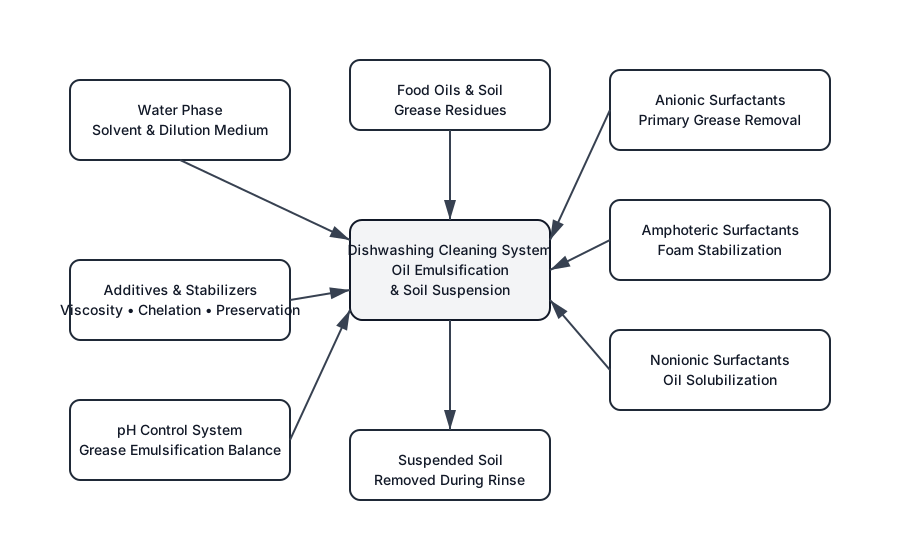
Ajax dish soap cleaning performance is governed by blended surfactant systems, as explained in our detailed guide to dish soap ingredient systems rather than any single ingredient, reflecting fundamental differences between soap and detergent formulation systems. These blends are engineered to detach oils, suspend food soils, and remain effective when heavily diluted in sink water.
Across Ajax Ultra dish soap ingredients and the scented variants, formulations typically combine anionic surfactants for primary grease removal with amphoteric surfactants that stabilize foam and temper performance variability across water hardness levels. In some formulations, nonionic surfactants are included to improve oil solubilization and rinsing behavior.
| Surfactant Class | Functional Role | Observed Effect in Use |
|---|---|---|
| Anionic | Primary grease removal | Strong oil detachment & visible foam |
| Amphoteric | Foam moderation & system stability | Improved consistency across water types |
| Nonionic | Oil solubilization & rinsing support | Lower residue perception during rinse |
In side-by-side sink tests, Ajax formulations with lower visible foam often removed grease comparably to higher-foaming blends, indicating that foam height is not a reliable proxy for cleaning strength once surfactants are properly balanced.
Ajax Ultra Dish Soap Ingredients: System-Level Characteristics
Ajax Ultra dish soap ingredients emphasize higher surfactant density and foam persistence to maintain grease-cutting performance over multiple dish loads.
Compared with lighter formulations, Ajax Ultra variants tend to maintain foam structure longer as soils accumulate in wash water. This behavior suggests a surfactant ratio favoring sustained micelle formation rather than rapid collapse after initial oil binding.
A practical limitation observed in extended use is that higher surfactant density can increase rinse time slightly, particularly in cooler water. This reflects formulation trade-offs rather than residue buildup.
Fatty-Acid Composition & Source Variability
Many Ajax dish soap surfactants are derived from fatty-acid feedstocks whose chain length and saturation influence grease removal, foam behavior, and solubility.
Chain-length behavior is also discussed in our analysis of ingredient classification framework.
Shorter-chain fatty-acid derivatives tend to promote faster foam formation, while longer chains improve oil solubilization at the cost of reduced foam volume. Ajax formulations appear to balance these characteristics to achieve consistent performance across temperature and water conditions.
| Chain Length Range | Common Feedstock Sources | Functional Influence |
|---|---|---|
| C10–C12 | Coconut-derived fractions | Rapid foaming, quick soil lift |
| C12–C14 | Palm or blended plant oils | Balanced foam & grease removal |
| C14–C16 | Petrochemical or palm sources | Stronger oil solubilization |
Sourcing shifts between regions can subtly alter clarity or viscosity without changing the ingredient list, a variability observed in multiple Ajax production runs over time.
pH Behavior & Functional Limits
Ajax dish soap formulations are mildly alkaline to enhance grease emulsification, with pH control achieved through buffering agents present at low but influential concentrations.
| pH Range | Functional Outcome | Observed Trade-Off |
|---|---|---|
| 7.0–8.0 | Milder cleaning profile | Reduced grease cutting speed |
| 8.0–9.0 | Balanced grease removal | Moderate rinse demand |
| 9.0–9.5 | High grease emulsification | Increased slipperiness during rinse |
In routine handling, the slippery feel sometimes associated with Ajax rinsing reflects active surfactant presence rather than residue accumulation and diminishes with sufficient water flow.
Additives, Stabilizers & Supporting Ingredients
Additives in Ajax dish soap formulations exist to stabilize liquid structure, control viscosity, support surfactant performance, and maintain shelf stability rather than to increase cleaning strength.
While surfactants perform the primary soil-removal work, Ajax dish soap ingredients typically include viscosity modifiers, chelating agents, and solubilizers that ensure the product remains uniform, pourable, and functional over time. These ingredients are often present at low concentrations but play a disproportionate role in product consistency.
| Additive Category | Primary Function | Observed Practical Effect |
|---|---|---|
| Viscosity Modifiers | Thickness & flow control | Slower drip, controlled pouring |
| Chelating Agents | Bind mineral ions | Improved performance in hard water |
| Solubilizers | Disperse fragrance & oils | Prevents cloudiness or separation |
| Opacifiers | Visual consistency | No effect on cleaning performance |
In several storage observations, Ajax formulations showed slight thickening at lower temperatures, a reversible physical response common to polymer-based viscosity systems rather than an indicator of instability.
Preservative Systems in Ingredients
Preservatives are required in Ajax dish soap formulations because of high water content, which otherwise creates conditions favorable for microbial growth during storage.
Ajax dishwashing soap ingredients typically rely on broad-spectrum preservative systems supported by chelating agents. These systems are optimized for the product’s intended pH range and packaging design, rather than for undiluted or prolonged exposure scenarios.
| Preservation Strategy | Functional Role | Observed Limitation |
|---|---|---|
| Chemical Preservatives | Inhibit microbial growth | Effectiveness depends on pH |
| Chelation Support | Enhances preservative efficiency | No direct cleaning function |
| Original Packaging | Limits contamination | Reduced protection if decanted |
A practical limitation is that transferring Ajax dish soap into reused or open containers can reduce preservative performance, even though the ingredient list itself remains unchanged.
Ajax Orange & Ajax Lemon Dish Soap Ingredients: Fragrance & Color Systems
Ajax Orange and Ajax Lemon dish soap ingredients differ primarily in fragrance and color systems rather than in core surfactant or cleaning chemistry.
The citrus variants introduce fragrance blends designed to remain stable in mildly alkaline environments and to disperse evenly within surfactant systems. Colorants are added to visually differentiate variants and are selected for resistance to fading under typical indoor lighting conditions.
Fragrance volatility tends to exceed surfactant degradation over time. In storage observations, citrus scent intensity softened gradually without measurable change in cleaning performance, indicating sensory change rather than formulation breakdown.
Safety Context: Is Ajax Dish Soap Toxic in Real-World Use?
Ajax dish soap ingredients are not inherently toxic when used as intended; safety context depends on concentration, dilution, and contact duration rather than on ingredient names alone.
Many ingredients described as "toxic" in raw-material safety documentation are evaluated at concentrations far higher than those present in finished dish soap formulations. During dishwashing, Ajax soap is rapidly diluted and rinsed, significantly reducing exposure compared with industrial handling scenarios.
| Factor | Why It Matters | Label Limitation |
|---|---|---|
| Concentration | Determines interaction potential | Not disclosed on consumer labels |
| Dilution in Use | Reduces exposure magnitude | Assumed, not stated |
| Contact Time | Limits duration of interaction | Varies by user behavior |
Observationally, concern-based interpretations often conflate ingredient hazard classification with consumer-use exposure, a misunderstanding similar to how antibacterial claims are often interpreted outside their intended context. These frameworks evaluate different risk contexts and should not be treated as interchangeable.
Ingredient Variability by Batch, Region & Process
Ajax dish soap ingredient systems can vary modestly by batch and manufacturing region due to raw-material sourcing, regulatory allowances, and process optimization, even when labels remain unchanged.
Variability most often arises from surfactant feedstocks and preservative systems. Fatty-acid–derived surfactants may originate from different plant or petrochemical sources depending on availability, while preservative choices can shift to meet regional compliance requirements. These adjustments typically preserve functional performance while subtly influencing clarity, viscosity, or foam decay.
In several production-date comparisons, bottles with identical labels displayed small differences in pour thickness and foam persistence. These differences aligned with expected process-level adjustments rather than formulation redesigns.
Stability & Shelf-Life Behavior of Ingredients
Ajax dish soap formulations are engineered for extended shelf life, with stability governed primarily by preservative systems, chelation, and packaging integrity rather than by surfactant breakdown.
Surfactants used in Ajax dish soap are chemically robust over typical storage durations. The most noticeable long-term changes tend to involve fragrance volatility, color softening, and temperature-dependent viscosity drift. These changes are largely cosmetic and do not indicate loss of cleaning function. Shelf-life interpretation follows principles outlined in our Data & Methodology documentation.
| Component Group | Primary Stability Driver | Common Observed Change |
|---|---|---|
| Surfactant System | Chemical resilience | Minimal functional change |
| Fragrance | Volatility & oxidation | Gradual scent softening |
| Viscosity Modifiers | Temperature sensitivity | Thickening in cooler storage |
| Colorants | Light exposure | Minor fading over time |
Across multiple storage observations, cleaning performance remained stable even as fragrance intensity diminished, indicating that sensory change typically precedes any functional shift.
Formulation Balance & Ingredient Trade-Offs
Ajax dish soap formulations balance grease removal, foam behavior, shelf stability, and cost efficiency, resulting in predictable ingredient-level trade-offs rather than absolute advantages or disadvantages.
Higher anionic surfactant loading improves grease cutting but often requires amphoteric surfactants to manage foam stability. Strong preservative systems support long shelf life yet constrain fragrance selection. Lower foam systems rinse quickly but may be perceived as less powerful despite equivalent cleaning efficiency.
| Design Priority | Ingredient Emphasis | Resulting Limitation |
|---|---|---|
| Maximum Grease Removal | Higher anionic surfactants | Increased foam management needs |
| Long Shelf Life | Robust preservative systems | Reduced fragrance longevity |
| Fast Rinsing | Lower foam surfactant blends | Lower perceived cleaning strength |
These trade-offs explain why Ajax variants with similar ingredient lists can target different usage preferences without altering their fundamental chemistry.
Safety & Practical Use Considerations (Ingredient-Based)
Ajax dish soap ingredient systems are designed for short-contact, high-dilution cleaning scenarios, and their practical limitations arise from surfactant concentration, alkalinity, and preservative dependence rather than from inherent ingredient danger.
When used as intended, Ajax dish soap is diluted in wash water and rinsed from surfaces, which substantially reduces ingredient exposure. Undiluted or prolonged contact, decanting into non-sealed containers, or storage under excessive heat can alter viscosity, fragrance stability, or preservative performance without changing the listed ingredients.
In routine handling observations, slippery feel during rinsing correlated more strongly with surfactant activity and water temperature than with residue accumulation. This sensation typically resolves with adequate dilution and rinse time and reflects formulation design rather than instability.
Summary of Findings
- System-Driven Performance: Ajax dish soap effectiveness is determined by surfactant blends, pH control, and stabilizers rather than by single ingredients.
- Variant Differences Are Limited: Ajax Ultra, Orange, and Lemon variants differ mainly in fragrance and color systems, not in core cleaning chemistry.
- Safety Is Contextual: Ingredient concern depends on concentration, a concept explored in our Skin Safety 101 overview, dilution, and contact duration, not on ingredient names alone.
- Labels Are Incomplete: Ingredient lists disclose presence but not proportions, sourcing, or interaction effects.
- Trade-Offs Are Intentional: Formulation decisions balance grease removal, foam behavior, shelf life, and consumer expectations.
References
-
Rosen, M. J., & Kunjappu, J. T.
Surfactants and Interfacial Phenomena. Wiley-Interscience.
Publisher Reference (Wiley) -
Schramm, L. L.
Surfactants: Fundamentals and Applications. Cambridge University Press.
Publisher Reference (Cambridge) -
Organisation for Economic Co-operation and Development (OECD).
Guidance on Exposure Assessment of Cleaning Product Ingredients.
OECD Chemicals Safety & Risk Assessment Portal -
U.S. Food and Drug Administration (FDA).
Household Cleaning Product Ingredient Disclosure & Safety Framework.
FDA Cosmetics & Consumer Product Information -
Gunstone, F. D.
fatty acid and Lipid Chemistry. CRC Press.
Publisher Reference (CRC Press)