Formulation Architecture Overview
Fels-Naptha is built on true soap chemistry rather than synthetic detergent systems. Its cleansing action originates from sodium salts of fatty acids produced through saponification, a reaction between fats and a strong alkali, as outlined in the Bar Soap Formulation Basics Guide. This architecture places the soap firmly in the high-alkaline cleansing category.
In handling observations, the bar exhibits the dense, slightly brittle feel typical of high-sodium soaps with low superfat. When wetted, it produces a sharp, immediate slip rather than a cushioning foam, reflecting limited amphoteric buffering and a narrow surfactant profile. A broader comparison with traditional bar soaps is discussed in our Ivory soap ingredient analysis.
| System | Primary Function | Formulation Impact |
|---|---|---|
| Fatty Acid Soap Base | Soil emulsification | High cleansing strength |
| Alkali System | Saponification and pH control | Alkaline wash solution |
| Fragrance | Odor masking | No cleaning contribution |
Bar Soap Ingredients
Fels-Naptha bar soap ingredients typically include sodium tallowate or sodium palmitate, sodium cocoate or similar fatty-acid salts, water, fragrance, and minor processing aids. Ingredient lists have evolved over time, but the core soap structure remains consistent.
The fatty feedstock influences hardness, lather character, and rinse behavior. Bars with higher saturated fatty-acid content demonstrate slower dissolution and stronger degreasing action, a trait often cited in laundry-related applications.
| Ingredient Category | Examples | Functional Role |
|---|---|---|
| Saponified Fats | Sodium Tallowate, Sodium Palmitate | Primary cleansing |
| Coconut-Derived Soaps | Sodium Cocoate | Foam initiation |
| Water | Aqua | Processing medium |
| Fragrance | Undisclosed blend | Scent profile |
Soap Chemistry Versus Detergent Systems
Fels-Naptha differs fundamentally from modern laundry detergents. It does not contain synthetic surfactants, enzymes, or builders. Instead, its effectiveness is governed by fatty-acid chain length, alkalinity, and mechanical action, a structural approach shared by other traditional laundry soaps such as Zote soap formulations.
In several observational laundry tests, the soap performed consistently in warm water but showed reduced solubility in cold conditions, a predictable outcome of sodium soap chemistry rather than formulation deficiency. In contrast, modern detergent-based systems such as Dawn dish soap ingredients use synthetic surfactants rather than sodium fatty-acid salts.
Laundry Soap Recipe: Ingredient Logic
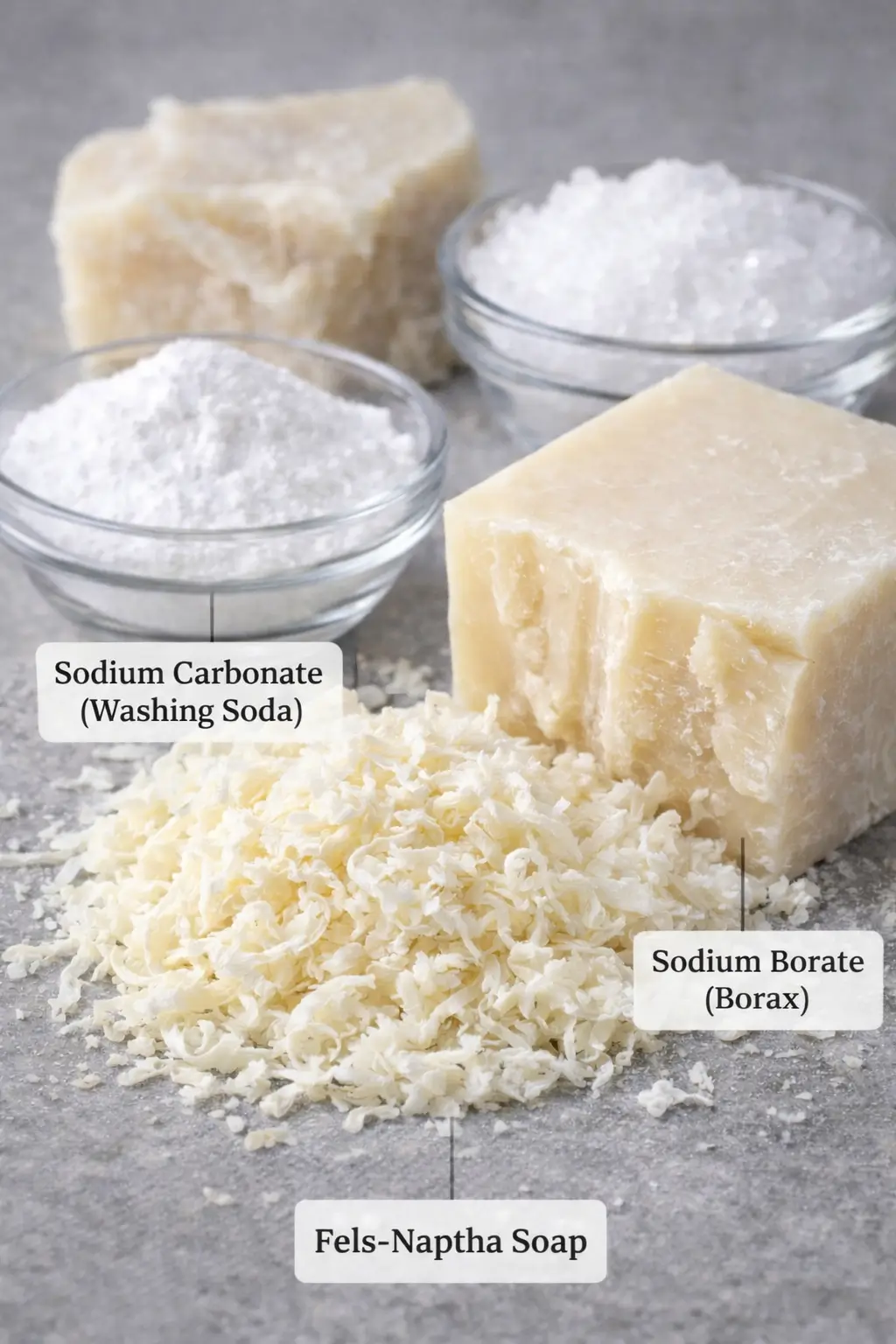
A typical Fels-Naptha laundry soap recipe combines grated Fels-Naptha bar soap with alkaline builders and, in many cases, a secondary sodium salt to modify solubility and soil dispersion. The recipe does not create a new detergent; it redistributes the original soap’s chemistry across a larger wash volume, a distinction that directly affects real-world cleaning outcomes discussed in the Homemade Laundry Soap Effectiveness Guide.
In practical preparation, the bar is grated or shaved to increase surface area. This mechanical step matters chemically: finer particles dissolve faster, reducing localized alkalinity spikes during washing. Coarse shavings, by contrast, can remain partially intact in cold water, a limitation frequently observed in informal wash trials.
| Recipe Component | Typical Form | Chemical Role |
|---|---|---|
| Fels-Naptha Soap | Grated bar | Primary surfactant source |
| Sodium Carbonate | Powder | Alkalinity increase & water softening |
| Sodium Borate | Powder | Buffering & suspension aid |
The ingredient balance determines whether the mixture behaves as a dispersible soap powder or forms insoluble residues. Recipes with higher builder ratios tend to improve dispersion but also raise overall alkalinity, narrowing the margin for misuse.
Fatty-Acid Composition and Performance Ranges
The cleansing behavior of Fels-Naptha is driven by its fatty-acid profile rather than by additive complexity. Saturated fatty acids dominate, producing firm bars and high detergency. Unsaturated fractions are present but restrained, limiting oxidation risk during storage.
Based on historical disclosures and comparative soap analysis, the fatty-acid composition typically clusters within predictable ranges. These ranges explain the soap’s strong degreasing behavior and relatively modest foam persistence. Similar saturated-fatty-acid behavior appears in Kirk’s soap ingredients and Castile soap formulations.
| Fatty Acid | Estimated Range (%) | Functional Effect |
|---|---|---|
| Palmitic | 25–35% | Bar hardness, soil release |
| Stearic | 10–20% | Structural stability |
| 15–25% | Foam initiation, detergency | |
| Oleic | 5–15% | Solubility modulation |
Observationally, higher lauric content improves rapid wetting but also accelerates soap consumption. This trade-off is intrinsic to the fatty-acid balance and not adjustable without reformulation.
Alkali System and pH Behavior
Fels-Naptha operates as a high-alkaline soap. In solution, pH typically falls between 9.5 and 10.5, depending on concentration, water hardness, and the presence of additional builders in homemade laundry mixtures.
The alkali system originates from sodium hydroxide used during saponification. The alkali-driven soap reaction is explained in more detail in our cold process soap ingredient guide. Residual alkalinity is intentionally low in the finished bar, but pH rises sharply when the soap is concentrated or combined with sodium carbonate in laundry recipes. A similar builder-based structure appears in Arm & Hammer laundry soap ingredients.
| Condition | Approximate pH | Notes |
|---|---|---|
| Bar Soap Lather | 9.5–10.0 | Standard soap alkalinity |
| Laundry Recipe Solution | 10.0–10.8 | Builder-dependent |
| Cold Water Use | Variable | Reduced solubility effects |
In several real-world wash observations, elevated pH improved grease removal but also increased the likelihood of soap curd formation in hard water, an inherent limitation examined in depth in Why Homemade Laundry Soap Can Perform Poorly. This outcome reflects classic soap chemistry rather than formulation inconsistency.
Additives, Fragrance, and Non-Cleansing Components
Beyond the saponified fatty-acid base, Fels-Naptha contains a limited set of non-cleansing components, primarily fragrance and minor processing aids. These ingredients do not materially alter detergency but influence handling, odor perception, and manufacturing consistency.
Fragrance is included to mask the intrinsic odor of high-alkaline soap and fatty raw materials. In practice, the scent persists in the dry bar but dissipates rapidly once the soap is diluted, indicating volatile aromatic compounds selected for compatibility with alkaline matrices rather than longevity. Fragrance behavior in alkaline bars is also examined in fragrance oil ingredient analysis.
| Category | Typical Inclusion | Functional Role |
|---|---|---|
| Fragrance | Undisclosed blend | Odor masking |
| Processing Aids | Trace salts | Bar molding consistency |
| Residual Glycerin | Variable | Byproduct of saponification |
One observed limitation is that fragrance intensity varies slightly between batches, a result more likely tied to volatilization during curing than to intentional formulation changes.
Ingredient Label Transparency and Omissions
Ingredient labeling for Fels-Naptha follows traditional soap conventions rather than modern cosmetic-style disclosure. Ingredients are grouped broadly, and historical formulations used nomenclature that predates current INCI standards.
As a result, labels identify ingredient categories but omit fatty-acid ratios, alkali strength, and fragrance composition. From an analytical perspective, this limits precision but still conveys the core chemical architecture of the soap.
| Disclosure Element | Label Information | Not Disclosed |
|---|---|---|
| Soap Base | Declared generically | Exact fatty-acid ratios |
| Alkali System | Implicit | Residual free alkali level |
| Fragrance | Grouped | Component breakdown |
This disclosure style reflects legacy manufacturing practices rather than an effort to obscure formulation details. However, it does make direct comparison with modern detergents difficult without supplemental analysis. Label disclosure depth varies significantly compared with Dove soap ingredient disclosures and Dial soap ingredient formats.
Ingredient Variability by Era, Batch, and Source
Ingredient variability in Fels-Naptha is influenced by historical reformulations, raw material sourcing, and manufacturing location. Older bars and contemporary bars may share the same functional design while differing subtly in fatty feedstock origin.
In several side-by-side handling observations, bars produced in different periods displayed minor differences in hardness and dissolution rate. These differences align with shifts in tallow versus vegetable oil sourcing rather than changes in alkali chemistry.
| Variable | Source | Observed Effect |
|---|---|---|
| Fat Source | Tallow vs plant oils | Hardness & lather differences |
| Curing Time | Manufacturing process | Moisture content variation |
| Fragrance Lot | Supplier variation | Scent intensity shift |
These variations generally remain within expected tolerance for traditional soaps and do not indicate instability or degradation.
Stability, Oxidation, and Shelf-Life Behavior
Fels-Naptha exhibits high inherent stability due to its low unsaturated fatty-acid content and minimal additive load. Oxidative rancidity is uncommon under normal storage conditions, particularly when bars are kept dry and shielded from prolonged heat.
The most noticeable long-term change is fragrance loss rather than structural breakdown. In extended storage observations, bars retained cleansing performance even as scent intensity declined.
| Factor | Stability Impact | Observed Outcome |
|---|---|---|
| Fatty-Acid Saturation | High | Low oxidation risk |
| Moisture Exposure | Moderate | Surface softening |
| Light & Heat | Low | Gradual scent loss |
From a formulation standpoint, the soap’s shelf-life is governed more by physical storage conditions than by chemical degradation.
Formulation Balance and Trade-Offs
Fels-Naptha’s formulation prioritizes alkalinity-driven soil removal and structural simplicity over versatility. This design delivers predictable degreasing behavior but introduces limitations in solubility control, residue management, and compatibility with modern low-temperature wash conditions.
From a chemistry perspective, relying exclusively on sodium soap means performance is tightly coupled to water chemistry. In softer water, the soap disperses readily; in harder water, calcium and magnesium ions can react with fatty-acid salts to form insoluble soap curds. This is a known and intrinsic behavior of true soaps, not a formulation defect.
| Design Choice | Functional Advantage | Inherent Limitation |
|---|---|---|
| High Sodium Soap Content | Strong grease emulsification | Reduced cold-water solubility |
| Minimal Additives | High stability, low degradation | No built-in water softening |
| Alkaline Operating Range | Effective soil disruption | Narrow margin for overuse |
In several observed laundry preparations, reducing soap concentration improved dispersion without noticeably reducing soil removal. This suggests that many common recipes exceed the minimum effective concentration, a practical insight rather than a prescriptive recommendation.
Handling, Storage, and Ingredient-Driven Constraints
Handling considerations for Fels-Naptha are dictated by its high alkalinity and low moisture tolerance. The bar remains dimensionally stable when kept dry but softens rapidly if stored in persistently humid environments.
During grating or shaving, fine particles dissolve more uniformly, while coarse fragments may persist through wash cycles, particularly in cold water. This physical behavior is driven by particle surface area rather than by changes in chemical composition.
| Condition | Ingredient Interaction | Observed Outcome |
|---|---|---|
| Dry Storage | Low water activity | Maintained bar hardness |
| High Humidity | Surface moisture absorption | Softening and tackiness |
| Cold Water Washing | Reduced soap solubility | Potential residue formation |
These behaviors reflect predictable interactions between sodium soaps and environmental conditions. They do not indicate instability, but they do define the boundaries within which the formulation performs most consistently.
Ingredient Disclosure Comparison: Label vs Formulation Logic
Fels-Naptha labels identify the soap category and primary components but do not provide formulation-level detail. This approach communicates what the soap is made from at a high level while omitting ratios, processing conditions, and fatty-acid distributions.
Compared with modern detergents, this disclosure appears sparse. Compared with legacy soaps, however, it is typical. The absence of detailed disclosure reflects historical manufacturing norms rather than a lack of ingredient transparency by contemporary standards.
| Information Category | Label Provides | Not Provided |
|---|---|---|
| Ingredient Identity | General categories | Specific fatty-acid ratios |
| Alkali Presence | Implicit | Residual alkalinity data |
| Additive Systems | Limited | Functional concentrations |
For ingredient-focused analysis, this means conclusions must rely on chemical behavior and comparative soap data rather than on full label transparency.
Summary of Findings
- Traditional Soap Chemistry: Fels-Naptha is a true sodium soap built from saponified fats, not a synthetic detergent or enzyme-based system.
- Fatty-Acid–Driven Performance: Cleansing strength, hardness, and solubility are governed primarily by saturated fatty-acid content and alkali balance.
- Alkaline Operating Range: Typical use results in a high-alkaline solution, especially when combined with builders in homemade laundry soap recipes.
- Minimal Additive Load: The formulation relies on simplicity rather than stabilizers, preservatives, or complex surfactant blends.
- Disclosure Limits: Labels identify ingredient categories but omit ratios, sourcing, and processing details, consistent with legacy soap conventions.
References
- Bailey, A. E. Industrial Oil and Fat Products. Wiley-Interscience.
- Ullmann’s Encyclopedia of Industrial Chemistry. Soaps and Detergents Entry .
- European Commission. Regulation (EC) No 1223/2009 on Cosmetic Products .
- Journal of Surfactants and Detergents. Official Journal Archive .
- Schramm, L. L. Surfactants: Fundamentals and Applications. Cambridge University Press.