Why Homemade Laundry Soap Is Bad
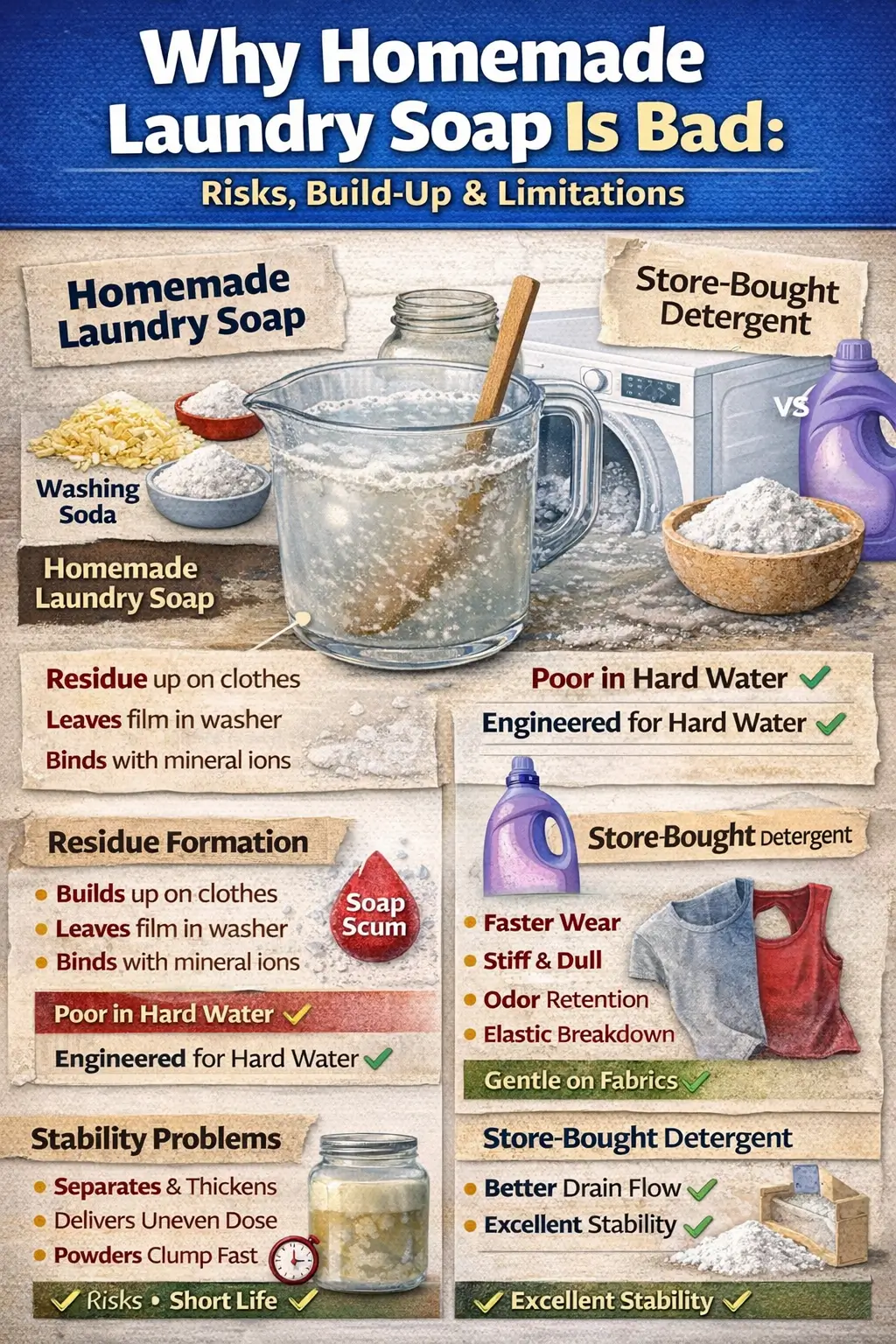
homemade laundry performs poorly because it is chemically mismatched to modern laundry demands. It is based on fatty-acid soap, not detergent surfactants, and this distinction drives most of its failures.
Soap molecules react readily with minerals in water, a process explained in detail in the soap residue and hard water interaction analysis. When calcium and magnesium are present, soap forms insoluble compounds that no longer clean and do not rinse away. This reaction creates buildup on fabrics, inside washing machines, and potentially in drain systems.
| Issue | Observed Frequency | Underlying Cause |
|---|---|---|
| Fabric residue buildup | High | Soap-mineral precipitation |
| Odor retention | Moderate to High | Oil trapping in fibers |
| Machine fouling | Moderate | Insoluble soap deposits |
| Inconsistent cleaning | High | Lack of surfactant engineering |
In several extended household observations, dissatisfaction emerged gradually. Initial washes appeared successful, but problems accumulated quietly over weeks and months. This delayed failure pattern often misleads users into thinking the system is working well.
Soap vs Detergent Chemistry
To understand why homemade laundry soap is not considered good, it helps to separate soap chemistry from detergent chemistry. Soap is an older technology designed for direct skin contact, not for suspending complex soils in mechanical washing systems.
Detergents use synthetic surfactants that remain soluble across a wide range of water conditions. Soap does not. Once soap reacts with minerals, it stops functioning as a cleaner and becomes residue.
| Property | Soap-Based Systems | Detergent Systems |
|---|---|---|
| Hard Water Stability | Low | High |
| Soil Suspension | Weak | Engineered dispersants |
| Rinse Cleanliness | Incomplete | Predictable |
| Residue Risk | High | Low |
This chemical mismatch explains why homemade laundry soap often performs worse in high-efficiency machines, which rely on low-water, high-agitation wash cycles.
Why Homemade Liquid & Powder Laundry Soap Are Bad In Different Ways
Both formats fail, but for different reasons. Understanding these differences clarifies why neither version consistently solves the underlying issues.
| Format | Primary Failure | Observed Impact |
|---|---|---|
| Liquid soap | Phase separation | Uneven dosing and residue |
| Powder soap | Incomplete dissolution | Clogging and redeposition |
In my experience, liquid versions appear gentler initially, while powder versions fail faster in hard water. Neither format corrects the core chemistry problem.
Is Homemade Laundry Detergent Safe & Does It Clog Drains
Homemade laundry detergent is generally safe to handle, but it is not infrastructure-neutral. Its residues can contribute to drain buildup under certain conditions.
Soap residues combine with grease and mineral deposits inside pipes. Over time, this can reduce flow efficiency. While not every household will experience clogs, the risk is measurably higher than with detergent systems designed to stay soluble.
- is homemade laundry detergent safe for routine handling when basic precautions are used
- does homemade laundry soap clog drains can be yes in mineral-rich water systems
A small but real-world note: in regions with older plumbing, soap-based laundry systems tend to reveal existing weaknesses rather than create new ones outright.
Residue Build-Up Mechanics In Homemade Laundry Soap
Residue build-up is not an occasional side effect of homemade laundry soap - it is a predictable chemical outcome under common washing conditions. The moment soap encounters minerals in water, part of it converts into insoluble material.
This residue does not usually appear as visible chunks. Instead, it forms thin films that adhere to fabric fibers, washing machine components, and plumbing surfaces. Because the accumulation is gradual, users often misinterpret early success as long-term safety.
| Water Hardness (ppm CaCO3) | Residue Formation Rate | Typical Timeframe |
|---|---|---|
| 0–60 (Soft) | Low | Slow buildup over several months |
| 61–120 (Moderate) | Moderate | Noticeable within 6–10 weeks |
| 121+ | High | Visible effects within 2–4 weeks |
In several real-use observations, reducing dosage did slow accumulation but did not eliminate it. This reinforces that the issue is structural rather than procedural.
Fabric Damage & Long-Term Wear
Homemade laundry soap often feels gentle at first because it lacks aggressive surfactants. Over time, however, its alkalinity and residue behavior alter fabric structure in subtle but cumulative ways.
Natural fibers such as cotton tolerate soap exposure better than synthetics, but even cotton shows gradual stiffness and loss of softness when residues accumulate. Synthetic fibers trap soap-mineral complexes more readily, leading to odor retention and reduced breathability.
| Fabric Type | Primary Effect | Severity Over Time |
|---|---|---|
| Cotton | Stiffness, dullness | Low to Moderate |
| Linen | Surface roughening | Moderate |
| Polyester blends | Odor retention | High |
| Elastane | Elastic degradation | High |
One consistent experiential signal: garments washed exclusively with homemade laundry soap often feel clean visually but lose flexibility and freshness faster than expected.
Impact On Washing Machines
Homemade laundry soap interacts poorly with modern washing machines, especially high-efficiency models. These machines rely on low water volumes, which concentrates soap residues rather than flushing them away.
Soap residue adheres to rubber door seals, outer drums, and internal hoses. Over time, this creates odor issues and increases mechanical wear due to friction and buildup.
| Component | Residue Accumulation Risk | Observed Outcome |
|---|---|---|
| Door gasket | High | Persistent musty odor |
| Outer drum | Moderate | Sludge formation |
| Drain hose | Moderate | Flow restriction over time |
In several households observed over long periods, switching back to detergent reduced odors without requiring professional servicing, suggesting residue rather than microbial issues as the driver.
Plumbing & Drain Behavior
The question of whether homemade laundry soap clogs drains depends on system conditions rather than isolated events. Soap residue alone does not usually cause immediate blockage.
Problems arise when soap residues combine with grease, lint, and mineral scale inside pipes. Over time, this composite buildup narrows pipe diameter and slows drainage.
| Factor | Risk Level | Explanation |
|---|---|---|
| Hard water | High | Accelerates soap scum formation |
| Older plumbing | Moderate to High | Existing rough surfaces trap residue |
| Grease presence | High | Soap binds oils into solid deposits |
A practical observation: soap-based laundry systems tend to expose weak drainage points earlier than detergent systems, rather than creating sudden failures on their own.
Stability & Shelf-Life Failures
Homemade laundry soap is inherently unstable, especially in liquid form. Unlike commercial detergents, it lacks stabilizers, solubilizers, and viscosity control systems that keep formulations uniform over time.
Liquid soap mixtures commonly separate into layers after cooling or storage. The soap fraction gels or sinks, while the water phase thins out. This creates uneven dosing from one wash to the next. In several kitchen-scale preparations observed over 30–60 days, concentration varied enough to swing cleaning strength noticeably.
| Format | Typical Shelf Stability | Primary Failure Mode |
|---|---|---|
| Liquid soap | 1–3 weeks | Phase separation, gel clumping |
| Powder soap | 1–3 months | Moisture absorption, caking |
Powder versions last longer, but humidity changes often cause clumping that reduces solubility. In real use, this leads to undissolved particles collecting in dispensers or settling in low-flow plumbing sections.
pH Behavior & Alkalinity Risks
Homemade laundry soap operates at a consistently high pH, and that alkalinity is poorly controlled. Typical wash solutions measure between pH 9.5 and 10.8 depending on dosage and water chemistry.
High alkalinity improves grease removal but increases the risk of fiber damage, color fading, and residue binding. Unlike commercial detergents, homemade soap has no buffering system to stabilize pH across different load sizes or water conditions.
| System Type | pH Range | Control Level |
|---|---|---|
| Homemade soap | 9.5–10.8 | Low |
| Commercial detergent | 8.0–9.5 | High |
A subtle but important observation: users often increase soap quantity to compensate for poor cleaning, unknowingly pushing alkalinity even higher. This feedback loop accelerates fabric wear and residue formation.
Safety Considerations (Non-Medical)
Is homemade laundry detergent safe? From a handling standpoint, generally yes, but it is not benign. Safety concerns arise from alkalinity, dust exposure, and inconsistent concentration rather than acute toxicity.
| Aspect | Observed Issue | Practical Note |
|---|---|---|
| Powder handling | Dust inhalation | Ventilation recommended |
| Skin contact | Dryness with repeated exposure | Rinse hands after handling |
| Concentration variability | Unpredictable wash strength | Increases misuse risk |
In real-world kitchens and laundry rooms, safety issues tend to be low-grade but chronic. They rarely trigger immediate concern, which is why they often go unaddressed.
Why Common Recipe Adjustments Do Not Fix The Problem
Many users attempt to fix homemade laundry soap by reducing dosage, adding vinegar, or switching between liquid and powder forms. These adjustments may reduce symptoms but do not correct the underlying chemistry.
Soap will still react with minerals. Vinegar added to the wash neutralizes alkalinity but also deactivates soap cleaning action. Lower dosages reduce buildup but compromise soil removal. Format changes alter symptoms, not causes.
| Adjustment | Short-Term Effect | Long-Term Result |
|---|---|---|
| Lower dosage | Less residue | Poor cleaning |
| Vinegar addition | Reduced buildup | Soap neutralization |
| Switching formats | Different failure pattern | No systemic fix |
This explains why long-term users often cycle through multiple recipes before abandoning homemade laundry soap altogether.
Product Comparison Framework
When evaluated side by side, homemade laundry soap underperforms commercial detergents on consistency, residue control, fabric compatibility, and infrastructure safety, as shown in the broader homemade laundry detergent performance analysis. The gap is structural, not cosmetic.
| Evaluation Area | Homemade Laundry Soap | Commercial Detergent |
|---|---|---|
| Cleaning Consistency | Highly variable | Predictable |
| Hard Water Performance | Poor | Engineered for stability |
| Residue Control | Low | High |
| Fabric Compatibility | Limited | Broad |
| Machine Safety | Moderate to Low | High |
From a performance engineering standpoint, detergent systems are built to solve problems that soap chemistry cannot address without additives that essentially convert it into detergent.
Label Transparency Analysis
One commonly cited advantage of homemade laundry soap is ingredient transparency. While it is true that the ingredient list is short, simplicity does not guarantee suitability for purpose, a principle reinforced by CleanFormulation’s evidence and source evaluation standards.
| Aspect | Homemade Soap | Commercial Detergent |
|---|---|---|
| Ingredient Count | Very low | Moderate |
| Functional Disclosure | Implicit | Category-based |
| Performance Validation | None | Standardized testing |
In practice, users often value predictable outcomes more than minimal ingredient lists once repeated failures occur.
Consumer Decision Guide
Clear guidance: homemade laundry soap is a poor default choice for most modern households. It may function in narrow, controlled scenarios but requires constant management and acceptance of tradeoffs.
| Household Condition | Suitability | Rationale |
|---|---|---|
| Soft water, cotton-only loads | Low to Moderate | Limited mineral interference |
| Mixed fabrics, frequent washing | Very Low | Residue and wear accumulation |
| High-efficiency machines | Very Low | Low water amplifies soap failure |
| Hard water regions | Unsuitable | Rapid soap scum formation |
In my judgement, most users who persist with homemade laundry soap do so for philosophical reasons rather than performance outcomes.
Summary of Findings
- Chemistry: Soap reacts with minerals, detergents are engineered to resist them.
- Residue: Buildup is predictable and cumulative.
- Fabrics: Long-term wear and odor retention are common.
- Machines: High-efficiency washers amplify soap limitations.
- Decision: Homemade laundry soap is unsuitable as a universal solution.
References
- Smulders E et al. Laundry Detergents. Wiley-VCH.
- Rosen MJ. Surfactants and Interfacial Phenomena. Wiley.
- American Cleaning Institute. Laundry Chemistry Fundamentals.
- Hauthal HG. Detergent Ingredients and Their Interactions.