Zote is a Mexican laundry bar widelyused for stain pre treatment and general laundry cleaning. The core material is saponified animal tallow together with coconut oil-derived soap. Common label ingredients reported across product lines include sodium tallowate, sodium cocoate, glycerin, fragrance, and optical brighteners. These ingredients produce a high-cleansing bar suitable for heavy soils and laundry applications rather than as a mild skin care soap.
Typical Ingredients (Laundry Bar Soap System)
| Ingredient / Component | Primary Functional Role | Status After Processing |
|---|---|---|
| Sodium Tallowate | Primary soap surfactant derived from animal fat (tallow); provides cleansing and bar structure | Fully formed soap after saponification; remains as main active cleansing agent |
| Sodium Cocoate | Secondary soap surfactant derived from coconut oil; enhances lather and grease removal | Fully formed soap; contributes to foam and solubility |
| Sodium Hydroxide | Alkaline reactant used for saponification of fats and oils | Consumed during reaction; converted into soap and glycerin (no free alkali in finished bar under proper processing) |
| Glycerin | Humectant and natural by-product of saponification; improves bar plasticity | Partially retained; remains distributed within soap matrix |
| Sodium Chloride | Controls bar hardness and processing behavior | Remains as structural modifier in final bar |
| Fragrance (Parfum) | Scent system providing characteristic odor profile | Partially volatile; gradually dissipates during storage and use |
| Citronella Oil (in some variants) | Fragrance component contributing specific scent notes | Remains as part of fragrance blend; volatile over time |
| Optical Brighteners | Fluorescent agents that enhance perceived whiteness of fabrics | Remain active; deposit on fabric rather than altering stains chemically |
| Colorants (e.g., CI 45170) | Provide product color identity (e.g., pink or white variants) | Remain inert within formulation |
| Water (Processing Phase) | Medium for saponification and mixing | Largely removed during drying; residual moisture remains in finished bar |
| Fatty Acid Residues (Palmitic, Stearic, Oleic Fractions) | Contribute to soap structure, hardness, and cleansing balance | Converted into sodium salts; no free fatty acids in significant amounts |
| Trace Processing Impurities | Minor residuals from raw materials and manufacturing | Remain at negligible levels; no functional role |
Clear Definition In Simple Terms
In plain language, Zote is a concentrated laundry bar made by saponifying fats and oils with a strong alkali. The process converts fats into sodium salts of fatty acids, which act as detergents. The finished bar is formulated for fabrics and laundry tasks. It is not formulated as a mild bath soap for daily face care. Product labels consistently describe the main soap components as tallow and coconut oil derivatives.
Origin And Brief History
Zote was introduced by Fábrica de Jabón La Corona in Mexico in the late 20th century and became a household laundry brand in Mexico and many export markets. The name plays on Spanish wordplay around large bars of soap. Over time the product family expanded into color variants for whitening and scent differences, but the manufacturing approach remained a traditional saponified bar designed primarily for laundry use.
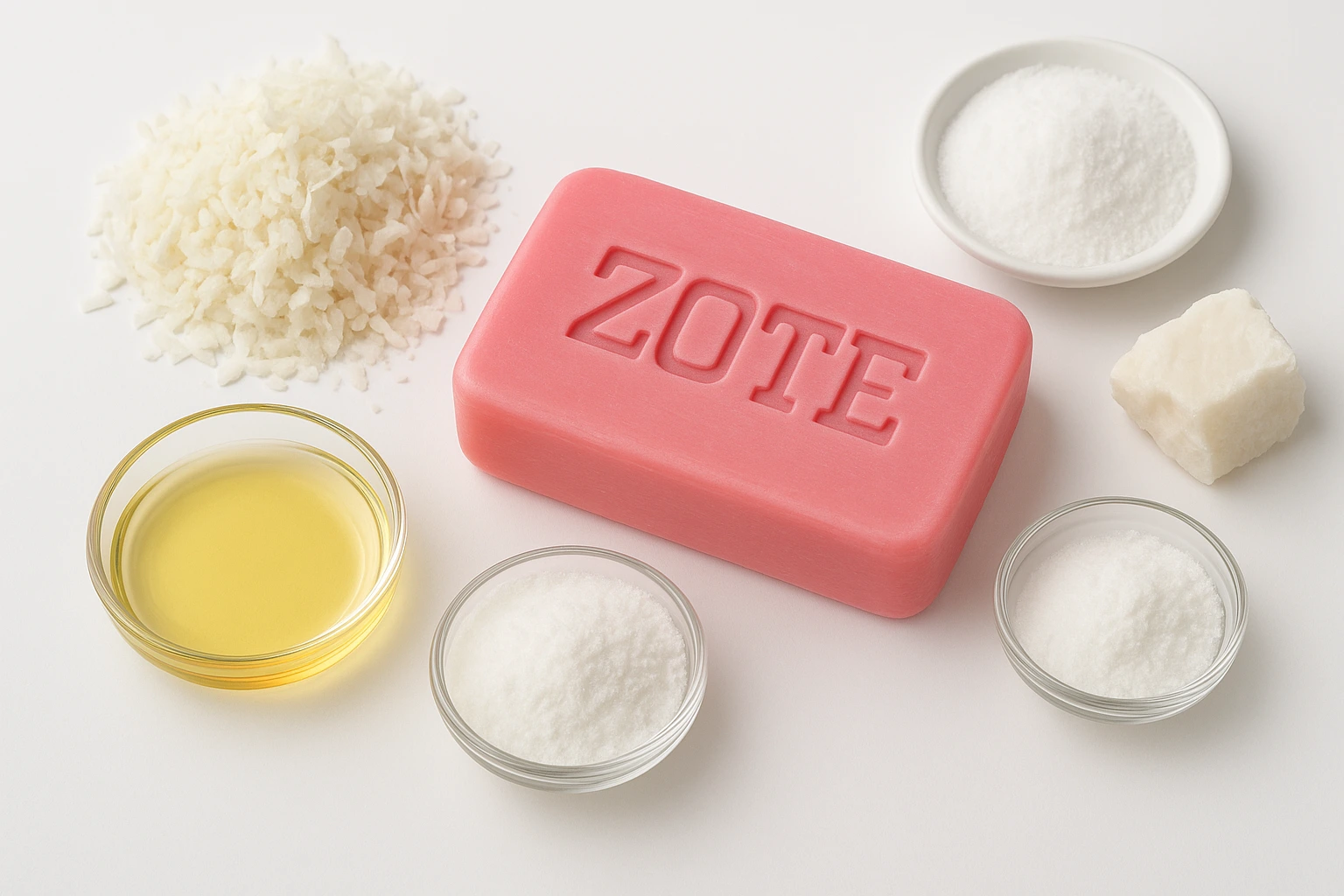
How Pink Zote Bar Soap Is Made
Zote is produced by a classical soap manufacturing route: neutralization of fatty acids or triglyceride fats with caustic soda (sodium hydroxide) to give sodium salts of fatty acids. The two principal raw fat inputs reported for Zote are tallow and coconut oil. These oils are reacted with sodium hydroxide in a controlled saponification step, followed by washing, concentration, and extrusion into bars. Additives such as glycerin may be retained, and optical brighteners plus dyes and fragrance are blended before final molding.
Basic Chemistry Notes
Reaction summary - triglyceride + NaOH -> glycerin + sodium fatty acid salt (soap). The sodium salt of lauric, myristic, palmitic, and stearic acids determines detergency, foaming, hardness, and solubility characteristics. Coconut oil provides high lauric and myristic content which delivers fast lather and strong grease cutting. Tallow contributes higher palmitic and stearic content and a firmer, longer lasting bar. The final bar typically contains small amounts of residual glycerin and may include Sodium Chloride for hardness control and optical brighteners for whiteness.
Forms And Types
Zote is sold in several formats and color variants: the pink laundry bar, the white laundry bar with increased whitening power, and associated flaked or liquid laundry forms in some markets. The color variants are marketing and formulation variants - for example, optical brighteners and colorants differ between pink and white bars. Functionally the bars remain laundry detergents designed for stain pretreatment and hand washing.
Ingredient Transparency And Full INCI Interpretation
Publicly available product labels and retailer item pages list the following recurring ingredient declarations for the white and pink Zote laundry bars: Sodium Tallowate, Sodium Cocoate, Glycerin, Fragrance, Optical Brightener. Some third party listings also include sodium chloride or dyes such as CI 45170 for color. Manufacturer and trade descriptions confirm tallow and coconut oil as primary raw materials that are neutralized with caustic soda.
INCI Style Interpretation
- Sodium Tallowate - INCI for the sodium salt of fatty acids derived from animal tallow. Contains palmitic and stearic acids predominantly.
- Sodium Cocoate - INCI for sodium salts of fatty acids derived from coconut oil. Rich in lauric and myristic acids.
- Glycerin - Humectant co-product from saponification; improves bar hardness and reduces dryness.
- Fragrance - Proprietary blend. Labels often specify citronella oil in some product literature but many market listings simply state fragrance. Use is typical for consumer scent.
- Optical Brightener - Synthetic molecules added to enhance perceived whiteness of fabrics by shifting reflected light into blue-violet range.
- Dyes / Colorants - Example CI 45170 for pink variant. Used for product identity rather than performance.
Key Characteristics And pH Notes
Functional characteristics observed or reported for Zote bars:
- High Cleansing Power - strong surfactant activity from sodium cocoate and sodium tallowate, effective on oils and soils.
- Fast Lather - coconut-derived fatty acids promote quick foam generation in water with agitation.
- Firm Bar - tallow-derived saturated fatty acids increase hardness and longevity of the bar.
- Whitener Additions - optical brighteners aim to improve fabric appearance rather than chemically bleach stains.
Typical pH behavior - finished solid soap bars used for laundry are alkaline, similar to systems discussed in the Fels-Naptha soap ingredient analysis. when dissolved in water. Commercial laundry bars often produce wash liquors with pH in the approximate range of 9 to 11 depending on formulation and dilution. Published analyses of bar soaps report median pH values commonly near 9 to 10 for many commercial bars. This alkalinity is a property of sodium carboxylate salts and any residual alkali from saponification processes.
Fatty Acid And Chemical Composition Tables
Zote uses two core raw fats - beef tallow and coconut oil. The table below summarizes typical fatty acid distributions for those fats to help interpret the properties of the resulting sodium salts.
| Fatty Acid | Coconut Oil Typical % | Beef Tallow Typical % | Detergency / Bar Effect |
|---|---|---|---|
| Lauric (C12) | ~45-50% | <1% | High foaming, quick cleaning |
| Myristic (C14) | ~15-20% | 1-3% | Foam stability, hardness contribution |
| Palmitic (C16) | ~8-10% | ~20-30% | Bar hardness, lubricity |
| Stearic (C18) | ~2-3% | ~10-25% | Hardness, reduced solubility |
| Oleic (C18:1) | ~6-10% | ~30-45% | Mildness, conditioning |
Sources for fatty acid reference ranges are standard lipid composition tables and manufacturer declarations for coconut and tallow feedstocks. Individual batch composition can vary by raw material source and processing.
Ingredient Function Table
| Ingredient | Function In Bar | Performance Notes |
|---|---|---|
| Sodium Tallowate | Main soap surfactant - cleans and emulsifies oils | Provides bar hardness and emollient feel to fabric |
| Sodium Cocoate | High-foaming surfactant fraction | Improves grease cutting and lather at cost of higher solubility |
| Glycerin | Humectant and plasticizer | Helps bar handle, reduces brittleness |
| Optical Brightener | Visual whitening of fabrics | No real stain removal chemistry - modifies reflected light |
| Fragrance | Scent profile | Consumer appeal; may contain multiple synthetic or natural components |
Ingredient Ranges, Ratios, And Percentages
Public label declarations typically list ingredients but not exact percentages. Open product disclosures and independent product records indicate the following approximate composition pattern for a Zote style laundry bar:
- Saponified Fats (Soap Anhydrous Equivalent) - 80 to 95% by weight combined (sodium tallowate + sodium cocoate). OpenFoodFacts lists estimated fatty acid content proportions for similar laundry bars.
- Glycerin - 0.5 to 5% typical as retained co-product and humectant.
- Optical Brightener - <1% range typical for whitening effect.
- Fragrance - trace to 1% typical depending on scent intensity and formulation.
- Sodium Chloride - used up to a few percent to control hardness or processing behavior in some formulations.
Because Zote is a formulated laundry product, a large majority of the bar is the functional soap fraction. Exact percentages are proprietary to the manufacturer but the public-facing items and trade descriptions align on the dominance of tallow and coconut-derived soap components.
Comparison Table
This table contrasts technical features of Zote-style laundry bar versus a mild bath soap for context.
| Feature | Zote Style Laundry Bar | Mild Bath Soap |
|---|---|---|
| Main Feedstocks | Tallow + Coconut Oil | Olive Oil, Coconut, Palm, or synthetic blends optimized for skin |
| pH Of Wash Liquor | ~9-11 (alkaline) | ~8-10 for traditional soap; synthetic syndet cleansers often pH 5.5-7 |
| Optical Brighteners | Present in whitening variants | Typically absent |
| Use Case | Fabric stain removal, laundry pretreatment | Body and facial cleansing |
| Fragrance | Often stronger and laundry oriented | Often formulated for skin compatibility |
Laundry soap formulation differences can also be compared with products analyzed in Arm & Hammer laundry soap ingredients
.Manufacturing Transparency
Public information from manufacturer statements and distributor product pages emphasizes the use of tallow and coconut oil with caustic neutralization as the production mechanism. Retail labels list the main soap salts but do not disclose exact weight percentages for each fatty acid salt or full fragrance compositions. Third party product registries such as OpenFoodFacts and retailer ingredient listings corroborate the ingredient set but do not provide proprietary ratios. For users requiring full material safety data or allergen declarations, contacting the manufacturer is the appropriate channel.
Practical Understanding Guidance
How to interpret and use Zote in practical contexts:
- Laundry Pretreatment - Wet the fabric, rub the bar on the stain, let sit and launder. For many oily stains a direct soap rub followed by washing is effective.
- General Cleaning - Zote bars are used for hand washing heavy soiled garments, delicates cleaning by hand, and even some household cleaning tasks such as greasy stains on counters when diluted and rinsed thoroughly.
- Concentration Awareness - Because the bar is concentrated, dissolve or dilute appropriately for hand wash or machine use to avoid excess residue.
- Skin Contact - While occasional hand contact when doing laundry is common, the bar is formulated as a laundry product rather than a mild skin soap. Those with sensitive skin may prefer dedicated skin cleansers for regular bathing use.
Environmental Notes
Environmental considerations include raw material sourcing and biodegradability. Soap made from saponified natural fats is biodegradable in the sense that fatty acid salts are ultimately broken down in wastewater treatment or the environment. However, optical brighteners are synthetic molecules that persist longer and are designed to absorb and reemit light, so they represent a different environmental profile compared with the soap salts. Tallow is an animal-derived feedstock and sourcing raises separate supply chain and sustainability questions compared with fully plant-derived oleochemicals. Buyers concerned with ingredient origin or synthetic brighteners should consult packaging or manufacturer sustainability disclosures. Ingredient sourcing differences are further discussed in the vegan soap ingredient analysis.
Myths Versus Reality
Common claims about Zote and factual context:
- Myth - Zote Is A Natural Skin Soap. Reality - Zote is formulated for laundry and contains optical brighteners and fragrance. It is a saponified detergent bar primarily intended for fabric use, not as a mild soap for daily facial use.
- Myth - Optical Brighteners Are Harmless Additives. Reality - Brighteners provide visual whitening but are synthetic chemicals with different environmental fates compared with natural soap components. Their purpose is optical, not chemical stain removal.
- Myth - Laundry Bars Are All The Same. Reality - Fatty acid profile differences, such as coconut versus tallow proportions, produce measurable differences in lather, hardness, cleaning speed, and fabric feel. Data driven comparison is important for application decisions.
People Also Ask Style Q And A
- Is Zote Soap Natural Or Chemical?
- It is a saponified natural fat product combined with synthetic additives. The soap salts are derived from natural fats, but the finished bar may contain synthetic brighteners and fragrances.
- Can I Use Zote On My Skin?
- It is safe for incidental skin contact during laundry tasks. Regular use as a daily facial soap is not recommended because the formulation targets laundry applications and may be more alkaline than mild skin cleansers. This is an informational statement and not medical advice.
- Does Zote Contain Animal Fat?
- Yes. Labels list sodium tallowate which is derived from animal tallow, so the product is not vegan.
- What Makes The Pink And White Bars Different?
- Color variants differ in optical brightener content, dyes, and possibly slight formulation adjustments for whitening effect. The underlying soap fraction remains tallow plus coconut-derived sodium salts.
Summary
Zote is a purpose built laundry bar whose primary cleaning action comes from saponified animal tallow and coconut oil derivatives listed on labels as sodium tallowate and sodium cocoate. The bar is concentrated, alkaline, high performing for grease and stain removal, and commonly formulated with optical brighteners and fragrance. For laundry tasks the formulation is rational and transparent for its purpose. Those seeking mild daily skin cleansers should prefer products formulated specifically for skin. Manufacturer and distributor ingredient listings align on the core ingredients but do not disclose exact proprietary percentages.
References
- Fábrica de Jabón La Corona: Product Information. Manufacturer information
- OpenFoodFacts Product Database: Zote Soap Listing. OpenFoodFacts record
- Gunstone, F. D. Vegetable Oils in Food Technology. Wiley reference
- Rosen, M. J. Surfactants and Interfacial Phenomena. Scientific reference
- U.S. FDA Cosmetic Ingredient Labeling Guidance. FDA reference