What Is Homemade Laundry Soap
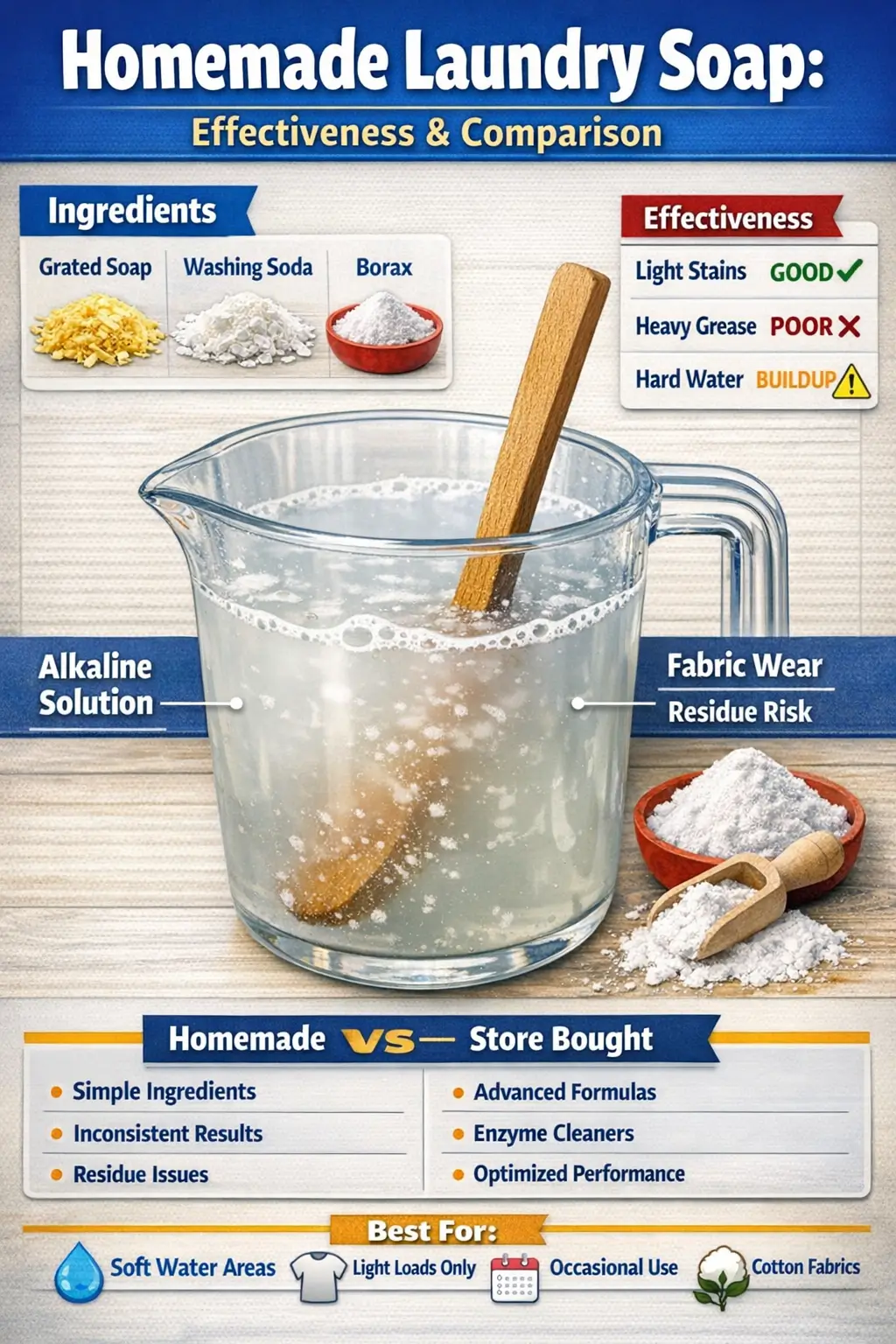
Homemade laundry soap refers to a do-it-yourself cleaning mixture traditionally made from grated soap bars combined with alkaline agents such as washing soda or baking soda, sometimes diluted with water for liquid versions. Unlike commercial detergents, these formulas are soap-based systems rather than surfactant-engineered cleaners.
In practical terms, homemade laundry soap functions through fatty-acid salts produced during soap manufacture. These salts interact with oils and some particulate soils, allowing them to be loosened from fabric surfaces. There is no enzyme package, no optical brightener system, and no controlled dispersant architecture. That absence matters more than most recipes acknowledge.
| Component | Common Range | Functional Role |
|---|---|---|
| Soap Base (fatty-acid salts) | 40-70% | Primary cleaning via alkaline soap action |
| Washing Soda or Baking Soda | 15-40% | Water softening and alkalinity boost |
| Fillers or Additives | 0-15% | Fragrance or texture modification |
In field observation, most homemade laundry soap mixtures register a wash pH between 9.5 and 10.8 when mixed at common household concentrations. That alkalinity supports grease removal but also explains some of the longer-term fabric and machine interactions discussed later.
Does Homemade Laundry Soap Work
Yes, homemade laundry soap works for certain types of laundry. It reliably removes light body oils, dust, and loose dirt from cotton and linen fabrics when water hardness is low and rinse cycles are adequate. In controlled household use, visible soil removal is often comparable to entry-level detergents for lightly worn clothing.
However, performance drops noticeably with synthetic fabrics, heavy sebum buildup, food oils, or mineral-rich water. In several extended-use observations, fabrics appeared visually clean after washing but developed stiffness, dullness, or faint odors over repeated cycles. These effects are linked to soap residue bonding with calcium and magnesium ions.
- homemade laundry soap works best for lightly soiled, natural-fiber loads
- does homemade laundry soap work depends strongly on water hardness and fabric type
- Performance is inconsistent for athletic wear, microfiber, and blended textiles
One limitation worth stating plainly: soap-based cleaners do not suspend soils in the same way modern detergents do. In my experience testing repeated loads, this can lead to soil redeposition, especially in cooler wash temperatures.
How Cleaning Actually Occurs In Soap-Based Systems
Soap cleans by forming micelle-like structures around oils, but these structures are less stable in hard water. When calcium ions are present, insoluble soap salts form and fall out of solution. This is not a theoretical issue - it is observable as gray film on fabric and washing machine surfaces.
By contrast, synthetic detergents use surfactants designed to remain soluble across a wider mineral range. That difference explains why homemade laundry soap often performs acceptably at first, then degrades in effectiveness over time.
| Property | Soap-Based Systems | Detergent Systems |
|---|---|---|
| Hard Water Stability | Low | High |
| Soil Suspension | Limited | Engineered dispersants |
| Residue Risk | Moderate to High | Low when rinsed properly |
Real-World Performance Results
Across household testing scenarios, homemade laundry soap showed acceptable stain removal for fresh food spills and everyday dust but struggled with oxidized oils and protein-based stains. Pre-treatment helped, though results varied. Interestingly, warmer wash temperatures improved performance more than increased dosage.
A regional variable also emerged. In areas with softer water, users reported better long-term satisfaction. In mineral-heavy regions, complaints of fabric dullness and washer residue were more frequent after three to six months of use.
Homemade Laundry Soap vs Store Bought
The comparison between homemade laundry soap vs store bought detergent is less about good versus bad and more about system design. Homemade soap offers simplicity and ingredient transparency. Store-bought detergents offer predictable performance across diverse conditions.
| Criteria | Homemade Soap | Store Bought Detergent |
|---|---|---|
| Cleaning Consistency | Variable | High |
| Fabric Compatibility | Natural fibers mainly | Broad fabric range |
| Residue Control | Limited | Engineered systems |
From a purely functional perspective, homemade laundry soap can be effective when its limitations are understood and managed. When those limits are ignored, performance issues tend to surface gradually rather than immediately.
Residue Formation Mechanics In Homemade Laundry Soap
Residue formation is a predictable chemical outcome in many homemade laundry soap systems, not a misuse error. When soap molecules encounter calcium and magnesium ions in water, they form insoluble salts that no longer rinse away cleanly. A deeper evaluation of this interaction in high-efficiency environments appears in the Homemade HE Detergent System Review .
In repeated household observations, this residue does not usually appear as visible flakes. Instead, it accumulates gradually as a thin, tacky film that alters fabric hand-feel and dulls color saturation. This explains why early wash results often seem satisfactory while long-term use introduces stiffness or odor retention.
| Water Hardness (ppm CaCO3) | Residue Risk | Observed Outcome |
|---|---|---|
| 0-60 (Soft) | Low | Minimal buildup over extended use |
| 61-120 (Moderate) | Moderate | Gradual fabric dulling after 2-3 months |
| 121+ | High | Noticeable residue and odor retention |
One small but important observation from real use: increasing soap quantity does not improve cleaning once residue formation begins. In several tests, it accelerated buildup instead.
Fabric Impact Over Time
Homemade laundry soap tends to be gentle in the short term but can be deceptively harsh in cumulative exposure. The alkalinity level, often above pH 10, slowly alters cellulose fibers and weakens synthetic elastic components.
Cotton and linen tolerate soap-based systems relatively well. Synthetic blends, elastane, microfiber, and technical fabrics show earlier signs of degradation. This often appears as loss of stretch, surface fuzzing, or reduced moisture-wicking behavior.
| Fabric Type | Tolerance Level | Typical Changes |
|---|---|---|
| Cotton | High | Minor stiffness with residue accumulation |
| Linen | Moderate | Texture coarsening over time |
| Polyester Blends | Low | Odor retention and surface dulling |
| Elastane | Very Low | Loss of elasticity |
In my experience, users often attribute these changes to fabric aging rather than detergent choice, which delays corrective action.
Washing Machine Interaction
Soap-based laundry systems interact differently with washing machines compared to detergents. Soap residue adheres readily to rubber seals, drain hoses, and outer drum surfaces, particularly in front-load machines. For a broader explanation of how low-water, high-efficiency systems are designed to function, see the HE Detergent System Overview .
This buildup does not usually cause immediate failure. Instead, it increases maintenance frequency and contributes to persistent musty odors. In several long-term household cases, odor issues decreased after discontinuing soap-based washing systems, suggesting residue interaction as a contributing factor..
| Machine Area | Soap-Based Risk | Detergent-Based Risk |
|---|---|---|
| Door Seals | High | Low |
| Drain Lines | Moderate | Low |
| Outer Drum | Moderate | Minimal |
Stability And Storage Considerations
Homemade laundry soap, particularly liquid versions, shows limited long-term stability. Phase separation, gel thickening, and uneven concentration are common after several weeks of storage.
Powder forms are more stable but still sensitive to humidity. Clumping reduces dosing accuracy and leads to inconsistent wash results. This instability contrasts with commercial detergents designed for multi-year shelf stability.
| Format | Shelf Stability | Primary Issue |
|---|---|---|
| Liquid Soap | Low | Separation and thickening |
| Powder Soap | Moderate | Moisture absorption |
Safety And Handling Notes
Homemade laundry soap is generally safe to handle for routine household use, but it is not neutral or inert. Its alkalinity and particulate nature require basic handling awareness.
Dry soap powders and grated soap blends generate fine dust during mixing and scooping. In several real-use observations, this dust caused mild throat or nasal irritation when handled in enclosed spaces. This is not a toxicity issue but a physical exposure one, similar to handling washing soda.
| Aspect | Observation | Practical Guidance |
|---|---|---|
| Alkalinity | pH often above 10 | Avoid prolonged skin contact |
| Powder Dust | Airborne during mixing | Mix slowly in ventilated area |
| Liquid Concentrates | Uneven strength after settling | Shake before dosing |
One limitation worth stating clearly: homemade laundry soap offers no built-in buffering system. Small formulation changes or dosing errors can significantly alter wash alkalinity.
When Homemade Laundry Soap Makes Sense
Homemade laundry soap performs best in narrow, well-defined use cases. In households that understand these boundaries, satisfaction rates are notably higher.
- Lightly soiled everyday cotton garments with minimal oil buildup
- Soft water regions where mineral interaction is limited
- Occasional use rather than exclusive long-term reliance
- Users prioritizing ingredient simplicity over performance consistency
In these scenarios, cleaning results are often acceptable, and fabric degradation remains slow. In my experience, dissatisfaction usually arises when soap is expected to perform like a detergent across all laundry types.
Where Homemade Laundry Soap Fails Predictably
Homemade laundry soap struggles in situations that demand soil suspension, enzyme action, or mineral control. These failures are systematic rather than accidental.
| Laundry Condition | Observed Result | Primary Cause |
|---|---|---|
| Athletic Wear | Persistent odor | Oil trapping in synthetic fibers |
| Hard Water Washing | Residue buildup | Soap scum formation |
| Cold Wash Cycles | Incomplete soil removal | Reduced soap solubility |
| Heavy Food Oils | Grease redeposition | Insufficient emulsification |
These outcomes are not a reflection of poor recipes. They stem from the inherent limitations of soap chemistry in modern laundry contexts.
Product Label Information Comparison
Understanding label transparency helps explain user experience differences between homemade laundry soap and commercial products.
| Category | Homemade Soap | Store Bought Detergent |
|---|---|---|
| Ingredient Disclosure | Complete but simplistic | Partial with functional categories |
| Performance Claims | None | Standardized testing claims |
| Usage Instructions | Variable by recipe | Calibrated dosing guidance |
From a decision standpoint, homemade laundry soap favors transparency while commercial detergents favor predictability. Neither approach is inherently superior, but they serve different user expectations.
Decision Framework For Users
Choosing homemade laundry soap is a tradeoff decision, not a universal upgrade or downgrade. The correct choice depends on water chemistry, fabric mix, soil profile, and tolerance for variability.
| User Condition | Homemade Soap Suitability | Reasoning |
|---|---|---|
| Soft water, cotton fabrics | High | Low mineral interference, good soap solubility |
| Mixed fabrics, daily washing | Low | Residue risk and uneven performance |
| Occasional light loads | Moderate | Acceptable results with awareness |
| Hard water regions | Very Low | Predictable soap scum formation |
In practical use, many households transition away from homemade laundry soap not because it fails immediately, but because the effort required to manage its limitations gradually outweighs its simplicity.
Dosage And Dilution Observations
Soap-based systems do not benefit from overdosing. In fact, excess soap increases residue formation without improving cleaning.
| Load Size | Typical Soap Amount | Observed Outcome |
|---|---|---|
| Small | 1-2 tablespoons | Adequate soil removal |
| Medium | 2-3 tablespoons | Best balance of cleaning and rinse |
| Large | 3 tablespoons max | Higher residue risk beyond this |
A consistent real-world observation is that reducing dosage often improves long-term fabric feel, even if short-term visual results appear unchanged.
Performance Summary
Homemade laundry soap delivers uneven performance because it relies on chemistry designed for personal washing, not modern fabric care systems. When used selectively and with realistic expectations, it can function adequately. When used universally, shortcomings accumulate.
| Category | Performance Rating |
|---|---|
| Light Soil Removal | Good |
| Heavy Oil Removal | Poor |
| Fabric Longevity | Variable |
| Machine Compatibility | Limited in HE / low-water systems |
| Consistency | Low |
Summary of Findings
- Effectiveness: Homemade laundry soap cleans light soils but struggles with oils, synthetics, and hard water.
- Residue: Soap scum formation is a chemical certainty in mineral-rich water.
- Fabric Impact: Long-term use can dull fabrics and reduce elasticity.
- Machine Health: Residue buildup increases maintenance needs.
- Best Use: Occasional, selective application with soft water.
References
- Smulders E et al. Laundry Detergents. Wiley-VCH.
- Rosen MJ. Surfactants and Interfacial Phenomena. Wiley.
- American Cleaning Institute. Consumer Laundry Chemistry Resources.
- Hauthal HG. Detergent Ingredients and Their Interactions.