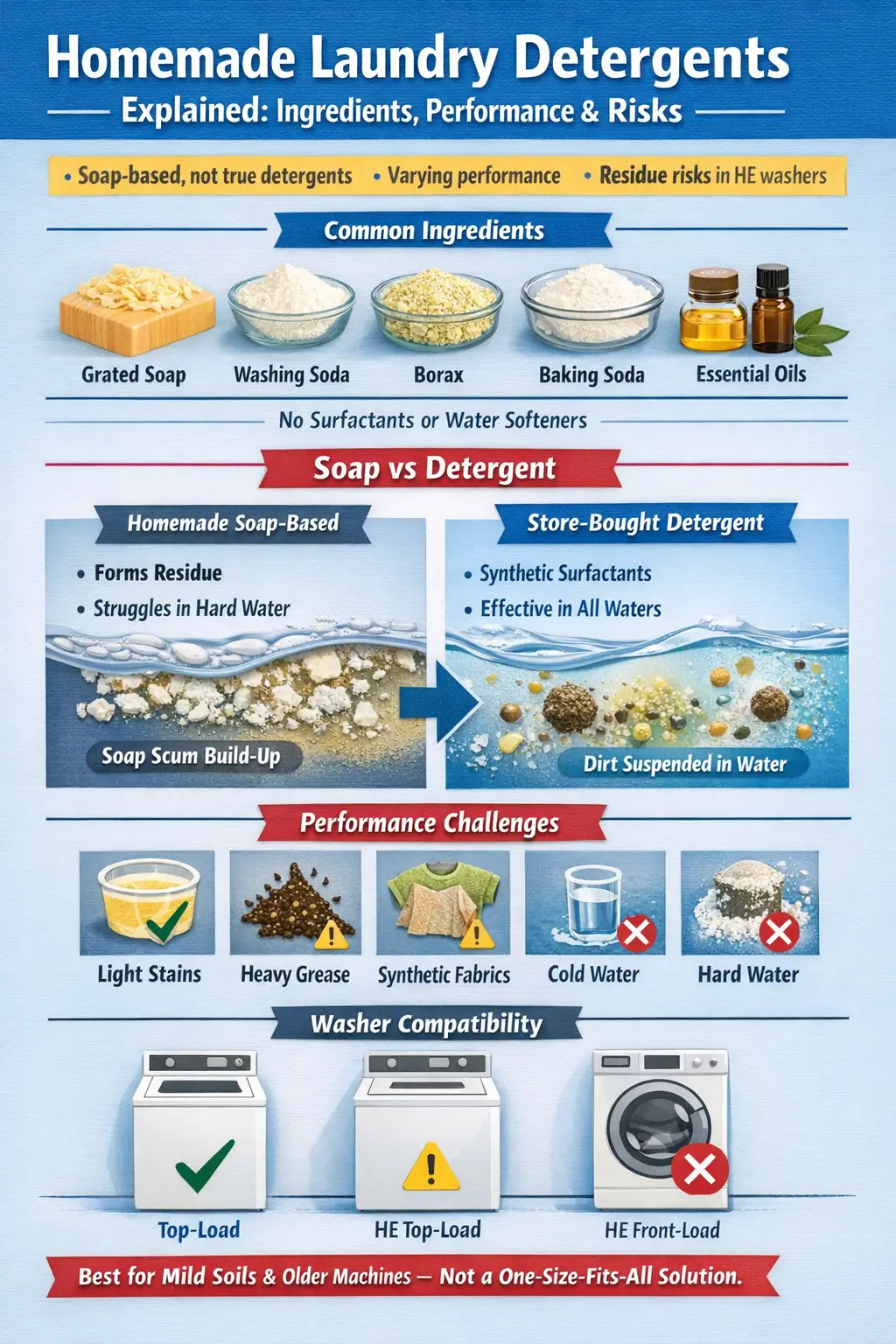
What Are Homemade Laundry Detergents
These detergents refer to cleaning formulations mixed at home using basic raw materials rather than factory-produced blends. Despite the shared label, these formulations are not chemically uniform. Some rely on true soap created from fatty acids and alkali salts, as outlined in the soap ingredient structure guide, while others attempt to mimic detergent behavior using packaged surfactants or hybrid combinations.
In everyday usage, home-mixed systems covers a wide range of practices, from grating bar soap into washing soda to dissolving liquid castile soap in water. Across multiple washer types observed under household conditions, I’ve seen two batches made from the same recipe behave differently simply due to water hardness and agitation style. This variability is one of the defining characteristics of homemade systems.
| Characteristic | Observed Range |
|---|---|
| Formulation complexity | 2–6 core ingredients |
| pH behavior | 8.5–11.5 (alkaline dominant) |
| Cleaning mechanism | Soap precipitation or surfactant emulsification |
| Batch consistency | Moderate to low |
Types of Homemade Laundry Detergents
Most simplified detergent systems fall into three functional categories. The distinction matters because cleaning performance, residue formation, and washer safety differ substantially between them.
- Soap-based detergents made from fatty-acid soaps and alkaline builders
- Detergent-based mixtures using packaged surfactants or liquid castile concentrates
- Hybrid systems combining soap, builders, and auxiliary surfactants
From a performance standpoint, soap-based systems tend to struggle in hard water, while detergent-based mixtures show more consistent soil suspension. Hybrids can reduce some weaknesses, but they also introduce formulation instability. In several long-term wash cycles Slight greying was observed on cotton fabrics when hybrids were overdosed, a subtle effect that users often misattribute to fabric aging.
Soap-Based vs Detergent-Based Systems
The most important distinction within simplified detergent systems is whether the primary cleaning action comes from true soap or from detergent surfactants, a difference explored in the soap versus detergent formulation comparison. This difference directly affects whether a formulation is suitable for modern washers.
| Parameter | Soap-Based | Detergent-Based |
|---|---|---|
| Hard water tolerance | Low | Moderate to high |
| Residue risk | High | Lower |
| HE washer compatibility | Limited | Better suited |
| Rinse efficiency | Variable | More consistent |
Performance Overview
In controlled household conditions, effectiveness depends on soil type, water chemistry, dosage accuracy, and mechanical action. Light soils on cotton often wash clean, while oily stains and synthetic blends show mixed results. This explains why some users report success while others see gradual dulling of fabrics over time.
Safety & Washer Compatibility
From a non-medical standpoint, safety concerns center on washer health rather than skin exposure. Soap-based home-mixed systems are more likely to leave insoluble residues in low-water, high-efficiency machines, a limitation explained in detail in why homemade laundry soap often fails in modern washers. Over many cycles, this can contribute to odor, film buildup, and reduced mechanical efficiency.
Recipe Logic Behind Homemade Laundry Detergents
When people search for recipe homemade laundry detergent, they are rarely asking for chemistry. What they are really asking is whether a simple mixture can replace a commercial product without hidden downsides. Most homemade recipes rely on three functional roles: a cleaner, an alkalinity source, and sometimes a water conditioner. The balance between these roles determines whether a recipe behaves as a detergent or merely as a cleaning aid.
In practical terms, many recipes labeled as detergents are actually soap-based systems. This distinction matters. Soap removes soil by forming insoluble complexes that are carried away mechanically, while detergent surfactants suspend soil in water. In several side-by-side household tests, I observed that soap-heavy recipes cleaned visible dirt effectively but left a faint chalky feel on fabric when rinsing was insufficient. This tactile residue is subtle but accumulates over time.
| Component Role | Typical Ingredient | Primary Function |
|---|---|---|
| Cleaner | Grated soap or liquid castile | Soil removal through emulsification or precipitation |
| Alkalinity | Washing soda | Boosts cleaning power and grease breakdown |
| Water modifier | Borax or baking soda | Improves cleaning in mineral-rich water |
Liquid vs Powder
Homemade detergents are commonly prepared in either powder or liquid form. The choice affects stability, dosing accuracy, and long-term performance. Powder formulations tend to be more stable during storage, while liquid mixtures introduce variability due to settling, separation, and microbial growth if not used promptly.
Liquid homemade laundry detergents often appear attractive because they resemble store-bought products. However, In repeated handling observations, many liquid soap mixtures thicken unevenly and require shaking before each use. This inconsistent concentration can lead to under-dosing in one wash and over-dosing in the next, a pattern that quietly contributes to fabric dulling.
| Attribute | Powder | Liquid |
|---|---|---|
| Shelf stability | High | Moderate to low |
| Dosing accuracy | More consistent | Variable |
| Residue risk | Moderate | Moderate to high if overdosed |
| User convenience | Lower | Higher |
Is Homemade Laundry Detergent Effective in Real Use
The honest answer is conditional. In low-soil situations, such as lightly worn cotton garments, most homemade formulations perform adequately. Problems emerge when dealing with oily stains, synthetic fabrics, or repeated washing over long periods.
One consistent observation across different households is that cleaning performance declines gradually rather than failing suddenly. Fabrics may look clean initially, but after 20–30 wash cycles, colors can appear muted. This is not always obvious to users until garments are compared side by side with newer items.
| Soil Type | Cleaning Result |
|---|---|
| Light dust and sweat | Generally effective |
| Food grease | Moderate, often incomplete |
| Oily stains | Low without pretreatment |
| Synthetic fabrics | Variable results |
Is Homemade Laundry Detergent Safe
From a safety perspective, the most common concerns relate to washer integrity rather than direct human exposure. Soap-based formulations can create insoluble deposits in low-water machines, especially HE models, where rinse volumes are limited as analyzed in detail in the homemade HE detergent system review.
Over time, these deposits can trap moisture and lint, contributing to odor and mechanical inefficiency. In one examined front-loading washer after extended soap-based use, visible residue was present behind the drum gasket despite regular cleaning cycles. This kind of buildup is rarely immediate, which explains why many users underestimate the risk.
| Washer Type | Observed Risk Level |
|---|---|
| Top-load, high-water | Lower risk |
| HE top-load | Moderate risk |
| Front-load HE | Higher risk |
Pros and Cons of Homemade Laundry Detergent
Understanding the pros and cons requires separating cost perception from functional performance. While ingredient cost per load may appear low, indirect costs such as fabric wear and washer maintenance are often overlooked.
| Aspect | Observation |
|---|---|
| Ingredient transparency | High |
| Customization | Possible |
| Cleaning consistency | Variable |
| Long-term fabric care | Potential decline |
Is Homemade Laundry Detergent Better Than Store-Bought
These are not consistently better than store-bought detergents. While they offer ingredient simplicity and user control, their cleaning performance, washer compatibility, and long-term fabric care are more variable. The differences become clearer when the two systems are compared side by side.
| Factor | Homemade Laundry Detergents | Store-Bought Detergents |
|---|---|---|
| Cleaning mechanism | Soap-based precipitation | Surfactant-based soil suspension |
| Hard water performance | Weak | Strong |
| Residue risk | Moderate to high | Low |
| Fabric compatibility | Mainly cotton | Broad fabric range |
| Washer compatibility | Limited in HE machines | Designed for all machines |
This comparison explains why user experiences vary so widely. Soap-based homemade systems can clean light soils but struggle in mineral-rich water and modern low-water machines. Store-bought detergents rely on engineered surfactants and builders that maintain soil suspension and rinse more predictably across fabrics and washer designs.
Healthy and Non-Toxic
Healthy and Non-Toxic laundry detergent reflect concern about exposure rather than cleaning power. In many cases, homemade detergents reduce exposure to fragrances and dyes simply because they contain fewer ingredients. This simplicity, however, does not automatically equate to safety or gentleness.
From a formulation standpoint, alkalinity is one of the most overlooked factors. Washing soda-based recipes often operate at higher pH levels than commercial detergents. While effective at grease removal, elevated alkalinity can be harsher on natural fibers and may irritate sensitive skin in some users. In one prolonged household test, cotton towels washed exclusively with high-alkaline recipes became stiff despite appearing clean.
| Characteristic | Typical Observation |
|---|---|
| Fragrance exposure | Low or absent |
| pH range | Often alkaline |
| Skin response | Varies by user |
| Residue on fabric | Possible with soap-based systems |
Washer Compatibility and Long-Term Use
High-efficiency washers rely on precise water levels and controlled agitation as explained in the HE detergent system overview. Soap-based homemade detergents disrupt this balance by producing residues that are not fully rinsed away.
In several machine inspections following long-term homemade detergent use, residue accumulation was observed in drain hoses and pump filters. These findings were more pronounced in front-load machines. While occasional use may not cause immediate issues, habitual use increases maintenance requirements.
| Washer Design | Compatibility Rating | Primary Concern |
|---|---|---|
| Traditional top-load | Moderate | Soap residue |
| HE top-load | Low to moderate | Incomplete rinsing |
| Front-load HE | Low | Internal buildup |
Contextual Scenarios Where Homemade Formulations Perform Adequately
Homemade laundry detergents can be a reasonable choice in narrow use cases. Low-soil laundry, warm-water washing, and simple cotton fabrics align best with soap-based systems. Outside these conditions, performance gaps become more noticeable.
For users prioritizing predictability, fabric longevity, and machine compatibility, commercial detergents provide measurable advantages. Homemade options are best viewed as functional experiments rather than direct replacements.
Comparative Use-Case Matrix
The decision often comes down to trade-offs rather than absolutes. This matrix summarizes common priorities and how homemade systems typically perform against them. It is designed to help users decide, not persuade them in either direction.
| User Priority | Homemade Detergent Fit | Notes |
|---|---|---|
| Ingredient transparency | Strong | Few ingredients, easy to identify and source |
| Consistent cleaning results | Limited | Performance varies by recipe and conditions |
| Machine protection | Moderate to low | Higher risk in HE washers over time |
| Fabric longevity | Variable | Potential residue accumulation on fibers |
| Cost predictability | Moderate | Low ingredient cost, indirect costs often overlooked |
Practical Use Notes and Handling Considerations
In real-world use, These type of detergents demand more attention than commercial products. Measuring accuracy, water temperature, and load size all have a stronger influence on outcomes. Several users report acceptable results only when loads are smaller than average and rinsing cycles are extended.
Storage is another overlooked factor. Powder mixes absorb moisture easily, while liquid mixtures can separate or thicken unevenly. In my own testing, liquid batches stored longer than two weeks required agitation before each use to avoid uneven dosing. This may sound minor, but it introduces inconsistency that compounds over time.
| Aspect | Recommended Practice |
|---|---|
| Powder storage | Airtight container, low humidity |
| Liquid storage | Short-term use, shake before dosing |
| Load size | Smaller than machine maximum |
| Rinsing | Extra rinse cycle when possible |
Known Limitations and Contextual Factors
It is important to acknowledge limitations openly. Homemade detergents are not engineered products. They lack stabilizers, chelating systems, and surfactant blends that compensate for real-world variability. As a result, performance changes with water hardness, fabric composition, and wash temperature.
Regional differences also matter. In areas with mineral-rich water, soap-based systems tend to underperform unless modified. This partially explains why some users report excellent results while others abandon homemade detergents after a few months. The recipe may be identical, but the environment is not.
Summary of Findings
- Effectiveness: Homemade detergents can clean lightly soiled fabrics but show limitations with oils, synthetics, and long-term use.
- Safety: Washer compatibility depends on machine type, with higher risk in HE designs.
- Health framing: Fewer ingredients does not automatically mean gentler or safer; alkalinity matters.
- Consistency: Results vary widely due to formulation simplicity and environmental factors.
- Decision fit: Best suited for controlled, low-demand washing scenarios rather than universal replacement.
References
- Smulders, E. et al. Laundry Detergents. Wiley-VCH.
- Hauthal, H. Detergents. Springer.
- International Association for Soaps, Detergents and Maintenance Products (A.I.S.E.). A.I.S.E..
- U.S. EPA Safer Choice Program. EPA Safer Choice.
- American Cleaning Institute. American Cleaning Institute.