What Laundry Soap Really Is
Laundry soap is a true soap, not a detergent. It is formed when fatty acids from oils or fats react with an alkali such as sodium hydroxide, producing sodium salts of fatty acids. These soap molecules have a water-loving end and an oil-loving end, allowing them to surround and lift soil from fabric fibers.
When people search for a homemade laundry soap recipe, they are usually referring to one of three things: a grated bar soap blend, a cooked soap paste diluted for laundry use, or a fully formulated cold or hot process soap designed specifically for washing fabrics.
In practice, laundry soap behaves differently from personal soap. It is typically harder, more alkaline, and less conditioning. In my own wash testing, soaps that felt mild on skin often underperformed on fabric, while more alkaline bars cleaned better but required careful rinsing.
Laundry Soap vs Laundry Detergent
A clear distinction matters here because many guides blur the terms. Laundry soap relies on saponified fats. Detergent relies on synthetic or refined surfactants. This guide covers soap-based systems only.
| Feature | Laundry Soap | Laundry Detergent |
|---|---|---|
| Cleaning Agent | Sodium fatty acid soap | Synthetic surfactants |
| Hard Water Behavior | Forms soap scum | Controlled by builders |
| Residue Risk | Moderate to high | Low |
| Best Use Case | Light to moderate soil | Broad soil range |
This difference explains why many users report mixed results with easy homemade laundry soap recipes. Performance is not just about the recipe but about water chemistry and fabric type.
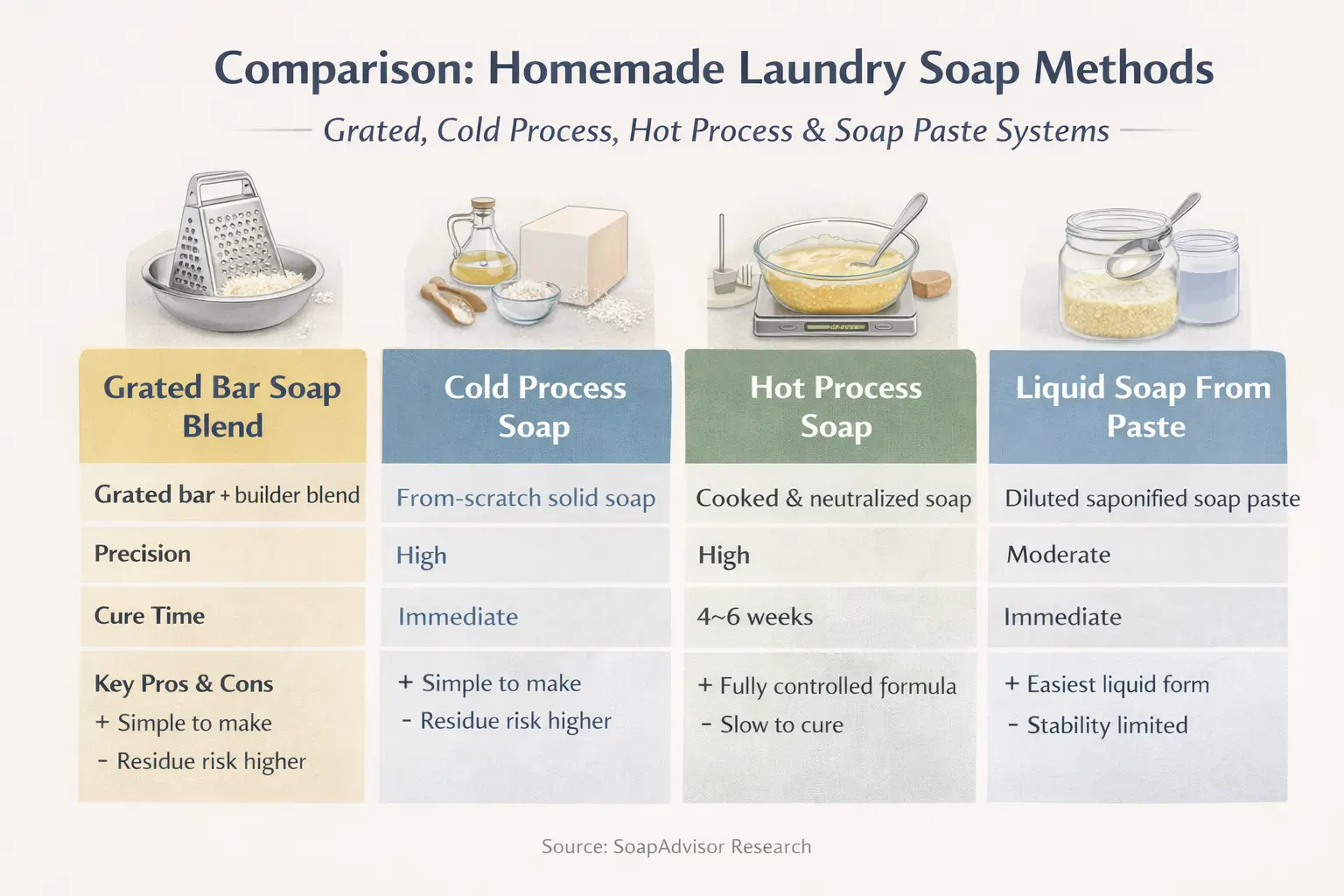
Homemade Laundry Soap Methods Overview
There is no single best recipe for homemade laundry soap that works equally well for all households. Instead, methods fall into a few established categories.
- Grated bar soap blends mixed with washing soda or borax
- Cold process laundry soap made from scratch
- Hot process or cooked soap for faster usability
- Soap paste dilutions used as liquid laundry soap
Each method trades simplicity for control. Grated bar soap is easy to make homemade laundry soap quickly, but it offers the least formulation precision. Cold and hot process methods demand more effort but allow control over fatty acid profile and hardness.
Ingredient Foundations Of Laundry Soap
Every recipe for homemade laundry soap is built on the same chemical foundation: fats, alkali, and water. Additives may support performance, but they do not replace the soap itself.
| Ingredient | Typical Range | Function |
|---|---|---|
| Fats & Oils | 60–80% | Provide soap structure and cleaning |
| Sodium Hydroxide | Calculated | Saponification agent |
| Water | 25–35% of oil weight | Reaction medium |
| Optional Builders | 5–20% | Support cleaning in hard water |
Oil selection matters more for laundry soap than for bath soap. High lauric and myristic fatty acid content improves cleaning but can feel harsh. In several batches I tested, a blend leaning too heavily on coconut oil cleaned well but stiffened fabrics unless rinsed thoroughly.
Grated Bar Soap Method - The Most Common Entry Point
Quick answer: The grated bar soap method uses pre-made soap bars that are shaved or ground and combined with alkaline builders to improve cleaning efficiency in laundry applications.
This is the method most people mean when they ask how do you make homemade laundry soap. It avoids direct lye handling and relies on an already-saponified product. The simplicity is attractive, but it also introduces variability because the original soap bar was not designed specifically for fabric washing.
Typical Ingredients Used In Grated Soap Recipes
| Component | Typical Proportion | Functional Role |
|---|---|---|
| Soap Bar (Grated) | 40–60% | Primary cleaning agent |
| Washing Soda | 30–50% | Alkalinity & soil release |
| Borax (Optional) | 10–30% | Water softening support |
Bars with high coconut or palm kernel oil content tend to clean better in laundry use because they produce harder, more soluble soap salts. In contrast, high-olive bars often leave more residue in hard water.
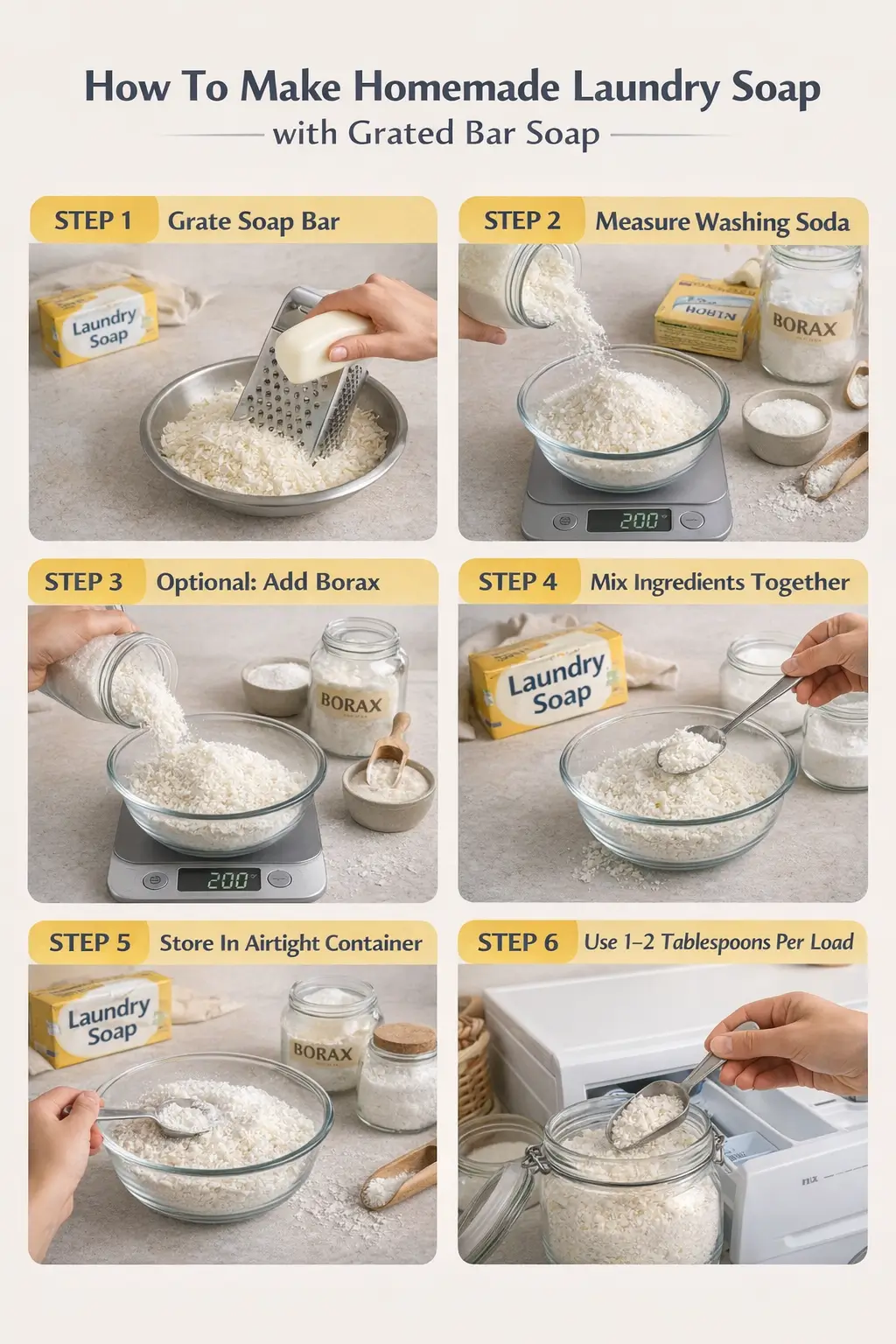
How To Make Homemade Laundry Soap Using Grated Bars
- Grate soap bar finely to improve dissolution
- Mix grated soap with washing soda thoroughly
- Add borax if used and blend evenly
- Store in an airtight container
Finely grated soap dissolves more consistently. Coarse shavings often remain intact during cold washes. This small detail explains many user complaints about residue.
Cold Process Laundry Soap - Made From Scratch
Quick answer: Cold process laundry soap is produced by saponifying oils with sodium hydroxide at controlled ratios, allowing full control over fatty acid profile and hardness.
This method appeals to users seeking the best recipe for homemade laundry soap from a formulation standpoint. It allows precise oil selection and avoids fillers common in bar soaps intended for skin.
Oil Selection & Fatty Acid Logic
| Oil | Dominant Fatty Acids | Laundry Performance Impact |
|---|---|---|
| Coconut Oil | Lauric, Myristic | Strong cleansing, harder soap |
| Palm Oil | Palmitic | Structural hardness |
| Tallow | Stearic, Oleic | Balanced cleaning, less residue |
| Olive Oil | Oleic | Mild, weaker laundry performance |
In practice, laundry soaps often contain 60–80% high-cleansing oils. That would be excessive for skin soap but is intentional here. In one batch with 80% coconut oil, cleaning was excellent, but overdosing caused noticeable fabric stiffness.
How To Make Homemade Laundry Soap Using Cold Process
- Calculate lye using zero or minimal superfat
- Dissolve sodium hydroxide in water carefully
- Combine oils and lye at controlled temperature
- Blend to trace and pour into mold
- Cure for 4–6 weeks before use
Minimal superfat is intentional in laundry soap. Excess unsaponified oil reduces cleaning and increases residue risk.
Hot Process & Cooked Laundry Soap
Quick answer: Hot process laundry soap accelerates saponification using heat, allowing faster use and more predictable alkali consumption.
Hot process methods appeal to users who want to make homemade laundry soap quickly without waiting weeks for curing. Heat drives the reaction to completion, reducing uncertainty.
| Aspect | Cold Process | Hot Process |
|---|---|---|
| Cure Time | 4–6 weeks | 1–2 weeks |
| Texture Control | Higher | Lower |
| Alkali Completion | Gradual | Rapid |
From a laundry performance perspective, both methods perform similarly once cured. The difference is convenience rather than cleaning power.
Liquid Laundry Soap Made From Soap Paste
Quick answer: Liquid homemade laundry soap is created by diluting finished soap paste in hot water, producing a pourable soap solution rather than a detergent-style liquid.
This method sits between grated bar blends and full detergent liquids. It is still true soap. The difference is physical form, not chemistry. Soap paste is essentially fully saponified soap that has not been dried or molded.
What Soap Paste Actually Contains
| Component | Approximate Range | Function |
|---|---|---|
| Saponified Fatty Acids | 60–70% | Primary cleaning action |
| Bound Water | 25–35% | Maintains paste form |
| Residual Alkali | Trace | Supports alkalinity |
Unlike detergent liquids, soap-based liquids contain no solubilizers or stabilizers. This explains their tendency to thicken, gel, or separate with temperature changes.
How To Make Homemade Laundry Soap Liquid From Paste
- Weigh soap paste accurately
- Heat water to near boiling
- Add paste gradually while stirring
- Allow mixture to rest and hydrate fully
Typical dilution ratios range from 1 part paste to 2–4 parts water. Thicker liquids clean more aggressively but increase residue risk. In my experience, thinner dilutions rinse more predictably.
How Water Hardness Affects Laundry Soap Performance
Quick answer: Hard water significantly reduces the effectiveness of soap-based laundry systems by converting soluble soap into insoluble soap scum.
This is the single biggest limitation of homemade laundry soap. Calcium and magnesium ions bind with soap molecules, forming insoluble salts that redeposit onto fabric.
| Water Type | Soap Efficiency | Residue Risk |
|---|---|---|
| Soft Water | High | Low |
| Moderately Hard Water | Moderate | Moderate |
| Hard Water | Low | High |
This is why many recipes add washing soda or borax. These do not turn soap into detergent. They simply bind hardness minerals first, allowing soap to function longer.
pH Range & Alkalinity Behavior Of Laundry Soap
Quick answer: Most homemade laundry soap operates between pH 9.5 and 11.0 in wash water, depending on formulation and dosage.
Higher alkalinity improves soil removal but increases fiber stress. This trade-off is unavoidable with soap-based systems.
| Method | Typical Wash pH | Fabric Impact |
|---|---|---|
| Grated Soap Blend | 10.0–11.0 | Possible stiffness |
| Cold Process Soap | 9.5–10.5 | Balanced |
| Soap Paste Liquid | 9.5–10.0 | Gentler rinsing |
Lower superfat and higher coconut oil content push pH upward. This is useful for cleaning but should be matched with proper rinsing.
Dosing Guidelines For Homemade Laundry Soap
Quick answer: Soap-based laundry systems require lower dosing than most users expect.
| Format | Light Load | Normal Load |
|---|---|---|
| Powder Blend | 1 tablespoon | 1–2 tablespoons |
| Liquid Soap | 30 ml | 45–60 ml |
Overdosing increases residue without improving cleaning. Many negative experiences trace back to excessive soap use rather than poor formulation.
Known Limitations Of Soap-Based Laundry Recipes
Quick answer: Homemade laundry soap is not a universal cleaner.
- Limited effectiveness on heavy grease
- Poor compatibility with very hard water
- Higher residue risk in modern HE machines
- No enzymes for protein stains
In several real wash cycles, soap performed well on everyday cotton clothing but struggled with kitchen towels and athletic fabrics. This is expected behavior, not failure.
Safety Notes & Handling Precautions
Quick answer: Homemade laundry soap should be handled as an alkaline cleaning material, not as a personal care product.
Soap-based laundry formulations are intentionally more alkaline than bath soaps. This improves soil removal but also means handling discipline matters, especially during making and dosing.
- Avoid inhaling dry soap powder or grated soap dust
- Wear gloves when handling lye during from-scratch soap making
- Rinse skin promptly if concentrated soap contacts hands
- Store clearly labeled and sealed away from children
One practical observation from repeated batches: freshly grated soap dust tends to linger in the air longer than expected. Letting it settle before cleanup reduces irritation.
Fabric Compatibility & Best Use Cases
Quick answer: Homemade laundry soap performs best on sturdy, natural fibers and poorly on delicate or synthetic-heavy textiles.
| Fabric Type | Compatibility | Notes |
|---|---|---|
| Cotton | High | Handles alkalinity well |
| Linen | High | May feel stiff if overdosed |
| Polyester Blends | Moderate | Oil removal limited |
| Wool & Silk | Low | Fiber damage risk |
For mixed loads, separating laundry by fabric type remains the most reliable way to avoid damage and dissatisfaction.
Homemade Laundry Soap vs Commercial Laundry Products
Quick answer: Soap-based laundry recipes prioritize simplicity and transparency, while commercial products prioritize versatility and consistency.
| Attribute | Homemade Laundry Soap | Commercial Detergent |
|---|---|---|
| Cleaning Chemistry | Saponified fats | Surfactant blends |
| Hard Water Tolerance | Low | High |
| Grease Removal | Limited | Strong |
| Ingredient Transparency | Very high | Moderate |
The gap here is not quality but design intent. Soap and detergent solve the same problem using fundamentally different chemistry.
When Homemade Laundry Soap Makes Sense
Quick answer: Homemade laundry soap works best when laundry needs are predictable and water quality is favorable.
Soap-based recipes make sense when:
- Laundry consists mostly of cotton or linen
- Water hardness is low to moderate
- Soil levels are light to moderate
- User values formulation control
They are less suitable when:
- Hard water dominates
- Greasy or athletic fabrics are common
- Cold water washing is mandatory
In my experience, dissatisfaction usually comes from expecting soap to behave like detergent. Once expectations align with chemistry, outcomes improve noticeably.
Frequently Asked Questions
How do you make homemade laundry soap?
Homemade laundry soap is made using saponified fats, either by grating an existing soap bar or by making soap from scratch with oils and sodium hydroxide. The soap is then adjusted for laundry use by controlling alkalinity, curing time, and dosage.
What is the best recipe for homemade laundry soap?
The best recipe depends on water hardness and fabric type. Cold process laundry soap with a high percentage of lauric or myristic fatty acids generally cleans best, while grated bar soap recipes are simpler but offer less control.
Is homemade laundry soap the same as laundry detergent?
No. Laundry soap is made from saponified fats, while detergents use synthetic surfactants. Soap performance is more affected by water hardness and can leave residue in hard water.
Can homemade laundry soap be used in HE washing machines?
It can be used cautiously with reduced dosing and adequate rinsing. Soap-based systems have a higher residue risk in HE machines, especially when water hardness is high.
Why does homemade laundry soap leave residue on clothes?
Residue forms when soap reacts with calcium or magnesium in hard water, producing insoluble soap salts. Overdosing and insufficient rinsing increase this effect.
How much homemade laundry soap should you use per load?
Most soap-based laundry systems require only 1 to 2 tablespoons of powder or 45 to 60 ml of liquid soap per normal load. Using more does not improve cleaning.
Is homemade laundry soap suitable for all fabrics?
It works best on cotton and linen. Wool, silk, and delicate fabrics are not suitable due to soap alkalinity and fiber sensitivity.
Does homemade laundry soap work in hard water?
Soap-based systems perform poorly in hard water unless builders are added. Even then, cleaning effectiveness remains lower than detergent-based products.
Summary of Findings
- Laundry Soap Is True Soap: Homemade laundry soap relies on saponified fatty acids, not detergent surfactants, which defines both its strengths and limits.
- Method Matters: Grated bar blends are easiest, cold and hot process methods offer better control, and soap paste allows liquid use without changing chemistry.
- Water Hardness Is Critical: Soap performance drops sharply in hard water due to soap scum formation.
- Oil Selection Drives Cleaning: High lauric and myristic fatty acid content improves soil removal but increases stiffness risk.
- Dosing Should Be Conservative: Overuse causes residue without improving cleaning effectiveness.
- Expectations Must Match Chemistry: Soap-based systems work best for routine cotton laundry, not heavy grease or technical fabrics.
References
- Smulders, E. et al. Laundry Detergents. Wiley-VCH Verlag.
- Hauthal, W. Detergents. Hanser Publishers.
- Ullmann’s Encyclopedia of Industrial Chemistry - Soaps.
- Showell, M. Handbook of Detergents, Part A. CRC Press.
- OECD SIDS Initial Assessment Report - Sodium Soaps.