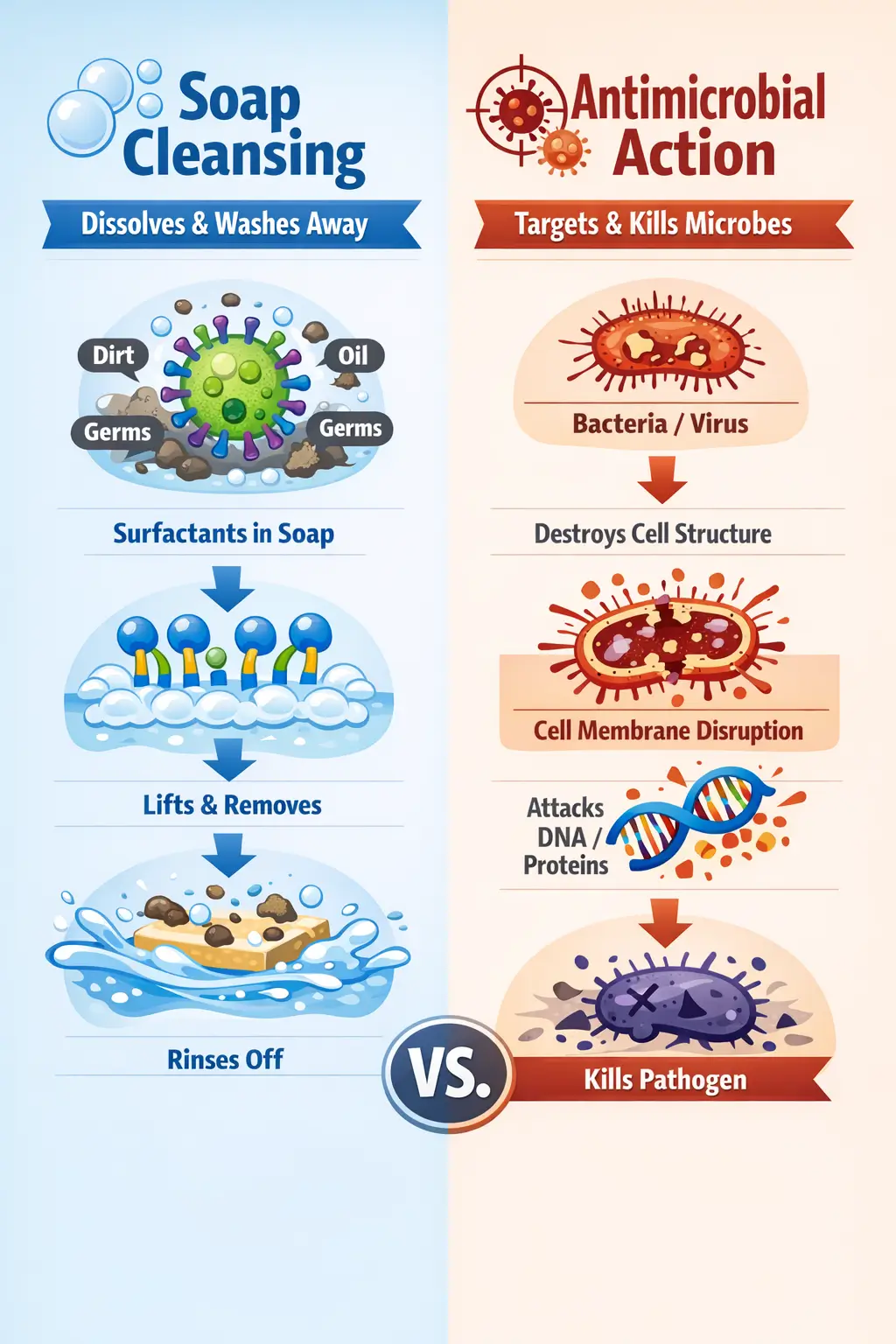
Cleansing Is A Physical Removal Process, Not A Killing Process
In everyday retail language, especially on supermarket shelves, it is common to see phrases such as "kills 99.9 percent of bacteria" placed visually near ordinary hand soaps. The assumption that follows is simple: soap works by killing microbes. Mechanistically, this is incomplete.
Traditional soap, composed of sodium or potassium salts of fatty acids, functions as a surfactant. Surfactants reduce surface tension and form micelles that trap oils and debris. Microorganisms present on the skin surface are incorporated into this removable layer and washed away during rinsing. The dominant process is displacement and removal.
This distinction matters because removal does not require microbial lethality. The physical act of washing, combined with surfactant chemistry and water flow, reduces surface load. It does not automatically imply chemical inactivation.
| Aspect | Cleansing | Antimicrobial Action |
|---|---|---|
| Primary Mechanism | Surfactant based removal through emulsification and rinsing | Chemical interaction with microorganisms |
| Requires Active Biocidal Substance | No | Yes, when claims are made |
| Regulatory Category In EU | Cosmetic product when intended for cleaning skin | May fall under Biocidal Products Regulation depending on claims |
The practical outcome in daily use may feel similar to consumers. Hands feel clean. Foam is present. Rinsing occurs. Yet the chemical pathway differs.
Antimicrobial Claims Depend On Substance And Intention
When a product uses terms such as "antibacterial" or "antimicrobial," it signals that a specific ingredient is included for its biocidal function. In European markets, such ingredients may include substances regulated under the Biocidal Products Regulation rather than solely under the Cosmetics Regulation.
The presence of ethanol in a hand gel, for example, changes both classification and expectations. Alcohol based products intended to disinfect hands are typically regulated differently from ordinary cosmetic hand washes. The difference lies not only in formula but in stated intention.
This distinction between functional intention and ingredient origin is also explored in our analysis of natural versus synthetic ingredient terminology, where classification language is often mistaken for performance or safety evaluation.
A common misunderstanding occurs when consumers interpret all soaps as disinfectants. Most cosmetic hand soaps are not positioned or regulated as disinfectants. Their function is cleansing. That distinction may not be immediately visible when packaging uses overlapping visual cues such as laboratory imagery or shield icons.
Ingredient Lists Do Not Automatically Reveal Claim Category
A long ingredient list does not necessarily indicate antimicrobial purpose. Consumers often scan for specific names such as benzalkonium chloride or chlorhexidine, assuming that their presence alone defines product strength or superiority. The regulatory status depends on intended use and labeling claims, not only on chemical presence.
On an EU compliant cosmetic label, ingredients are listed according to INCI naming conventions. These names communicate composition, not marketing claims. The claim appears elsewhere on the packaging and must align with regulatory requirements.
Under Regulation (EC) No 1223/2009, Article 19 requires cosmetic products to list ingredients using standardized nomenclature (INCI) in descending order of weight at the time of incorporation. This obligation governs disclosure format and ingredient transparency. It does not, however, determine whether a product qualifies as antimicrobial. Classification depends on intended purpose and claims rather than ingredient listing alone.
Encountering a product labeled simply as "hand wash" without explicit antimicrobial wording typically signals cosmetic classification. Encountering explicit bactericidal language suggests a different regulatory pathway. The label hierarchy often clarifies this, though it may require careful reading beyond the front panel.
EU Regulatory Context Shapes The Distinction
In the European Union, cosmetic products are governed by Regulation (EC) No 1223/2009. Products intended to control harmful organisms fall under Regulation (EU) No 528/2012, known as the Biocidal Products Regulation. The intended purpose determines classification.
A hand soap marketed for routine cleansing typically remains within cosmetic scope. A product marketed for disinfecting surfaces or eliminating pathogens may require separate authorization pathways. This regulatory boundary influences wording, testing requirements, and permissible claims.
The boundary is not always visually obvious to consumers standing in a pharmacy aisle. Packaging design can blur functional categories. The legal framework, however, draws clearer lines.
A structured overview of how ingredient purpose, regulatory classification, and disclosure systems interact is outlined in the Ingredient Framework, which explains how functional categories are interpreted across cosmetic and non-cosmetic products.
What This Article Does Not Decide
This discussion does not attempt to determine which approach is more effective in specific real world scenarios. It does not evaluate product performance or clinical outcomes. It does not assess safety or suitability for individual users.
Real world effectiveness depends on contact time, concentration, rinsing technique, and environmental conditions. Those variables extend beyond label wording alone.
The purpose here is interpretive clarity. Understanding what cleansing means, and what antimicrobial means, prevents conceptual confusion. It does not resolve every situational question.
Summary of Findings
- Cleansing: Primarily refers to surfactant driven removal of soil and microorganisms through rinsing.
- Antimicrobial Action: Refers to chemical interaction with microorganisms and depends on specific active substances and claims.
- EU Regulation: Cosmetics and biocidal products are governed by distinct regulatory frameworks based on intended purpose.
- Label Reading: Ingredient lists describe composition, while claims determine regulatory category.
For a related explanation of how functional ingredients appear on labels without automatically signaling performance claims, see our discussion on why preservatives exist in formulated products. Similar interpretive limits apply when reading antimicrobial terminology.
Regulatory References & Legal Framework
| Regulation / Instrument | Authority | Specific Relevance To This Article | Official Source |
|---|---|---|---|
| Regulation (EC) No 1223/2009 – Article 19 | European Parliament & Council | Establishes mandatory ingredient listing requirements (INCI), governing how cosmetic products disclose composition. | EUR-Lex Consolidated Text |
| Regulation (EU) No 655/2013 | European Commission | Establishes common criteria for cosmetic claims, including requirements that marketing communication must not mislead regarding product characteristics. | EUR-Lex Claims Regulation |
| Regulation (EU) No 528/2012 | European Parliament & Council | Governs products making antimicrobial or biocidal claims. Determines classification when intended purpose extends beyond cleansing. | EUR-Lex Biocidal Products Regulation |