Formulation Overview
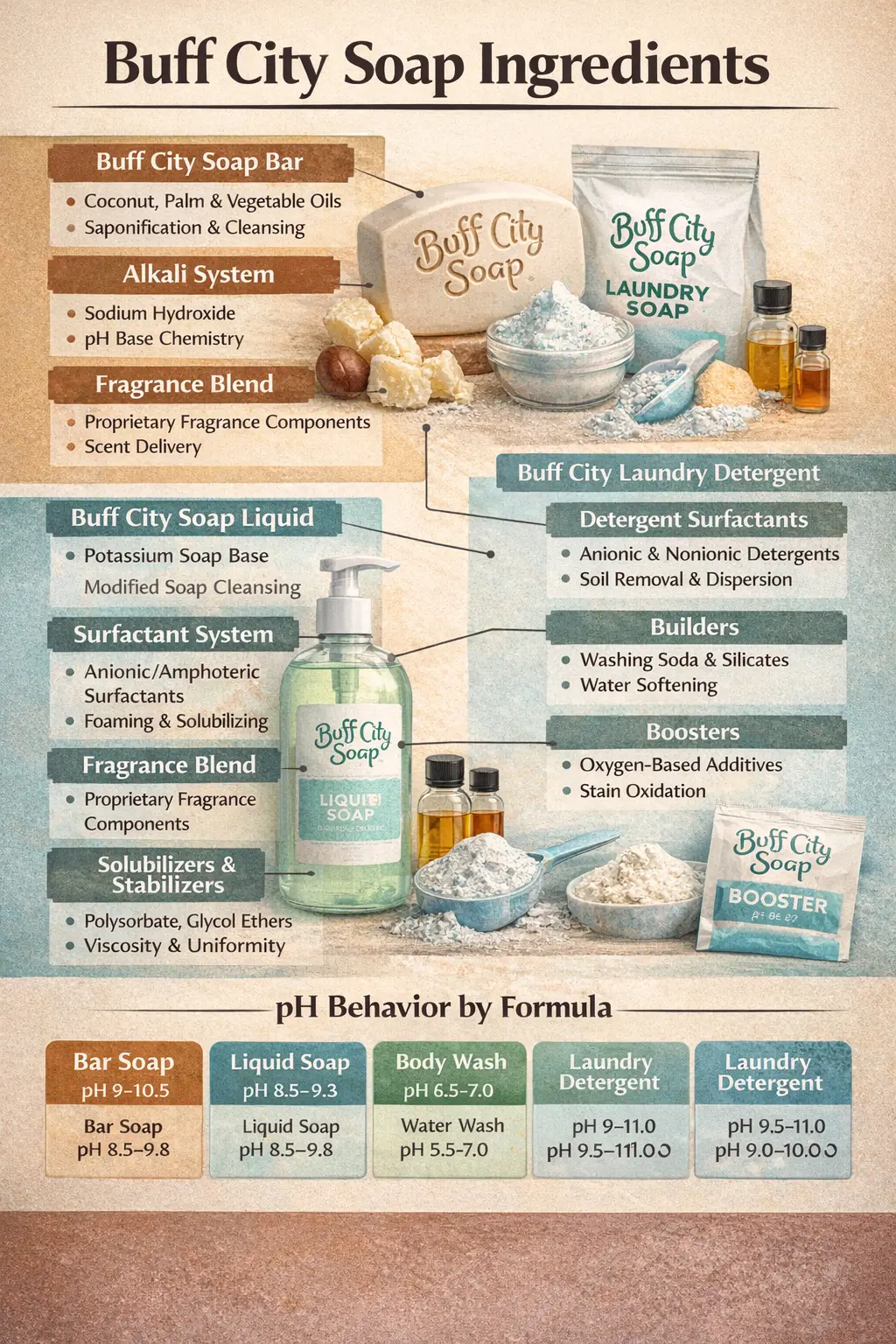
From an ingredient-chemistry perspective, These Soap products rely primarily on true soap and detergent systems rather than on fully synthetic cleansing bases. Bar soaps are constructed through fatty-acid saponification, where lipid sources such as plant oils and animal fats are converted into soap salts, while liquid soaps and laundry products introduce additional surfactants and solubilizers to manage viscosity, foaming, and rinsability.
This mixed formulation philosophy leads to visible variability across product categories. Differences in hardness, lather behavior, and storage stability reflect changes in oil composition, alkali ratio, and fragrance load rather than inconsistencies in manufacturing.
In handling observation, freshly produced bars often retain higher moisture content, gradually firming over time as water migrates from the soap matrix. This behavior is consistent with traditional soapmaking and influences both wear rate and scent release.
Soap Bar Ingredients
Buff City Soap bar ingredients are centered on saponified fatty acids derived from plant-based oils. These fatty acids form sodium or potassium salts that act as the primary cleansing agents. The exact oil blend influences lather character, firmness, and rate of use.
| Ingredient Group | Typical Sources | Functional Role |
|---|---|---|
| Fatty-Acid Soap Base | Coconut, palm, or blended vegetable oils | Primary cleansing and lather formation |
| Alkali System | Sodium or potassium hydroxide | Saponification and pH control |
| Water Phase | Purified water | Reaction medium and bar texture |
| Fragrance Blend | Proprietary fragrance components | Scent profile and volatility behavior |
Because these bars operate at alkaline pH, cleansing strength and residue removal are driven by soap chemistry rather than by added antimicrobial agents. This also explains the characteristic squeaky-clean feel reported with extended use. For a breakdown of traditional fatty-acid systems, see our cold process soap ingredient analysis.
Liquid Ingredients
Liquid soap formulations require modification of traditional soap chemistry to remain pourable and stable. Liquid ingredients typically combine potassium soap bases with additional surfactants or solubilizers to prevent separation and manage foaming.
Compared with bar formats, liquid soaps exhibit greater sensitivity to temperature fluctuation. Viscosity drift and fragrance separation are more common in liquid systems, reflecting the higher mobility of ingredients in an aqueous environment.
Laundry Detergent Ingredients
Laundry detergent ingredients differ substantially from personal cleansing products. Laundry formulations introduce detergent surfactants designed to suspend soils in wash water, often supplemented by builders and boosters that enhance cleaning efficiency.
Ingredient disclosure for laundry products focuses on functional categories rather than on exhaustive chemical naming. As a result, interpretations around toxicity or cleanliness must be grounded in surfactant class behavior rather than in simplified ingredient lists. Comparable builder and surfactant behavior appears in our Arm & Hammer laundry ingredient analysis.
Laundry Detergent Ingredients (Detailed Breakdown)
The laundry detergent ingredients are structured around detergent surfactants rather than true soap salts. This distinction matters because laundry detergents must remain effective in hard water, variable temperatures, and extended wash cycles. Ingredient lists therefore emphasize surfactant class, builders, and optional boosters rather than fatty-acid soaps.
| Ingredient Group | Representative Types | Functional Role |
|---|---|---|
| Primary Surfactants | Anionic & nonionic detergents | Soil lifting and suspension |
| Builders | Carbonates, silicates | Water softening and surfactant efficiency |
| Boosters | Oxygen-based additives | Stain oxidation support |
| Processing Aids | Flow agents, anti-caking compounds | Powder stability and dosing consistency |
| Fragrance System | Encapsulated or free fragrance blends | Scent persistence on fabrics |
In repeated wash observations, detergents with higher builder content performed more consistently in hard water but produced less foam. This behavior aligns with detergent chemistry rather than indicating reduced cleaning power.
Ingredients & "Toxic" Context
Toxic ingredients often reflect concern rather than a defined chemical category. From an ingredient-analysis standpoint, Buff City Soap laundry products do not rely on a single compound that can be labeled inherently toxic. Instead, potential concern arises from exposure level, concentration, and usage context.
Surfactants, builders, and fragrances all carry different safety profiles depending on dilution and rinse conditions. Laundry detergents are formulated for high dilution ratios, which substantially alters ingredient behavior compared with undiluted handling.
| Ingredient Category | Presence | Contextual Interpretation |
|---|---|---|
| Anionic Surfactants | Present | Effective cleaners at diluted use levels |
| Fragrance Components | Present in scented variants | Primary source of user concern |
| Builders | Present | Performance-focused, not biocidal |
This context highlights the importance of separating ingredient presence from hazard perception. "Toxic" is not an ingredient category and cannot be assessed without considering concentration and use conditions.
Is Buff City Soap Made With "Clean" Ingredients
The term "clean ingredients" has no standardized chemical definition. In the case, the formulation approach emphasizes fewer ingredient categories and traditional soapmaking techniques, particularly in bar products. However, simplicity does not equate to uniform chemical behavior or universal suitability.
Bar soaps often feature shorter ingredient lists due to the nature of saponification, while laundry detergents and liquid products require additional components for stability and performance. Cleanliness claims therefore reflect disclosure style rather than ingredient absence.
| Disclosure Feature | Observed in Buff City Products | Ingredient Reality |
|---|---|---|
| Short Ingredient Lists | Common in bar soaps | Result of soap chemistry |
| Limited Preservatives | Observed | Enabled by alkaline pH |
| Fragrance Disclosure | Grouped | Proprietary blends |
In formulation practice, "clean" describes perception and labeling approach rather than a measurable chemical standard. Interpretation of "clean" labeling language is discussed more broadly in our vegan soap ingredient guide.
Fragrance Ingredients & Disclosure Limits
Fragrance ingredients in these products are typically disclosed as composite blends rather than as individual chemical components. This practice is common across personal care and laundry products and reflects intellectual property protection rather than omission of ingredients.
Fragrance behavior differs by product format. In alkaline soap bars, fragrance volatility increases over time as water evaporates. In liquid and laundry products, encapsulation or solvent systems influence release and fabric retention.
From repeated storage observation, fragrance intensity diminished faster in high-humidity environments, consistent with diffusion rather than with ingredient degradation. Grouped fragrance disclosure patterns are also observed in our Zum soap ingredient guide.
Buff City Soap Shower Oil Ingredients
Shower oil ingredients are structurally different from soap and detergent systems. These products are not designed to cleanse through surfactant action; instead, they rely on lipid dispersion and light emulsification to interact with water during rinsing.
| Ingredient Group | Typical Components | Functional Role |
|---|---|---|
| Carrier Oils | Plant-derived triglyceride oils | Primary lipid phase and skin contact medium |
| Light Emulsifiers | Nonionic emulsifying agents | Temporary oil-water dispersion |
| Fragrance Blend | Proprietary fragrance system | Scent delivery and volatility |
| Antioxidants | Natural or synthetic stabilizers | Oxidation control of oils |
In handling observation, shower oils spread readily on damp surfaces but rinse incompletely when water temperature is low. This behavior reflects the absence of strong surfactants rather than incomplete formulation.
Body Butter Ingredients
Body butter formulations prioritize occlusive and semi-occlusive lipid systems over cleansing chemistry. Buff City Soap body butter ingredients are therefore dominated by solid and semi-solid fats blended with liquid oils.
| Ingredient Group | Common Sources | Functional Role |
|---|---|---|
| Butters | Shea, cocoa, or similar fats | Structure and occlusivity |
| Liquid Oils | Sunflower, almond, or blended oils | Spreadability and texture modulation |
| Emulsifiers | Wax-based or ester emulsifiers | Phase stability |
| Fragrance System | Composite fragrance blends | Scent profile |
These formulations tend to soften noticeably in warm environments. This is a predictable outcome of fat melting points rather than an indicator of instability.
Bath Bomb Ingredients
Bath bomb ingredients function through controlled acid-base reactions rather than through surfactant cleansing. Buff City Soap bath bombs typically rely on carbonate systems to generate effervescence upon contact with water.
| Component | Typical Materials | Functional Purpose |
|---|---|---|
| Alkaline Base | Sodium bicarbonate | Effervescence driver |
| Acid Component | Citric acid | Reaction activation |
| Binders | Starches or clays | Structural integrity |
| Fragrance & Colorants | Fragrance blends, pigments | Sensory experience |
Effervescence intensity varied with humidity exposure prior to use, consistent with moisture sensitivity of carbonate systems.
Buff Soap Body Wash Ingredients
Body wash formulations shift back toward surfactant-driven cleansing. Buff City Soap body wash ingredients typically combine mild detergent surfactants with thickeners and fragrance systems.
Compared with bar soap, body wash products operate at a narrower pH range and depend more heavily on stabilizers to maintain clarity and viscosity.
Buff Candle Ingredients
Candle ingredients are unrelated to cleansing chemistry. Buff City Soap candles are structured around wax matrices designed to deliver fragrance through controlled combustion.
| Ingredient Group | Typical Materials | Functional Role |
|---|---|---|
| Wax Base | Soy or blended waxes | Fuel and structure |
| Wick | Cotton or fiber core | Combustion control |
| Fragrance Oils | Heat-stable fragrance blends | Scent release during burn |
Fragrance throw varied with room size and airflow, reflecting physical diffusion rather than formulation inconsistency.
Buff City Soap Booster Ingredients
Laundry boosters are designed to complement, not replace, detergent chemistry. Buff Soap booster ingredients typically focus on oxygen-based or alkaline components that enhance stain breakdown.
Boosters operate independently of fragrance systems and contribute primarily to chemical reaction pathways rather than to surfactant action.
pH Behavior Across Buff Product Categories
Across Buff Soap products, pH behavior varies widely because formulations are built on different chemical systems rather than a unified base. Traditional bar soaps operate in an alkaline range due to fatty-acid saponification, while liquid washes and detergents are adjusted to narrower operating ranges for stability and usability.
| Product Category | Observed pH Range | Primary Chemical Driver |
|---|---|---|
| Bar Soap | 9.0–10.5 | Saponified fatty-acid salts |
| Liquid Soap | 8.5–9.8 | Potassium soap & solubilizers |
| Body Wash | 5.5–7.0 | Detergent surfactants & buffers |
| Laundry Detergent | 9.5–11.0 | Builders & alkaline cleaning systems |
| Bath Bomb | Variable (reaction-based) | Acid–base effervescence |
These ranges reflect formulation necessity rather than optimization for a single use environment. Attempts to compare pH across categories without accounting for chemistry often lead to misinterpretation. Alkalinity differences are explored further in our Castile soap ingredient breakdown.
Ingredient Stability & Shelf-Life Considerations
Ingredient stability in Buff City Soap products is influenced by water content, fat composition, fragrance load, and storage conditions. Products with higher free water content, such as liquid soaps and body washes, are more sensitive to temperature fluctuation and microbial pressure.
| Factor | Most Affected Products | Observed Impact |
|---|---|---|
| Humidity Exposure | Bar soaps, bath bombs | Softening or premature reaction |
| Heat | Body butters, shower oils | Lipid melting & texture change |
| Light | Fragrance-heavy products | Scent degradation over time |
| Air Exposure | Liquid soaps | Oxidation & viscosity drift |
In practical observation, tightly sealed storage and moderate temperature conditions extended usable life across all product types, regardless of formulation complexity.
Label Transparency & Ingredient Disclosure
Buff ingredient labels emphasize functional ingredient groups rather than exhaustive chemical naming. This approach is common in traditional soapmaking environments and reflects both formulation simplicity and proprietary considerations.
| Product Type | Disclosure Style | Implication for Interpretation |
|---|---|---|
| Bar Soap | Oil-based + alkali terms | Short lists due to saponification |
| Liquid Soap | Grouped surfactants | Functional clarity over specificity |
| Laundry Detergent | Category-level ingredients | Performance-focused disclosure |
| Fragrance | Composite labeling | Intellectual property protection |
While this disclosure style limits ingredient-by-ingredient chemical tracing, it aligns with industry norms for handcrafted and semi-industrial formulations. Differences between soap and detergent systems are examined further in our Dawn dish soap ingredient review.
Formulation Balance & Trade-Offs
Every Buff City Soap formulation reflects trade-offs between simplicity, performance, stability, and sensory experience. Traditional soap bars favor minimal ingredient lists at the expense of pH neutrality, while liquid and laundry products prioritize performance consistency through added components.
From an analytical standpoint, no single formulation approach dominates across all categories. Instead, ingredient choices are optimized for intended function rather than for uniformity across the brand.
Buff City Soap Narcissist Ingredients
This Soap Narcissist is a fragrance-specific variant built on the same soap base used across Buff City bar and liquid soap formulations. From an ingredient perspective, the cleansing system, fatty-acid composition, and alkali balance remain unchanged. The only formulation difference lies in the fragrance system, which is disclosed as a proprietary blend rather than as individual aroma chemicals.Handling & Storage Considerations
Handling behavior for City Soap products follows directly from their ingredient structure rather than from brand-specific design. Products dominated by fatty-acid soaps and lipids respond primarily to moisture, heat, and air exposure, while detergent-based products are more resilient but sensitive to prolonged humidity.
Bar soaps retain structural integrity longest when allowed to dry fully between uses. Liquid products benefit from sealed containers to reduce oxidation and fragrance loss. Laundry detergents and boosters perform most consistently when protected from ambient moisture that can trigger clumping or premature reaction.
In real-world storage observation, products kept in enclosed, temperature-stable environments maintained texture and scent fidelity longer than those stored in open or high-humidity spaces.
Oxygen-Based Additives
Oxygen-based additives refer to a group of oxidizing compounds commonly used in laundry and cleaning formulations to assist in the breakdown of stain-causing materials. Rather than acting as primary cleansers, these substances support the washing process by releasing reactive oxygen species when dissolved in water. This oxidative action helps disrupt colored organic residues such as food stains, body soils, and certain environmental deposits, making them easier to remove during rinsing.
| Property | Description |
|---|---|
| Functional Role | Acts as an oxidizing support agent that enhances stain removal alongside surfactants. |
| Typical Form | Often present as solid peroxygen compounds that activate upon contact with water. |
| Mechanism | Releases oxygen species that break down complex organic stain structures. |
| Formulation Context | Used in laundry systems to improve cleaning performance without functioning as a primary detergent. |
Practical Functional Use Boundaries
Ingredient-driven limitations define how Buff City Soap products perform outside their intended context. Soap bars and liquid soaps are formulated for direct contact rinsing, while laundry detergents depend on mechanical agitation and dilution to function correctly.
Cross-use scenarios, such as applying laundry detergents outside wash cycles or using body products for cleaning tasks, alter ingredient behavior and are not representative of formulation intent. These boundaries reflect chemistry, not brand positioning.
Large multinational soap brands often rely on standardized fatty-acid systems and synthetic binders, which become clearer when examining Amway’s soap ingredient structure in detail.
Summary of Findings
- Multiple Formulation Systems: Buff City Soap products span true soap, detergent, lipid, and combustion-based systems, each with distinct ingredient behavior.
- Ingredient Simplicity Varies: Short ingredient lists in bar soaps reflect saponification chemistry, while liquid and laundry products require additional stabilizing components.
- Fragrance Disclosure Is Grouped: Fragrance ingredients are typically listed as composite blends, consistent with industry disclosure norms.
- "Clean" Is Not a Chemical Standard: Clean ingredient perceptions stem from labeling style rather than from measurable formulation thresholds.
- Storage Influences Performance: Moisture, heat, and air exposure significantly affect texture, scent, and stability across product categories.
References
-
Garrett, H. E. Handbook of Detergents, Part A: Properties. CRC Press.
CRC Press Publisher Page -
Rosen, M. J., & Kunjappu, J. T. Surfactants and Interfacial Phenomena. Wiley.
Wiley Online Library -
ISO 22716 – Cosmetics Good Manufacturing Practices.
ISO Official Page -
OECD Series on the Safety of Detergents and Surfactants.
OECD Chemicals Safety Portal