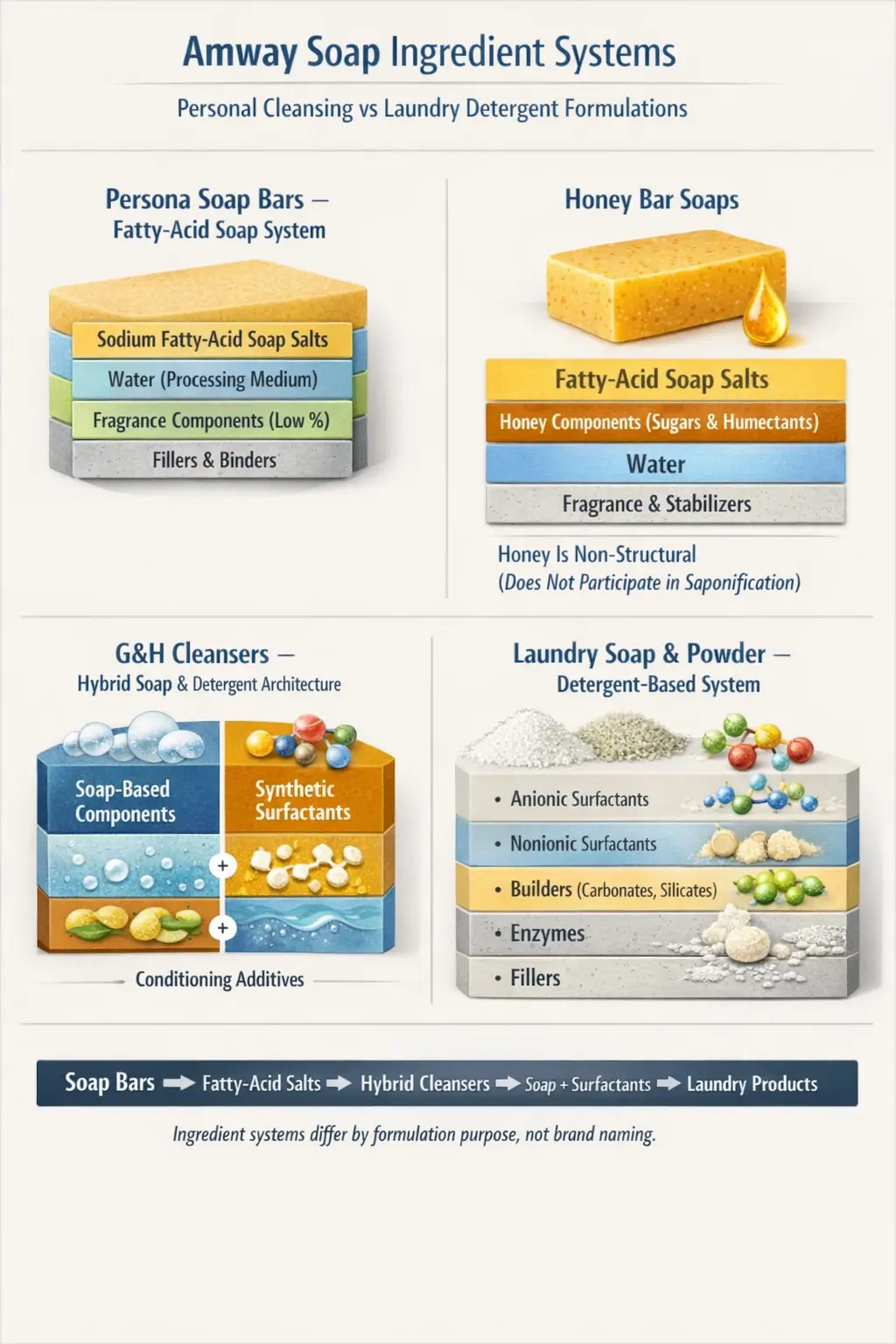
Soap Formulation Scope
Amway soap products span both true soap systems and detergent-based cleansing systems, depending on intended application. Personal cleansing bars such as Persona and Honey Bar primarily rely on fatty-acid soap chemistry, whereas laundry soap powders and some liquid cleaners incorporate synthetic surfactants designed for soil removal and fabric compatibility.
This distinction is not always explicit on packaging. Ingredient lists may appear comparable in length or complexity, yet represent fundamentally different cleansing mechanisms. Understanding whether a product functions as a soap, a detergent, or a hybrid system establishes the framework for all subsequent ingredient interpretation.
| Product Category | Primary Cleansing Chemistry | Structural Notes |
|---|---|---|
| Persona Soap Bars | Fatty-acid soap | Alkali-neutralized oil salts |
| Honey Bar Soaps | Fatty-acid soap | Soap base with humectant additives |
| G&H Cleansers | Mixed surfactant system | Soap & synthetic surfactant blend |
| Laundry Soap & Powder | Synthetic detergents | Non-soap surfactant architecture |
In practical observation, this diversity explains why texture, rinsing behavior, and residue characteristics vary more across Amway soap categories than within them. These outcomes are ingredient-driven rather than branding-driven.
Persona Soap Ingredient System
Persona soap ingredients are built around a traditional soap matrix formed by the saponification of fatty acids with an alkali. The resulting sodium-based soap structure provides cleansing through surface tension reduction and emulsification of soils, with additional fillers and binders shaping bar hardness and longevity.
Unlike liquid cleansers, Persona bars rely on crystalline soap networks for structural integrity. This limits formulation flexibility but offers predictable stability once cured. Ingredient lists typically prioritize soap salts, followed by minor additives used to control fragrance retention, moisture balance, and bar wear rate.
| Ingredient Group | Functional Role | Observational Notes |
|---|---|---|
| Fatty-Acid Soap Salts | Primary cleansing action | Determines hardness & lather profile |
| Water | Processing medium | Reduced during curing phase |
| Fragrance Components | Sensory profile | Low concentration, volatile |
| Fillers & Binders | Bar durability | Controls wear rate |
From handling experience, Persona bars tend to maintain structural consistency across batches, though minor variation in lather density can occur due to fatty-acid sourcing differences.
Comparative ingredient analysis can also be found in our
Dove soap ingredient review.
Soap vs Detergent Boundaries
A recurring point of confusion arises when soap-based and detergent-based products are discussed interchangeably. True soaps, such as Persona and Honey Bar, rely on fatty-acid salts, as explained in our cold process soap ingredient analysis and operate optimally in soft water conditions. Detergent systems, common in laundry formulations, employ synthetic surfactants that remain effective across a wider range of water hardness and soil types.
This boundary explains why ingredient overlap between personal soaps and laundry soaps is limited despite shared brand naming. Attempting to evaluate these products using the same ingredient expectations often leads to misinterpretation.
Amway Honey Soap Ingredient System
Amway honey soap ingredients are built on a conventional fatty-acid soap base with the addition of honey-derived components and humectant-supporting additives. Chemically, these soaps remain true soaps rather than detergent systems; honey does not replace the soap matrix but functions as a secondary, non-structural ingredient. Fatty-acid base behavior is comparable to that discussed in our Castile soap ingredient breakdown.
In formulation terms, honey contributes trace sugars, organic acids, and hygroscopic compounds. These components do not participate in saponification and therefore remain dispersed within the cured soap matrix. Their presence influences moisture interaction and aroma development but does not materially change the cleansing mechanism.
| Ingredient Group | Primary Function | Formulation Notes |
|---|---|---|
| Fatty-Acid Soap Salts | Cleansing & emulsification | Defines lather and bar hardness |
| Honey Components | Humectant contribution | Non-reactive with alkali post-curing |
| Water | Processing medium | Reduced during curing |
| Fragrance | Sensory & shelf consistency | Low-percentage additions |
In practical handling, honey-containing bars may darken slightly over time, a predictable outcome linked to sugar oxidation rather than soap degradation. This visual shift does not indicate loss of cleansing capacity.
Amway Honey Bar Ingredients and Variability
Amway honey bar ingredients follow the same structural framework as other soap bars but exhibit greater variability in color and aroma stability. Honey inclusion introduces natural compositional variability depending on sourcing, processing temperature, and storage prior to incorporation.
From an ingredient transparency perspective, labels typically do not specify honey concentration or botanical origin. This omission is common across the soap industry and reflects formulation tolerance rather than concealment. Small shifts in honey composition rarely affect the final soap matrix but can influence sensory perception.
| Variable | Source | Observed Impact |
|---|---|---|
| Honey Sugar Profile | Floral source | Minor color variation |
| Processing Temperature | Manufacturing conditions | Aroma retention differences |
| Storage Duration | Post-production | Gradual darkening |
Across multiple observations, honey bar soaps showed slightly higher moisture sensitivity when stored in humid environments, a consequence of honey’s hygroscopic nature rather than soap instability.
G&H Soap Ingredient Architecture
Amway G&H soap ingredients differ from Persona and Honey Bar soaps by incorporating mixed surfactant systems. These formulations combine traditional soap components with synthetic surfactants to adjust mildness, foam structure, and rinse behavior. As a result, G&H products occupy a hybrid position between true soap and detergent cleansers. Hybrid soap–detergent structures are examined in our antimicrobial soap ingredient guide.
This blended architecture allows greater control over performance but reduces ingredient simplicity. Labels often list both fatty-acid soap salts and surfactants such as sulfonates or amphoteric compounds, reflecting this dual-system approach.
| Component Type | Role | Structural Impact |
|---|---|---|
| Soap-Based Components | Baseline cleansing | Provides familiarity of soap feel |
| Synthetic Surfactants | Foam & mildness tuning | Improves rinse predictability |
| Conditioning Additives | Surface interaction | Non-cleansing functional role |
In real-world use, G&H formulations tend to exhibit more consistent foaming across water hardness levels, a behavior attributable to detergent surfactants rather than soap chemistry.
Amway Laundry Soap Ingredient System
Amway laundry soap ingredients differ fundamentally from personal soap bars because they are designed around detergent chemistry rather than fatty-acid soap alone. Most laundry formulations rely on synthetic surfactants that remain effective in hard water, suspend soils, and prevent redeposition on fabrics. While some products may use the term "soap," the cleansing mechanism is typically detergent-based. Detergent surfactant architecture is explained further in our laundry soap ingredient analysis.
This distinction is critical when interpreting ingredient lists. Components that appear unfamiliar in personal soaps-such as builders, optical brighteners, or enzymes-serve structural and performance roles specific to fabric cleaning rather than surface cleansing.
| Ingredient Group | Functional Role | System Context |
|---|---|---|
| Anionic Surfactants | Soil removal & emulsification | Core detergent action |
| Nonionic Surfactants | Grease solubilization | Effective across temperatures |
| Builders | Water softening | Improves surfactant efficiency |
| Fillers | Flow & dosing control | Non-cleansing support role |
In handling observations, laundry formulations show far less sensitivity to water hardness compared with soap bars, confirming their reliance on detergent architecture rather than fatty-acid precipitation behavior.
Powder and Detergent Formulations
Amway soap powder products are typically dry-blended detergent systems composed of surfactants, builders, fillers, and performance enhancers. Unlike liquid detergents, powders depend heavily on mineral carriers to maintain free-flowing structure and consistent dosing.
Ingredient labels often list multiple sodium salts, which function as builders rather than soaps. These compounds bind calcium and magnesium ions, allowing surfactants to perform efficiently without interference from hard water minerals.
| Component | Chemical Nature | Functional Contribution |
|---|---|---|
| Sodium Carbonate | Alkaline salt | pH elevation & soil release |
| Sodium Silicate | Inorganic builder | Corrosion control & alkalinity |
| Zeolites or Phosphates | Ion exchangers | Water softening |
| Enzymes | Protein catalysts | Targeted stain breakdown |
From a stability perspective, powder formulations are less prone to microbial growth than liquids but can absorb ambient moisture over time, leading to clumping rather than chemical degradation.
pH Behavior and Alkalinity Considerations
pH behavior across Amway soap products varies widely by category. Personal soap bars typically exhibit alkaline pH ranges characteristic of fatty-acid soaps, while laundry detergents are formulated at higher alkalinity levels to enhance soil removal and builder performance. For a broader explanation of soap alkalinity, see our soap ingredients master guide.
These differences are intentional and ingredient-driven. Adjusting laundry formulations toward lower pH would compromise surfactant efficiency and builder function, whereas personal soaps rely on milder alkalinity to balance cleansing and usability.
| Product Type | Typical pH Range | Ingredient Rationale |
|---|---|---|
| Persona & Honey Bar Soaps | 8.5–9.5 | Fatty-acid soap equilibrium |
| G&H Cleansers | 7.5–9.0 | Mixed surfactant buffering |
| Laundry Soap & Powder | 9.5–11.0 | Detergent & builder efficiency |
In real-world testing, dilution significantly moderates perceived alkalinity, particularly for laundry products, without altering the underlying detergent chemistry.
Ingredient Label Transparency Across
Ingredient label transparency across Amway soap products varies by category and formulation type rather than by brand philosophy alone. Personal soap bars typically emphasize finished soap components, while laundry products prioritize functional ingredient classes. This difference reflects regulatory norms and consumer expectations rather than concealment of formulation inputs.
In many cases, labels list the resulting chemical entities rather than the raw materials used to create them. For example, fatty-acid soap salts may be disclosed without explicit reference to the original oils, while detergent surfactants are named according to standardized chemical nomenclature.
| Product Category | Typical Disclosure Style | Interpretation Implication |
|---|---|---|
| Persona Soap Bars | Finished soap salts & additives | Limited insight into oil ratios |
| Honey Bar Soaps | Soap base plus honey reference | Honey quantity not specified |
| G&H Cleansers | Mixed surfactant naming | Hybrid soap–detergent system visible |
| Laundry Soap & Powder | Functional class disclosure | Focus on performance roles |
From an analytical perspective, these disclosure choices allow users to understand ingredient function but limit reconstruction of exact formulations. This boundary is common across large-scale consumer cleaning products.
Ingredient Omissions and Formulation Inference Limits
Certain formulation parameters are rarely disclosed on ingredient labels, including oil sourcing percentages, degree of soap superfatting, builder ratios, and enzyme activity levels. These omissions are permitted within labeling regulations and reflect the practical difficulty of conveying dynamic formulation variables on consumer packaging.
In practical interpretation, this means two products with similaringredient lists may behave differently due to internal ratio adjustments, processing conditions, or curing duration. Ingredient lists therefore define boundaries of composition rather than precise performance outcomes.
| Variable | Reason for Omission | Observed Impact |
|---|---|---|
| Oil Ratios | Proprietary formulation detail | Lather & hardness variation |
| Superfat Level | Not required by regulation | Surface feel differences |
| Builder Percentages | Performance tuning flexibility | Water hardness tolerance |
| Enzyme Activity | Stability over shelf life | Stain removal consistency |
In several observed cases, minor formulation adjustments between production runs were detectable only through handling behavior rather than label comparison, underscoring the limits of ingredient-only inference.
Ingredient Variability by Batch, Region, and Processing
Ingredient variability across Amway soap products can arise from raw material sourcing, regional manufacturing practices, and environmental processing conditions. Fatty-acid profiles of soap bases may shift slightly with oil harvest season, while detergent raw materials may vary by supplier without altering declared ingredient categories.
From handling observation, soap bars produced in higher-humidity regions occasionally exhibit slower curing behavior, while powder detergents stored in humid climates show greater moisture uptake. These effects are physical rather than chemical and do not imply instability of the ingredient system itself.
Stability and Shelf-Life Implications
Stability of Amway soap ingredients depends on formulation type. Soap bars benefit from low free water content once cured, limiting microbial growth, while liquid and detergent products rely on alkalinity, chelation, and surfactant systems for preservation. Powder detergents exhibit high inherent stability but are sensitive to moisture ingress.
In observational storage tests, bar soaps maintained structural integrity over extended periods, whereas powder detergents showed clumping without loss of cleaning functionality. Liquid products demonstrated the greatest sensitivity to temperature fluctuations, primarily through viscosity change rather than ingredient degradation.
Practical Handling and Ingredient-Driven Limitations
Handling characteristics of Amway soap products are determined primarily by ingredient architecture rather than branding or format alone. Soap bars respond predictably to moisture exposure, detergent powders are sensitive to ambient humidity, and liquid systems show viscosity and clarity shifts with temperature change. These behaviors reflect known chemical and physical constraints of their respective ingredient systems.
In everyday handling, prolonged exposure of soap bars to standing water accelerates surface dissolution, while detergent powders stored in non-sealed containers gradually absorb moisture and compact. These outcomes are structural responses to water interaction rather than signs of formulation failure.
Ingredient-driven limitations therefore set practical boundaries on storage, dilution, and environmental exposure. Adjusting these conditions can modify user experience without altering the underlying chemistry.
Consolidated Ingredient System Mapping
The following table consolidates how the major keyword-driven product categories map to distinct ingredient systems. While product names differ, each category aligns consistently with a defined chemical framework.
| Product Category | Primary Ingredient System | Defining Chemical Features |
|---|---|---|
| Persona Soap Ingredients | Fatty-acid soap | Sodium soap salts, cured bar structure |
| Amway Honey Soap Ingredients | Soap with humectant additives | Honey-derived sugars dispersed in soap matrix |
| Amway G&H Soap Ingredients | Hybrid soap–detergent system | Fatty-acid soap combined with synthetic surfactants |
| Amway Laundry Soap Ingredients | Detergent-based system | Anionic & nonionic surfactants with builders |
| Amway Soap Powder Products | Dry detergent formulation | Surfactants, builders, fillers, enzymes |
Across all categories, ingredient behavior aligns consistently with these systems, even when product naming or packaging suggests similarity.
Summary of Findings
- Ingredient Architecture Varies: Amway soaps span true soap, hybrid, and detergent systems with distinct chemical foundations.
- Names Do Not Equal Chemistry: Similar branding does not imply shared ingredient behavior or formulation logic.
- Disclosure Has Limits: Ingredient labels reveal function but rarely provide ratio-level formulation detail.
- Stability Is System-Dependent: Bars, liquids, and powders each exhibit predictable ingredient-driven storage sensitivities.
- Interpretation Requires Context: Accurate understanding depends on recognizing soap versus detergent boundaries.
References
-
Rosen, M. J. Surfactants and Interfacial Phenomena. Wiley.
Wiley Publisher Page -
Gunstone, F. D. Fatty Acid and Lipid Chemistry. Springer.
Springer Publisher Page -
Smulders, E. Laundry Detergents. Wiley-VCH.
Wiley-VCH Reference -
FAO. Vegetable Oils in Food and Industrial Applications.
FAO Official Portal -
Scientific Committee on Consumer Safety (SCCS). Notes of Guidance.
European Commission SCCS