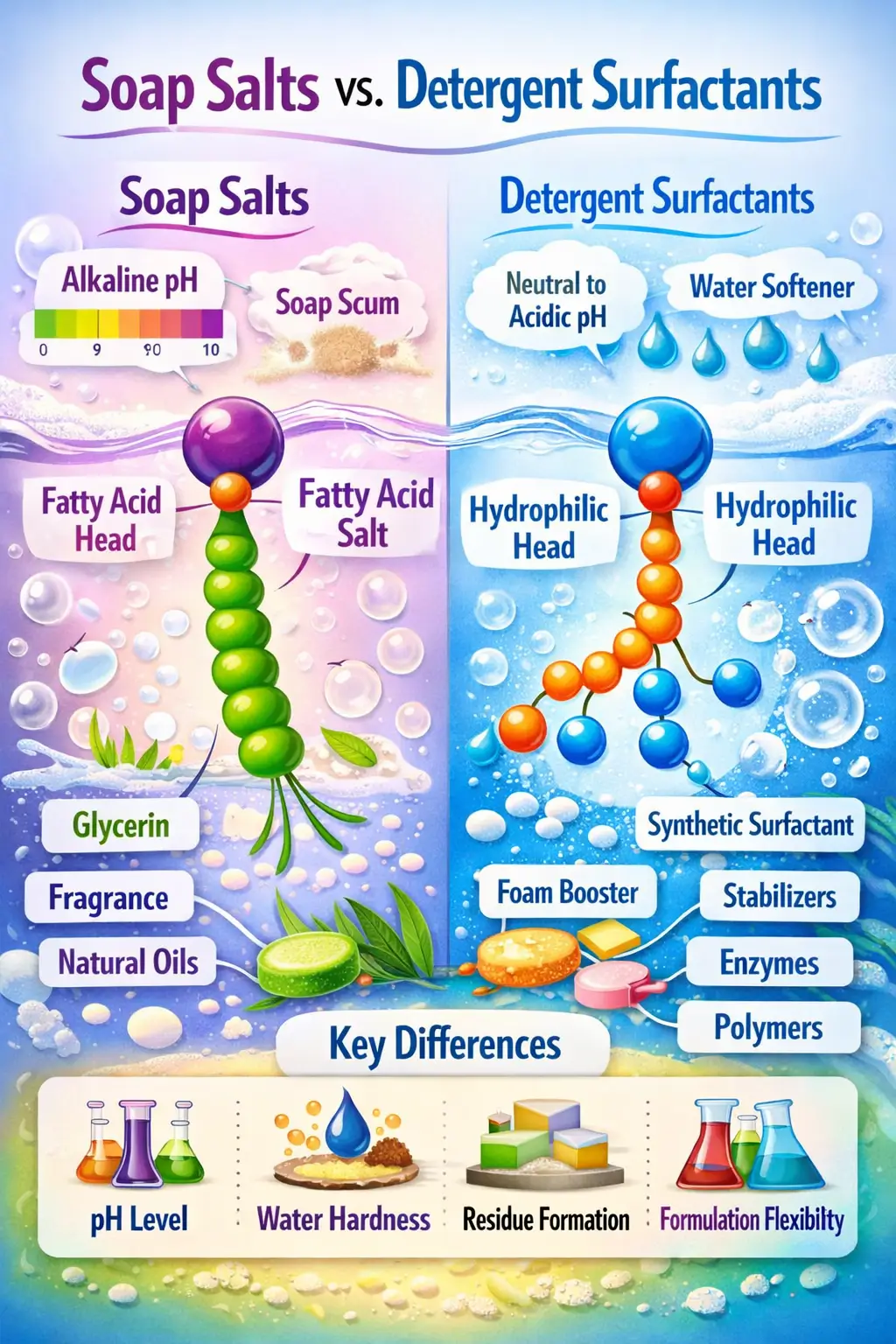
What Defines A Soap System
A soap formulation is defined by the presence of fatty acid surfactants (fatty acid salts) created through the reaction of fats or oils with an alkali, a chemical foundation outlined in the Soap Ingredients Guide. This reaction produces molecules that are amphiphilic by nature, meaning each molecule contains both a water-attracting head and an oil-attracting tail. Cleansing occurs when these molecules self-organize in water and surround soils, allowing them to be rinsed away.
The defining characteristic of soap is not its physical form, but its chemical dependency on alkalinity. Soap salts remain stable and functional only within a basic pH environment, a constraint explained in detail in the understanding soap pH guide. This constraint shapes every downstream design choice, from ingredient selection to preservative strategy and packaging, and intersects with classification and compliance boundaries discussed in How Soaps Are Regulated.
In practical use, soap systems tend to respond directly to external variables such as mineral content in water, concentration at the point of use, and contact time. These responses are not formulation flaws but predictable outcomes of how soap chemistry operates.
What Defines A Detergent System
Detergents are cleansing systems built from synthetic or semi-synthetic surfactants that do not rely on fatty acid salts, a formulation approach explored in greater system detail across the Detergent Guides section. Instead, they use molecules engineered to remain surface-active across a wide pH range and in the presence of minerals that would disable soap.
Because detergent surfactants are chemically independent of alkalinity, the surrounding formulation can be adjusted for viscosity, fragrance stability, preservative effectiveness, and mildness without destabilizing the cleansing mechanism itself. This decoupling of cleansing action from pH is one of the system’s most significant structural differences from soap.
In household and personal care contexts across Europe, detergent systems are often chosen not for stronger cleaning, but for consistency. Their behavior tends to remain stable across regions with varying water hardness, refill dilution practices, and storage conditions.
Structural Contrast Between Cleansing Systems
While both systems rely on surfactant behavior, the origin and constraints of those surfactants differ substantially. Soap surfactants emerge as a result of saponification and exist within a narrow chemical tolerance. Detergent surfactants are manufactured with targeted performance characteristics and broader operating ranges.
| System Property | Soap | Detergent |
|---|---|---|
| Primary Surfactant Type | Fatty acid salts | Synthetic or modified surfactants |
| Effective pH Range | Typically alkaline | Broad, adjustable |
| Mineral Sensitivity | High | Low |
| Formulation Flexibility | Constrained by chemistry | High |
These differences explain many common usage observations, such as residue formation in hard water regions or the ease with which detergent products can be thickened, fragranced, or preserved without altering their cleansing core.
Why pH Dependency Shapes Soap Behavior
Soap systems are inseparable from alkalinity. The fatty acid salts that perform cleansing exist only while the surrounding environment remains basic. When the pH drops, even locally at the skin surface or during rinsing, these salts can partially revert to free fatty acids, altering solubility and rinsing behavior.
This dependency explains why soap formulations often operate within a narrow design window. Adjustments intended to change fragrance stability, color, or preservation cannot freely alter pH without affecting the cleansing system itself. In practice, soap formulations are balanced rather than tuned.
In everyday European household use, this behavior becomes visible in situations such as short handwashing cycles, cold water use, or rapid rinsing. Under these conditions, the system may not fully re-solubilize before removal, leading to tactile or visual residue that users sometimes misinterpret as incomplete cleansing.
How Detergents Decouple Cleansing From pH
Detergent systems separate cleansing performance from alkalinity by using surfactants that remain surface active across a wide pH range. This allows formulators to adjust acidity or neutrality for stability, compatibility, or sensory reasons without disrupting soil removal.
This decoupling introduces design flexibility. Viscosity modifiers, fragrance systems, preservatives, and chelating agents can be selected independently, provided they remain compatible with the chosen surfactant blend. The cleansing mechanism remains largely unchanged.
In refill oriented product ecosystems common in several European markets, detergent systems also tolerate dilution variability more predictably than soap systems. While performance still changes with concentration, the system tends to degrade gradually rather than structurally.
Water Hardness As A Boundary Condition
Water hardness introduces one of the clearest behavioral contrasts between soap and detergent systems, reflecting the mineral sensitivity defined in the soap and hard water interaction framework. Calcium and magnesium ions readily interact with fatty acid salts, forming insoluble compounds that no longer participate in cleansing. This interaction is inherent to soap chemistry and cannot be fully designed out.
In regions with moderately to highly mineralized water, this interaction may manifest as visible film, reduced lather, or deposits on sinks and fittings. These outcomes reflect ion exchange chemistry rather than formulation error.
Detergent surfactants are generally designed to resist this interaction. Many systems incorporate chelators or use surfactant structures that do not readily precipitate with hardness ions, allowing cleansing to proceed with fewer visible byproducts.
| Condition | Soap System Response | Detergent System Response |
|---|---|---|
| Low mineral water | Stable lather and rinse | Stable lather and rinse |
| Moderate hardness | Reduced efficiency, residue risk | Minimal change |
| High hardness | Precipitation likely | System remains functional |
Residue Formation And Rinsing Dynamics
Residue is often treated as a performance failure, yet it is more accurately a system interaction outcome rooted in the precipitation mechanisms described in soap scum formation chemistry. In soap systems, residue commonly originates from insoluble fatty acid salts or re-acidified fatty acids that remain on surfaces after water removal.
Rinsing behavior plays a central role. Short rinse times, low temperatures, or high mineral content increase the likelihood that these compounds remain deposited. The system has not malfunctioned; it has reached its operational boundary.
Detergent systems can also leave residue, but the source differs. Here, residue more often reflects surfactant over-deposition, fragrance carriers, or polymeric thickeners rather than precipitation chemistry. The visual outcome may appear similar, while the underlying cause is not.
Why Ingredient Roles Are Commonly Misinterpreted
One of the most frequent interpretation errors occurs when individual ingredients are evaluated outside their system role. In soap formulations, fatty acid salts perform multiple functions simultaneously. They provide cleansing, structure, and in some cases contribute to opacity or bar hardness, with excess free oils further modifying system balance through mechanisms explained in the superfatting bar soap systems guide. Attempting to isolate a single function often leads to incorrect conclusions.
Detergent formulations distribute functions across a broader ingredient set. Primary surfactants handle soil removal, while secondary surfactants modify foam behavior, and additional agents manage viscosity, preservation, or mineral interaction. Observers sometimes assume this complexity indicates superiority, when it primarily reflects modular design rather than stronger cleansing.
These differences explain why ingredient lists between the two systems vary significantly in length without implying intent, quality, or performance hierarchy. The systems are solving different formulation constraints.
Why Formulation Flexibility Differs Between Systems
Soap formulations are constrained by the need to preserve fatty acid salt stability. Changes to fragrance systems, colorants, or additives must remain compatible with alkaline conditions and avoid disrupting saponified structures. As a result, flexibility exists, but within narrow boundaries.
Detergent systems permit broader modification because cleansing performance is not chemically tied to alkalinity. This allows formulators to adjust sensory properties, appearance, and storage behavior with fewer downstream effects on soil removal.
A common misunderstanding arises when flexibility is interpreted as optimization. In reality, it reflects different system architectures rather than different cleansing goals.
Usage Context And Variability In Real Environments
Cleansing systems do not operate in isolation. Household practices, water temperature, contact time, and surface type all influence observed outcomes. In many European homes, cold water washing and rapid rinsing are common, which can accentuate the differences between soap and detergent systems.
Refill and dilution practices introduce additional variability. Soap systems respond sharply to concentration changes, while detergent systems often exhibit more gradual performance shifts. Neither response indicates improper use; both reflect system design.
These contextual factors explain why identical formulations may be perceived differently across regions or households without any change in composition.
System Limitations And Boundary Conditions
No cleansing system operates without limits. Soap systems are bounded by mineral sensitivity, pH dependence, and reactivity with acidic environments. Detergent systems, while more tolerant, can encounter limitations related to over-deposition, polymer buildup, or incompatibility between surfactant blends and additives.
These limitations become most visible at the edges of typical use conditions. High mineral water, extreme dilution, prolonged storage, or repeated application without adequate rinsing can expose behaviors that are not apparent during standard use.
Understanding these boundaries helps explain outcomes without attributing them to product failure or misuse.
Summary of Findings
- System Definition: Soap and detergent are distinct cleansing systems built on different chemical assumptions.
- Structural Constraint: Soap depends on alkalinity, while detergents separate cleansing from pH.
- Environmental Sensitivity: Water hardness and rinsing conditions shape soap behavior more visibly.
- Formulation Design: Ingredient list length reflects system architecture, not performance ranking.
- Boundary Awareness: Observed residue or variation usually indicates system limits, not malfunction.
All interpretations follow the analytical framework described in our Ingredient Framework and Editorial Policy.
References
- Rosen, M. J. Surfactants and Interfacial Phenomena. Publisher Page
- Schramm, L. L. Surfactants: Fundamentals and Applications. Cambridge Reference
- OECD SIDS Initial Assessment Reports – Fatty Acid Salts and Synthetic Surfactants. OECD Chemical Portal
- European Commission – Cosmetic Ingredient Database (CosIng). Official Database