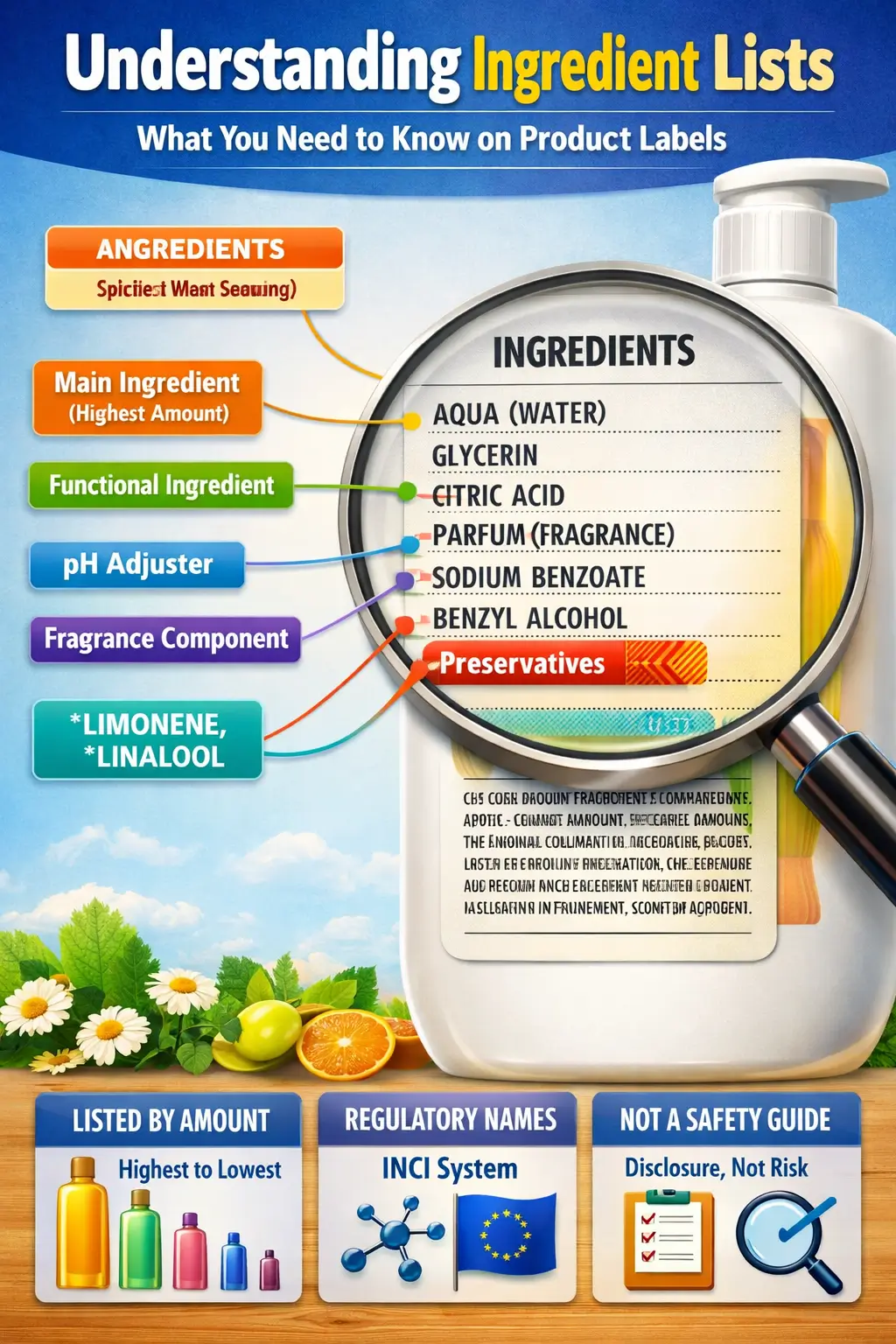
What An Ingredient List Is And Is Not
An ingredient list is a compliance document. Its primary role is to meet regulatory disclosure requirements, not to educate, reassure, or persuade the consumer. This distinction is often overlooked, particularly when ingredient lists are read as narratives rather than inventories.
In practical terms, the list answers one narrow question: which substances were used to make this product, according to standardized naming rules, at the point of manufacture. It does not explain why each ingredient was chosen, how it behaves once combined with others, or how noticeable it will be during use.
For readers who want a broader orientation, it can be helpful to consult the soap ingredients guide, or to see how traditional formulations are represented on labels in examples such as Amish soap ingredient listings.
This gap between disclosure and interpretation is where most confusion begins. A consumer may reasonably expect the list to function as a guide to quality or suitability. The labeling system, however, was not built for that purpose.
What Order Really Indicates And What It Does Not
The same ingredient name can also signal very different formulation contexts depending on how and when it is incorporated during production, a distinction illustrated clearly in the cold process soap ingredients breakdown.
Under EU labeling rules, ingredients are generally listed in descending order by weight as they are added during formulation. This is often simplified to "highest to lowest amount," which is directionally correct but incomplete.
The order reflects relative weight at a specific moment in manufacturing, not the final functional impact of each ingredient. Small-percentage ingredients can exert outsized effects, while high-percentage components may be present primarily as carriers, solvents, or structural bases.
This distinction matters because consumers often equate position with importance. Seeing an ingredient near the top of a list can feel significant, even when that ingredient serves a largely passive role.
| Assumption | What Order Actually Indicates |
|---|---|
| Top-listed ingredient defines the product | Indicates highest weight at formulation stage, not performance or purpose |
| Lower-listed ingredients are insignificant | Lower weight does not imply lower functional impact |
| Order reflects final product behavior | Order reflects formulation input, not post-use interaction |
Why Ingredient Names Often Feel Unfamiliar
Ingredient lists follow a defined regulatory logic that determines naming, grouping, and disclosure thresholds, as outlined in the ingredient framework used to standardize interpretation across product categories.
Many ingredient lists appear opaque not because information is hidden, but because regulatory naming systems prioritize consistency over familiarity. In cosmetics and personal care, this often means INCI names rather than everyday terms.
This contrast is often highlighted in brands that emphasize natural positioning, where ingredient disclosures for examples such as Dr. Squatch soap formulations illustrate how regulatory naming differs from marketing language.These names are standardized to reduce ambiguity across languages and markets. The trade-off is that they rarely resemble the language consumers use in daily life or marketing materials.
This mismatch can create the impression that ingredient lists are intentionally technical. In reality, they are optimized for cross-border clarity, not consumer readability.
Why Ingredient Lists Feel Precise But Are Not
Ingredient lists often give the impression of precision. Names are exact, order is fixed, and formatting appears deliberate. This can suggest that the list represents a finely tuned breakdown of a product. In reality, the system communicates presence and relative position, not granular measurement.
Below certain concentration thresholds, ingredients may be grouped, reordered, or listed without any indication of their exact proportion. This is not a loophole or a concealment tactic. It reflects a regulatory balance between transparency and practical labeling limits.
For the reader, this means the list should be interpreted as directional information. It shows what is included and broadly how formulation weight is distributed, but it does not support numerical comparison or dose-based inference.
Why An Absent Ingredient Does Not Mean An Absent Function
A common interpretation error occurs when consumers scan a list for a familiar ingredient and assume that its absence means a function is missing. This is particularly noticeable with preservatives, surfactants, or fragrance-related components.
Formulation functions can often be achieved through multiple ingredient pathways. Two products may perform similarly while using different substances to reach that outcome. The list reflects the chosen pathway, not the function itself.
This is one reason ingredient lists should not be read as performance checklists. They document composition, not capability.
This distinction is especially relevant for products marketed around specific functions, where ingredient lists for examples such as Defense Soap formulations show how similar outcomes can be achieved through different compositional pathways.
How Ingredient Lists Appear In Real European Retail Settings
In European supermarkets and pharmacies, ingredient lists are often compressed into small panels, folded inserts, or secondary packaging. Space constraints influence layout, font size, and readability, but not the underlying disclosure requirements.
Mass-market soaps sold in European retail settings often illustrate these constraints clearly, as seen in ingredient disclosures for products such as Caress soap formulations.Refill packaging, multi-language labels, and shared regional compliance formats can further limit how explanatory a list appears. What may look like minimal disclosure is often the result of physical packaging constraints rather than informational omission.
This context helps explain why ingredient lists rarely include explanatory language. Their role is to disclose consistently across markets, not to guide interpretation at the shelf.
Where Ingredient Lists Stop Being Informative
There are clear boundaries to what ingredient lists can explain. They do not convey ingredient quality grades, sourcing practices, interaction effects, or changes that occur during storage and use.
They also cannot account for individual expectations or sensitivities. Two consumers may read the same list and draw different conclusions based on prior experience, assumptions, or external information.
Recognizing these limits is not a failure of the system. It is an acknowledgment that ingredient lists were designed as disclosure tools, not interpretive guides.
Summary of Findings
- Ingredient lists disclose composition: They show what was used and how it was ordered, not how the product performs.
- Order reflects formulation input: Position indicates relative weight at manufacture, not functional importance.
- Naming follows regulatory systems: Unfamiliar names are standardized for consistency, not obscurity.
- Absence does not imply absence of function: Different ingredients can serve similar formulation roles.
- Interpretation has limits: Ingredient lists are not designed to answer questions of suitability or outcome.
References & Primary Sources
| Source Title | Authority | Specific Relevance | Official Link |
|---|---|---|---|
| Regulation (EC) No 1223/2009 | European Parliament & Council | Article 19 establishes ingredient list formatting and descending order requirements; Annex III outlines fragrance allergen disclosure thresholds. | EUR-Lex (Consolidated) |
| Commission Implementing Decision On Cosmetic Ingredient Naming (INCI System) | European Commission | Defines standardized International Nomenclature of Cosmetic Ingredients (INCI) naming conventions used on EU cosmetic labels. | European Commission – Cosmetics |
| Regulation (EU) No 655/2013 | European Commission | Establishes common criteria for cosmetic claims, clarifying boundaries between labeling disclosure and marketing interpretation. | Claims Regulation |
| Substance Identification And Naming Conventions | European Chemicals Agency (ECHA) | Provides guidance on standardized substance identification relevant to ingredient naming consistency. | ECHA Guidance |
Related Technical Standards & Naming Frameworks
- INCI (International Nomenclature of Cosmetic Ingredients): Global standardized ingredient naming system used across EU cosmetic labeling.
- Article 19(1)(g): Detailed provisions governing ingredient list format and order under Regulation 1223/2009.