Why Labels Differ Across Countries
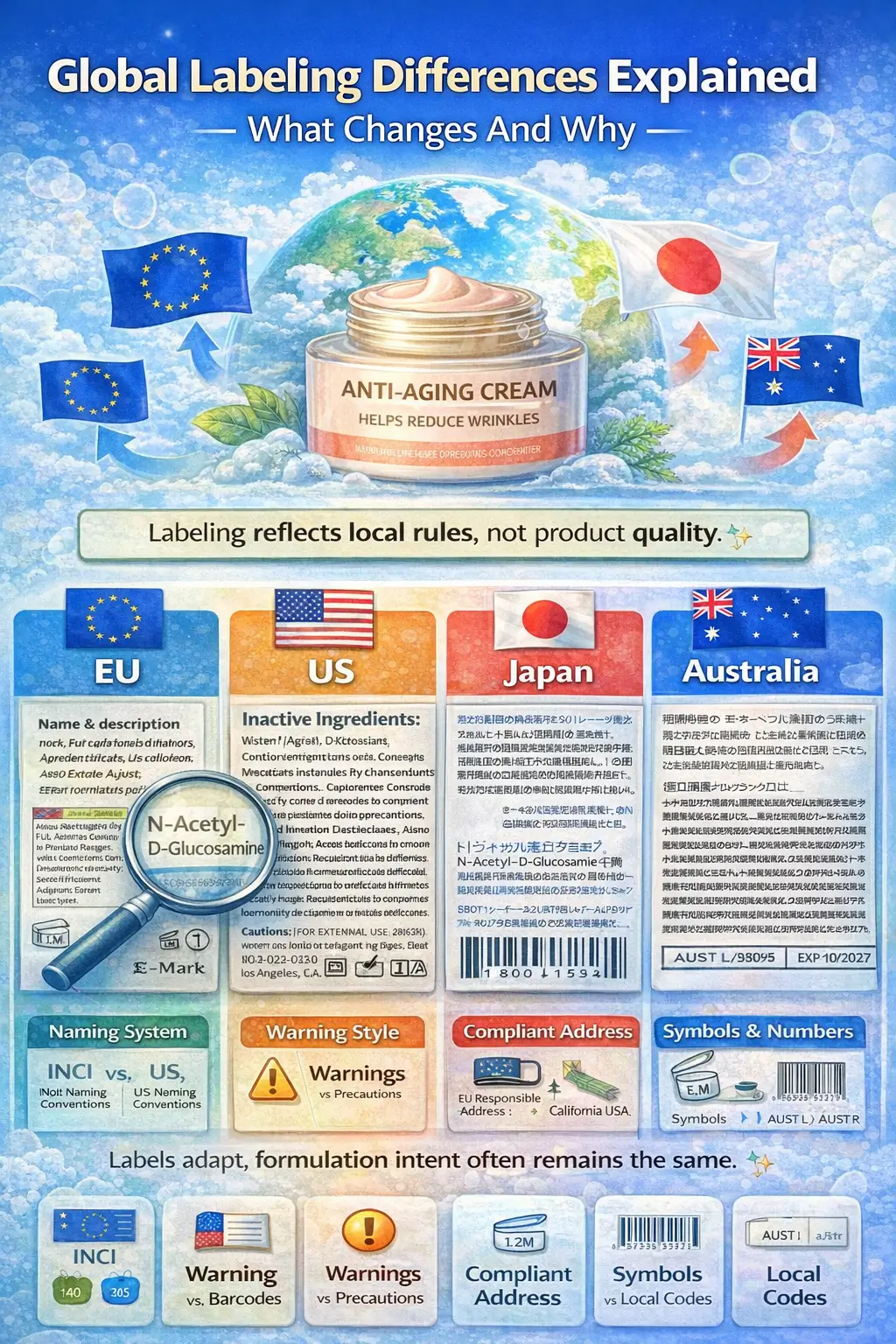
Product labels are shaped by national and regional regulatory systems. Each system defines what must be disclosed, how information is presented, and which terms are permitted. These requirements are designed to align with local law, language, and market structure.
As a result, labeling differences often emerge even when the underlying product remains unchanged. The label adapts to regulatory expectations rather than reflecting a change in formulation intent.
For consumers, this can be confusing. Different labels can appear to signal different levels of transparency or safety when they are primarily expressions of jurisdiction, a pattern that reflects how labels are structured and interpreted rather than how products differ in substance.
What Typically Changes On Global Labels
Across regions, certain elements are more likely to change than others. These include ingredient naming conventions, warning statements, claim phrasing, and the order or visibility of disclosures.
In multilingual markets, space constraints may compress explanations or relocate information to secondary packaging. In other regions, additional qualifiers may be required to clarify claim boundaries.
These variations reflect compliance strategies rather than product divergence. Understanding this helps contextualize why labels rarely look identical worldwide.
What Often Stays The Same Despite Label Changes
While surface details vary, core elements frequently remain consistent. Ingredient systems, formulation intent, and manufacturing processes often do not change between markets.
The same product may therefore appear differently labeled while behaving identically in use. This disconnect is one of the most common sources of misinterpretation.
Recognizing what remains stable helps prevent labels from being read as comparative judgments across regions.
Why Ingredient Names Change Across Regions
One of the most noticeable global differences is ingredient naming. The same substance may appear under different names depending on the regulatory system governing the label. These naming conventions are designed to standardize disclosure within a region, not to create confusion.
In some markets, international nomenclature systems are required. In others, common names or translated equivalents are permitted. The variation reflects linguistic and regulatory alignment rather than a change in the substance itself.
For consumers comparing labels across borders, unfamiliar names can feel like new or additional ingredients. In most cases, they are simply alternate identifiers for the same material.
How Warnings And Symbols Are Used Differently
Warning statements and symbols are another area where labels diverge globally. Some regions require explicit cautionary language, while others rely on standardized icons or indirect phrasing.
These differences do not necessarily indicate a change in risk profile. They reflect how regulatory systems choose to communicate obligations to consumers within local cultural and legal contexts.
Interpreting symbols outside their intended framework can lead to overestimation or underestimation of their significance.
How Global Label Differences Appear In Real Retail Settings
In international retail environments such as airports, border regions, or online marketplaces, consumers often encounter multiple versions of the same product. The labels may differ in layout, language density, or emphasis.
A product sold in Europe may display a detailed ingredient list and responsible party information, while the same product elsewhere emphasizes usage instructions or claim limitations.
These changes are often interpreted as meaningful signals when they are primarily administrative, rather than explanations of formulation intent or product behavior.
Where Interpretation Of Global Labels Reaches Its Limits
Global labeling systems are not designed to be compared side by side by consumers. Each label communicates within its own regulatory logic, which does not translate cleanly across borders.
Attempting to rank labels by perceived strictness or detail often leads to mistaken conclusions. More text does not necessarily mean more oversight, and fewer warnings do not imply lower standards.
Understanding this limit helps reframe global label differences as contextual rather than comparative.
Summary of Findings
- Labels reflect jurisdiction: Differences arise from regulatory structure, not product quality.
- Naming systems vary: The same ingredient may appear under different names globally.
- Warnings are contextual: Symbols and statements follow local communication norms.
- Retail presentation differs: Layout and emphasis adapt to regional requirements.
- Comparison has limits: Global labels are not designed for direct ranking.
References
- European Commission. Cosmetic Products Regulation (EC) No 1223/2009.
- European Commission. Guidance on cosmetic labeling and multilingual presentation.
- ISO. Principles for consumer product labeling and communication.
- OECD. Regulatory cooperation and international labeling frameworks.