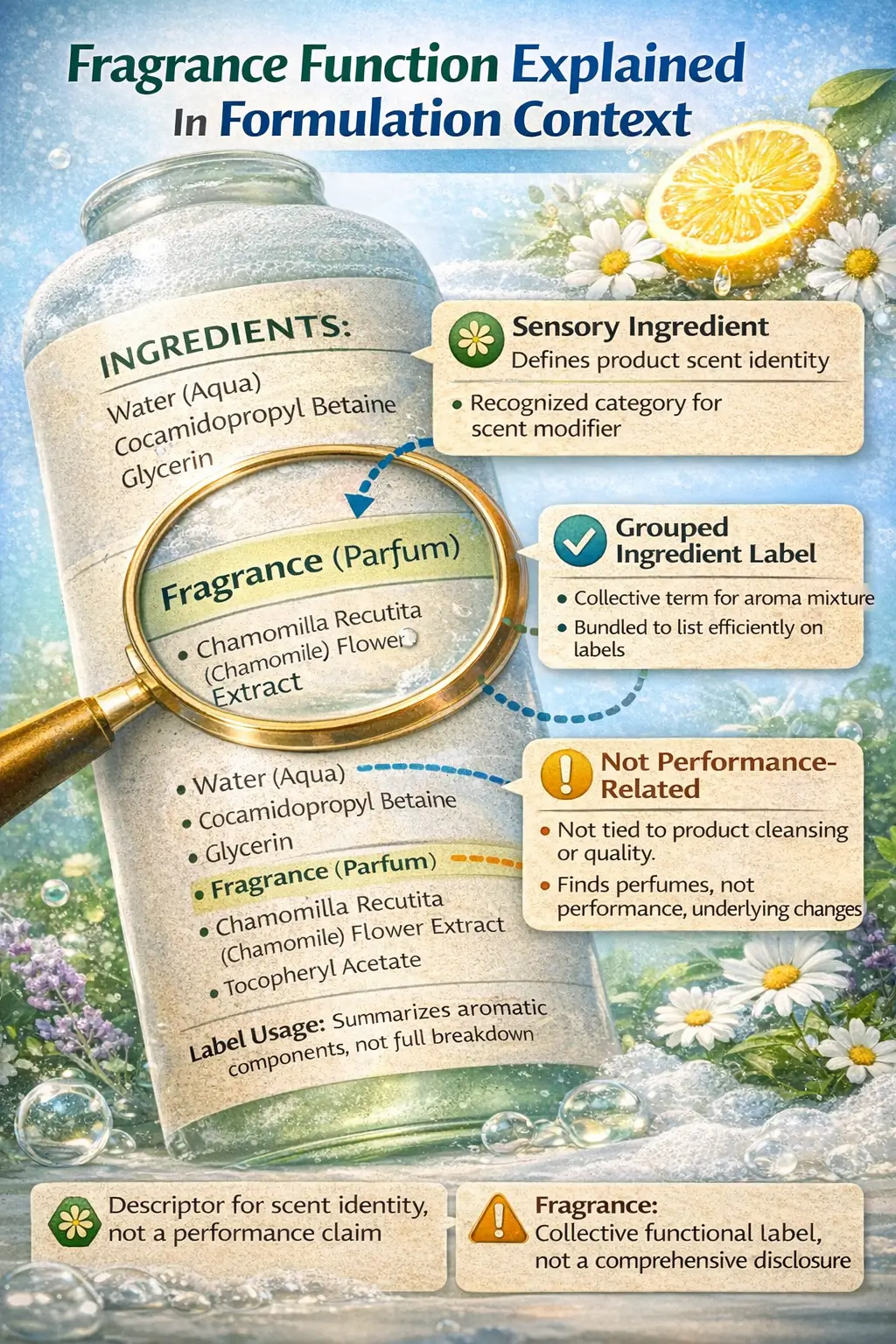
What Fragrance Represents In Formulations
In formulation terms, fragrance refers to a deliberately composed mixture added to impart a characteristic scent. Its primary role is sensory identification rather than functional modification of cleansing or preservation systems.
This role is often misunderstood. Fragrance does not exist to change how a product cleans, foams, or stabilizes. Instead, it shapes how a product is recognized, remembered, and distinguished from otherwise similar formulations, a dynamic clearly visible in strongly scent-identified products such as Irish Spring soap formulations.
Because fragrance interacts with human perception rather than chemical performance, it occupies a different category than most functional ingredients. Labels reflect this distinction by grouping fragrance separately rather than listing each aromatic component individually.
Why Fragrance Appears As A Single Label Entry
On European ingredient labels, fragrance commonly appears as a single term rather than a breakdown of its constituent materials. This approach is intentional and rooted in how labeling frameworks balance transparency with practicality.
Fragrance compositions can include numerous aromatic substances, each present in small proportions. Listing each component would dramatically expand ingredient lists without necessarily improving interpretive clarity for consumers.
As a result, labels prioritize functional grouping over exhaustive disclosure. Fragrance is identified as a formulation element, while detailed composition is handled through separate regulatory documentation rather than consumer-facing labels.
Common Misconceptions About Fragrance On Labels
One of the most persistent assumptions is that fragrance is a performance modifier. Many readers intuitively associate scent with cleansing strength, freshness, or product quality. In formulation terms, those associations are indirect at best.
Fragrance does not make a soap clean better, rinse faster, or last longer. When consumers report perceived differences in effectiveness tied to scent, those experiences usually reflect sensory expectation rather than formulation mechanics. The label, however, offers no signal that distinguishes perception from function.
Another misunderstanding involves equating fragrance with a single substance. In reality, fragrance is a category descriptor. It identifies a role within the formulation, not a uniform material with predictable behavior across products.
What Fragrance Labels Do Not Communicate
Ingredient labels are often read as explanatory tools. In practice, they are disclosure tools with clear limits. When fragrance appears on a label, it does not explain how the scent was designed, how it interacts with other ingredients, or how it will be perceived by different users.
Labels also do not indicate why a particular fragrance profile was chosen, or how that profile appears across different applied fragrance products. Decisions may relate to product positioning, regional preference, or alignment with an overall product line. None of that context is visible at the ingredient list level.
This gap between disclosure and interpretation is structural. Labels are not intended to narrate formulation decisions, only to identify categories of components present in the product.
Fragrance In Context: Label Term vs Formulation Meaning
| Label Term | Formulation Context | What It Does Not Indicate |
|---|---|---|
| Fragrance | Sensory identifier added to define product scent | Cleansing strength, safety outcome, or performance level |
| Parfum | Collective term for aromatic composition | Single ingredient identity or uniform composition |
| Aroma | Alternate labeling term with equivalent function | Source origin or formulation complexity |
Limits Of What Fragrance Context Can Explain
Even with careful interpretation, fragrance behavior cannot be fully inferred from labels or general formulation principles. Sensory perception varies widely between individuals and environments.
Factors such as storage conditions, water temperature, and surrounding scents can influence how fragrance is experienced in use, particularly in relation to stability and volatility. These variables fall outside the scope of formulation disclosure and cannot be resolved through labeling alone.
Understanding fragrance context helps narrow misinterpretation, but it does not eliminate uncertainty. That limitation is inherent to sensory-driven formulation elements.
Summary of Findings
- Functional Role: Fragrance exists to define scent identity, not product performance.
- Labeling Purpose: Fragrance is grouped as a category for disclosure efficiency, not secrecy.
- Interpretation Gap: Labels identify presence, not formulation intent or sensory outcome.
- Context Matters: Sensory experience depends on factors beyond ingredient lists.
References & Primary Sources
| Source Title | Authority | Specific Relevance | Official Link |
|---|---|---|---|
| Regulation (EC) No 1223/2009 | European Parliament | Defines cosmetic product labeling requirements, including ingredient listing (Art. 19) and fragrance allergen disclosure (Annex III). | EUR-Lex (Consolidated) |
| Manual On Borderline Products | European Commission | Clarifies classification boundaries between cosmetics, medicinal products, and biocides when fragrance-related claims are made. | EC Guidance |
| Regulation (EU) No 655/2013 | European Commission | Establishes common criteria for cosmetic claims, relevant to fragrance-related marketing language. | Claims Regulation |
Related Technical Standards & Guidance
- INCI Naming Convention: International Nomenclature of Cosmetic Ingredients framework governing ingredient list terminology.
- Article 19(1)(g): Specific provisions governing fragrance allergen disclosure thresholds under Regulation 1223/2009.