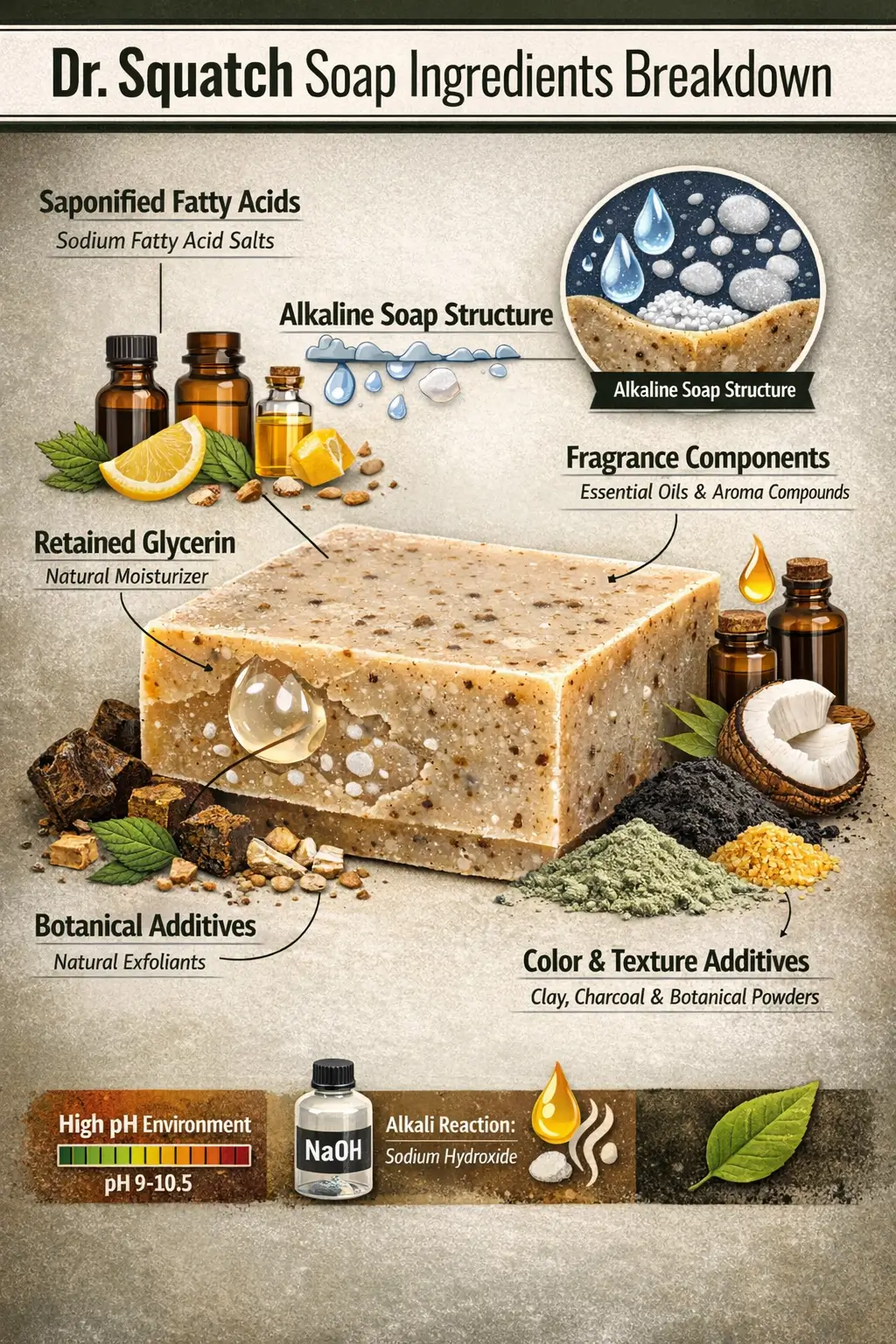
Ingredient Disclosure Overview
Dr. Squatch soap ingredient labels reflect conventional cosmetic soap disclosure practices, listing oils, alkali agents, fragrance, colorants, and additives by name. These labels identify the materials used to construct the soap matrix but do not disclose concentration ranges, saponification ratios, or processing conditions.
Across core bars, limited-edition collaborations, and seasonal releases, ingredient lists remain structurally similar. Variation is primarily observed in fragrance components, botanical additives, and colorants rather than in the foundational soap base.
| Disclosure Element | Observed Practice | Analytical Implication |
|---|---|---|
| Oils & Fats | Individually named | Supports fatty-acid inference |
| Alkali Agents | Explicit | Confirms soap-based chemistry |
| Fragrance | Grouped as fragrance | Component-level opacity |
| Additives | Named botanicals & clays | Functional role interpretation |
Alkali Soap Base & Saponification
Dr. Squatch bar soaps are produced through alkali saponification, as explained in our cold process soap ingredient analysis, where triglyceride oils react with sodium hydroxide to form sodium fatty-acid salts and glycerin. This reaction defines the structural and cleansing behavior of the finished bar.
Residual alkalinity after curing is minimal when saponification is properly balanced. Observationally, cured bars exhibit the firmness and low solubility typical of traditional soap rather than syndet formulations.
| Component | Function | Observed Role |
|---|---|---|
| Sodium Hydroxide | Saponification agent | Converted during curing |
| Fatty-acid Salts | Cleansing matrix | Primary soap structure |
| Glycerin | Natural byproduct | Contributes slip & humectancy |
Fatty-Acid Composition & Oil Sources
The fatty-acid profile of Dr. Squatch bar soaps is determined by the blend of oils used prior to saponification. Common oils contribute lauric, myristic, palmitic, stearic, and oleic acids in varying proportions, shaping hardness, lather type, and bar longevity. A broader overview of fatty acid behavior in cleansing bars is discussed in our soap ingredients guide.
In handling comparisons, bars with higher coconut-derived fatty acids produce faster, higher-volume lather, while those with greater long-chain saturated acids feel denser and wear more slowly.
| Fatty Acid | Primary Source | Functional Effect |
|---|---|---|
| Lauric & Myristic | Coconut oil | Rapid lather formation |
| Palmitic & Stearic | Animal or plant fats | Bar hardness & longevity |
| Oleic | Smoother lather texture |
Bar Soap Structural Architecture
Dr. Squatch bars combine saponified oils, retained glycerin, fragrance systems, and insoluble additives such as clays or botanical particles. These elements coexist within a crystalline soap matrix formed during curing.
Slight surface irregularities and embedded particulates observed in some variants reflect additive inclusion rather than manufacturing inconsistency.
Variant-Specific Ingredient Logic Across Bars
Dr. Squatch bar soap variants differ primarily through secondary ingredients layered onto a consistent alkali soap base. These differences include fragrance systems, botanical additives, abrasives, and colorants, while the underlying fatty-acid salt structure remains largely unchanged.
From a formulation perspective, variant differentiation is achieved without altering saponification chemistry. Instead, post-saponification additives and oil selection fine-tune sensory characteristics such as aroma, surface texture, and visual appearance. Compared with syndet-based bars such as Dove soap ingredients, Dr Squatch bars remain fully alkali-based.
| Differentiation Layer | Ingredient Type | Formulation Role |
|---|---|---|
| Fragrance System | Essential oils & aroma compounds | Scent identity |
| Botanical Additives | Plant extracts, powders | Visual & tactile modification |
| Abrasive Elements | Ground botanicals, clays | Surface texture variation |
| Colorants | Mineral or plant-derived | Bar appearance |
Pine Tar Soap Ingredients
Dr. Squatch Pine Tar soap incorporates pine tar as a secondary additive within the standard alkali soap base. Pine tar contributes aroma, coloration, and resinous characteristics rather than altering the soap’s cleansing chemistry.
Pine tar is typically added at low percentages due to its strong scent and dense composition. In cured bars, it appears as a darkened matrix with a firmer feel relative to lighter-colored variants.
| Ingredient | Functional Role | Observed Effect |
|---|---|---|
| Pine Tar | Aromatic & visual modifier | Dark coloration, resinous scent |
| Essential Oils | Scent balance | Offsets tar intensity |
| Soap Base | Cleansing matrix | Unchanged from core formula |
Wood Barrel Bourbon & Bourbon Soap Ingredient Structure
Wood Barrel Bourbon and related bourbon-themed soaps rely on fragrance systems designed to evoke woody and caramelized notes. Actual distilled spirits are not functionally significant; instead, fragrance accords simulate barrel-aged characteristics.
Colorants and fragrance compounds are selected to remain stable in alkaline environments. These ingredients influence aroma and bar tone without contributing to cleansing or lather formation.
| Ingredient Group | Role | Formulation Impact |
|---|---|---|
| Fragrance Accord | Aroma construction | Woody & sweet notes |
| Colorants | Visual identity | Amber to brown tones |
| Botanical Extracts | Marketing-aligned additives | Minor compositional presence |
Peppermint, Coconut & Aloe Ingredient Considerations
Peppermint, coconut, and aloe variants modify the base soap through essential oils, plant extracts, or oil selection. These ingredients influence scent, surface feel, and bar softness rather than altering the fundamental soap structure.
Peppermint oils are added at low levels due to volatility, while coconut-related variants emphasize coconut-derived fatty acids. Aloe is typically present as a minor extract within the cured bar.
| Variant | Key Ingredient | Primary Effect |
|---|---|---|
| Peppermint | Peppermint oil | Aromatic sharpness |
| Coconut | Coconut oil | Lather volume & bar hardness |
| Aloe | Aloe extract | Minor conditioning presence |
Fragrance Systems & Scent Construction
Dr. Squatch soap fragrances are constructed as blended aroma systems added to the cured soap matrix at low concentrations. These systems typically combine essential oils with fragrance compounds selected for stability in alkaline environments.
Because traditional soap has a naturally high pH, not all aromatic materials remain stable after saponification. Fragrance components used in Dr. Squatch bars are therefore limited to compounds that tolerate alkalinity without rapid degradation or discoloration.
| Fragrance Component Type | Purpose | Formulation Constraint |
|---|---|---|
| Essential Oils | Natural aroma notes | Alkali sensitivity, volatility |
| Aroma Compounds | Scent reinforcement | Must remain pH-stable |
| Fixatives | Fragrance persistence | Limited compatibility in soap |
In practical observation, scent strength tends to diminish gradually with bar age and use, reflecting volatility and rinse-off dynamics rather than formulation inconsistency. Fragrance stability challenges in alkaline systems are further examined in our fragrance oil ingredient analysis.
Limited Editions, Collaborations & Themed Variants
Limited-edition Dr. Squatch soaps, including Hufflepuff, SpongeBob, Minecraft, and other themed releases, are formulated on the same alkali soap base as core products. Ingredient differentiation occurs primarily through fragrance composition, colorants, and decorative additives.
Despite branding differences, ingredient lists for these editions typically mirror standard bars, with no unique surfactant systems or alkali modifications introduced for collaborations.
| Ingredient Category | Core Bars | Limited Editions |
|---|---|---|
| Soap Base | Consistent | Consistent |
| Fragrance System | Variant-specific | Variant-specific |
| Colorants | Minimal | More prominent |
| Decorative Additives | Occasional | More frequent |
From a formulation standpoint, these variants do not introduce new chemical behavior but may affect bar appearance and scent profile.
"Edible Soap" Claims & Ingredient Reality
Occasional references to "edible" Dr. Squatch soaps stem from marketing language or novelty discussions rather than ingredient composition. Dr. Squatch bars are conventional alkali soaps and are not formulated for ingestion.
Ingredient lists include sodium hydroxide–derived soap salts, fragrance compounds, and additives that are standard for personal cleansing products. These ingredients are selected for topical rinse-off use, not dietary compatibility.
| Claim Context | Ingredient Reality | Formulation Purpose |
|---|---|---|
| "Edible" Framing | Standard soap ingredients | External cleansing only |
| Food-Named Scents | Fragrance accords | Aroma simulation |
| Natural Additives | Botanical powders & oils | Sensory modification |
This distinction is important for interpreting ingredient labels accurately and avoiding confusion between naming conventions and formulation intent.
Liquid Soap Ingredient Systems
Dr. Squatch liquid soaps differ fundamentally from bar soaps in chemistry and structure. Rather than relying on saponified fatty-acid salts, liquid formats use blended surfactant systems designed to remain stable in aqueous solution.
Ingredient lists for liquid soaps typically include anionic surfactants supported by amphoteric and nonionic co-surfactants, along with solubilizers, preservatives, and viscosity modifiers. These systems are selected for clarity, pour consistency, and shelf stability rather than bar hardness or curing behavior.
| Ingredient Group | Functional Role | Formulation Impact |
|---|---|---|
| Anionic Surfactants | Primary cleansing | Soil & oil removal |
| Amphoteric Surfactants | Foam moderation | Smoother lather feel |
| Nonionic Solubilizers | Fragrance dispersion | Clear formulation |
| Preservatives | Microbial control | Extended shelf life |
In handling observations, liquid variants maintain consistent viscosity across routine temperature changes, suggesting conservative thickener and electrolyte tuning.
pH Behavior & Alkali Context
Dr. Squatch bar soaps exhibit pH values typical of traditional alkali soaps, generally falling in the alkaline range due to sodium fatty-acid salt composition. Liquid soaps, by contrast, operate closer to neutral pH ranges through buffering systems.
Observed rinse-phase pH values for bar soaps typically range from approximately 9.0 to 10.5, while liquid soaps trend lower, often between 6.5 and 7.8. These ranges reflect formulation architecture rather than performance intent.
| Product Format | Estimated pH Range | Primary Determinant |
|---|---|---|
| Bar Soap | 9.0–10.5 | Sodium fatty-acid salts |
| Liquid Soap | 6.5–7.8 | Buffered surfactant system |
These pH differences influence ingredient compatibility, fragrance stability, and preservative selection across formats. For a deeper explanation of alkaline soap pH ranges, see our Castile soap ingredient breakdown.
Ingredient Variability by Batch, Region & Process
Ingredient composition in Dr. Squatch soaps can vary modestly across batches and geographic markets. Variability is most commonly observed in fragrance blends, botanical additive sourcing, and colorant intensity rather than in the core soap base.
Seasonal availability of botanical materials and regional regulatory frameworks may influence ingredient selection without altering the fundamental formulation logic.
| Variable Factor | Likely Ingredient Change | Observable Outcome |
|---|---|---|
| Fragrance Supplier | Component substitution | Scent nuance variation |
| Botanical Source | Powder or extract grade | Color & texture shift |
| Manufacturing Batch | Minor ratio adjustment | Bar firmness variation |
In real-world observation, these differences rarely affect lather formation or cleansing behavior but may influence visual appearance and fragrance longevity.
Ingredient-Driven Formulation Limitations
Dr. Squatch formulations exhibit predictable limitations that stem from traditional alkali soap chemistry and fragrance choices rather than from manufacturing quality. These constraints are inherent to sodium fatty-acid soap systems and apply across bar variants.
One notable limitation is accelerated scent loss during use. Alkaline environments reduce the persistence of many aromatic compounds, requiring conservative fragrance loading to avoid discoloration or instability. Another limitation is higher water solubility compared to syndet bars, which can lead to faster bar wear under continuous moisture exposure.
| Formulation Aspect | Limitation | Underlying Ingredient Cause |
|---|---|---|
| Fragrance Longevity | Gradual fade | Alkali sensitivity & volatility |
| Bar Longevity | Faster dissolution | High solubility of soap salts |
| Additive Stability | Color variation | Natural botanical variability |
These limitations reflect deliberate trade-offs associated with traditional soap construction rather than formulation errors.
Stability, Shelf-Life & Environmental Sensitivity
Dr. Squatch bar soaps are chemically stable when stored under dry, ventilated conditions. Stability is governed by crystalline soap matrix formation, retained glycerin content, and the oxidative behavior of fragrance components rather than microbial risk.
In observational storage, bars exposed to high humidity softened at the surface but retained internal structure. Extended exposure to heat accelerated fragrance loss without altering lather formation, consistent with volatile compound evaporation rather than base degradation.
| Condition | Observed Effect | Ingredient-Level Explanation |
|---|---|---|
| High Humidity | Surface softening | Water uptake by soap salts |
| Heat Exposure | Fragrance fade | Volatile aroma loss |
| Long-Term Storage | Minimal structural change | Stable crystalline matrix |
Oxidative rancidity is limited due to saponification and low free-oil content, though natural fragrance components may oxidize slowly over time.
Summary of Findings
- Core Chemistry: Dr. Squatch bar soaps are traditional alkali soaps built on saponified fatty acids, with glycerin retained from the reaction.
- Variant Differences: Pine tar, bourbon, peppermint, coconut, aloe, and themed editions differ mainly in fragrance systems, botanicals, and colorants, not in soap base chemistry.
- Fragrance Behavior : Scents are formulated for alkaline tolerance but still fade gradually due to volatility and rinse-off dynamics.
- Format Distinction: Liquid soaps use buffered surfactant systems with lower pH, while bars remain alkaline by nature.
- Transparency Scope: Ingredient labels identify materials but omit concentrations and ratios, requiring system-level interpretation.
References
- Rosen, M. J., & Kunjappu, J. T. Surfactants and Interfacial Phenomena. Wiley-Interscience.
- Rieger, M. Harry’s Cosmeticology. Chemical Publishing.
- European Commission. Regulation (EC) No 1223/2009 on Cosmetic Products .
- Journal of Surfactants and Detergents. Official Journal Archive .
- United States Pharmacopeia. Stability Guidance Resources .