Ingredient Labels Explained
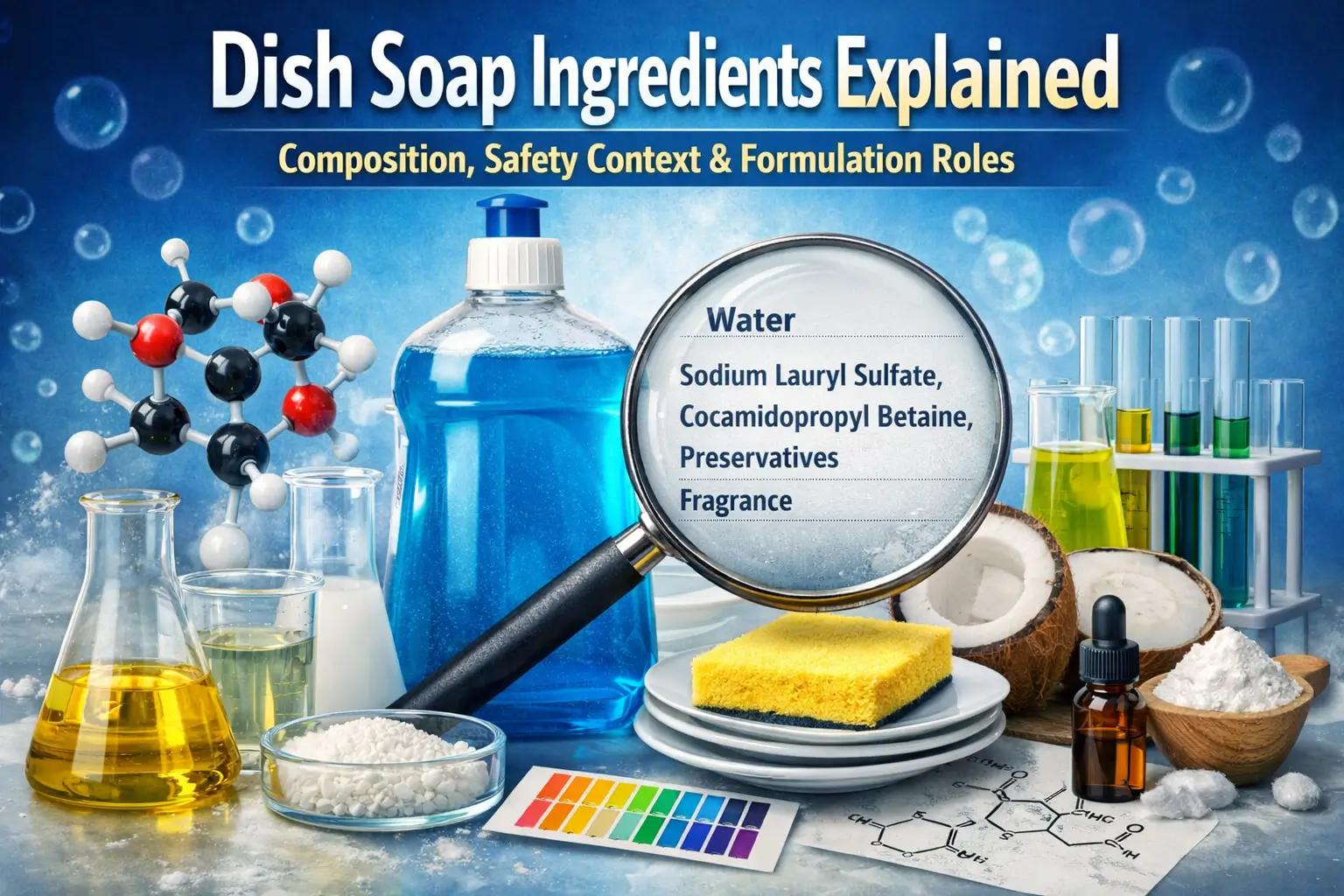
Dish soap ingredient labels typically reflect regulatory disclosure requirements rather than full formulation logic. Ingredients are listed by descending weight at the time of manufacture, which means high-volume carriers like water appear first, while functionally critical components such as preservatives, dyes, or fragrance compounds may appear near the end despite outsized functional impact.
In practice, dishwashing soap ingredients fall into a limited number of functional categories surfactants that remove oils, solvents that carry those surfactants, viscosity modifiers that control pour behavior, stabilizers that prevent separation, and optional fragrance or color components consistent with the structural patterns outlined in liquid soap formulation systems. The label does not disclose concentration ranges, sourcing differences, or processing adjustments, all of which materially affect how the formula behaves once diluted in sink water.
| Ingredient Category | Primary Function | Label Visibility |
|---|---|---|
| Water | Carrier & dilution medium | Always listed first |
| Surfactants | Oil removal & soil suspension | Usually mid-label |
| Viscosity Modifiers | Thickness & flow control | Lower label positions |
| Preservatives | Microbial stability | Near end of list |
| Fragrance & Color | Sensory characteristics | Final label entries |
One limitation of ingredient lists is that they do not distinguish between dish soap ingredients used at functional trace levels and those present at structurally meaningful concentrations. In several formulations observed during routine handling, ingredients listed near the end still influenced scent persistence, bottle residue, or clarity stability despite their low listed position.
Surfactant Systems Used
Dish soap cleaning performance is driven primarily by surfactant systems rather than by single ingredients. In most formulations, multiple surfactants are combined to balance grease removal, foam behavior, rinseability, and cost stability. No single surfactant performs all required roles effectively on its own under typical dishwashing conditions. Similar surfactant balance differences can also be observed in our Ajax dish soap ingredient analysis.
Observationally, modern dishwashing soap ingredients rely on blended anionic and amphoteric surfactants, sometimes supplemented by nonionic surfactants, as illustrated in brand-specific formulations such as those documented in Dawn dish soap ingredient analysis. The blend ratio determines how aggressively oils are lifted, how stable foam remains in the presence of food soils, how quickly residues rinse away from surfaces, and how fragrance systems persist during use, a performance dimension examined further in the Williams-Sonoma dish soap performance and scents guide.
| Surfactant Class | Typical Functional Role | Common Observational Traits |
|---|---|---|
| Anionic | Primary grease removal | High cleaning strength, strong foam response |
| Amphoteric | Foam stabilization & irritation buffering | Improves mildness & foam persistence |
| Nonionic | Soil suspension & rinse aid | Low foam, strong oil solubilization |
In practical use, surfactant behavior changes noticeably once diluted in sink water. At typical hand-washing dilutions, foam volume becomes a less reliable indicator of cleaning efficiency. In several side-by-side observations, lower-foaming formulations removed oils comparably while rinsing faster, illustrating that surfactant chemistry matters more than visual cues.
One formulation limitation commonly observed is foam collapse in hard water environments. Surfactant systems without adequate chelation support may show reduced performance due to mineral interference, even when ingredient labels appear similar.
Fatty-Acid Composition & Source Variability
Many dishwashing soap ingredients are derived from fatty alcohols or fatty acids that originate from plant oils or petrochemical feedstocks. The fatty-acid chain length and saturation profile influence surfactant strength, solubility, and foam characteristics.
Fatty-acid sourcing is not disclosed on ingredient labels, yet it materially affects formulation behavior. Coconut-derived chains tend to favor shorter carbon lengths, while palm-derived inputs often skew slightly longer. These differences can subtly alter grease cutting efficiency and rinse feel, even when ingredient names remain unchanged.
| Carbon Chain Range | Common Source Types | Observed Functional Impact |
|---|---|---|
| C10–C12 | Coconut or mixed plant oils | High foaming, rapid grease lifting |
| C12–C14 | Palm or blended feedstocks | Balanced cleaning & foam stability |
| C14–C16 | Petrochemical or palm fractions | Lower foam, stronger oil solubilization |
Variability between batches can occur when sourcing shifts or when supply chains change regionally. In several formulations evaluated over time, slight differences in clarity and viscosity were observed without any change to the ingredient list, suggesting upstream feedstock variation rather than formulation redesign.
Alkali Systems & pH Control in Dishwashing Soap
Dish soap formulations are generally mildly alkaline, as alkalinity improves grease emulsification and soil release. Alkali systems are not always obvious on labels, as pH adjusters may be present at low concentrations but exert disproportionate influence on performance.
Typical dishwashing soap ingredients used for pH control include mineral bases or buffering agents that stabilize the formulation during storage and dilution. The target pH range is selected to optimize surfactant efficiency rather than to match skin pH.
| pH Range | Functional Outcome | Trade-Off Consideration |
|---|---|---|
| 6.5–7.5 | Lower alkalinity cleaning | Reduced grease cutting |
| 7.5–8.5 | Balanced cleaning performance | Moderate residue control |
| 8.5–9.5 | High grease removal efficiency | Increased material stress on surfaces |
In routine handling, higher-alkaline formulations often feel more slippery during rinsing, a sensation caused by sustained surfactant activity rather than residue buildup. This behavior can be misinterpreted as poor rinsability when it is actually a function of formulation design.
Clean Ingredient Explained
"Clean ingredient dish soap" is not a regulated formulation category. The term is generally used to describe dish soaps that limit ingredient complexity, avoid certain surfactant classes, and emphasize transparent labeling rather than altered cleaning chemistry.
| Ingredient Group | Typical Presence | Formulation Rationale |
|---|---|---|
| Primary Surfactants | Anionic or nonionic detergents | Effective soil removal at lower residue levels |
| Fragrance | Reduced or absent | Lower sensory complexity |
| Colorants | Often absent | Cosmetic exclusion, not performance-based |
| Preservatives | Limited selection | Dependent on water activity & pH |
From a formulation standpoint, "clean" reflects disclosure and exclusion preferences rather than a fundamentally different detergent system. Cleaning performance remains driven by surfactant chemistry and concentration, not by the clean label designation itself.
Additives, Stabilizers & Supporting Ingredients
Additives in dish soap formulations exist to maintain physical stability, control viscosity, prevent ingredient separation, and preserve shelf life rather than to enhance cleaning strength.
While surfactants perform the primary cleaning work, dish soap ingredients typically include several secondary components that ensure the product remains pourable, visually uniform, and microbially stable over extended storage. These additives are often present at low concentrations but are essential to formulation integrity.
| Additive Category | Primary Function | Typical Impact on Use |
|---|---|---|
| Viscosity Modifiers | Control thickness & flow | Affects pour speed & drip behavior |
| Chelating Agents | Bind mineral ions | Improves performance in hard water |
| Solubilizers | Disperse fragrance & oils | Prevents cloudiness or separation |
| Opacifiers | Visual consistency | No cleaning impact |
In several formulations observed during storage testing, viscosity modifiers showed slight thickening under cooler conditions, a reversible physical response rather than a sign of degradation.
Preservative Systems in Dishwashing Soap Ingredients
Preservatives are necessary in liquid dish soap formulations because high water content creates an environment where microbial growth could otherwise occur.
Unlike solid bar soaps, dishwashing liquids rely on chemical preservative systems to maintain product safety and odor stability. These systems are typically broad-spectrum and are supported by chelating agents that reduce metal-catalyzed degradation.
| Preservation Strategy | Mechanism | Observed Limitation |
|---|---|---|
| Chemical Preservatives | Inhibit microbial growth | pH-dependent effectiveness |
| Chelation Support | Improves preservative efficiency | No direct cleaning effect |
| Packaging Control | Limits contamination | Reduced effectiveness if decanted |
A practical limitation is that preservative systems are optimized for the original container. Transferring dish soap into open or reused bottles can shorten shelf stability, even when ingredient composition remains unchanged.
Ingredients: Toxicity Context vs Real-World Exposure
Ingredient toxicity depends on concentration, exposure route, and contact duration rather than on ingredient names alone.
Many dish soap ingredients labeled as "harmful" or "toxic" in isolation are evaluated at concentrations far higher than those present in finished formulations. Ingredient hazard classifications typically reflect raw-material handling risks rather than consumer-use scenarios. Comparable exposure discussions also appear in our antibacterial soap ingredient analysis.
| Factor | Why It Matters | Label Limitation |
|---|---|---|
| Concentration | Determines biological interaction | Not disclosed on labels |
| Dilution in Use | Reduces exposure dramatically | Assumed but not stated |
| Contact Time | Limits interaction duration | Varies by user behavior |
Observationally, concern-driven interpretations often ignore the fact that dishwashing soap is designed for rapid dilution and rinsing. Ingredient behavior under these conditions differs significantly from laboratory or industrial exposure scenarios.
Ingredient Labels: Transparency & Disclosure Gaps
Dish soap ingredient labels disclose presence but not proportion, interaction, or sourcing, which limits their usefulness for detailed risk assessment.
Labels do not distinguish between structural ingredients and trace-level stabilizers, nor do they reveal surfactant ratios or preservative concentrations. This omission is regulatory-compliant but complicates consumer interpretation, particularly for those evaluating dish soap ingredients to avoid.
In practice, two dish soaps with nearly identical ingredient lists may behave differently due to undisclosed formulation variables such as surfactant balance, fatty-chain sourcing, or preservative synergy.
Ingredient Variability by Batch, Region & Process
Dish soap ingredient composition can vary modestly across batches and regions due to sourcing changes, regulatory constraints, and process optimization, even when the label appears unchanged, a pattern also observed in comparative breakdowns such as the Ajax dish soap ingredient profile.
Variability most commonly arises from upstream surfactant feedstocks and preservative systems. Fatty-chain sourcing may shift between plant-derived and petrochemical inputs depending on availability, while preservative selection can vary to meet regional regulations. These changes typically do not alter the functional category listed on the label but can influence clarity, viscosity, or foam persistence.
In routine handling comparisons, two bottles with identical labels but different production dates showed small differences in pour thickness and foam decay rate, suggesting process-level adjustments rather than formulation redesign.
Stability & Shelf-Life Behavior of Ingredients
Dish soap formulations are engineered for long shelf life, with stability governed by preservative systems, chelation, and packaging integrity rather than by surfactant degradation.
Surfactants are generally stable over time, while the most noticeable long-term changes tend to involve fragrance volatility, color fading, and viscosity drift. Exposure to heat cycles can accelerate these changes without meaningfully affecting cleaning performance.
| Component | Primary Stability Driver | Common Change Over Time |
|---|---|---|
| Surfactants | Chemical robustness | Minimal functional change |
| Fragrance | Volatility & oxidation | Scent softening |
| Viscosity Modifiers | Temperature sensitivity | Thickening or thinning |
| Colorants | Light exposure | Gradual fading |
In several storage observations, cleaning efficacy remained stable even as fragrance intensity declined, indicating that sensory degradation often precedes functional change.
Formulation Balance & Ingredient Trade-Offs
Dish soap formulations balance grease removal, foam behavior, stability, and cost, resulting in predictable ingredient trade-offs rather than universally "good" or "bad" ingredients.
Higher anionic surfactant levels improve oil removal but may require amphoteric surfactants to moderate foam behavior. Increased preservative robustness supports shelf life but can constrain fragrance choices. Lower pH improves mildness perception yet may reduce grease cutting efficiency. Detergent balance differences are also visible in Dawn dish soap ingredient analysis.
| Design Goal | Ingredient Emphasis | Resulting Limitation |
|---|---|---|
| Maximum Grease Removal | Higher anionic surfactants | Potential foam excess |
| Long Shelf Life | Robust preservative systems | Reduced fragrance flexibility |
| Fast Rinsing | Lower foam systems | Perceived lower cleaning power |
These trade-offs explain why two dish soaps can target different user preferences while using broadly similar ingredient categories.
Safety & Practical Use Considerations (Ingredient-Based)
Dish soap ingredient systems are designed for short-contact, high-dilution cleaning contexts, and their practical limitations arise from formulation balance, alkalinity, and preservative dependence rather than from inherent ingredient danger.
From an ingredient-behavior perspective, dishwashing liquids function as intended when used in diluted sink water and rinsed promptly from surfaces. Extended undiluted contact, decanting into unsealed containers, or prolonged heat exposure can shift viscosity, fragrance stability, or preservative performance without altering the listed ingredients.
In routine handling observations, residue or slippery feel during rinsing was more closely tied to surfactant concentration and water temperature than to any single ingredient. These effects resolve with sufficient dilution and rinse time and reflect formulation design rather than instability.
Summary of Findings
- Ingredient Systems Matter: Dish soap performance is determined by surfactant blends, pH balance, and stabilizers rather than individual ingredients in isolation.
- Labels Are Partial: Ingredient labels disclose presence but not proportions, sourcing, or interaction effects that influence real-world behavior.
- Toxicity Is Contextual: Ingredient concern depends on concentration, dilution, and contact duration, not on ingredient names alone.
- Variability Exists: Batch, region, and sourcing changes can alter viscosity or foam behavior without changing the ingredient list.
- Trade-Offs Are Intentional: Formulation decisions balance grease removal, stability, foam, and shelf life rather than maximizing a single attribute.
References
- Schramm, L. L. Surfactants: Fundamentals and Applications in the Petroleum Industry. Cambridge University Press. Publisher
- Rosen, M. J., & Kunjappu, J. T. Surfactants and Interfacial Phenomena. Wiley Online Library
- U.S. FDA: Cosmetic & Consumer Product Regulation Framework. FDA Cosmetics Guidance
- OECD Exposure Assessment Guidance. OECD Chemical Safety
- Gunstone, F. D. Fatty Acid and Lipid Chemistry. CRC Press. CRC Press