Definition and System Identity
Alcohol Ethoxylates(Alcohol Ethoxylate) are nonionic surfactants used in detergent and cleansing formulations to enable grease solubilization, surface wetting and controlled foam behavior.
They are produced by reacting fatty alcohols with ethylene oxide, resulting in molecules that combine a hydrophobic alkyl chain with a hydrophilic ethoxylated segment.
Within formulation systems, they function as low-foaming surfactants that assist in dissolving oily soils and stabilizing mixed surfactant systems alongside anionic components.
This page is part of the CleanFormulation Ingredient Library, a research-driven project analyzing how ingredients behave inside real cleansing formulations rather than in isolation.
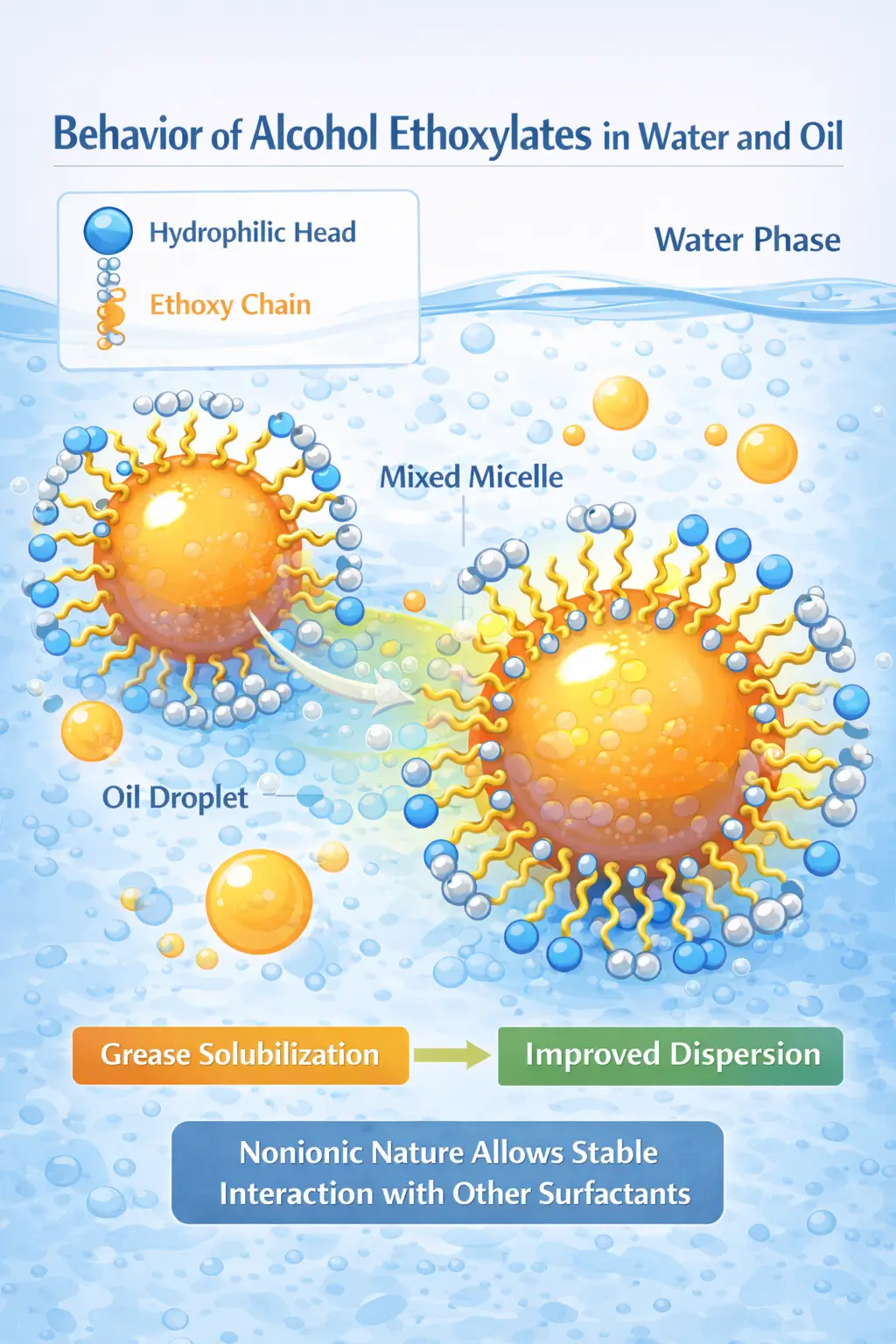
Quick Facts
| Property | Description |
|---|---|
| Ingredient Type | Primary or co-surfactant |
| Chemical Class | Ethoxylated alcohol surfactant |
| Functional Role | Grease solubilization, wetting, emulsification |
| Ionic Class | Nonionic |
| Typical Use Context | Laundry detergents, dishwashing liquids, industrial cleaners |
| Foam Profile | Low to moderate, controlled foam |
| Hydrophilic Component | Ethylene oxide (EO) chains |
| Hydrophobic Component | Linear fatty alcohol chain (C12–C15 typical) |
| HLB Range | Adjustable (typically 8–15 depending on EO content) |
| Solubility Behavior | Water-soluble; increases with higher ethoxylation |
| Cloud Point | Temperature-dependent phase separation behavior critical in liquid systems |
| Grease Removal Efficiency | High, especially for oily and non-polar soils |
| Performance in Hard Water | Unaffected by calcium and magnesium ions |
| Synergy with Anionics | Enhances detergency and reduces harshness in blended systems |
| Wetting Performance | Rapid surface wetting and penetration |
| Micelle Behavior | Forms nonionic micelles with strong oil solubilization capacity |
| pH Stability | Stable across wide pH range (acidic to alkaline systems) |
| Electrolyte Sensitivity | Moderate; solubility and cloud point affected by salts |
| Formulation Role | Balances foam, improves grease cleaning, stabilizes surfactant systems |
| System Limitation | Clouding at elevated temperatures; performance depends on EO level |
Why This Ingredient Appears on Labels
Alcohol ethoxylates appear on ingredient labels because they function as key nonionic surfactants within cleansing systems, particularly where grease removal and controlled foam behavior are required.
They are typically included alongside anionic surfactants to improve cleaning balance, especially in formulations designed for variable water conditions or low-foam applications such as machine washing.
On labels, they may be listed using INCI-compliant naming structures or described through ethoxylated alcohol terminology. Their placement in the ingredient list reflects their role as functional surfactants rather than auxiliary additives, as explained in the ingredient list interpretation guide.
In practical use, their presence is associated with faster grease dispersion, reduced foam accumulation and more stable rinse behavior compared to systems relying solely on high-foaming surfactants.
Chemical Identity and Classification
Alcohol Ethoxylates belong to a class of nonionic surfactants formed by the reaction of fatty alcohols with ethylene oxide. This process produces a series of molecules with varying ethoxylation lengths, resulting in a distribution rather than a single uniform compound.
The hydrophobic portion consists of a linear or branched alkyl chain derived from natural or synthetic alcohols, while the hydrophilic portion is composed of repeating ethylene oxide units. The number of these units determines water solubility and interaction behavior within the formulation.
Unlike anionic surfactants, these molecules do not carry a charge in aqueous systems. This nonionic character allows them to remain stable across a wide range of pH conditions and in the presence of dissolved salts.
From a classification perspective, they are grouped within nonionic surfactants alongside other ethoxylated systems, forming a distinct functional category used to balance cleansing performance and formulation stability.
This structural flexibility means that formulation outcomes depend not only on the presence of alcohol ethoxylates but also on the specific distribution of ethoxylation within the system.
Functional Role in Detergent Systems
Alcohol ethoxylates function primarily as grease solubilizers and wetting agents within detergent formulations, enabling rapid interaction between water and hydrophobic soils.
When introduced into water, they reduce interfacial tension and facilitate the spreading of the liquid phase across surfaces, improving contact between the cleaning system and soil deposits.
This results in three key functional behaviors:
- Wetting enhancement: improved penetration of water into fabric or surface layers
- Grease solubilization: incorporation of oils into dispersed micellar or mixed structures
- Controlled foam profile: reduced foam compared to high-foaming surfactants
In contrast to systems dominated by strong foaming agents such as linear alkylbenzene sulfonates, alcohol ethoxylates contribute to a more controlled washing environment where foam does not interfere with mechanical action.
In practical observation, this translates into faster spreading of wash water, reduced visible foam accumulation and more uniform removal of oily residues across surfaces.
Ingredient Interaction Logic
The performance of alcohol ethoxylates is strongly dependent on their interaction with other components in the formulation rather than their isolated properties.
Interaction with Anionic Surfactants
Alcohol ethoxylates are frequently combined with anionic surfactants to form mixed systems that balance cleaning strength and foam control.
In these systems, nonionic molecules integrate into mixed micelles, modifying their structure and reducing electrostatic repulsion between charged head groups. This results in improved stability and enhanced grease handling.
This interaction is particularly relevant in formulations containing synthetic anionic surfactants, where nonionic components help moderate foam and improve performance under varying wash conditions.
Interaction with Water Phase
In aqueous environments, alcohol ethoxylates dissolve without ionization, allowing them to remain effective regardless of water hardness or ionic strength.
Their behavior is influenced by temperature and concentration, with aggregation patterns shifting depending on system conditions rather than fixed charge interactions.
Interaction with Builders and Electrolytes
Builders such as carbonates and phosphates modify the surrounding chemical environment by adjusting pH and binding hardness ions.
Because alcohol ethoxylates do not form insoluble salts with calcium or magnesium ions, their functionality remains largely unaffected in hard water systems, supporting consistent cleaning behavior.
This compatibility is a key reason they are widely used in modern detergent formulation systems, where predictable performance is required across different water compositions.
Interaction with Fragrance Systems
Hydrophobic fragrance components are often incorporated into surfactant systems through solubilization mechanisms.
Alcohol ethoxylates assist in stabilizing these compounds within the aqueous phase, complementing the role described in fragrance system behavior.
Interaction with Co-Surfactants
When used alongside amphoteric or other nonionic surfactants, alcohol ethoxylates contribute to the overall balance of cleansing strength, viscosity and rinse performance.
These interactions highlight that formulation outcomes are determined by the collective behavior of multiple surfactants rather than any single ingredient.
Phase Behavior and Physical Characteristics
The behavior of alcohol ethoxylates in aqueous systems is governed by their solubility characteristics and their response to temperature changes, particularly through a phenomenon known as cloud point.
At lower temperatures, these molecules remain fully soluble in water, forming clear solutions or mixed micellar systems. As temperature increases, solubility decreases and phase separation can occur once the cloud point is reached.
This behavior is directly linked to the ethoxylate chain length. Higher ethoxylation generally increases water solubility, while lower ethoxylation results in reduced solubility and earlier phase separation.
Cloud Point Behavior
The cloud point represents the temperature at which the surfactant solution becomes turbid due to separation of surfactant-rich phases from water.
In formulation design, this property is used to control performance characteristics such as grease removal efficiency and rinse behavior.
In practical terms, this means that temperature changes during washing can influence how effectively the surfactant interacts with oily soils, especially in low-temperature wash conditions.
Foam Characteristics
Alcohol ethoxylates produce relatively low and quickly collapsing foam compared to strongly foaming anionic surfactants.
This property makes them suitable for systems where excessive foam would interfere with mechanical washing processes, such as high-efficiency machines.
Solubility and Hydration Behavior
Unlike ionic surfactants, their solubility is not driven by charge interactions but by hydrogen bonding between ethoxylate chains and water molecules.
This results in a more gradual and temperature-sensitive solubility profile rather than abrupt changes linked to ionic dissociation.
Comparison With Related Surfactants
Alcohol ethoxylates are often used alongside anionic surfactants, but their behavior differs significantly in terms of foam, solubility and interaction with water chemistry.
| Feature | Alcohol Ethoxylates | Anionic Surfactants |
|---|---|---|
| Ionic Nature | Nonionic | Negatively charged |
| Foam Behavior | Low, controlled | High, stable |
| Hard Water Sensitivity | Low | Moderate depending on system |
| Primary Function | Grease solubilization, wetting | Soil removal, foam generation |
| Temperature Sensitivity | Cloud point dependent | Less temperature sensitive |
This distinction explains why alcohol ethoxylates are commonly paired with anionic surfactants, forming balanced systems that combine strong cleaning with controlled foam behavior.
Regulatory Context
Alcohol ethoxylates are regulated within broader chemical and detergent frameworks rather than as specialized active substances.
In the European Union, their use in cleaning products is governed by detergent regulations, where biodegradability and environmental interaction are considered key parameters.
When used in personal cleansing formulations classified as cosmetics, they fall under general cosmetic regulation frameworks, as outlined in the cosmetic classification system.
Their labeling follows standardized naming conventions and ingredient disclosure rules described in the ingredient list interpretation guide.
Regulatory evaluation is based on intended use, formulation context and exposure conditions rather than solely on chemical identity.
Common Misunderstanding
A common misconception is that alcohol ethoxylates are simply weaker alternatives to high-foaming surfactants because they produce less visible foam.
In reality, foam generation is not directly proportional to cleaning effectiveness. Alcohol ethoxylates contribute to grease removal through wetting and solubilization mechanisms rather than foam formation.
Another misunderstanding is that all surfactants behave similarly in water. Nonionic systems operate through different interaction mechanisms compared to charged surfactants, leading to distinct performance characteristics.
These differences become clearer when examining how cleansing differs from antimicrobial action, as discussed in the cleansing mechanism explanation.
Structural and Formulation Limitations
Despite their versatility, alcohol ethoxylates present certain formulation constraints that must be managed within system design.
- Temperature sensitivity: performance can vary near the cloud point, affecting solubility and system clarity.
- Foam limitation: low foam generation may not meet expectations in formulations designed for visible lather.
- Dependence on co-surfactants: often require combination with anionic surfactants to achieve balanced cleaning performance.
- Distribution variability: differences in ethoxylation degree can lead to variability in behavior across formulations.
These constraints highlight the importance of formulation balance, where alcohol ethoxylates function as part of a broader surfactant system rather than as standalone agents.
Formulation References Using This Ingredient
Summary of Findings
- Classification: Alcohol ethoxylates are nonionic surfactants derived from ethoxylated fatty alcohols.
- Functional Role: They contribute to grease solubilization, wetting and controlled foam behavior in detergent systems.
- Interaction Logic: Their performance depends on interaction with anionic surfactants, builders and formulation conditions.
- System Behavior: They remain stable in varying water conditions but exhibit temperature-dependent solubility.
- Limitations: Cloud point sensitivity and low foam characteristics influence formulation design.