Ingredient Identity and Chemical Classification
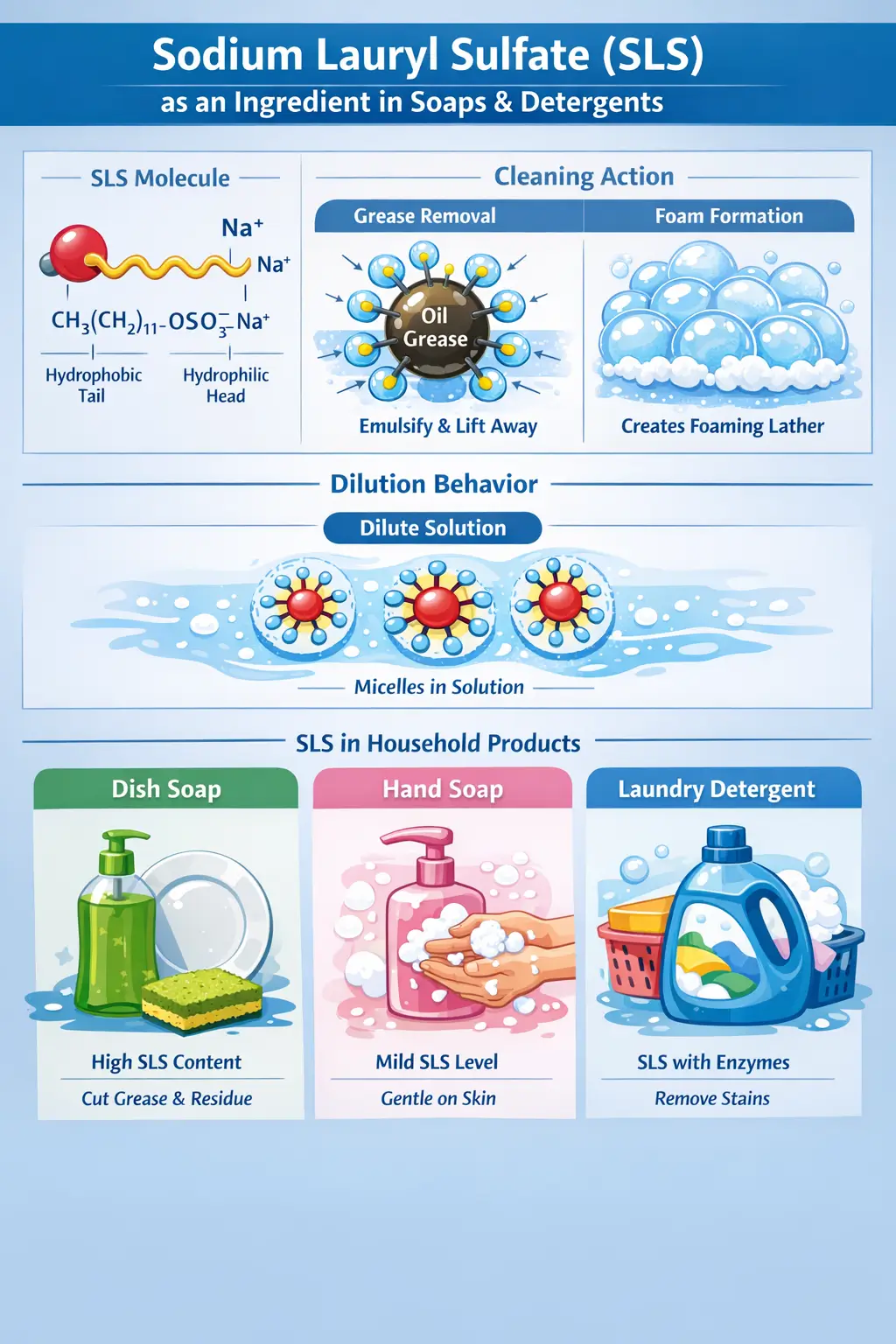
Chemically, Sodium Lauryl Sulfate belongs to the alkyl sulfate family of surfactants. It is produced through sulfation of lauryl alcohol followed by neutralization with sodium salts, resulting in a water-soluble compound capable of interacting simultaneously with oils and water molecules. This dual interaction allows grease and residues to become suspended during washing rather than remaining attached to surfaces.
Although often discussed in consumer conversations as a single ingredient category, manufacturing sources and processing routes can vary. Lauryl alcohol inputs may originate from plant-derived fatty alcohol streams or petrochemical synthesis pathways, yet the resulting surfactant performs similarly once incorporated into finished formulations.
| Attribute | Description |
|---|---|
| Ingredient Type | Anionic surfactant |
| Chemical Family | Alkyl sulfate |
| Primary Functional Role | Oil removal and soil suspension |
| Water Solubility | High |
| Common Product Systems | Dish soap, hand soap, shampoos, laundry detergents |
Because of predictable cleansing performance, Sodium Lauryl Sulfate has also historically been used as a comparison reference in surfactant testing research. However, modern consumer formulations rarely rely on SLS alone. Most products combine it with amphoteric or nonionic surfactants similar to systems described in broader cleansing formulation discussions such as the soap ingredient functional guide.
Also Known As: Naming Variations on Labels
Ingredient naming differences can create confusion when comparing labels across detergents and personal cleansing products. Sodium Lauryl Sulfate may appear under abbreviated or chemically equivalent terminology depending on regulatory disclosure systems or technical documentation.
- SLS: common abbreviation used in formulation discussions
- Sodium dodecyl sulfate: chemical naming equivalent used in research literature
- Alkyl sulfate surfactant: functional classification reference
Label interpretation becomes particularly difficult when comparing household detergents with cosmetic cleansing products, since disclosure rules differ between detergent and cosmetic regulatory frameworks. As a result, two products performing similarly may list surfactant systems differently despite relying on comparable chemistry.
Where Sodium Lauryl Sulfate Is Used in Cleaning Formulations
Sodium Lauryl Sulfate appears across multiple categories of cleansing products because its behavior remains relatively stable under dilution and mechanical agitation. While the ingredient name may remain identical across labels, formulation goals differ substantially between dishwashing liquids, hand cleansing products, and laundry detergents. These differences influence concentration levels, surfactant pairing strategies, and rinse performance.
In practice, formulators adjust surrounding ingredients rather than relying solely on SLS strength. Foam control agents, water conditioners, or secondary surfactants are commonly introduced to modify how the system behaves during real-world washing conditions.
Role of Sodium Lauryl Sulfate in Dish Soap
In dishwashing liquids, Sodium Lauryl Sulfate primarily contributes to grease dispersion and rapid soil suspension. Cooking oils and food residues tend to bind strongly to surfaces, particularly under cooler washing temperatures. Anionic surfactants such as SLS help break this attachment by surrounding oil particles and allowing them to remain suspended in rinse water.
Dish soap formulations typically combine SLS with amphoteric surfactants that stabilize foam during exposure to fats and proteins released from food waste. Without this balance, foam collapse can occur quickly once oils accumulate in sink water: a behavior often mistaken for reduced cleaning performance.
Ingredient systems observed in products analyzed throughout the ingredient library, including formulations discussed in the Dawn dish soap ingredient analysis and the Ajax dish soap formulation profile, illustrate how surfactant blending rather than individual ingredients determines grease removal efficiency.
| Formulation Goal | Contribution of SLS |
|---|---|
| Grease removal | Emulsifies cooking oils and fats |
| Foam response | Produces visible foam during agitation |
| Residue suspension | Prevents redeposition on dishes |
| Rinse performance | Supports rapid dilution in water |
Role of Sodium Lauryl Sulfate in Hand Soap and Personal Cleansing
When used in hand soaps or body cleansing systems, Sodium Lauryl Sulfate serves a similar cleansing purpose but operates within a different formulation balance. Personal cleansing products must maintain foam stability while limiting excessive residue after rinsing, particularly under repeated daily use.
For this reason, SLS is frequently paired with milder amphoteric surfactants or viscosity modifiers that influence how the product spreads across skin surfaces. The resulting blend changes user perception significantly even when the underlying surfactant chemistry remains comparable.
Liquid hand soaps and syndet-style cleansers evaluated across ingredient breakdowns such as the Dial soap ingredient explanation and Dove cleansing bar ingredient analysis demonstrate how surfactant combinations alter foam density and rinse feel without fundamentally changing the cleaning mechanism.
| Design Objective | Formulation Adjustment |
|---|---|
| Foam stability | Balanced with amphoteric surfactants |
| Spreadability | Supported by viscosity modifiers |
| Rinse behavior | Controlled through dilution response |
| Cleaning efficiency | Removal of oils and particulate soils |
Role of Sodium Lauryl Sulfate in Laundry Detergent Systems
Laundry detergents operate under more complex washing conditions compared with hand or dish cleaning environments. Fabrics trap soils within fibers, requiring surfactants capable of lifting oils while preventing redeposition during extended wash cycles.
In powdered or liquid laundry systems, Sodium Lauryl Sulfate may function alongside builders, enzymes, and water-softening agents. These supporting components allow surfactants to remain effective even in mineral-rich water environments where cleaning efficiency might otherwise decline.
Ingredient comparisons found in formulations such as the Arm & Hammer laundry soap ingredient breakdown show that surfactant performance becomes closely tied to alkalinity control and mineral binding rather than foam generation alone.
| Laundry Requirement | Surfactant Contribution |
|---|---|
| Oil lifting from fabrics | Disperses hydrophobic residues |
| Soil suspension | Prevents redeposition during wash cycle |
| Compatibility with builders | Maintains activity in alkaline systems |
| Agitation response | Supports mechanical washing action |
Unlike handwashing contexts, visible foam in washing machines provides limited information about cleaning performance. Modern detergent systems frequently prioritize soil suspension and rinse efficiency instead.
Typical Concentration Context Across Cleaning Products
Discussion surrounding Sodium Lauryl Sulfate often focuses on the ingredient name itself rather than the concentration at which it operates within finished formulations. In practical manufacturing environments, surfactant performance changes significantly depending on dilution level, supporting ingredients, and intended cleaning conditions.
Dishwashing liquids, personal cleansers, and laundry detergents rarely use identical surfactant loading even when labels appear similar. Instead, formulators adjust active surfactant content to balance grease removal, rinsability, viscosity stability, and storage performance.
| Product Category | Typical Functional Range* | Primary Reason |
|---|---|---|
| Dishwashing liquid | Moderate surfactant systems | Rapid grease dispersion in sink dilution |
| Hand soap / cleansers | Lower active balance | Frequent use and rinse behavior control |
| Laundry detergent | Variable depending on builders | Extended wash cycle soil suspension |
*Ranges reflect formulation observation patterns and public ingredient disclosures rather than laboratory quantification.
Because ingredient lists disclose presence rather than proportion, consumers comparing labels may assume formulations behave similarly when underlying surfactant balance differs considerably.
Dilution Behavior During Real-World Use
One of the defining characteristics of Sodium Lauryl Sulfate is how rapidly its behavior changes once introduced into water. Most cleaning scenarios involve immediate dilution: sink water during dishwashing, running water during handwashing, or full wash cycles inside laundry machines.
Under dilution, surfactant molecules reorganize into microscopic structures capable of surrounding oils and suspended particles. This process reduces direct interaction between grease and surfaces, allowing contaminants to rinse away more easily.
Observational handling comparisons show that temperature, agitation, and mineral content of water frequently influence cleaning outcomes more than ingredient selection alone. Hard water environments, for example, may interfere with surfactant efficiency unless chelating agents or builders are present within the formulation.
| Variable | Observed Effect |
|---|---|
| Water hardness | Minerals may reduce surfactant efficiency |
| Temperature | Warmer water improves oil mobility |
| Mechanical agitation | Improves soil suspension |
| Dilution level | Changes foam and rinsing behavior |
These variables explain why identical products may appear to perform differently between households despite unchanged ingredient composition.
Formulation Trade-Offs When Using Sodium Lauryl Sulfate
No surfactant simultaneously maximizes grease removal, foam stability, mildness perception, and rinse speed. As a result, Sodium Lauryl Sulfate is typically incorporated as one component within a balanced detergent system rather than as a dominant ingredient.
Increasing anionic surfactant strength may improve oil removal but can also require foam regulators or co-surfactants to prevent excessive residue perception during rinsing. Conversely, reducing surfactant intensity may improve user comfort while lowering performance under heavy soil conditions.
| Design Priority | Adjustment Involving SLS | Potential Limitation |
|---|---|---|
| Maximum grease removal | Higher anionic contribution | Foam persistence increases |
| Fast rinsing | Balanced surfactant blending | Reduced visible foam |
| Long shelf stability | Supportive stabilizers added | Formula complexity increases |
| Hard water tolerance | Builders or chelators required | Higher formulation cost |
These formulation decisions help explain why products targeting different cleaning environments may rely on comparable ingredient lists while delivering noticeably different performance characteristics.
Why Ingredient Labels Do Not Fully Describe Cleaning Behavior
Ingredient disclosure systems prioritize transparency regarding presence rather than interaction between components. Sodium Lauryl Sulfate listed on a label therefore reveals only part of the formulation structure.
Surfactant ratios, processing methods, and stabilizer systems remain undisclosed despite strongly influencing viscosity, foam stability, and rinsability. Two detergents containing SLS may therefore behave differently even when ingredient ordering appears nearly identical.
This limitation is frequently observed when comparing formulations across detergent and soap categories documented throughout the broader ingredient function reference library, where similar surfactant systems produce distinct outcomes depending on formulation balance.
Stability and Storage Behavior in Finished Products
Within properly formulated detergents and cleansing products, Sodium Lauryl Sulfate is chemically stable across typical storage conditions. Changes noticed by consumers over time are more often linked to fragrance volatility, viscosity modifiers, or temperature exposure rather than degradation of the surfactant itself.
Liquid formulations stored under repeated heat and cooling cycles may show temporary thickening or separation effects depending on supporting ingredients. These physical shifts generally reflect formulation sensitivity rather than loss of cleaning function.
| Observed Change | Likely Cause |
|---|---|
| Thickness variation | Temperature response of viscosity modifiers |
| Reduced fragrance strength | Volatile compound evaporation |
| Cloudiness | Solubilizer balance shifts |
| Foam differences | Water conditions during use |
In most observed cases, cleaning performance remains largely unchanged even when cosmetic characteristics evolve during long storage periods.
Safety Interpretation in Practical Cleaning Use
Interpretation of ingredient safety frequently depends on exposure conditions rather than ingredient identity alone. Sodium Lauryl Sulfate is typically used within rinse-off systems where dilution and short contact duration significantly influence interaction outcomes.
Laboratory hazard classifications often evaluate concentrated raw materials under extended exposure conditions. Household cleaning scenarios differ substantially because surfactants are rapidly diluted and removed through rinsing processes.
A detailed evaluation of human exposure studies and regulatory interpretation updates is maintained separately within the Sodium Lauryl Sulfate evidence and concentration review , which documents how research findings are interpreted within the CleanFormulation framework.
Manufacturing and Batch Variability
Although Sodium Lauryl Sulfate follows standardized chemical specifications, finished product behavior may vary slightly between manufacturing batches or geographic markets. Supply chain sourcing, water quality during production, and supporting ingredient substitutions can influence viscosity or foam persistence without requiring label modification.
Such variation is common within large-scale detergent manufacturing and does not necessarily indicate reformulation. Minor differences observed between bottles or production dates are often related to processing adjustments intended to maintain consistency under changing raw material availability.
Summary of Ingredient Findings
- Functional Ingredient: Sodium Lauryl Sulfate operates primarily as an oil-removing surfactant used across dishwashing, hand cleansing, and laundry detergent systems.
- Performance Depends on Formulation: Cleaning behavior is determined by surfactant blends, builders, and dilution conditions rather than SLS alone.
- Usage Context Matters: Dishwashing, personal cleansing, and fabric washing environments require different formulation balances despite similar ingredient labeling.
- Labels Provide Limited Detail: Ingredient lists disclose presence but not surfactant ratios or interaction effects influencing real-world performance.
- Exposure Is Dilution-Dependent: Most household cleaning scenarios involve rapid dilution and rinse removal.
References
- Schramm, L. L. Surfactants: Fundamentals and Applications. Cambridge University Press. Publisher reference
- Rosen, M. J., & Kunjappu, J. T. Surfactants and Interfacial Phenomena. Wiley-Interscience. Publisher reference
- OECD. Guidance documents on exposure assessment of cleaning product ingredients. OECD publications
- Cosmetic Ingredient Review (CIR). Safety assessments of alkyl sulfate surfactants. CIR safety database
- European Commission. Detergent ingredient disclosure framework. Regulatory documentation