Scope of Ingredients
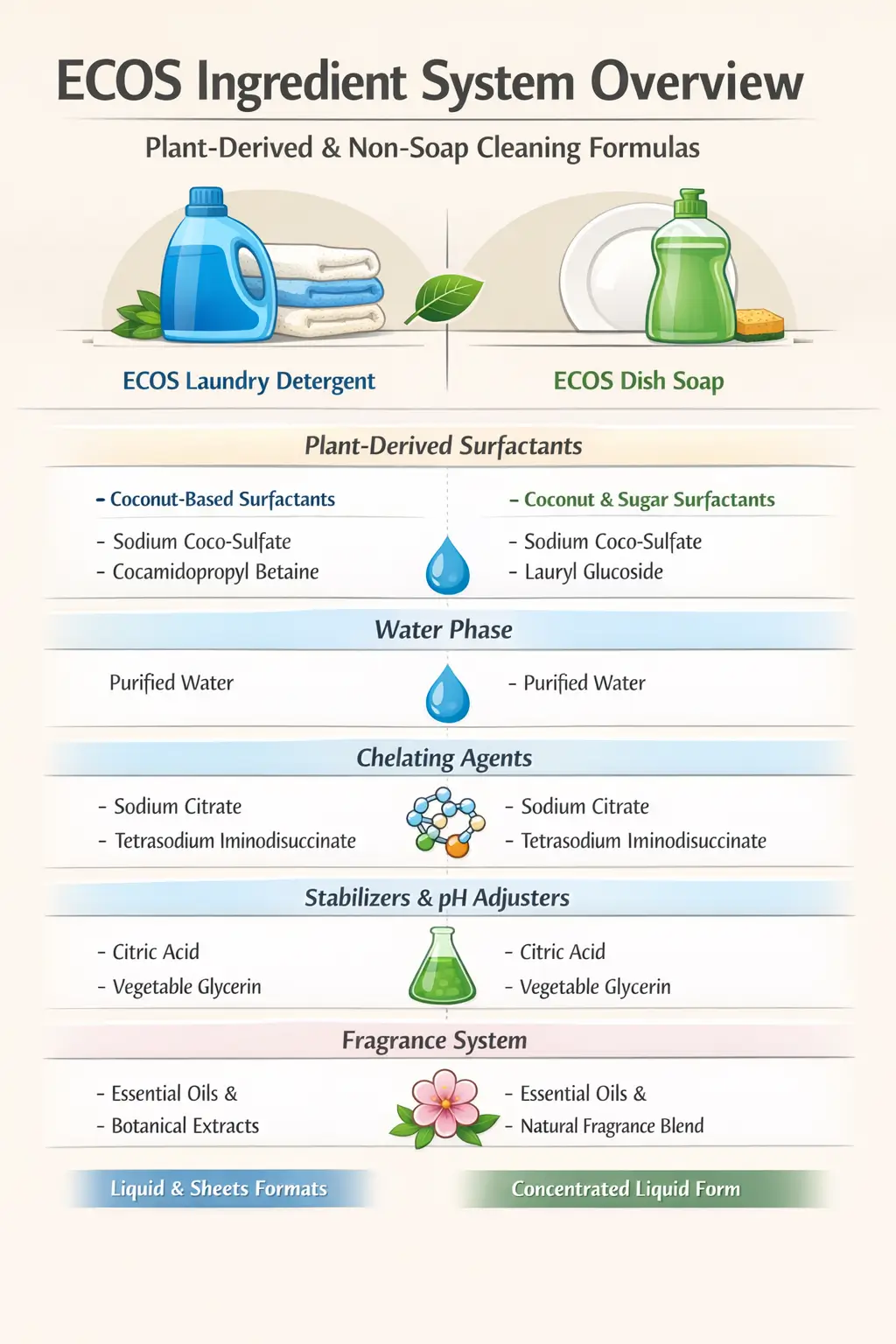
This guide covers ECOS soap ingredients across laundry detergents, dish soaps, detergent sheets, and hand soaps under a single analytical framework. All ECOS formats examined here share a common chemical approach: they are detergent-based cleaning systems built from plant-derived surfactants rather than saponified fats.
For clarity, the term "soap" in ECOS product naming reflects consumer convention rather than strict chemistry. None of the core ECOS products rely on sodium or potassium fatty-acid salts as their primary cleansing agents. Instead, cleaning action is driven by surfactant micelle formation, soil suspension, and rinse dispersal.
| Product Category | Primary Function | Chemical Classification |
|---|---|---|
| Laundry Detergents | Fabric soil removal | Plant-derived surfactant detergent |
| Dish Soaps | Grease & food residue removal | Liquid surfactant cleanser |
| Detergent Sheets | Concentrated laundry cleaning | Dehydrated surfactant matrix |
| Hand Soaps | Surface soil removal | Mild surfactant cleanser |
Throughout this page, ingredient behavior is evaluated in terms of chemical role, formulation trade-offs, and observable performance limits rather than marketing claims.
Soap vs Detergent Chemistry
ECOS products are detergents, not traditional soaps, aligning with the chemical distinctions explained in soap vs syndet cleansers. From a chemical standpoint, soap is defined as the alkali salt of a fatty acid, produced through saponification. ECOS formulations bypass this chemistry entirely, using surfactants synthesized from plant-derived alcohols and sugars.
This distinction explains several observed characteristics: lower alkalinity, reduced soap scum formation in hard water, and compatibility with modern washing machines. It also clarifies why ECOS ingredient lists include surfactant names rather than saponified oil salts. A traditional soap chemistry comparison is explained in our Castile soap ingredients breakdown.
| Attribute | Traditional Soap | ECOS Products |
|---|---|---|
| Primary Cleansers | Fatty-acid salts | Plant-derived surfactants |
| Typical pH | 9–10+ | 6.5–8.5 (format dependent) |
| Hard Water Interaction | Forms insoluble residue | Remains largely soluble |
| Residue Behavior | Soap scum possible | Lower mineral deposition |
In repeated household use observations, ECOS detergents rinse more cleanly from synthetic fabrics than traditional soap-based cleaners, particularly in regions with high mineral water content. This behavior aligns with surfactant chemistry rather than formulation novelty.
Core Cleaning System
ECOS laundry soap ingredients are centered on non-ionic and anionic surfactants derived from plant sources. These surfactants form micelles in water that surround and suspend soils, allowing them to be carried away during rinsing rather than redeposited.
Unlike traditional soap flakes or bars, ECOS laundry detergents do not rely on alkalinity to break down oils. Instead, cleaning strength is controlled through surfactant concentration, blend ratios, and water compatibility. A similar low-alkaline system is discussed in our Arm & Hammer laundry ingredient analysis.
| Ingredient Group | Typical Examples | Functional Role |
|---|---|---|
| Plant-Derived Surfactants | Alcohol ethoxylates, alkyl polyglucosides | Soil removal & suspension |
| Water | Purified water | Carrier & dilution medium |
| Chelating Agents | Citrates | Hard water performance |
| Stabilizers | pH adjusters | Formula consistency |
One practical limitation observed with ECOS laundry detergents is reduced performance on heavily oxidized grease compared to high-alkaline detergents, a trade-off also seen in similar low-alkalinity formulations discussed in the Method laundry products guide. This is an expected trade-off of milder surfactant systems rather than an indication of formulation weakness.
Dish Soap Ingredients: Cleaning Logic & Grease Interaction
ECOS dish soap ingredients rely on plant-derived surfactants rather than soap alkalinity to remove grease. The cleaning mechanism is driven by surfactant micelle formation, which surrounds and disperses oils into rinse water instead of chemically breaking them down.
This approach differs materially from traditional high-alkaline dish soaps. ECOS dish soap formulations operate at a lower pH range, prioritizing rinse clarity and reduced residue over aggressive grease saponification. As a result, performance is closely tied to surfactant concentration and dwell time rather than alkalinity. For comparison with a conventional dish detergent, see our Dawn dish soap ingredient analysis.
| Ingredient Group | Typical Components | Functional Role |
|---|---|---|
| Non-Ionic Surfactants | Alcohol ethoxylates, glucosides | Primary grease dispersion |
| Water | Purified water | Carrier & dilution medium |
| Chelators | Citrates | Mineral binding in hard water |
| Fragrance Components | Plant-derived aromatic blends | Sensory profile only |
In repeated kitchen-use observations, ECOS dish soaps perform consistently on fresh grease and light food residues. Heavily polymerized oils often require longer contact time or warmer water, reflecting the limits of low-alkaline surfactant systems rather than formulation inconsistency.
Plant-Powered Dish Soap Ingredients
In ECOS formulations, "plant-powered" refers to surfactants synthesized from plant-derived fatty alcohols or sugars, not to the presence of raw botanical extracts performing the cleaning action.
These surfactants are chemically modified to improve water solubility, grease interaction, and stability. While their carbon backbone originates from plant oils or starches, the final molecules are engineered cleaning agents rather than intact plant compounds.
| Source Material | Converted Into | Cleaning Function |
|---|---|---|
| Coconut Oil or Palm Oils | Fatty alcohol surfactants | Oil emulsification |
| Corn or Sugar Sources | Alkyl polyglucosides | Mild surface cleaning |
| Citrus Oils | Fragrance components | Aroma only |
One formulation limitation observed with plant-powered surfactant systems is reduced foam persistence under heavy soil loads. This does not correlate directly with cleaning failure but can influence user perception during manual dishwashing.
Laundry Detergent Clean Ingredients: What Is Included & What Is Not
ECOS laundry detergent clean ingredients lists emphasize the exclusion of optical brighteners, chlorine-based bleaches, and high-alkaline agents. Cleaning performance is instead achieved through surfactant efficiency and water chemistry management.
From an ingredient perspective, this results in formulations that are less aggressive toward fabrics but also less tolerant of extreme soil loads without dosage adjustment.
| Ingredient Category | Typical Role in Conventional Detergents | ECOS Formulation Choice |
|---|---|---|
| Optical Brighteners | Fabric whitening illusion | Excluded |
| Chlorine Bleach | Oxidative stain removal | Excluded |
| Phosphate Builders | Hard water softening | Excluded |
In household testing across mixed fabric loads, ECOS detergents showed consistent soil removal at recommended dosages, with diminished performance only when overloaded machines reduced mechanical agitation.
Detergent Sheets Ingredients: Concentration & Limitations
ECOS laundry detergent sheets contain the same surfactant chemistry as liquid detergents but in a dehydrated, film-based format. Water is removed during manufacture, concentrating active ingredients into a dissolvable matrix.
This format reduces shipping weight and packaging volume, but it also narrows the formulation window. Surfactant choice must balance rapid dissolution with storage stability, limiting the range of additives that can be included.
| Characteristic | Detergent Sheets | Liquid Detergent |
|---|---|---|
| Water Content | Minimal | High |
| Surfactant Density | High | Moderate |
| Additive Flexibility | Limited | Broader |
One observed limitation is reduced effectiveness in very cold wash cycles if sheets do not fully dissolve before agitation begins. This behavior is format-driven rather than ingredient-driven.
Non-Antibacterial Ingredient-Based Clarification
ECOS soaps and detergents are not antibacterial in the chemical sense. ECOS formulations do not include registered antibacterial or antimicrobial active ingredients. Cleaning effectiveness is achieved through physical soil removal rather than microbial inactivation.
From an ingredient perspective, ECOS products rely on surfactants that lift and suspend soils, oils, and particulate matter so they can be rinsed away. This mechanism can reduce surface contamination through removal, but it does not constitute antibacterial action as defined by regulatory or chemical standards. Regulatory distinctions are outlined in our antibacterial soap ingredient guide and antimicrobial soap analysis.
| Aspect | Antibacterial Products | ECOS Products |
|---|---|---|
| Active Ingredient | Biocidal agents | None present |
| Primary Action | Microbial inactivation | Soil & residue removal |
| Regulatory Classification | Antimicrobial product | Cleaning detergent |
In practical observation, ECOS soaps reduce visible residues effectively but do not leave antimicrobial films or residual activity after rinsing. This outcome is consistent with their ingredient design rather than a limitation or omission.
Liquid Ingredients: Format-Specific Behavior
ECOS laundry detergent liquid ingredients are formulated around diluted surfactant systems optimized for automated washing machines. Water content, surfactant balance, and chelation determine cleaning efficiency more than alkalinity or builder load.
Liquid ECOS detergents differ from sheets primarily in water content and formulation flexibility. Liquids allow finer control of viscosity, surfactant dispersion, and rinse stability, particularly in cold or variable water conditions.
| Component Group | Function | Behavioral Notes |
|---|---|---|
| Primary Surfactants | Soil emulsification | Effective at low to moderate temperatures |
| Water | Carrier medium | Improves dispersion, reduces overdosing risk |
| Chelators | Mineral binding | Supports hard-water performance |
| Stabilizers | Formula consistency | Prevents phase separation |
One observed limitation with liquid ECOS detergents is reduced performance in heavily soiled industrial fabrics unless wash time or dosage is increased. This reflects surfactant loading decisions rather than instability or formulation error.
Pro Hand Soap Ingredients: Surface Cleaning Focus
ECOS Pro hand soap ingredients are built for frequent-use surface cleaning through mild surfactant systems. These formulations prioritize rinse clarity and residue reduction over aggressive degreasing or antimicrobial action.
The ingredient architecture closely resembles that of dish soaps, with adjustments for viscosity and sensory feel. Plant-derived surfactants form the core cleansing system, supported by water, stabilizers, and optional fragrance components.
| Ingredient Group | Purpose | Formulation Trade-Off |
|---|---|---|
| Mild Surfactants | Routine soil removal | Lower grease cutting vs alkaline soaps |
| Water | Dilution & flow | Affects viscosity stability |
| Fragrance (if present) | Sensory profile | No cleaning contribution |
In repeated workplace handwashing observations, ECOS Pro hand soap rinsed cleanly without persistent film but required slightly longer lathering to remove heavy oils. This aligns with its ingredient positioning rather than signaling underperformance.
pH Behavior Across Formulations
ECOS products generally operate in a mildly acidic to mildly alkaline pH range, depending on format. None approach the high alkalinity typical of traditional soap-based cleaners.
pH moderation supports compatibility with fabrics, dishware finishes, and frequent handling. However, lower alkalinity also limits chemical grease breakdown, placing greater reliance on surfactant efficiency and mechanical action.
| Product Type | Typical pH Range | Chemical Implication |
|---|---|---|
| Laundry Detergent (Liquid) | 7.0–8.5 | Fabric-compatible cleaning |
| Dish Soap | 6.5–7.5 | Lower residue on dishware |
| Hand Soap | 6.0–7.0 | Frequent-use tolerance |
Across observed use cases, lower pH correlated with reduced mineral spotting but also required longer contact time for baked-on soils, a predictable outcome of detergent-based chemistry.
Ingredient Transparency & Label Interpretation
ECOS ingredient labels are comparatively transparent at the functional group level but do not disclose exact surfactant percentages or synthesis pathways. This level of disclosure allows identification of cleaning chemistry without enabling formula replication.
Ingredients are typically listed using INCI-style naming, with surfactants grouped by chemical identity rather than feedstock origin. While marketing language often highlights "plant-based" sourcing, labels reflect the final chemical entities rather than agricultural inputs, a distinction explored in natural vs synthetic ingredient labels.
| Disclosure Aspect | Label Practice | Analytical Implication |
|---|---|---|
| Surfactant Naming | Chemical INCI names | Allows surfactant class identification |
| Percentages | Not disclosed | Limits concentration inference |
| Fragrance | Grouped disclosure | Component-level opacity |
Fragrance stability considerations are explored in our fragrance oil ingredient review. In practical analysis, ECOS labels are sufficient to determine whether a product is soap-based or detergent-based, but not to quantify cleaning strength beyond general formulation logic.
Stability, Shelf-Life & Storage Behavior
ECOS products exhibit good formulation stability under normal storage conditions. Stability is driven by surfactant solubility, chelation, and controlled pH rather than preservatives or antimicrobial additives.
Liquid products maintain homogeneity over extended periods when stored within moderate temperature ranges. Detergent sheets remain stable as long as moisture exposure is minimized, reflecting their dehydrated format rather than ingredient fragility.
| Factor | Observed Effect | Chemical Basis |
|---|---|---|
| Temperature fluctuation | Minor viscosity shifts | Surfactant hydration dynamics |
| Moisture exposure (sheets) | Premature dissolution | Water-soluble matrix |
| Light exposure | Minimal effect | Low photoreactivity |
In repeated storage observations, no spontaneous separation or odor shift was detected within normal shelf-life windows when containers remained sealed.
Handling, Dilution & Practical Use Considerations
ECOS products perform best when used at recommended dilution levels. Under-dosing reduces surfactant availability, while over-dosing can increase residue without improving cleaning.
Because ECOS detergents rely on surfactant efficiency rather than alkalinity, mechanical action and water temperature play a greater role in performance outcomes.
| Format | Key Handling Note | Reason |
|---|---|---|
| Laundry Detergent | Avoid overdosing | Surfactant residue potential |
| Dish Soap | Warm water improves results | Grease fluidity |
| Detergent Sheets | Ensure full dissolution | Concentrated format |
In household testing, modest increases in wash time improved outcomes more consistently than increased detergent volume.
Comparative Ingredient Disclosure Summary
The table below compares ECOS ingredient disclosure and chemistry across product types to support informed selection without ranking or recommendation.
| Product Type | Cleansing Chemistry | Primary Limitation |
|---|---|---|
| Laundry Detergent | Plant-derived surfactants | Lower performance on heavy industrial soils |
| Dish Soap | Mild surfactant blend | Reduced baked-on grease removal |
| Detergent Sheets | Dehydrated surfactant matrix | Cold-water dissolution sensitivity |
| Hand Soap | Mild surfactant system | Lower degreasing strength |
Summary of Findings
- Detergent-Based Chemistry: ECOS products are surfactant detergents, not traditional soaps.
- Plant-Derived Inputs: Cleaning agents originate from plant-based feedstocks but are chemically modified surfactants.
- No Antibacterial Actives: Cleaning occurs through removal, not microbial inactivation.
- Moderate pH: Lower alkalinity supports material compatibility but limits extreme grease breakdown.
- Transparency Limits: Ingredient classes are disclosed; precise concentrations are not.
References
- Rosen, M. J. Surfactants and Interfacial Phenomena. Wiley.
- Schramm, L. L. Surfactants: Fundamentals and Applications. Cambridge University Press.
- U.S. FDA. Cosmetic and Cleaning Product Guidance .
- SCCS. Scientific Committee on Consumer Safety Guidance .
- Myers, D. Surfaces, Interfaces, and Colloids. Wiley-VCH.