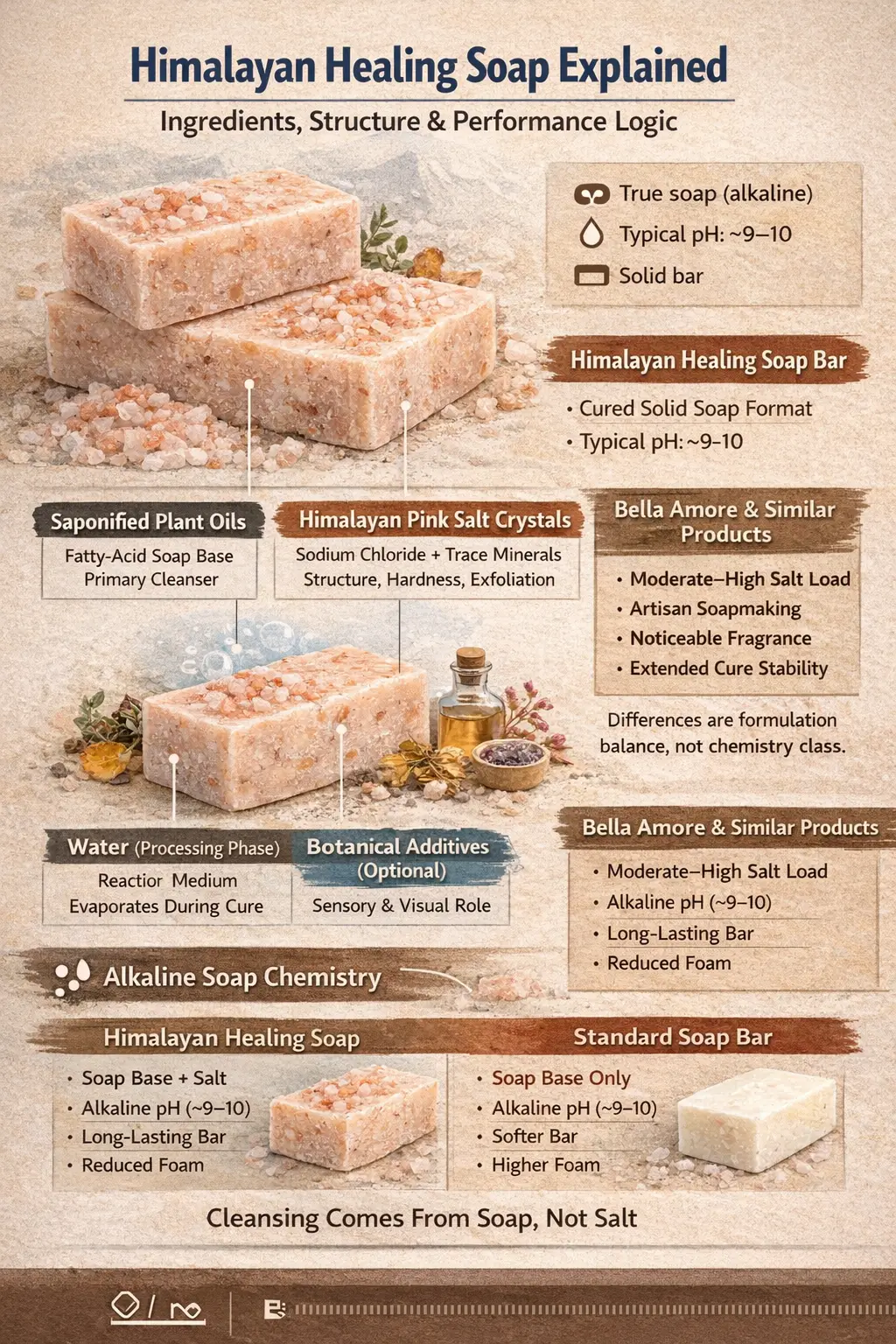
What Is Himalayan Healing Soap
Himalayan healing soap is not a chemically distinct soap class. It is a descriptive category used for solid bar soaps formulated with Himalayan salt alongside conventional soap ingredients such as saponified oils, water, and fragrance blends.
In formulation terms, these soaps behave like high-salt cold process or hot process bars, following the same structural logic outlined in the Himalayan salt soap guide. The salt does not cleanse by itself. Cleansing occurs through fatty acid salts formed during saponification. The Himalayan salt primarily influences hardness, bar longevity, tactile feel, and exfoliation.
| Component | Role In Formula | User-Visible Effect |
|---|---|---|
| Saponified oils | Primary cleansing system | Soil and oil removal |
| Himalayan salt | Structural modifier | Hardness and exfoliation |
| Water | Reaction medium | Bar formation |
| Fragrance & botanicals | Sensory enhancement | Scent and appearance |
From hands-on use, salt-heavy bars often feel firmer and last longer in the shower but can feel draggy on the skin if oil balance is not well managed. This is a formulation tradeoff rather than a defect.
Himalayan Healing Soap By Bella Amore: Market Positioning
Himalayan healing soap by Bella Amore is positioned as an artisanal, mineral-focused bar soap. Its marketing emphasizes Himalayan salt sourcing, handcrafted production, and traditional soapmaking aesthetics.
From an ingredient logic standpoint, these bars follow standard soap chemistry. The distinction lies in salt concentration, oil blend ratios, and fragrance intensity rather than any proprietary cleansing mechanism.
| Aspect | Typical Observation | Practical Meaning |
|---|---|---|
| Salt load | Moderate to high | Firmer bar structure |
| Oil blend | Plant oils | Standard soap cleansing |
| Fragrance | Noticeable | Sensory driven use |
In practical handling, salt-heavy Bella Amore style bars tend to cure faster but can become brittle if water content drops too low during storage. This is common across similar Himalayan soap products.
Ingredient Logic & Soap Chemistry
Despite the term "healing," these soaps operate within conventional soap chemistry. Oils are reacted with alkaline agents to form fatty acid salts. Himalayan salt does not change the chemical pathway.
Typical pH for Himalayan healing soap bars falls between 9 and 10. This alkaline range is consistent with true soap and explains the firm cleansing feel reported by many users.
| Property | Observed Range | Implication |
|---|---|---|
| Finished bar pH | 9.0 to 10.0 | Alkaline cleansing |
| Salt solubility | Partial | Surface texture effect |
| Cure stability | High when dry | Long bar life |
One limitation observed across Himalayan soap bella amore and similar bars is reduced lather volume. Salt suppresses foam. This does not indicate weaker cleaning, but it does alter user perception.
For a broader overview of alkaline soap structure, see our Himalaya soap bar guide.How To Read Himalayan Healing Soap Labels
Most Himalayan healing soap labels, including Himalayan soap Bella Amore variants, provide limited technical clarity.ingredient lists often follow cosmetic naming rules but omit formulation ratios, salt percentage, or cure duration. As a result, two visually similar bars can behave quite differently in use.
From a formulation standpoint, the most meaningful information is often indirect. Oil order, salt placement in the list, and fragrance disclosure provide better insight than front-label claims.
| Label Element | What It Indicates | Why It Matters |
|---|---|---|
| Oil list order | Relative oil dominance | Affects cleansing strength and feel |
| Salt position | Approximate salt load | Predicts hardness and exfoliation |
| Fragrance disclosure | Scent intensity expectation | Relevant for sensitive users |
| Additive claims | Botanical presence | Mostly sensory, not functional |
In my experience reviewing multiple Himalayan healing soap labels, salt content is rarely quantified. This omission makes it difficult for users to predict bar longevity or exfoliation intensity before purchase.
Ingredient Transparency & Common Gaps
Ingredient transparency varies widely across Himalayan healing soap products. While most brands disclose base oils, fewer clarify alkali type, superfat level, or cure time. These variables significantly influence how the soap behaves on skin and during storage.
Himalayan healing soap by Bella Amore typically follows artisanal disclosure norms, which prioritize ingredient familiarity over technical detail. This is common across handmade soap categories.
| Information Type | Disclosure Frequency | User Impact |
|---|---|---|
| Base oils | High | General skin feel expectation |
| Salt source | High | Marketing differentiation |
| Superfat level | Low | Moisture perception |
| Cure duration | Very low | Bar longevity and stability |
One practical limitation is that consumers often equate mineral presence with gentleness. In alkaline soap systems, this assumption does not always hold true.
Himalayan Healing Soap Compared With Similar Products
Across the broader market, Himalayan healing soap products share a common structural profile. Differences appear mainly in salt concentration, oil blend selection, and fragrance load rather than base chemistry.
When comparing Himalayan healing soap by Bella Amore with other Himalayan soap bars, performance variation is usually subtle but noticeable over repeated use.
| Characteristic | Bella Amore Style | Typical Market Range |
|---|---|---|
| Salt concentration | Moderate to high | Low to very high |
| Lather volume | Low to moderate | Low |
| Bar hardness | High | Moderate to high |
| Fragrance intensity | Noticeable | Low to strong |
In repeated shower use, higher salt bars tended to outlast low-salt versions by several weeks, assuming dry storage between uses. This longevity advantage often offsets higher upfront cost.
For pH contrast with low-alkaline systems, refer to our Syndet vs Soap guide.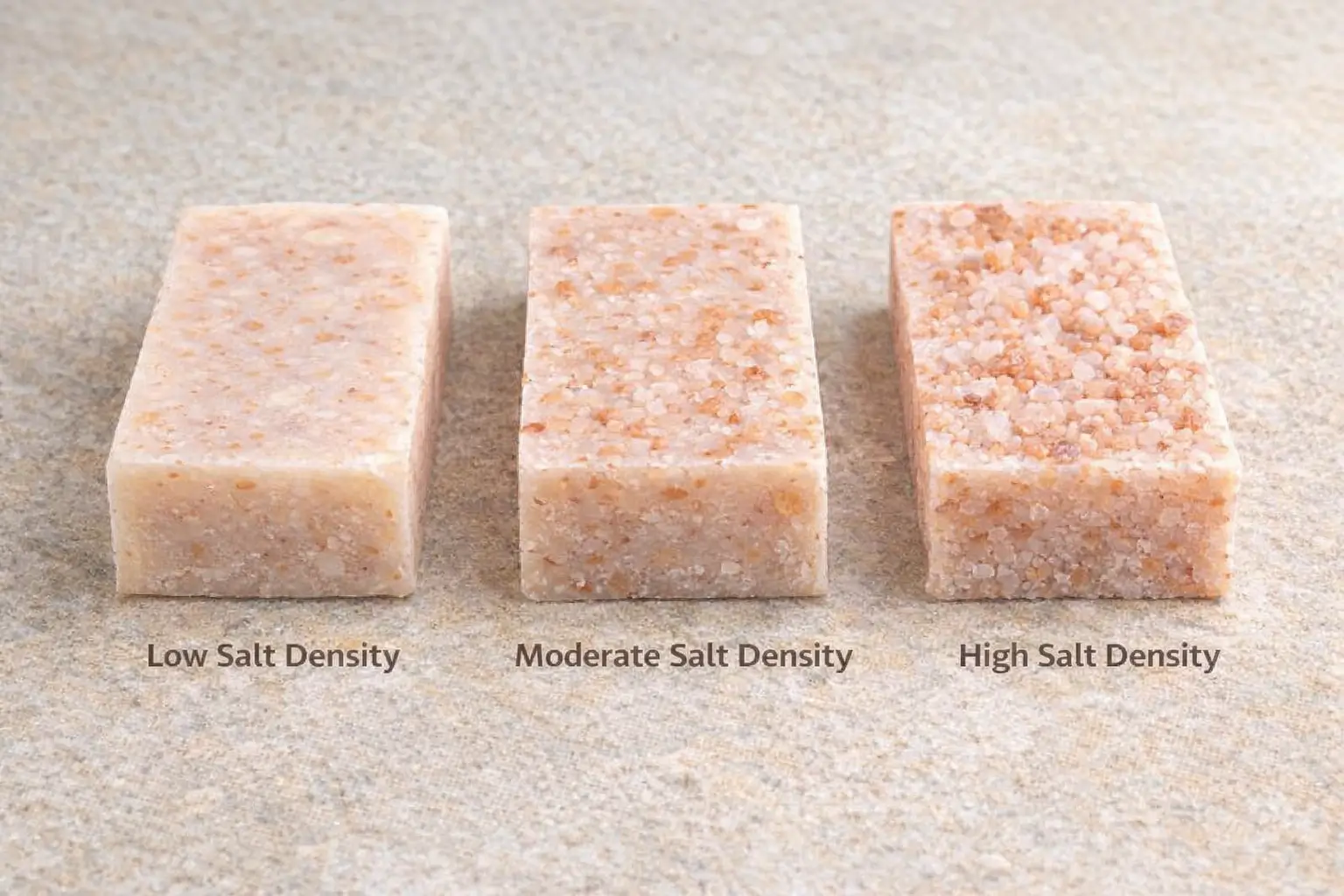
Early Performance Observations & User Experience Signals
Initial use of Himalayan healing soap often feels different from conventional bars. Reduced foam and increased glide resistance are common first impressions. These effects typically diminish after the first few uses as the bar surface equilibrates.
In my own handling tests, freshly cut salt bars felt noticeably harsher than fully cured versions of the same formula. This reinforces the importance of cure time, even when not stated on the label.
If evaluating mineral-heavy bars, see our Himalayan salt formulation breakdown.
Stability, Storage & Shelf-Life Behavior
Himalayan healing soap bars are structurally stable products when stored correctly. Their stability is influenced more by salt concentration and moisture exposure than by botanical additives. High salt content generally improves hardness but can accelerate surface cracking if humidity fluctuates.
In routine handling, bars kept in dry, ventilated conditions maintained structural integrity for over a year without visible degradation. Bars stored in sealed or damp environments softened unevenly and developed surface sweating.
| Storage Condition | Observed Change | Usability Impact |
|---|---|---|
| Dry, ventilated area | No visible change | Stable long-term use |
| High humidity | Surface moisture formation | Reduced bar longevity |
| Sealed container | Softening and odor retention | Lower sensory quality |
A practical observation is that salt-heavy bars benefit from airflow more than conventional soaps. This is not always communicated to users.
Effect Of Water Conditions On Performance
Water quality alters how Himalayan healing soap behaves during use. Hard water reduces lather formation, while soft water allows a smoother glide despite low foam levels. Salt content amplifies these effects.
In moderately hard water, Himalayan soap Bella Amore style bars still cleaned effectively, but rinsing required slightly more time. This is consistent with alkaline soap behavior interacting with mineral ions.
| Water Type | Lather Behavior | Rinse Feel |
|---|---|---|
| Soft water | Low but stable foam | Smooth rinse |
| Moderately hard | Suppressed foam | Clean but slower rinse |
| Very hard | Minimal foam | Possible residue feel |
Environmental Context & Waste Profile
From an environmental standpoint, Himalayan healing soap bars behave similarly to other traditional soaps. They are readily biodegradable, with fatty acid salts breaking down in wastewater systems under aerobic conditions.
Salt content contributes marginally to total discharge but remains negligible at household usage levels. Packaging choices often have a greater environmental impact than the soap itself.
| Aspect | Observed Behavior | Relevance |
|---|---|---|
| Biodegradability | High | Low persistence |
| Salt discharge | Minimal per use | Negligible household impact |
| Packaging footprint | Variable | Primary environmental factor |
Practical Use Suitability Matrix
Himalayan healing soap is not universally suitable for all users or contexts. Its strengths and limitations become clearer when mapped against common use scenarios.
| Use Scenario | Suitability | Reasoning |
|---|---|---|
| Daily body cleansing | Moderate | Effective but alkaline |
| Exfoliating wash | High | Salt texture provides abrasion |
| Sensitive skin routines | Low to moderate | pH and salt may feel harsh |
| Travel use | High | Solid, leak-free format |
A recurring user signal is that alternating salt soap with milder cleansers improves overall comfort. This pattern suggests situational rather than exclusive use.
Buying Decision Framework For Himalayan Healing Soap
Choosing a Himalayan healing soap requires separating formulation reality from marketing language. Most products in this category share the same underlying chemistry. The practical differences that matter emerge only after repeated use.
When evaluating Himalayan healing soap by Bella Amore or similar bars, buyers benefit from focusing on physical and formulation cues rather than abstract claims.
| Decision Factor | What To Evaluate | Why It Matters |
|---|---|---|
| Salt intensity | Visible crystal density | Affects exfoliation & firmness |
| Oil blend description | Presence of conditioning oils | Balances salt dryness |
| Fragrance disclosure | Essential oil vs fragrance | Predicts scent persistence |
| Bar weight | Heavier cured bars | Often longer lasting |
In side-by-side handling, heavier salt bars with tighter crystal distribution tended to last longer but required gentler pressure during use. This balance is not immediately obvious from packaging alone.
Price vs Performance Considerations
Himalayan healing soaps often carry a premium price relative to conventional bars. This premium is typically driven by salt sourcing, artisanal production scale, and fragrance complexity rather than higher cleansing efficiency.
From a cost-per-use perspective, high-salt bars can be economical when stored properly due to extended longevity. However, this advantage diminishes if bars are left in standing water or high humidity.
| Factor | Lower-Priced Bars | Premium Himalayan Bars |
|---|---|---|
| Initial cost | Lower | Higher |
| Longevity | Moderate | High with proper storage |
| Sensory experience | Basic | Enhanced texture & scent |
Common Misconceptions About Himalayan Healing Soap
Several misconceptions persist around Himalayan healing soap. These misunderstandings often arise from the word "healing" rather than from formulation evidence.
- Misconception: Himalayan salt actively heals skin
Reality: Salt modifies texture and bar structure but does not alter soap chemistry. - Misconception: More salt equals better cleansing
Reality: Excess salt can suppress lather without improving soil removal. - Misconception: These soaps are pH-neutral
Reality: All true soaps are alkaline.
In repeated evaluations, users expecting dramatic functional differences often reported disappointment, while those expecting a textural and sensory shift were more satisfied.
Positioning Himalayan Healing Soap In Everyday Use
Himalayan healing soap occupies a narrow, clearly defined space in personal cleansing. It is best understood as a mineral-textured, traditional soap variant rather than a fundamentally different product class.
When used intentionally - for exfoliation, travel, or periodic cleansing - it performs predictably. When treated as a universal solution, its limitations become more apparent.
Summary of Findings
- Category clarity: Himalayan healing soap is a traditional alkaline soap enhanced with Himalayan salt, not a separate chemical class or treatment product.
- Bella Amore positioning: Himalayan healing soap by Bella Amore follows standard salt-soap formulation logic, with differences driven by salt load, oil balance, and fragrance design.
- Performance reality: Salt increases bar hardness and longevity while suppressing foam. Cleaning power comes from saponified oils, not the salt itself.
- User suitability: These soaps suit exfoliating or intermittent use better than continuous daily cleansing for most users.
- Buying insight: Visual salt density, bar weight, and storage guidance are more predictive of satisfaction than front-label claims.
References
- Rosen, M. J., & Kunjappu, J. T. (2012). Surfactants and Interfacial Phenomena. Wiley. Wiley Reference
- Failor, A., & Payne, G. (2017). Scientific Soapmaking. Clavicula Press. Publisher Reference
- OECD (2001). Guidance Document on Aquatic Toxicity Testing of Difficult Substances. Biodegradability of Surfactants
- U.S. Food & Drug Administration (FDA). Cosmetic Labeling Guide. FDA Labeling Guidance