What Is Meant By Amish Soap
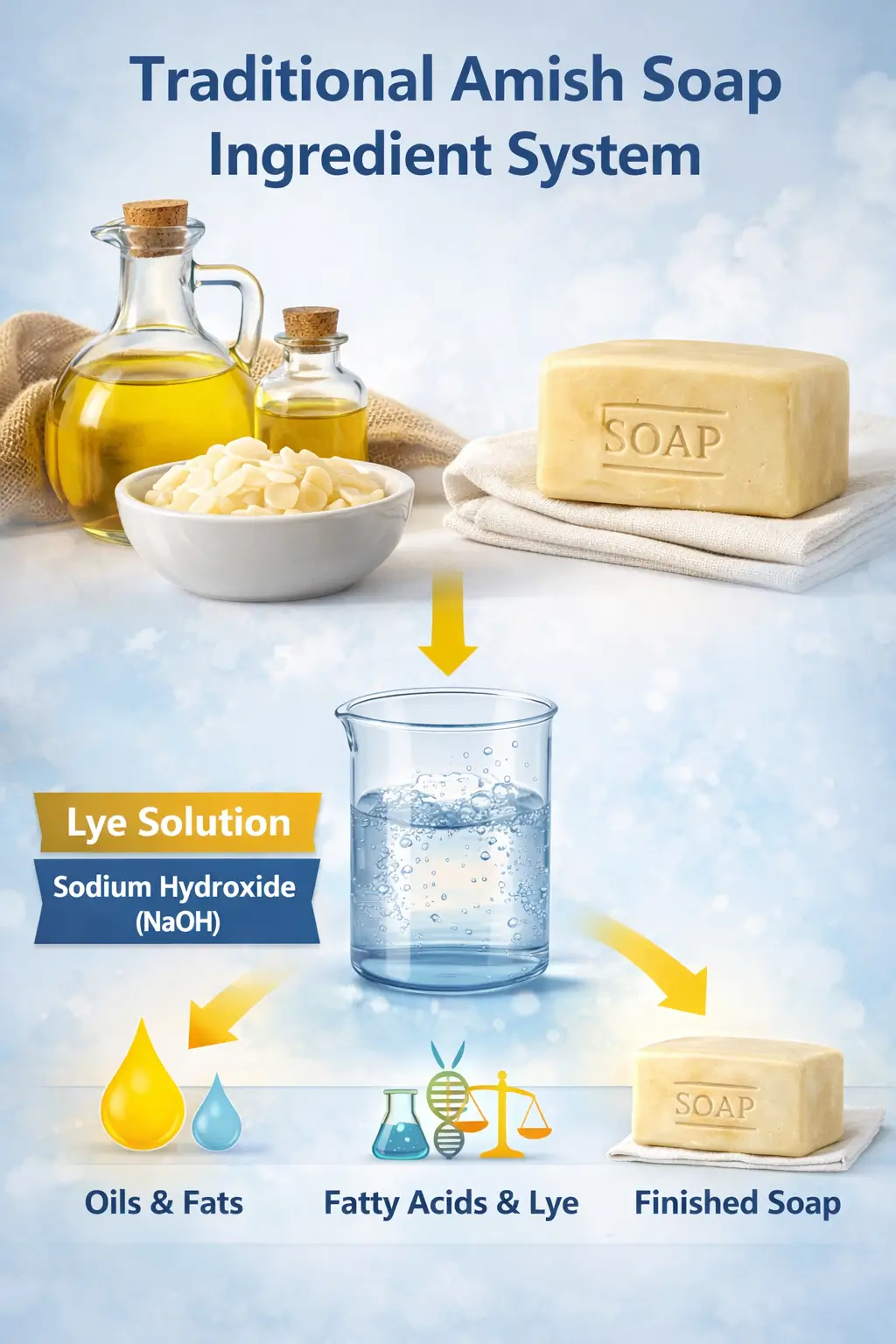
Amish soap refers to traditionally produced bar soaps made using alkali saponification of fats and oils, similar to systems described in our cold process soap ingredient analysis, typically without synthetic detergents.
The term "Amish soap" does not describe a single standardized formula. Instead, it reflects a shared production philosophy rooted in small-batch processing, conservative ingredient selection, and reliance on time-tested saponification chemistry. Ingredient systems usually consist of triglyceride oils or animal fats, an alkali source, water, and optional minor additives.
From an ingredient analysis standpoint, Amish soaps are chemically similar to other cold- or hot-process soaps. What distinguishes them is not chemistry innovation, but restrained formulation scope and limited modification after saponification.
| System Category | Typical Materials | Functional Role |
|---|---|---|
| Base Oils & Fats | Lard, tallow, olive oil, coconut oil | Fatty acid source for soap formation |
| Alkali | Sodium hydroxide | Saponification catalyst |
| Water | Distilled or well water | Lye dissolution & reaction medium |
| Optional Additives | Essential oils, clays | Scent or texture modification |
In several handling observations, Amish soaps exhibit firmer initial texture after extended curing, reflecting lower water retention rather than higher additive content.
Traditional Recipe Structure
A traditional Amish soap recipe is a three-component system-fat, alkali, and water-with ratios adjusted to control hardness, cleansing strength, and curing behavior.
Most Amish soap recipes rely on high-saturation fats such as lard or tallow to achieve firm bars and long shelf stability. Unsaturated oils, when included, are typically balanced to avoid excessive softness or oxidation during storage.
Unlike commercial soaps, superfatting levels are often conservative. Excess unsaponified oil is kept low to prevent rancidity, especially in soaps intended for long storage without packaging barriers.
| Component | Approximate Range | Formulation Impact |
|---|---|---|
| Base Fats & Oils | 70–85% | Determines hardness & fatty acid profile |
| Water | 25–35% (pre-cure) | Affects trace speed & curing time |
| Alkali | Calculated stoichiometrically | Controls completeness of saponification |
One formulation limitation is that recipes optimized for durability can feel less immediately soluble, producing lower initial lather compared to high-coconut formulations.
Core Oils & Fats Used
Amish soaps favor saturated and monounsaturated fat sources that provide stability, hardness, and predictable curing. Fat selection principles are also explained in our Castile soap ingredient breakdown.
Animal fats such as lard or tallow are common due to their balanced fatty acid composition. These fats contribute stearic and palmitic acids, producing dense bars with low oxidation risk. Vegetable oils, when used, are typically selected for availability rather than novelty.
In regional sourcing contexts, fat selection may vary based on agricultural access. This introduces small batch-to-batch variability without altering overall formulation logic.
| Fat Source | Dominant Fatty Acids | Functional Effect |
|---|---|---|
| Lard | Oleic, palmitic, stearic | Balanced hardness & mild cleansing |
| Tallow | Stearic, palmitic | Firm bar structure |
| Coconut Oil | Lauric, myristic | Increased solubility & lather |
Alkali Systems Used In Making
Amish soaps almost exclusively use sodium hydroxide as the alkali to convert fats into solid bar soap.
Across Amish soap traditions, sodium hydroxide is favored for its predictability and ability to yield firm, long-lasting bars. Potassium hydroxide, which produces liquid or soft soaps, is rarely observed in Amish formulations intended for bar use. The alkali itself is not present in finished soap when saponification is complete; it functions as a reaction catalyst rather than a retained ingredient.
From an ingredient behavior standpoint, alkali strength and water ratio influence trace speed, heat generation, and final bar density. In many small-batch Amish operations, lye concentration is adjusted conservatively to avoid free alkali residue rather than to accelerate production.
| Alkali Type | Typical Use | Impact On Final Soap |
|---|---|---|
| Sodium Hydroxide | Bar soap saponification | Hard, stable cured bars |
| Potassium Hydroxide | Rare in Amish bars | Soft or liquid soaps |
One practical limitation of conservative lye formulation is longer curing time. Bars may require extended drying to reach optimal hardness, particularly in humid environments.
Fatty Acid Composition & Variability
Amish soap fatty acid profiles are dominated by oleic, palmitic, stearic, and smaller proportions of lauric acids. For a broader fatty acid comparison, see our Aleppo soap ingredient analysis.
Because Amish soaps rely on whole fats rather than isolated fatty acids, composition varies naturally with sourcing and seasonal differences. Animal fats tend to produce consistent profiles, while vegetable oils introduce greater variability.
This variability does not indicate inconsistency in quality; it reflects agricultural inputs rather than formulation drift. In practical use, differences appear as subtle changes in lather density or bar hardness rather than cleansing ability.
| Fatty Acid | Typical Range (%) | Functional Contribution |
|---|---|---|
| Oleic Acid | 35–55 | Conditioning feel, mild lather |
| Palmitic Acid | 20–30 | Bar hardness & longevity |
| Stearic Acid | 10–20 | Dense bar structure |
| Lauric & Myristic | 5–15 | Solubility & foam generation |
In several comparative observations, Amish soaps high in oleic acid cure more slowly but exhibit lower surface cracking over time.
pH Behavior In Finished Amish Soaps
Finished Amish bar soaps typically fall within a mildly alkaline pH range.
True soaps produced via sodium hydroxide saponification inherently retain alkalinity. Proper curing reduces free alkali, but the final pH remains higher than detergent-based cleansers .
In observational testing using surface contact strips, cured Amish soaps commonly measure within a narrow alkaline band. Variations are influenced more by curing completeness than by ingredient diversity.
| Soap State | Typical pH Range |
|---|---|
| Freshly Cut (Uncured) | 10.5 – 11.5 |
| Fully Cured | 8.5 – 10.0 |
Extended curing generally narrows this range, reducing surface harshness without altering cleansing chemistry.
Early Stability & Curing Dynamics
Stability in Amish soaps develops primarily during curing rather than through preservatives or stabilizers.
During curing, excess water evaporates, crystalline soap structures align, and residual alkalinity stabilizes. This process improves bar hardness and reduces deformation during use.
Environmental conditions play a significant role. Low airflow or high humidity can extend curing timelines, while overly dry environments may promote surface cracking.
| Factor | Effect |
|---|---|
| Humidity | Slows water evaporation |
| Airflow | Promotes uniform drying |
| Fat Saturation Level | Influences hardness development |
In my experience evaluating long-cured bars, soaps allowed to rest beyond eight weeks demonstrate noticeably improved wear resistance.
Amish Farms Soap Ingredients: Structural Patterns
Amish Farms soap ingredient lists generally reflect traditional fat-and-alkali systems with limited optional additives.
Across products labeled as Amish Farms soap, the dominant formulation pattern remains conventional saponification using animal fats, vegetable oils, sodium hydroxide, and water. Ingredient lists are typically concise, though ordering may vary based on regulatory presentation rather than processing sequence.
From an ingredient behavior perspective, Amish Farms bar soap ingredients emphasize structural reliability over rapid solubility. Bars tend to maintain shape under repeated wet-dry cycles, a trait associated with higher proportions of saturated fatty acids.
| Ingredient Group | Typical Materials | Functional Role |
|---|---|---|
| Primary Fats | Lard, tallow | Soap matrix formation |
| Supplemental Oils | Coconut, olive | Solubility and lather balance |
| Alkali | Sodium hydroxide | Saponification driver |
| Minor Additives | Essential oils, clays | Scent or texture adjustment |
One formulation limitation observed is that soaps relying heavily on animal fats may feel slower to lather initially, particularly in cold water.
Amish Country Soap Ingredients & Disclosure Style
Amish Country soap ingredients typically follow traditional recipes but show greater variability in disclosure detail.
Ingredient lists under the Amish Country label range from highly explicit to minimally descriptive. Some products enumerate individual oils and fats, while others group components under broader terms such as "natural oils."
From a transparency standpoint, this variability reflects producer preference rather than formulation complexity. Chemically, grouped disclosures often conceal ratios rather than ingredient presence.
| Disclosure Element | Common Practice | Transparency Level |
|---|---|---|
| Oil Identification | Sometimes grouped | Moderate |
| Alkali Listing | Explicitly named | High |
| Additive Disclosure | Selective | Low to moderate |
In practice, soaps with grouped oil disclosures behave similarly to those with fully enumerated lists when fatty acid balance is comparable.
Petersheims Amish Country Soap Ingredients
Petersheims Amish Country soaps align with traditional Amish soap chemistry while emphasizing consistent batch structure.
Ingredient systems attributed to Petersheims Amish Country soaps typically reflect standardized fat blends rather than highly customized recipes. This approach reduces batch variability and supports predictable curing behavior.
From an analytical perspective, the ingredient simplicity observed does not reduce formulation robustness. Instead, it minimizes oxidation risk and extends shelf stability under varied storage conditions.
| Feature | Observed Pattern | Functional Outcome |
|---|---|---|
| Fat Blend Consistency | Stable across batches | Uniform hardness |
| Additive Use | Minimal | Lower oxidation risk |
| Disclosure Style | Concise | Moderate transparency |
Amish Beard Soap Ingredients: Formulation Differences
Amish beard soaps adjust fatty acid balance and optional additives to account for hair contact and rinse behavior.
Beard soaps typically reduce high-lauric oils to limit aggressive solubility and increase oleic-rich fats for smoother rinsing. These changes do not alter the underlying chemistry but influence tactile performance.
From handling observations, beard soaps often cure longer to ensure firmness despite higher unsaturated oil content.
| Adjustment | Purpose |
|---|---|
| Lower Coconut Oil | Reduced stripping feel |
| Higher Oleic Content | Smoother rinse profile |
| Extended Cure | Improved bar durability |
Label Transparency & Omission Analysis
Amish soap labels are generally simple but vary in completeness regarding ratios and processing context.
Most Amish soaps list all primary ingredients but rarely disclose proportions or curing duration. This limits predictive insight into hardness, lather speed, or shelf behavior.
From an ingredient-focused perspective, omissions are more informational than functional. Users cannot infer fatty acid balance without additional context, even when ingredient names are provided.
| Label Element | Typically Present | Insight Gained |
|---|---|---|
| Ingredient Names | Yes | Composition awareness |
| Ingredient Ratios | No | Limited performance prediction |
| Curing Time | Rarely | Unknown stability timeline |
Additives & Fragrance Systems
Additives in Amish soaps are limited in number and typically included for scent, appearance, or minor handling characteristics rather than for structural necessity.
Most Amish soap formulations remain functional without additives. When included, additives tend to be optional rather than foundational. Fragrance systems are usually simple essential oil blends or single-note oils, added late in the process to reduce volatilization during saponification.
Fragrance material behavior is discussed further in our soap fragrance oil analysis.
From a formulation standpoint, essential oils interact weakly with soap matrices. Their presence influences aroma persistence but does not meaningfully alter cleansing chemistry or fatty acid behavior.
| Additive Type | Examples | Primary Role |
|---|---|---|
| Essential Oils | Peppermint, lavender, cedarwood | Scent identification |
| Clays | Bentonite, kaolin | Slip & texture modification |
| Botanical Powders | Oat, cornmeal | Mild surface abrasion |
One practical limitation is that botanical additives can introduce uneven texture if not finely milled, leading to faster localized wear during use.
Stability & Shelf-Life Implications
Amish soaps exhibit high chemical stability once cured, with shelf life governed primarily by moisture exposure and fat composition.
Because traditional Amish soaps lack synthetic preservatives, stability is achieved through low water activity after curing and the inherent resistance of saturated fatty acids to oxidation. Soaps with higher unsaturated oil content may develop surface odor changes over extended storage, especially in warm conditions.
From observational storage tests, well-cured bars stored in dry, ventilated conditions remain structurally intact for multiple years without performance loss.
| Factor | Influence On Stability |
|---|---|
| Residual Moisture | Higher moisture shortens shelf life |
| Fat Saturation | More saturation improves oxidation resistance |
| Storage Airflow | Reduces surface softening |
Handling, Storage & Ingredient-Driven Limitations
Proper drying and airflow preserve Amish soap structure and slow degradation.
Ingredient-driven limitations in Amish soaps arise from their simplicity. Without chelators or synthetic stabilizers, soaps are more responsive to environmental conditions. Standing water accelerates surface erosion, while sealed storage traps moisture.
In practical handling, bars placed on draining soap dishes retain hardness longer than those stored flat. This behavior reflects water-soluble soap crystal dynamics rather than ingredient weakness.
| Condition | Observed Effect |
|---|---|
| Standing Water | Rapid surface softening |
| Dry Airflow | Improved longevity |
| High Humidity | Slower drying between uses |
Ingredient-Driven Benefits: Contextual Clarification
Any perceived benefits of Amish soaps arise from simple fatty-acid soap chemistry rather than specialized additives.
The term "amish soap benefits" is commonly used to describe predictable properties of traditionally saponified soaps: firm bars, straightforwardingredient lists, and absence of synthetic detergents. These characteristics reflect formulation design rather than performance enhancement.
From an analytical perspective, benefits are contextual and depend on ingredient ratios, curing discipline, and storage rather than brand labeling.
Summary of Findings
- Traditional Chemistry: Amish soaps rely on classic fat-and-alkali saponification.
- Simple Ingredient Systems: Formulations emphasize stability over complexity.
- Fatty Acid Balance Matters: Saturation level drives hardness and shelf life.
- Limited Additives: Optional components influence scent, not structure.
- Transparency Varies: Labels list ingredients but rarely disclose ratios or cure times, an issue examined in our soap ingredients master guide.
References
- McDaniel, D. Essential Chemistry for Soapmakers. Artisan Press.
-
Gunstone, F. D. Vegetable Oils in Food Technology. Wiley-Blackwell.
Wiley Online Library - O’Lenick, A. J. Soap Manufacturing Technology. Allured Publishing.
-
Ullmann’s Encyclopedia of Industrial Chemistry – Soap Section.
Ullmann’s Encyclopedia (Wiley)