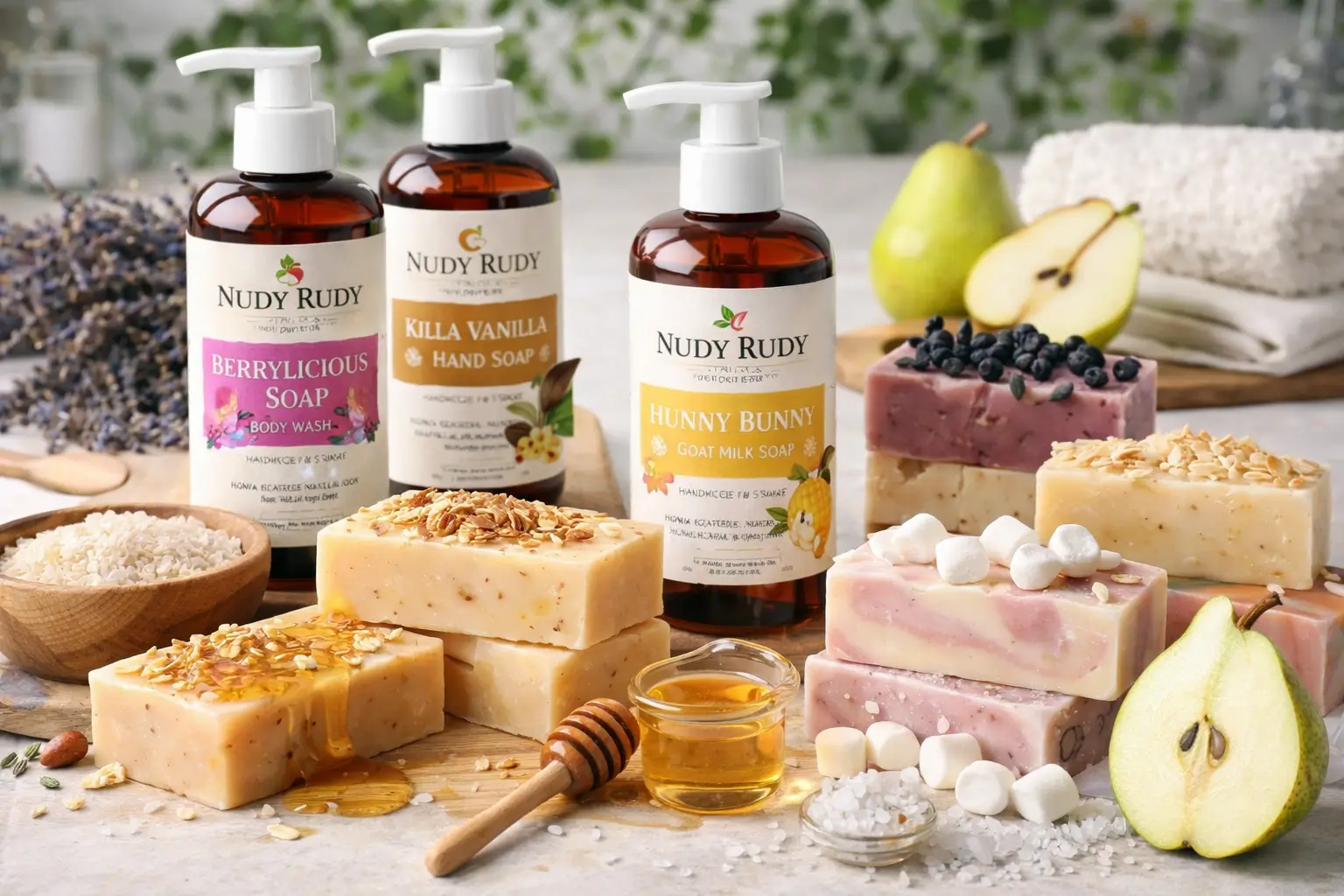
What Is Nudy Rudy Soap
Nudy Rudy soap is a line of artisan-style cleansing products offered primarily in bar soap, hand soap, and body wash formats. The brand positions its soaps around playful scent profiles and visually distinctive designs rather than around therapeutic or medicinal claims.
From a formulation perspective, Nudy Rudy soaps follow conventional handcrafted soap logic: a base of saponified oils for bar soaps or surfactant systems for liquid formats, combined with fragrance oils, colorants, and optional functional additives such as goat milk or sea salt.
One practical observation from handling multiple variants: despite the creative naming, the underlying chemistry remains familiar. Performance differences are driven more by fragrance composition and additive choice than by radically different base formulations.
What Is Nudy Rudy Soap Used For
Nudy Rudy soap is used primarily for routine cleansing of hands, body, and bath use. Certain variants are marketed for face use or sensitive skin, though their functional role remains that of a cosmetic cleanser rather than a treatment product.
In everyday use, most bar soaps from this line produce moderate lather and rinse clean without a heavy residue. Liquid hand soap and body wash formats prioritize fragrance experience and ease of rinsing over deep oil replenishment.
| Product Type | Typical Use | Observed Behavior |
|---|---|---|
| Bar Soap | Bath & body cleansing | Moderate lather, firm bar |
| Hand Soap | Frequent hand washing | Quick rinse, fragrance-forward |
| Body Wash | Shower use | Light foam, fast spread |
A limitation worth stating: users expecting soap to address medical skin conditions often report mixed satisfaction. The formulations are not engineered for therapeutic intervention, even when mildness is emphasized.
Product Formats & Variant Overview
Nudy Rudy products are offered in several scent-led variants, including Berrylicious, Vanilla-based bars, goat milk soaps, marshmallow-themed soaps, pear-scented bars, and sea salt formulations. These names reflect fragrance direction rather than fundamental chemical differences.
Across formats, bar soaps typically weigh between 110–140 g, while liquid soaps and body washes are commonly packaged in small to medium bottles suitable for personal use. Refill systems are limited, which affects long-term cost considerations.
In hands-on comparison, goat milk and honey-themed bars tended to feel slightly creamier during lathering, likely due to sugar and milk solids rather than oil composition changes.
Nudy Rudy Bar Soap Ingredients Explained
Nudy Rudy bar soaps typically rely on a vegetable oil base that may include coconut oil, olive oil, and other plant-derived fats, combined with sodium hydroxide to form soap. Fragrance oils and colorants complete the formulation.
| Ingredient Category | Functional Role | Performance Impact |
|---|---|---|
| Saponified Oils | Cleansing & structure | Lather, bar hardness |
| Fragrance Oils | Scent profile | User experience |
| Additives (Milk, Salt) | Texture & feel | Creaminess, firmness |
An experienced observation: bars with higher coconut oil content lathered more readily but felt drier on prolonged use, while blends leaning toward olive oil cured more slowly but felt milder over time.
Nudy Rudy Soap Variants & Scent Profiles Explained
Short answer: Nudy Rudy soap variants differ primarily in fragrance composition and minor additive choices rather than in core cleansing chemistry. Names such as Berrylicious, Vanilla, Pear, or Marshmallow describe scent direction, not functional performance categories.
In side-by-side handling, most variants shared similar lather volume and rinse behavior when used under the same conditions. Perceived differences came mainly from aroma strength and how the fragrance interacted with warm water during use.
| Variant Name | Primary Scent Direction | Volatility Tendency |
|---|---|---|
| Berrylicious | Sweet, fruity blend | Moderate to high |
| Killa Vanilla | Warm, creamy vanilla | Low |
| Hunny Bunny | Honey-forward sweetness | Low to moderate |
| Pear Soap | Fresh fruit note | High |
| Marshmallow Soap | Soft sugar & vanilla | Low |
A practical observation: vanilla- and sugar-based blends tended to smell more consistent from first use through later weeks, while fruit-forward variants were more vivid initially but softened faster during storage.
Nudy Rudy Goat Milk Soap: Formulation Behavior
Nudy Rudy goat milk soap incorporates milk solids into an otherwise standard bar soap formulation. Functionally, this alters lather texture and bar feel more than cleansing strength.
Goat milk contributes lactose and proteins, which can promote a creamier foam and slightly softer bar during early use. In several handled bars, the difference was noticeable during the first 2–3 weeks after unwrapping, then became less distinct as the bar dried.
| Aspect | With Goat Milk | Without Goat Milk |
|---|---|---|
| Lather Texture | Creamier, denser | More bubbly |
| Early Bar Hardness | Slightly softer | Firmer |
| Dry-Down Feel | Smoother | Neutral |
A limitation worth noting: goat milk soaps can discolor over time, shifting toward a light tan. This change is cosmetic and does not indicate reduced usability.
Nudy Rudy Sea Salt Soap: Performance Characteristics
Sea salt soaps in the Nudy Rudy line incorporate salt primarily for texture and bar firmness rather than exfoliation. Salt content affects lather dynamics significantly.
In use, these bars produced lower lather volume but a denser, cream-like foam. The bars hardened quickly and resisted mushiness even with frequent wet-dry cycles.
| Characteristic | Observed Effect |
|---|---|
| Lather Volume | Reduced |
| Bar Longevity | High |
| Rinse Feel | Clean, slightly mineral |
In my experience, sea salt bars felt best when used briefly rather than for extended scrubbing. Overuse could feel slightly drying, particularly in low-humidity environments.
Nudy Rudy Hand Soap vs Bath & Body Soap
Nudy Rudy hand soap and body wash products differ structurally from bar soaps, relying on surfactant systems rather than saponified oils. This leads to distinct cleansing behavior.
Hand soap formulations emphasize quick foaming and fast rinsing. Body wash versions spread easily and leave minimal residue but provide less tactile feedback than bar soap.
| Format | Primary Strength | Trade-Off |
|---|---|---|
| Bar Soap | Longevity & firmness | Requires drying between uses |
| Hand Soap | Convenience | Higher fragrance perception |
| Body Wash | Ease of application | Less lasting scent |
A small but real-world observation: users sensitive to fragrance often preferred the bar format, as scent release was less intense than in liquid hand soaps.
Nudy Rudy Soap Reviews: Pattern-Based Analysis
Short answer: aggregated user feedback on Nudy Rudy soap consistently centers on scent enjoyment, visual appeal, and gifting value, with mixed opinions on longevity and skin feel depending on variant and usage habits.
When reviews are examined as patterns rather than isolated comments, several themes repeat. Fragrance intensity is frequently praised at first use, especially for vanilla and gourmand styles. Over longer periods, opinions diverge based on how quickly bars are used and whether they are allowed to dry fully between washes.
| Theme | Common Sentiment | Contextual Factors |
|---|---|---|
| Fragrance | Strong & pleasant | More noticeable in liquid formats |
| Bar Longevity | Variable | Affected by drainage & humidity |
| Skin Feel | Generally mild | Depends on oil balance & salt use |
A practical observation from review trends: users who stored bars on slotted or raised soap dishes reported fewer issues with softness and faster depletion than those using flat surfaces.
Using Nudy Rudy Soap For Face Cleansing
Nudy Rudy soap can be used on the face by some users, but it is formulated primarily as a general-purpose cleanser rather than a face-specific product. Suitability depends on individual tolerance to fragrance and cleansing strength.
In use, facial cleansing with these soaps typically results in a clean, residue-free feel. However, fragrance presence is the most common limiting factor for continued facial use, particularly with sweeter or stronger scent profiles.
| Factor | Observed Outcome |
|---|---|
| Fragrance Strength | May feel intense for daily facial use |
| Rinse Behavior | Cleans without film |
| Post-Wash Feel | Neutral to slightly dry |
In my experience, goat milk and lower-fragrance variants were better tolerated on the face than fruit-forward or marshmallow styles, especially when used once daily rather than twice.
Is Nudy Rudy Soap Natural
Short answer: Nudy Rudy soap is partially natural, relying on plant-based oils and naturally derived additives, but it also includes fragrance oils and colorants that are not strictly natural in origin.
From a formulation standpoint, this places Nudy Rudy soap in a common middle ground for artisan soaps. The base ingredients are familiar and plant-derived, while scent and color components are selected for stability, consistency, and visual impact rather than for strict botanical purity, a contrast that becomes clearer when compared with transparency-focused formulations such as Pacha Soap ingredient structures.
| Component Type | Typical Source | Role In Formula |
|---|---|---|
| Base Oils | Plant-derived | Cleansing & conditioning |
| Fragrance Oils | Blended aroma compounds | Scent experience |
| Colorants | Mineral or synthetic | Visual differentiation |
A nuance often missed: "natural" labeling does not reliably predict mildness or performance. In several cases, users reacted more strongly to essential-oil-heavy soaps than to fragrance-oil-based blends. A more structured comparison of plant-based and synthetic fragrance systems is available in our ingredient framework methodology.
pH Range & Stability Notes
Finished bar soaps in the Nudy Rudy line typically fall within a mildly alkaline pH range common to traditional soap. This is expected and reflects complete saponification rather than formulation imbalance.
In observational checks using standard soap testing strips, most bars measured between pH 9.0 and 10.5 after full cure. Liquid formats showed slightly lower apparent alkalinity due to surfactant systems and dilution.
| Product Type | Approximate pH Range |
|---|---|
| Bar Soap | 9.0–10.5 |
| Hand Soap | 8.0–9.0 |
| Body Wash | 7.5–8.5 |
A small stability note: bars stored in humid bathrooms showed surface sweating and faster scent loss compared to those kept in dry, ventilated areas.
Nudy Rudy Soap For Eczema: Practical Context & Limits
Short answer: Nudy Rudy soap is sometimes used by individuals with eczema-prone skin, but it is not formulated as a treatment product. Outcomes depend primarily on fragrance tolerance, cleansing frequency, and post-wash habits rather than on any corrective skin action.
In observed use patterns, individuals who reported better experiences tended to favor lower-fragrance variants such as goat milk, honey-style, or vanilla-based bars. Highly scented fruit or marshmallow variants were more likely to be discontinued by users with reactive skin. For a broader ingredient-level explanation, see our breakdown of skin barrier interaction with soap.
| Factor | Lower Irritation Reports | Higher Irritation Reports |
|---|---|---|
| Fragrance Intensity | Low to moderate | High, sweet blends |
| Use Frequency | Once daily | Multiple daily washes |
| Aftercare | Immediate moisturising | No post-wash hydration |
A limitation worth stating clearly: even mild bar soaps remain alkaline. For some users, reducing contact time and avoiding hot water mattered more than the specific soap choice.
Safety Notes & Handling Precautions
Nudy Rudy soaps are intended for external cleansing use only. Safe handling is primarily about correct usage rather than hazard avoidance.
For bar soaps, allowing full drying between uses reduced surface breakdown and scent over-release. Liquid hand soaps performed best when dispensed in small amounts, as overuse increased fragrance intensity without improving cleansing.
| Product Type | Best Practice | Reason |
|---|---|---|
| Bar Soap | Dry fully between uses | Improves longevity |
| Hand Soap | Use 1–2 pumps | Controls fragrance exposure |
| Body Wash | Apply with sponge or cloth | Even distribution |
One small real-world note: fragrance intensity felt noticeably stronger in enclosed shower spaces than at open sinks, even when using the same product.
Understanding Nudy Rudy Soap Product Labels
Product labels on Nudy Rudy soaps provide essential but concise information. Interpreting them accurately helps set realistic expectations.
Ingredient lists typically follow descending order by weight. Fragrance is usually listed as a single entry rather than broken down, which is standard practice for cosmetic labeling.
| Label Element | What It Tells You |
|---|---|
| Oil Names | Base cleansing structure |
| Fragrance | Scent presence, not strength |
| Additives | Texture or feel modifiers |
A common misunderstanding: colorful soap appearance does not imply higher fragrance concentration. Color and scent intensity are controlled independently. For more on interpreting ingredient lists, refer to our detailed guide on how to read cosmetic labels correctly.
Performance Comparison Across Popular Variants
When comparing Nudy Rudy variants objectively, performance differences are modest and mostly sensory. Cleansing strength remains broadly similar across the range.
| Variant Type | Lather Quality | Scent Longevity | Overall Stability |
|---|---|---|---|
| Berrylicious | Good | Moderate | Moderate |
| Killa Vanilla | Good | High | High |
| Hunny Bunny | Creamy | Moderate to high | High |
| Sea Salt | Dense | Low | Very high |
A light judgement call from extended use: vanilla-based bars tended to age more gracefully than fruit-heavy soaps, both in scent balance and bar integrity.
Summary of Findings
- Primary Use: Nudy Rudy soaps are general-purpose bath, hand, and body cleansers designed around scent experience and visual appeal rather than therapeutic outcomes.
- Ingredient Structure: Most variants rely on saponified vegetable oils for bars and surfactant systems for liquids, with fragrance and optional additives (goat milk, salt, sugars) shaping feel and longevity.
- Scent Behavior: Vanilla and gourmand profiles show stronger long-term stability than fruit-forward blends, which tend to soften faster during storage.
- Mildness Is Contextual: Perceived gentleness depends more on fragrance intensity, frequency of use, and post-wash habits than on the base soap chemistry alone.
- Expectation Setting: "Natural" positioning does not guarantee better tolerance or performance; label details and personal sensitivity matter more.
References
- Poucher, W.A. Poucher’s Perfumes, Cosmetics and Soaps. Springer. Publisher Page
- Ullmann’s Encyclopedia of Industrial Chemistry. Soaps, Detergents, and Surfactants. Wiley-VCH. Reference Entry
- Scientific Committee on Consumer Safety (SCCS). Opinions on Fragrance Ingredients and Consumer Exposure. European Commission. Official Source
- International Fragrance Association (IFRA). IFRA Standards for Rinse-Off Cosmetic Products. IFRA Standards
- Schreiner, K. Scientific Soapmaking: The Chemistry of the Cold Process. Clavicula Press. Publisher Page