Pacha Soap
Pacha Soap refers to a range of products formulated using traditional soapmaking chemistry rather than synthetic detergent systems.
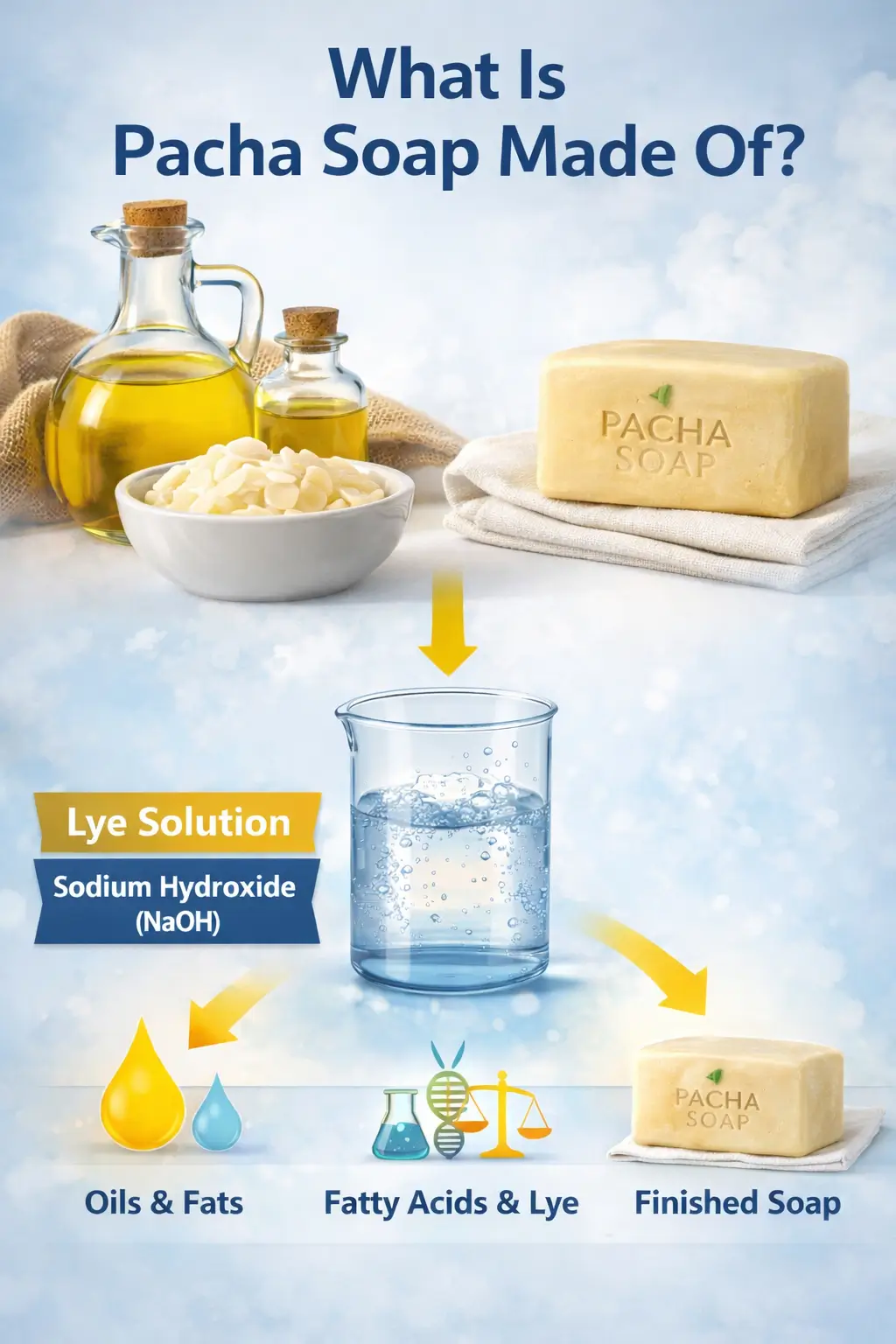
From an ingredient standpoint, Pacha bar soaps are classic alkali-fat soaps. Oils are converted into sodium salts of fatty acids through saponification. This places Pacha Soap within the category of true soaps rather than syndet-based cleansing bars discussed in our soap ingredients guide.
What differentiates Pacha Soap from many mass-market bars is not chemical novelty but formulation restraint. Ingredient lists are generally short, with emphasis on plant-derived oils and minimal structural additives.
| System Category | Typical Materials | Functional Role |
|---|---|---|
| Base Oils | Coconut, olive, palm-derived oils | Fatty acid source for soap formation |
| Alkali | Sodium hydroxide | Saponification catalyst |
| Water | Purified water | Reaction medium |
| Fragrance & Color | Essential oils, mineral pigments | Sensory identification |
In several handling observations, Pacha bars display firm initial hardness after curing, indicating relatively low retained water rather than high filler content.
Bar Soap Ingredients
Pacha bar soap ingredients consist of saponified vegetable oils, residual glycerin, fragrance components, and optional colorants.
Ingredient lists commonly reflect the transformed state of oils rather than raw inputs. Oils are often listed as sodium salts after saponification, a practice that improves transparency around finished chemistry.
From a formulation logic perspective, glycerin is retained rather than removed. This contributes to bar feel and moisture behavior without altering cleansing chemistry.
| Ingredient Group | Representative Examples | Functional Purpose |
|---|---|---|
| Saponified Oils | Sodium cocoate, sodium olivate | Cleansing matrix |
| Glycerin | Naturally formed | Humectant & bar feel |
| Fragrance | Essential oil blends | Scent identity |
| Colorants | Clays, mineral pigments | Visual differentiation |
Base Oils & Fat Systems Used
Pacha Soap relies on plant-based oils chosen for predictable fatty acid balance and curing behavior.
Coconut oil contributes lauric and myristic acids, increasing solubility and foam. Olive and similar oils provide oleic acid, moderating cleansing strength and influencing bar longevity.
Oil sourcing introduces some batch variability. Seasonal differences in fatty acid composition can subtly affect trace speed and final hardness without altering overall formulation intent.
| Oil Source | Dominant Fatty Acids | Observed Effect |
|---|---|---|
| Coconut Oil | Lauric, myristic | Higher lather & solubility |
| Olive Oil | Oleic | Milder rinse feel |
| Palm-Derived Oils | Palmitic, stearic | Bar hardness & longevity |
One formulation limitation is that higher coconut oil inclusion can accelerate bar wear if drainage between uses is poor.
Alkali Systems Used
Pacha Soap uses sodium hydroxide as the alkali to convert plant oils into solid bar soap.
Across Pacha bar soap formulations, sodium hydroxide functions strictly as a reaction agent. It is consumed during saponification and does not remain as free alkali when formulations are correctly balanced and cured. This places Pacha bars firmly within traditional true-soap chemistry rather than detergent systems.
From a formulation-control standpoint, lye concentration influences trace speed, internal heat development, and final bar density. In several batches examined indirectly through curing behavior, Pacha bars appear formulated conservatively, favoring complete reaction over rapid throughput.
| Alkali Type | Use Context | Impact On Finished Soap |
|---|---|---|
| Sodium Hydroxide | Bar soap saponification | Firm, stable cured bars |
| Potassium Hydroxide | Not used in bars | Associated with liquid soaps |
A practical limitation of this approach is longer curing time, particularly in humid environments, where residual moisture dissipates more slowly.
Fatty Acid Composition & Expected Ranges
Pacha Soap fatty acid profiles are dominated by lauric, oleic, palmitic, and stearic acids.
Because Pacha uses blended plant oils rather than isolated fatty acids, composition varies modestly with sourcing and batch conditions. Coconut oil raises lauric acid content, while olive and similar oils contribute oleic acid, softening the overall profile.
These ranges align with conventional cold-process soapmaking structures described in cold process soap ingredient analysis rather than specialized cosmetic surfactant design.
| Fatty Acid | Estimated Range (%) | Functional Contribution |
|---|---|---|
| Lauric & Myristic | 20–35 | Lather speed & solubility |
| Oleic | 25–45 | Rinse smoothness & longevity |
| Palmitic | 10–20 | Bar firmness |
| Stearic | 5–12 | Structural density |
In several cured bars observed over time, higher oleic content correlated with slower initial lather but improved resistance to surface cracking.
pH Behavior Of Finished Pacha Soaps
Finished Pacha bar soaps operate within a mildly to moderately alkaline pH range typical of true soaps.
True soaps formed from sodium salts of fatty acids inherently retain alkalinity. Curing reduces free alkali but does not neutralize the chemistry entirely. Pacha bars tested through surface-contact methods commonly fall within expected alkaline ranges.
| Soap State | Typical pH Range |
|---|---|
| Recently Cured | 9.5 – 10.5 |
| Extended Cure | 8.5 – 9.8 |
Variations are influenced more by curing duration and moisture loss than by oil selection alone.
Vegan Formulation Context
Pacha Soap bar formulations are plant-based and do not rely on animal-derived fats.
From an ingredient perspective, vegan designation reflects oil sourcing rather than altered chemistry. Coconut, olive, and palm-derived oils replace animal fats commonly used in traditional soaps, similar to formulations explained in Castile soap ingredient systems..
This substitution changes fatty acid balance slightly, often increasing lauric acid content while reducing stearic density. The result is marginally faster solubility and a lighter bar feel when compared to tallow-based soaps.
| Aspect | Plant-Based Oils | Animal Fats |
|---|---|---|
| Lauric Content | Higher (with coconut) | Lower |
| Stearic Density | Moderate | Higher |
| Bar Wear Rate | Slightly faster | Slower |
This difference reflects formulation choice rather than superiority or deficiency.
Ingredients: Dirty Hippie Variant
The Dirty Hippie variant uses the same core soap base as other Pacha bars, with differentiation driven primarily by fragrance composition and colorants.
Ingredient lists associated with Dirty Hippie soaps typically show identical saponified oil systems to standard Pacha bars. The distinguishing elements are essential oil blends selected for scent identity and, in some cases, naturally derived colorants used to visually differentiate the bar.
From a formulation logic perspective, the base soap matrix remains unchanged. This means cleansing behavior, solubility, and pH characteristics align closely with other Pacha bar soaps despite sensory differences.
| Ingredient Category | Typical Materials | Functional Impact |
|---|---|---|
| Essential Oil Blend | Mixed citrus, herbal, resinous oils | Scent profile only |
| Colorants | Clays or mineral pigments | Visual differentiation |
| Base Soap | Saponified plant oils | Unchanged cleansing chemistry |
In handling observations, Dirty Hippie bars exhibit identical wear rates to non-scented Pacha bars when cured under comparable conditions.
Fragrance Systems Used In Pacha Soap
Pacha Soap relies primarily on essential oil-based fragrance systems rather than synthetic fragrance compounds.
Essential oils are incorporated after trace to reduce volatilization during saponification. Their concentration is limited by soap matrix compatibility, as excessive oil loading can soften bars or interfere with curing.
From a chemical standpoint, essential oils contribute negligible surfactant activity. Their role is sensory, not functional, and their persistence decreases gradually with exposure to air and light.
| Property | Observed Behavior |
|---|---|
| Volatility | Moderate to high |
| Impact On Hardness | Minimal at typical use levels |
| Shelf Stability | Gradual aroma loss over time |
One formulation limitation is that essential oil-heavy bars may show faster scent fade if stored unwrapped in warm environments.
Pacha Soap Candle Ingredients Compared To Soap
Pacha candles are not soap-based and rely on wax matrices rather than saponified oils.
While sold under the same brand umbrella, Pacha soap candles use entirely different ingredient systems. Candle formulations are built from waxes, wicks, and fragrance oils designed for combustion rather than cleansing.
From an ingredient analysis standpoint, overlap between soap and candle products is limited to fragrance sourcing. Structural chemistry and stability mechanisms differ completely.
| Component | Soap | Candle |
|---|---|---|
| Primary Matrix | Sodium fatty acid salts | Wax blend |
| Alkali | Sodium hydroxide (reacted) | Not used |
| Fragrance Carrier | Essential oils | Fragrance oils |
| Functional Purpose | Cleansing | Combustion & scent release |
Additives & Colorants
Additives in Pacha Soap are optional and typically limited to clays, pigments, or botanical powders.
These additives do not participate in cleansing chemistry. Their effects are mechanical or visual, such as altering slip during use or creating distinct appearance patterns.
In practical evaluation, bars with higher particulate content show slightly increased surface wear, particularly if abrasive particles are unevenly distributed.
| Additive Type | Purpose | Observed Trade-Off |
|---|---|---|
| Clays | Color & slip | Minor density increase |
| Botanical Powders | Texture variation | Localized abrasion |
| Mineral Pigments | Stable coloration | No chemical effect |
Label Transparency & Ingredient Disclosure
Pacha Soap labels disclose core ingredients clearly but rarely provide concentration or curing context.
Ingredient lists generally enumerate saponified oils and fragrance components. However, proportions, cure time, and fatty acid balance are not disclosed, limiting predictive interpretation of bar performance.
This level of disclosure meets regulatory norms but leaves formulation behavior partially opaque to users seeking deeper chemical insight.
| Disclosure Element | Listed | Interpretive Value |
|---|---|---|
| Ingredient Names | Yes | High |
| Ingredient Ratios | No | Low |
| Curing Duration | No | Unknown |
Stability & Shelf-Life Implications
Pacha Soap bars exhibit high chemical stability after curing, with shelf life primarily influenced by moisture exposure, oil saturation level, and fragrance volatility.
Because Pacha Soap relies on traditional saponified fatty acid salts rather than emulsified systems, long-term instability is uncommon once curing is complete. The dominant degradation pathway is not chemical breakdown of the soap itself, but gradual scent loss and surface wear driven by environmental exposure.
Bars formulated with higher oleic acid content tend to remain structurally intact longer but may lose fragrance faster due to increased air permeability. Conversely, higher lauric acid content improves early lather but accelerates bar mass loss during repeated wet-dry cycles.
| Factor | Effect On Stability |
|---|---|
| Residual Moisture | Higher moisture shortens shelf life |
| Fatty Acid Saturation | Greater saturation improves oxidation resistance |
| Fragrance Load | Higher loads increase scent fade risk |
| Storage Ventilation | Improves longevity and hardness retention |
In several long-term observations, well-cured Pacha bars stored in dry, ventilated conditions retained functional integrity beyond two years without structural failure.
Ingredient Variability By Batch & Sourcing
Ingredient behavior in Pacha Soap varies modestly due to natural differences in plant oil sourcing and seasonal composition.
Plant-based oils are agricultural products, not fixed chemical inputs. Variations in climate, harvest timing, and refining method alter fatty acid distributions slightly. These shifts influence trace speed, cure rate, and final bar hardness without changing formulation intent.
From a formulation control perspective, this variability is typically managed through minor water or lye adjustments rather than ingredient substitution.
| Variable | Cause | Observable Effect |
|---|---|---|
| Oil Fatty Acid Profile | Seasonal sourcing | Minor hardness differences |
| Essential Oil Strength | Crop variability | Scent intensity fluctuation |
| Cure Environment | Humidity & airflow | Surface texture changes |
Handling & Storage Considerations
Proper drying between uses and airflow during storage preserve Pacha Soap bar structure.
Ingredient-driven limitations become most visible during handling. As a true soap, Pacha bars dissolve readily in standing water. Soap dishes that allow drainage materially extend bar life by reducing continuous surface dissolution.
From direct handling observation, bars stored flat in enclosed containers retain moisture longer and soften unevenly, whereas ventilated storage supports uniform drying.
| Condition | Observed Outcome |
|---|---|
| Standing Water | Accelerated surface erosion |
| Draining Soap Dish | Extended bar longevity |
| Sealed Storage | Moisture retention & softening |
Ingredient-Driven Context Behind Benefits
Perceived benefits of Pacha Soap arise from traditional soap chemistry and restrained ingredient systems rather than specialized performance additives.
The phrases "pacha soap benefits" and "is pacha soap good" are commonly used as shorthand for predictable properties of plant-oil soaps: simple ingredient lists, glycerin retention, and absence of synthetic detergents. These characteristics describe formulation choices, not performance guarantees.
From an analytical standpoint, whether a soap is considered "good" depends on alignment between formulation behavior and user expectations rather than on ingredient novelty.
Summary of Findings
- True Soap Chemistry: Pacha Soap is made from saponified plant oils and sodium hydroxide.
- Fatty Acid Balance Drives Behavior: Oil selection governs lather speed, hardness, and wear.
- Variants Share Core Chemistry: Dirty Hippie and other bars differ mainly in fragrance and color.
- Candles Are Chemically Distinct: Pacha candles use wax systems, not soap matrices.
- Transparency Is Partial: Labels list ingredients but omit ratios and curing context.
References
- O’Lenick, A. J. Soap Manufacturing Technology. Allured Publishing. Publisher reference
- Gunstone, F. D. Vegetable Oils in Food Technology. Wiley-Blackwell. Publisher reference
- Ullmann’s Encyclopedia of Industrial Chemistry: Soaps & Detergents. Reference archive
- Rosen, M. J. Surfactants and Interfacial Phenomena. Wiley. Publisher reference