Definition
Sodium palmate is the sodium salt of fatty acids derived from palm oil and functions as a primary structural soap ingredient within traditional bar soap systems. Chemically it belongs to the class of fatty acid salts produced through alkaline hydrolysis of triglycerides, a reaction commonly referred to as saponification. In finished cleansing products, sodium palmate forms part of the solid soap matrix that provides cleansing capability, bar hardness, and structural stability.
Within a soap formulation, sodium palmate operates as an anionic surfactant. The molecule contains a hydrophilic sodium carboxylate head and a hydrophobic fatty acid chain. This dual structure allows the ingredient to interact with oils, soil residues, and water simultaneously, enabling removal of hydrophobic material from surfaces during washing. The ingredient therefore contributes both to cleansing performance and to the physical architecture of the soap bar itself.
This page belongs to the CleanFormulation Ingredient Library, a research project focused on analyzing how ingredients behave inside real cleansing formulations rather than evaluating them as isolated cosmetic marketing claims.
Quick Facts
| Property | Description |
|---|---|
| Ingredient Type | Soap base component |
| Chemical Class | Sodium salt of palm oil fatty acids |
| Functional Role | Cleansing surfactant and structural component in bar soaps |
| Ionic Class | Anionic surfactant |
| Typical Use Context | Solid bar soaps and blended soap bases |
| Typical Production Method | Saponification of palm oil triglycerides with sodium hydroxide |
| Chemical Formula | Representative fatty acid salt often approximated as C16H31NaO2 |
Ingredient Interaction Logic
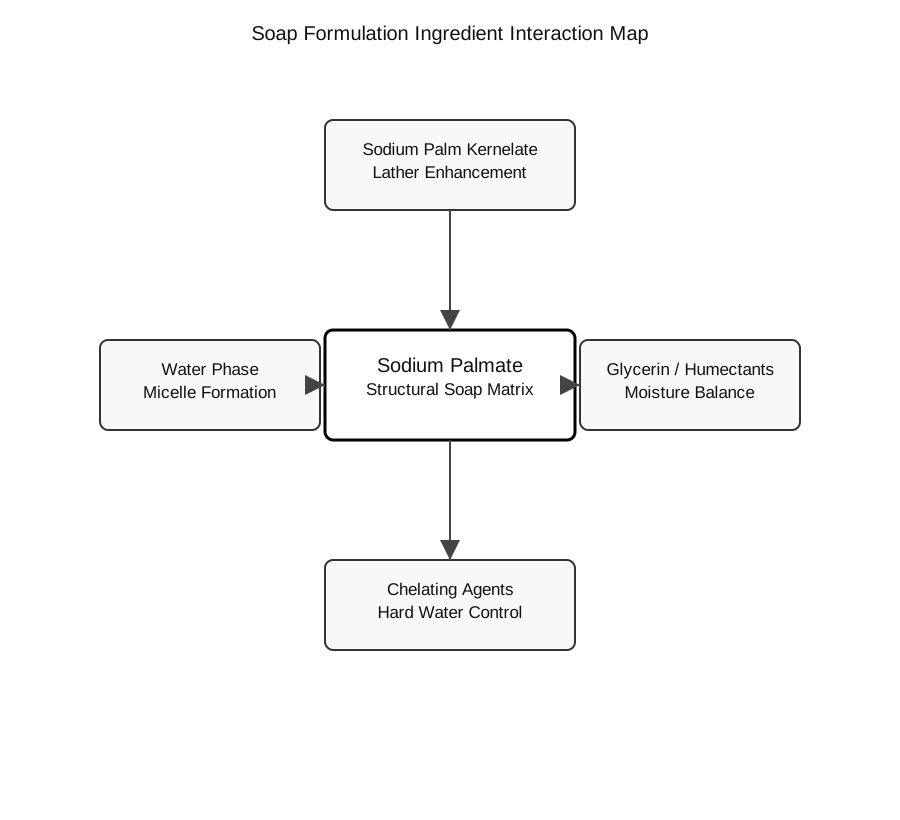
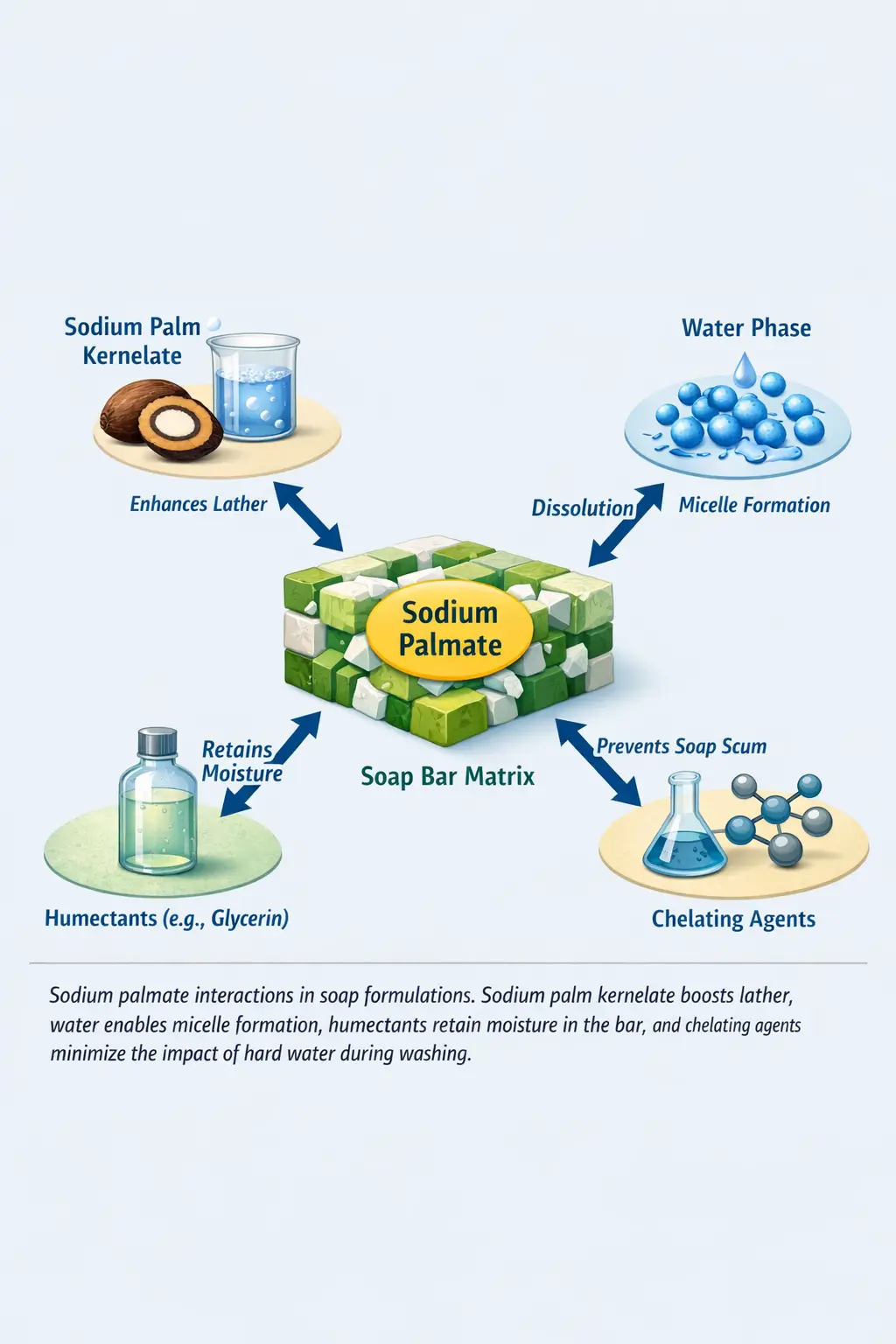
Soap formulations operate as multi component systems in which individual ingredients influence the behavior of others. Sodium palmate interacts with several common formulation components, including other soap salts, water, humectants, and chelating agents. These interactions determine how the soap behaves during storage and during washing.
When combined with other fatty acid salts, sodium palmate contributes to a composite crystalline matrix that defines the internal structure of the soap bar. Blends containing sodium palm kernelate, for example, often produce a balance between structural firmness and rapid lather generation. The shorter chain fatty acids present in palm kernel oil dissolve more readily in water, increasing foam production while the palmitate fraction stabilizes the physical bar.
Water present within the soap matrix influences how these salts hydrate and organize into crystalline domains. Even solid soap bars contain a small amount of internal water, which affects hardness, dissolution rate, and the rate at which surfactant molecules are released during washing.
Additional formulation components can further modify system behavior. Humectants such as glycerin alter moisture distribution within the soap structure. Chelating agents reduce the effect of mineral ions present in hard water, which otherwise interact with soap salts to form insoluble deposits sometimes referred to as soap scum.
Why This Ingredient Appears on Cosmetic Labels
Consumers often encounter the term sodium palmate while reading ingredient labels on bar soaps and cleansing products. Cosmetic labeling regulations require manufacturers to declare ingredients using standardized INCI names rather than describing the entire manufacturing process. As a result, soaps produced through saponification appear as individual fatty acid salts rather than as the original oils from which they were derived.
During soap manufacturing, palm oil triglycerides react with sodium hydroxide to produce glycerin and sodium salts of fatty acids. One of the dominant fatty acids present in palm oil is palmitic acid. When converted into its sodium salt during saponification, the resulting ingredient listed on labels becomes sodium palmate.
The appearance of sodium palmate on an ingredient list therefore reflects the chemical identity of the soap after saponification rather than the presence of raw palm oil itself. In many formulations, this ingredient works alongside related soap salts such as sodium palm kernelate, sodium cocoate, or sodium tallowate, depending on the oil blend used during production.
Chemical Identity & Classification
Sodium palmate is the sodium salt of palmitic acid, a saturated fatty acid commonly found in palm oil and several other plant and animal fats. The ingredient belongs to the broader category of fatty acid soaps, which are produced when triglycerides react with an alkaline base such as sodium hydroxide. The resulting molecules carry a negatively charged carboxylate group associated with a sodium ion, giving the ingredient its anionic surfactant behavior in aqueous systems.
The chemical formula typically associated with sodium palmate represents the palmitate ion paired with sodium. Because natural oils contain mixtures of fatty acids, practical soap materials rarely consist of a single pure compound. Instead, sodium palmate functions as part of a fatty acid salt distribution within the soap matrix. This distribution influences properties such as hardness, melting behavior, and lather stability.
From a formulation perspective, sodium palmate belongs to the same structural family as other long chain fatty acid soaps. The hydrocarbon chain length contributes hydrophobic character, while the ionic head group interacts with water. This amphiphilic structure allows the ingredient to organize into micelles in aqueous environments, a key process underlying cleansing behavior.
Functional Role in Soap Systems
Within solid cleansing bars, sodium palmate primarily functions as a structural soap salt that contributes to the firmness and durability of the finished product. Palm oil contains a relatively high proportion of palmitic acid compared with many other vegetable oils. When converted into its sodium salt during saponification, this fatty acid produces a soap component that tends to crystallize into a relatively stable solid matrix. This structural behavior is one reason palm derived soap bases are widely used in traditional bar soap formulations.
The ingredient also participates directly in the cleansing mechanism of soap. Like other fatty acid salts, sodium palmate acts as an anionic surfactant capable of forming micelles when dissolved in water. These micelles organize hydrophobic fatty acid chains inward while exposing hydrophilic ionic groups outward toward the surrounding water phase. The resulting structure allows oily residues and particulate soil to become encapsulated within micellar aggregates during washing.
In practical formulations, sodium palmate rarely functions alone. Soap manufacturers typically blend multiple fatty acid salts to balance cleansing performance, lather generation, and structural integrity. For example, shorter chain fatty acid salts may enhance lather formation, while longer saturated chains such as palmitate contribute to bar hardness and slower dissolution during use.
The resulting soap system behaves as a cooperative mixture rather than a single ingredient. Sodium palmate therefore plays an architectural role in the soap matrix while simultaneously contributing to the surfactant activity required for cleansing.
Phase Behavior
The physical behavior of sodium palmate in cleansing products depends strongly on its phase environment. In dry form, fatty acid soaps typically exist as crystalline solids composed of organized molecular domains. Within a finished bar soap, these crystalline structures form a continuous matrix that determines hardness, melting behavior, and resistance to rapid dissolution.
When exposed to water during washing, portions of the soap matrix dissolve into the aqueous phase. Dissolved molecules reorganize into micelles once a sufficient concentration threshold is reached. This transition from crystalline solid to micellar solution allows soap molecules to interact with oils and particulate matter present on surfaces being cleaned.
Temperature also influences this behavior. Elevated temperatures tend to increase soap solubility, which can accelerate the rate at which the bar dissolves during use. Conversely, cooler storage conditions tend to preserve structural rigidity because the crystalline domains remain more stable.
The presence of mineral ions in water introduces an additional phase interaction. Calcium and magnesium ions commonly found in hard water can react with fatty acid salts to produce insoluble metal soaps. These materials precipitate out of solution and reduce the availability of active surfactant molecules during washing.
Regulatory Context
Sodium palmate appears in cosmetic ingredient declarations under the International Nomenclature of Cosmetic Ingredients system, commonly abbreviated as INCI. Cosmetic regulations in many jurisdictions require finished products to disclose ingredients using standardized INCI terminology rather than describing the manufacturing process that produced them.
Within the European Union, cosmetic ingredient labeling follows the requirements outlined in Regulation (EC) No 1223/2009 on cosmetic products. According to these rules, ingredients must be declared in descending order of concentration when present above defined thresholds. Fatty acid soap salts generated during saponification are listed individually under their corresponding INCI names, including sodium palmate and related soap salts such as sodium palm kernelate.
Regulatory databases such as CosIng classify sodium palmate as a surfactant with cleansing function. The classification reflects its role within finished cosmetic formulations rather than the raw oil used during manufacturing. In practice, this labeling approach allows regulatory authorities and consumers to identify the functional components present in the final product.
Ingredient disclosure systems therefore focus on the chemical identity present in the finished formulation. For traditional soaps manufactured through alkaline hydrolysis of oils, this means the label reflects the sodium salts produced during the reaction rather than the starting triglyceride materials.
Common Misunderstanding
A common misunderstanding surrounding sodium palmate arises from the way soap ingredients appear on cosmetic labels. Many consumers assume that the presence of sodium palmate indicates that palm oil has been added directly to the finished soap formulation. In reality, the ingredient name represents the chemical form that results after the saponification reaction has already occurred.
During soap production, triglycerides contained in oils are chemically transformed when they react with sodium hydroxide. The reaction breaks the triglyceride molecules into glycerin and fatty acid salts. Palmitic acid present in palm oil therefore becomes sodium palmate once the reaction is complete.
This labeling convention means the ingredient list reflects the composition of the finished soap matrix rather than the raw materials originally placed into the production vessel. Similar transformations occur with many other oils used in soap manufacturing. Coconut oil, for example, produces sodium cocoate after saponification rather than appearing under its original oil name.
Structural Limitations
Although sodium palmate contributes important structural properties to solid soaps, its behavior within cleansing systems is influenced by several formulation constraints. One limitation arises from the interaction between soap salts and mineral ions present in hard water. Calcium and magnesium ions readily react with fatty acid salts to form insoluble metal soaps. These materials reduce the availability of surfactant molecules during washing and may leave visible residues on surfaces.
Another limitation relates to pH environment. Soap systems formed from fatty acid salts typically exist in alkaline conditions because they originate from reactions with strong bases such as sodium hydroxide. This inherent alkalinity influences how soap formulations behave when compared with synthetic detergent systems that may operate across a broader pH range.
Solubility behavior also introduces practical boundaries. While sodium palmate contributes to bar hardness and structural stability, it dissolves more slowly than shorter chain soap salts. Excessive reliance on long chain fatty acid salts may produce bars that dissolve more slowly but generate less rapid foam formation during early stages of washing.
For this reason, many formulations balance sodium palmate with additional soap salts derived from other oils. The resulting mixture allows formulators to adjust lather characteristics, dissolution behavior, and structural durability simultaneously.
Product Formulation References Using This Ingredient
- Nivea Ingredients Analysis
- Himalaya Almond, Cucumber & Honey Soap
- ABC Detergent Soap
- Amway Soap Ingredients Analysis
- Dial Himalayan Salt Hand Soap
- Himalaya Neem & Turmeric Soap
- Himalaya Soap Bar Guide
- Cetaphil Cleansing Formulations Analysis
- ABC Laundry Soap & Washing Powder
- Fels Naptha Soap Ingredients Analysis
- Ivory Soap Ingredient Analysis
Summary of Findings
Sodium palmate is a fatty acid soap salt produced during the alkaline hydrolysis of palm oil triglycerides. As the sodium salt of palmitic acid, it belongs to the broader family of anionic surfactants commonly used in traditional bar soap systems. Within finished formulations, the ingredient contributes both cleansing capability and structural integrity to the soap matrix.
- Chemical Classification: Sodium palmate is the sodium salt of palmitic acid and functions as an anionic surfactant within soap systems.
- Functional Role: The ingredient contributes to cleansing activity while also forming part of the crystalline matrix that gives bar soaps their firmness.
- Interaction Logic: In most formulations, sodium palmate operates alongside other fatty acid salts such as sodium palm kernelate to balance lather generation and structural durability.
- Phase Behavior: The ingredient exists as a crystalline solid in bar soaps and transitions into micellar structures when dissolved in water during washing.
- Formulation Boundaries: Interactions with mineral ions in hard water and the inherent alkalinity of soap systems influence how the ingredient behaves during use.