Overview & Introduction
Lye soap has been discussed, debated, misunderstood, and examined for generations. It occupies a unique place in cleansing science because it originates from the oldest known method of making true soap: combining alkali with fats to trigger saponification. Modern conversations surrounding safety, pH, skin compatibility, and real risks sometimes blur technical distinctions between raw lye and finished soap. Because of this, many people question whether lye soap is beneficial or potentially harmful, especially for facial use and sensitive skin categories.
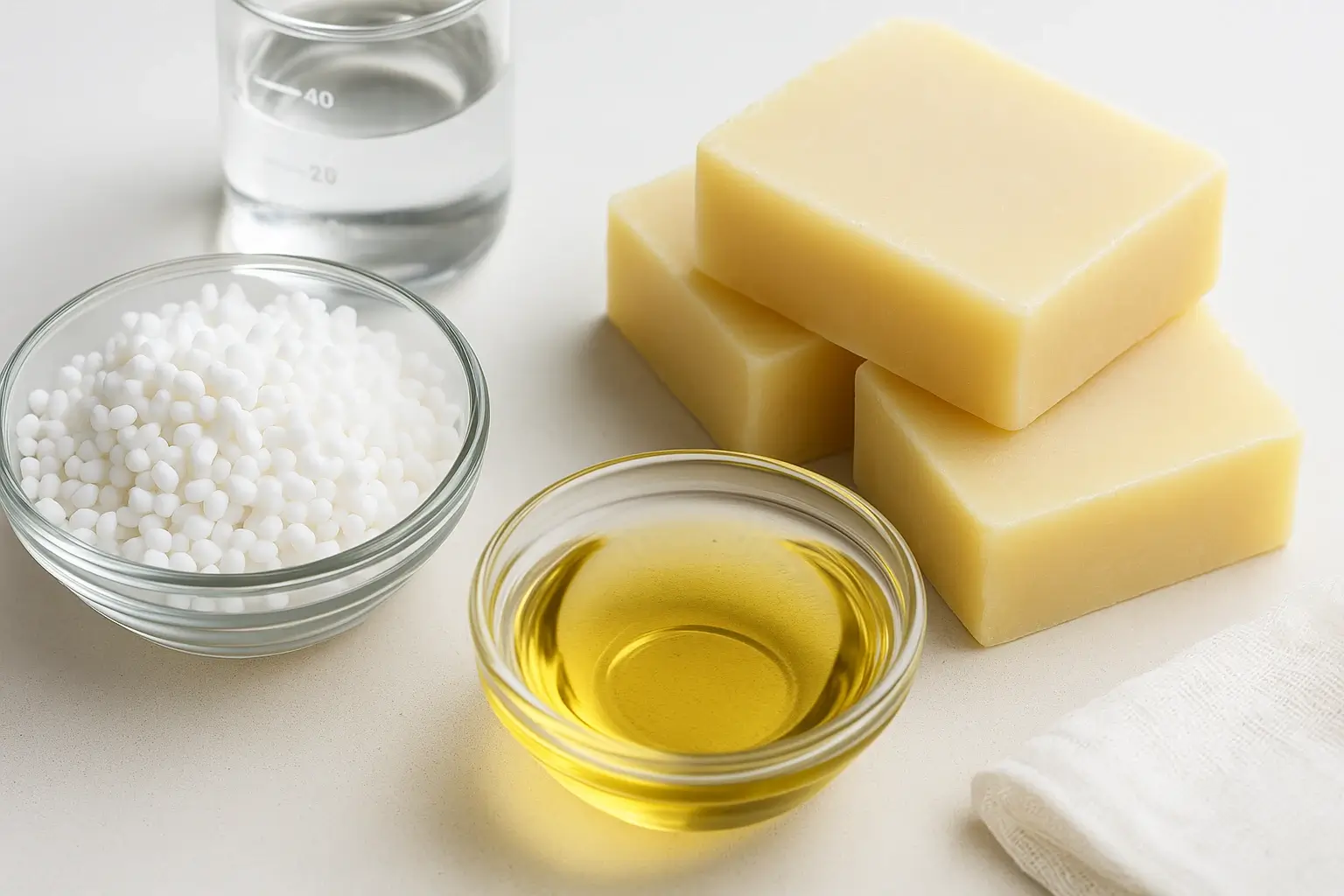
This long-form guide aims to present a transparent, evidence-based evaluation of lye soap, explaining how saponification works, why properly formulated bars contain no active lye, where real hazards occur, and how characteristics like fatty acid composition, pH ranges, cure times, and formulation variables influence safety and performance. The intent is not to advocate for or against lye soap, but to clarify chemistry and practical considerations so readers can make informed decisions.
All information is educational and research-based, without offering medical claims or treatment recommendations. Safety depends on formulation accuracy, cure time, ingredient balance, and manufacturing precision-not assumptions or anecdotal claims.
Is Lye Soap Safe?
In finished bar soap, safety is determined by whether the saponification reaction has completed, leaving no unreacted sodium hydroxide, and whether the formulation is balanced with appropriate oil-to-lye ratios. When made correctly, the final bar contains sodium salts of fatty acids and naturally produced glycerin rather than caustic alkali.
Raw sodium hydroxide is highly alkaline and corrosive in its unmixed state. However, once it fully reacts with triglycerides, the resulting product is chemically distinct. Properly formulated lye soap is considered safe for general cleansing usage when cured and when the recipe is balanced stoichiometrically.
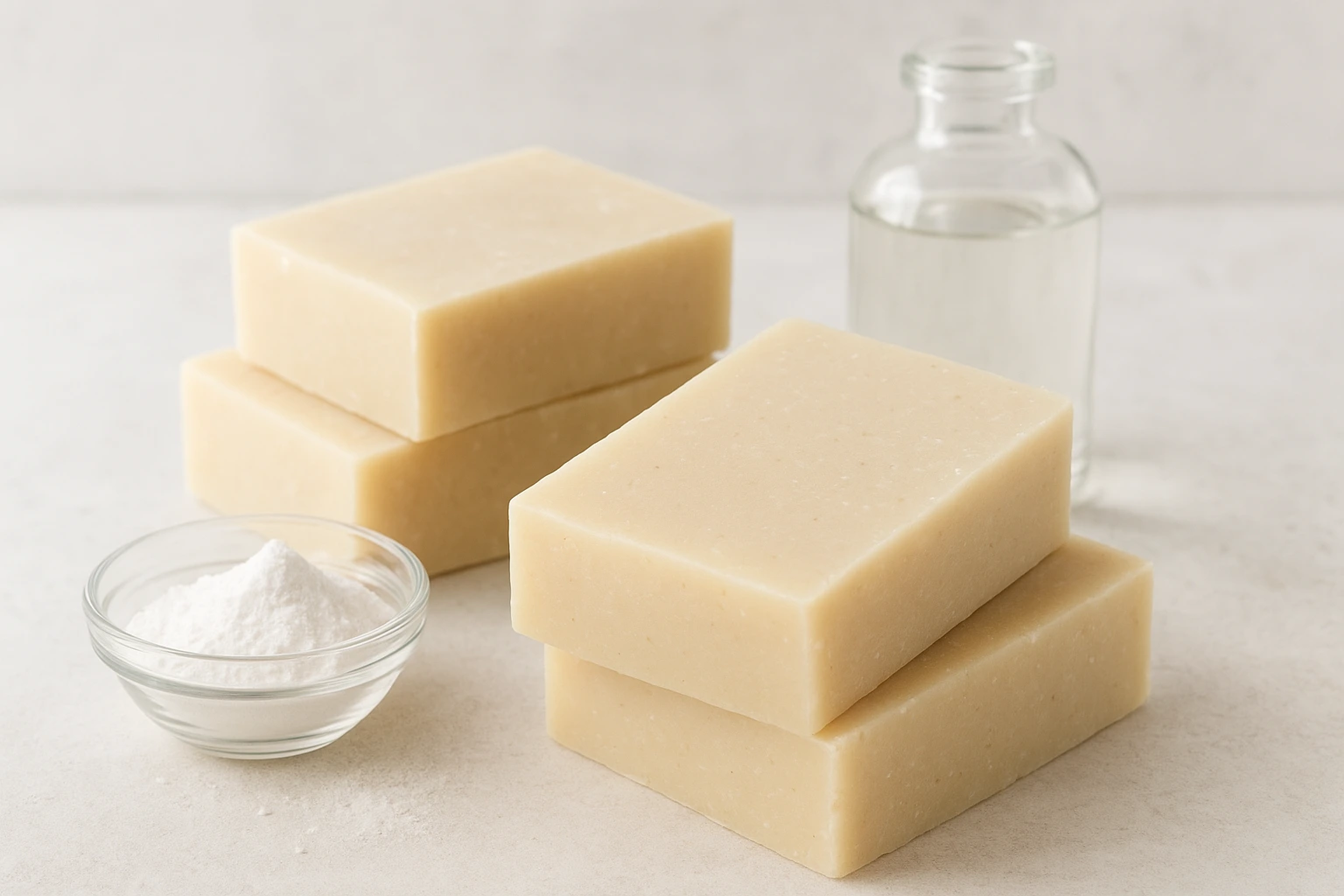
Why Finished Soap Contains No Harsh Lye When Properly Made
During saponification, triglycerides from oils and butters react with sodium hydroxide, producing two new substances: soap molecules sodium salts of fatty acids (soap surfactants) and glycerin. When the reaction reaches completion and the bar undergoes adequate curing, the resulting bar does not contain free lye. Instead, sodium hydroxide is consumed as a reagent and transformed.
| Reactants | Products |
|---|---|
| Triglycerides (fats/oils) + NaOH (lye) | Sodium fatty acid salts (soap) + Glycerin |
Stoichiometric accuracy matters. Soap calculators estimate the required lye amount based on saponification values (SAP values), which represent the quantity of alkali needed per gram of fat. Excess lye leads to harshness; excess oil (superfatting) leaves non-saponified fatty acids contributing mildness and conditioning properties.
What Makes Lye Soap Safe or Unsafe in Practice
| Safety Factor | Effect on Bar |
|---|---|
| Lye-to-oil ratio | Balanced ratios produce a mild bar; excess lye increases harshness |
| Superfat percentage | Extra oils improve conditioning and reduce risk of residual alkalinity |
| Cure time (4–6 weeks typically) | Ensures evaporation, crystallization, stability, and pH settling |
| Fatty acid composition | Influences hardness, cleansing strength, lather, and skin feel |
| Manufacturing method control | Precision prevents pockets of unreacted alkali |
When any of these variables are neglected, the product may behave unpredictably, potentially causing irritation. The problem is not the existence of lye in the historical recipe, but the presence of unreacted alkali due to incorrect formulation or inadequate curing.
Is Lye Soap Good for Your Skin?
Skin response to lye soap depends on the fatty acid distribution of the oils used, superfat level, finished pH range, and the user’s barrier integrity. Properly formulated bars with balanced cleansing and conditioning properties can be suitable for many skin types. Yet, since true soap typically has a naturally alkaline pH (9–10.5), individual responses vary. Understanding composition matters more than relying on marketing terms or assumptions.
Historically, simple lye soap was formulated using tallow or lard, producing a dense bar with moderate cleansing and low solubility. Modern handcrafted soap often uses combinations like olive, coconut, palm, shea butter, sunflower, and castor oils to deliberately control mildness and lather outcomes.
Skin Benefits of Traditional Lye Soap
The benefits commonly associated with lye soap arise from natural glycerin retention and from specific fatty acid profiles. Unlike many commercial detergent bars that remove glycerin during processing, handcrafted lye soap retains naturally generated glycerin, improving water binding and reducing moisture loss from stratum corneum layers. The bar’s performance reflects its chemistry.
| Fatty Acid | Source Oils | Primary Function |
|---|---|---|
| Oleic (C18:1) | Olive, High Oleic Sunflower, Avocado | Soft, gentle conditioning, creamy lather |
| Lauric (C12:0) | Coconut, Babassu, Palm Kernel | Strong cleansing, bubbly lather |
| Stearic (C18:0) | Tallow, Shea Butter | Hardness, longevity, dense stable lather |
| Linoleic (C18:2) | Safflower, Sunflower | Light-conditioning, emollient properties |
A balanced bar typically features stronger cleansing fatty acids (lauric/myristic) in the 14–22% range and conditioning fatty acids (oleic/linoleic/stearic) around 45–65% depending on preference. When these proportions are aligned and superfat is maintained at 3–8%, users often describe a comfortable cleansing effect rather than tightness.
Who Should Avoid Lye Soap (Sensitive or Compromised Skin Types)
Individuals with disrupted moisture barriers may experience sensitivity to alkaline products regardless of ingredient quality. Skin that is already stressed can react strongly to pH shifts or higher cleansing action. Excessively high cleansing formulas dominated by lauric/myristic acids may remove sebum aggressively for those prone to dryness. Additionally, bars that are too young (insufficient cure) or improperly balanced may present irritation risk.
| Potential Concern | Reason |
|---|---|
| Barrier-compromised skin | Can be reactive to alkaline pH regardless of formulation |
| Very high cleansing bars | Can increase dryness by lipid removal |
| Freshly made, uncured bars | pH has not stabilized; excess water and alkali may remain |
What Does Lye Actually Do in Soap Making?
Lye initiates saponification, a process explained in detail in our guide to bar soap formulation basics, converting triglycerides in oils into soap molecules. Without lye, true soap cannot form because the process depends on breaking the ester bonds of triglycerides, releasing fatty acids, and bonding them to sodium ions. Once this transformation completes, lye no longer exists in its original caustic state.
The Saponification Reaction: Turning Oils and Lye Into Soap + Glycerin
Triglycerides consist of three fatty acids connected to a glycerol backbone. Sodium hydroxide cleaves these bonds, freeing the fatty acids and creating glycerol. The fatty acids then bond with sodium to form soap. The chemistry explains why finished soap is fundamentally different from raw ingredients.
| Stage | Transformation |
|---|---|
| Before Reaction | Oils + NaOH exist separately; alkali is caustic |
| During Reaction | Triglycerides break apart; glycerol and sodium salts form |
| After Completion | Soap + glycerin; NaOH is consumed |
Why Lye Is Essential and Cannot Be Substituted
Products called "soap" that do not use sodium hydroxide or potassium hydroxide are not true soap chemically. They are typically synthetic detergent bars formulated using surfactants such as sodium lauryl sulfate, sodium cocoyl isethionate, or sodium lauryl sulfoacetate. They may perform differently, offering lower pH and tailored attributes, but they are manufactured through entirely different processes.
Is Lye in Soap Bad for You?
Concerns about the safety of lye in soap generally arise from confusion between raw sodium hydroxide (NaOH), which is a highly alkaline caustic ingredient, and fully saponified, cured soap, where sodium hydroxide has already chemically reacted with oils and no longer exists in its original caustic state. Raw lye can cause burns on contact, but once the saponification reaction is complete, it is chemically transformed into soap and glycerin, forming a new neutral compound.
In professionally formulated soap, the balance between oil and sodium hydroxide is calculated using stoichiometric ratios and verified via digital lye calculators. The formulation typically includes a deliberate superfat margin of 3–8%, meaning a portion of oil remains unreacted by design, ensuring that no free lye remains in the finished bar. This margin improves mildness and reduces irritation potential, especially for personal care use.
Raw soap batter within the first 24–48 hours after mixing still contains active alkali. Testing methods used by experienced soap makers-such as phenolphthalein testing (colorimetric pH indicator), zap testing (traditional qualitative method), and titration for free alkalinity-determine whether a soap batch retains any unreacted sodium hydroxide. A value above 0.1% free alkali indicates unsafe soap. Properly made soap consistently registers 0%.
Cured solid soap bars normally stabilize to a pH range of 8.0–10.0. This alkaline value is inherent to all true soap and does not imply the presence of active lye. Many users tolerate this pH well for everyday cleansing, but people with compromised skin barriers may prefer low-pH syndet products. In such cases, the consideration is alkaline pH interaction, not sodium hydroxide exposure.
Therefore, the correct statement is: Raw lye is dangerous; finished, fully cured lye soap is not chemically comparable to raw lye at all. The safety evaluation depends entirely on formulation precision, reaction completion, and adequate curing time-not the ingredient list alone.
Understanding pH and Skin Barrier Effects
Human skin typically maintains a slightly acidic surface pH around 4.7–5.5, which supports microbiome stability and lipid organization. True soap falls in the alkaline range of about 9–10.5. Temporary increases in skin surface pH occur after washing but generally recover within a short period depending on barrier integrity. Higher cleansing fatty acids can enhance surfactant strength and sebum removal.
| Material | Typical pH |
|---|---|
| Human skin surface | 4.7–5.5 |
| Finished cold-process lye soap | 9–10.5 |
| Liquid castile soap | ~10–11 |
How Curing Time Eliminates Lye from Finished Bars
Cold-process soap typically requires 4–6 weeks of curing. During this period, water evaporates, crystalline structure stabilizes, and pH settles to predictable levels. The bar becomes harder, milder, and longer-lasting. Insufficiently cured soap may feel slimy, soft, or sharp on the skin and may contain pockets of alkalinity. Cure time and recipe accuracy work together to prevent harsh outcomes.
Dangers of Lye in Soap Making
The primary risks exist during manufacturing, not during use of a properly cured bar. Sodium hydroxide and potassium hydroxide are strong alkalis and require standard laboratory precautions to prevent skin or eye injury. Once saponification is complete, the material transformed into soap is no longer hazardous in the same chemical sense.
Handling Raw Lye Safely
Raw alkali requires protective equipment and controlled mixing procedures. Water is added first, followed by lye granules, because the dissolution reaction is exothermic and produces heat. Accidental splashing, dust inhalation, and improper storage represent primary areas of concern.
| Procedure | Reason |
|---|---|
| Add lye to water, not water to lye | Prevents rapid boiling and splashing |
| Use eye + skin protection | Alkali contact can cause burns |
| Work in ventilated environment | Water-vapor reaction can release irritation fumes |
| Measure precisely by mass | Accuracy ensures complete saponification |
Common Mistakes That Create Harsh or Unsafe Soap
Errors in formulation or curing can cause irritation despite soap’s safe chemistry when completed. Unreacted lye pockets may occur when oils and alkali do not blend uniformly or when acceleration (trace thickening) occurs too quickly. Bars intended to be gentle should not have excessive cleansing fatty acid values or extreme superfat that leads to instability.
| Error | Potential Issue |
|---|---|
| Incorrect lye calculation | Residual alkalinity |
| Insufficient curing | Higher pH and instability |
| Excessive coconut or palm kernel oils | Over-cleansing for dry or sensitive skin |
| Incomplete mixing | Localized irritant pockets |
What Happens to Lye During Saponification?
Saponification is the chemical reaction in which lye (sodium hydroxide, NaOH) combines with triglycerides found in fats and oils. Each triglyceride molecule breaks apart, releasing fatty acids that react with sodium ions to form soap (sodium salts of fatty acids) and glycerol (glycerin) as a natural byproduct.
The reaction can be represented simplistically as:
Fat (Triglyceride) + NaOH → Soap (Sodium Fatty Acid Salt) + Glycerin
As saponification progresses, the concentration of active lye decreases continuously. Laboratory pH tracking shows measurable reduction in alkalinity within the first 24–72 hours, and complete consumption of NaOH typically occurs by the time the soap becomes firm enough to unmold. A standard curing period of 4–6 weeks allows remaining water to evaporate, finalizing bar hardness, and stabilizing pH.
In a correctly formulated recipe with sufficient superfat (typically 3–8% excess oils), analytical tests confirm that no free lye remains in the finished bar. The end result is a chemically neutral soap bar containing fatty acid salts and glycerin, not sodium hydroxide.
Why Do Soap Makers Use Lye?
Lye is required to transform raw oils into soap molecules. Without sodium hydroxide (for solid soap) or potassium hydroxide (for liquid soap), the chemical transformation into a cleansing compound cannot occur. Every authentic bar soap begins with lye, including traditional, artisan, and commercial formulations.
Some products marketed as "lye-free" actually use pre-made soap bases (melt-and-pour) that have already undergone saponification at a manufacturing stage. The consumer does not handle lye, but the base itself was produced using lye.
In contrast, products such as syndet bars use synthetic detergents instead of soap chemistry, which is why ingredients may include names like sodium cocoyl isethionate instead of oils and lye.
Misconceptions About Lye and Skin Damage
A common concern is that lye soap burns or chemically damages skin. This misconception stems from confusion between active sodium hydroxide (a caustic alkali) and finished cured soap (a mild cleansing compound). Only improperly formulated soap that contains excess unreacted lye poses a burn risk.
Professionally measured formulations use stoichiometric calculations and soap-specific calculators to determine exact quantities of oils and lye. Additionally, intentional superfatting (3–8%) ensures that excess free oil remains instead of free lye.
Studies analyzing handcrafted soap batches demonstrate that final bars show zero detectable NaOH when test-titrated after full cure. The perception of harshness is usually related to pH, water hardness, or high-cleansing oil selections (e.g., coconut oil over ~25%).
pH Levels of Lye Soap and Skin Compatibility
Finished traditional soap generally has a pH between 8 and 10. While this is more alkaline than the skin’s natural surface pH of approximately 4.7–5.5, the skin barrier typically rebalances within 20–90 minutes after washing. Many users tolerate alkaline soaps well, especially when bathing frequency and water mineral content are moderate.
Variations depend on formulation: soaps high in oleic acid (olive-based soaps) and soaps with incorporated humectants such as naturally retained glycerin tend to feel milder. In contrast, high lauric/myristic formulas (coconut, palm kernel) increase cleansing intensity.
People with conditions involving a compromised barrier may experience sensitivity and should perform a patch test before switching products.
Is Homemade Lye Soap Safe Compared to Commercial Bars?
Safety in handmade lye soap depends on precision in both measurement and process control. The correct ratio of oils to sodium hydroxide, verified through a soap calculator, ensures that every lye molecule will bond with an oil molecule. A full curing time of 4–6 weeks allows evaporation, hardness development, and stable pH distribution throughout the bar.
A distinguishing factor is glycerin retention: commercial detergent bars frequently remove glycerin to use in other cosmetic products, whereas handcrafted soaps retain 8–13% naturally produced glycerin, affecting mildness and rinse feel.
Both handmade and manufactured products vary; correct formulation results in safe soap, poor formulation does not. The determining factor is chemistry, not whether it is homemade.
Lye Soap vs Detergent Bars: What’s the Difference?
Lye-based soap is a true soap composed of sodium fatty acid salts and glycerin. Many commercial cleansing bars are technically detergents (syndets) made from synthetic surfactants designed to solubilize oils and dirt. These may include ingredients such as sodium cocoyl isethionate, sodium lauryl sulfate, or disodium sulfosuccinate.
Functional differences:
- Mildness: True soap softness varies by oil profile; syndets are engineered for mildness at low pH.
- Biodegradability: Natural soaps biodegrade readily; some synthetic detergents persist longer.
- Glycerin: Present naturally in handmade soap; often removed from commercial bars.
Choosing between them depends on performance preferences and formulation goals rather than safety alone.
Potential Risks If Lye Soap Is Not Made Correctly
Risks arise only when the chemical process is incomplete or miscalculated. Too much lye relative to oil results in a bar with detectable free alkali, which may feel sharp, dry, or irritating on contact. High pH from inadequate cure time can also cause discomfort.
Other risks include:
- Inadequate mixing leading to localized pockets of unsaponified lye.
- Incorrect water ratios or premature use before full cure.
- Temperature fluctuations causing separation or crystallization.
Proper formulation, full curing, and measurement accuracy prevent these issues reliably.
A practical breakdown of heavy-cleansing formulations is covered in our lye soap exposure guide.Functional Characteristics of Properly Formulated Lye Soap
Well-formulated lye soap delivers controlled cleansing performance, balanced by naturally formed humectant glycerin and straightforward ingredient composition. Many formulas rely on two to five core base oils rather than long ingredient lists.
Benefits include:
- Effective yet gentle cleansing when oil profiles are well balanced.
- Retention of 8–13% glycerin produced during saponification.
- Biodegradable composition without synthetic foaming agents.
- Customizable fatty acid profiles for hardness, lather, or mildness.
Performance depends strongly on oil selection and cure, not simply the term "lye soap".
Scientific References
- Ananthapadmanabhan, K.P. et al. (2008). Cleansing without compromise: The science of mild surfactants. Journal of Dermatological Science, 51, 1–10. View Source
- Kabara, J.J. (1978). Fatty acids and derivatives as antimicrobial agents. Journal of the American Oil Chemists’ Society, 55, 770–778. View Source
- Rietschel, R.L., Fowler, J.F. (2008). Fisher’s Contact Dermatitis, 6th ed.
- Gladman, A.C. (2006). Toxicodendron dermatitis. Wilderness & Environmental Medicine, 17(2), 120–128. View Source