What Regulatory Classification Means
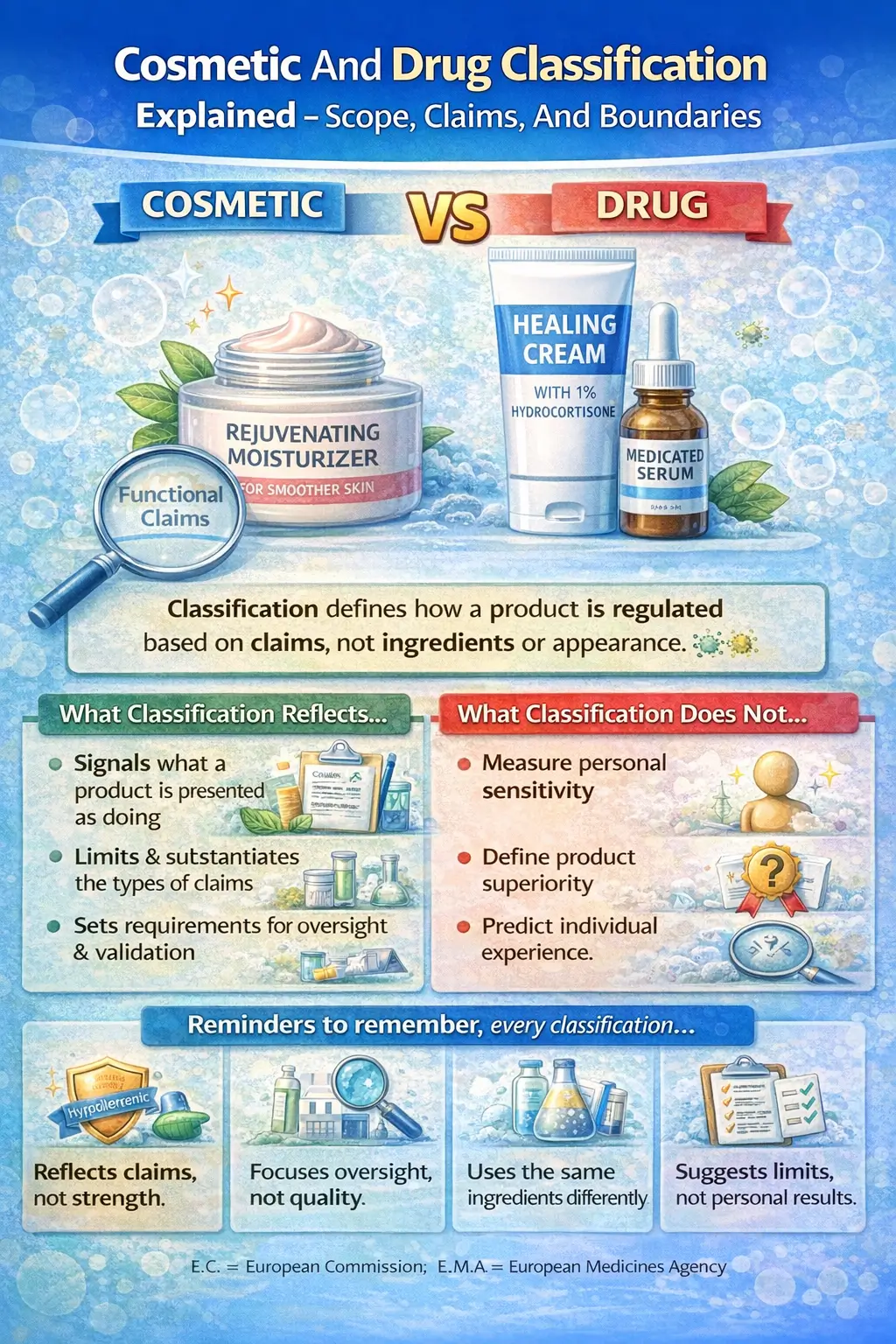
Regulatory classification defines the framework under which a product is evaluated, labeled, and monitored. It determines which rules apply to claims, documentation, and market placement. It does not function as a judgment of effectiveness or desirability.
For consumers, the term drug often carries an implication of strength or seriousness, while cosmetic suggests mildness or everyday use. In regulatory terms, these associations are not reliable indicators.
Classification exists to separate oversight pathways, not to rank products or signal outcomes.
Why Claims Determine The Category
The primary factor that places a product into a cosmetic or drug category is the nature of its claims. Claims that suggest treatment, prevention, or alteration of bodily functions move a product toward drug classification.
Cosmetic claims, by contrast, are limited to cleaning, perfuming, protecting, or maintaining appearance without implying physiological change.
This distinction explains why two products with similar formulations may be regulated differently if their language crosses different claim boundaries.
Why Ingredients Alone Do Not Decide Classification
It is common to assume that certain ingredients automatically place a product into a drug category. In reality, many substances appear in both cosmetic and drug contexts depending on how they are used and described.
An ingredient’s presence does not dictate classification in isolation. Concentration, intended function, and claim language all interact to determine regulatory treatment.
This is why ingredient-focused interpretation often fails to predict how a product is regulated.
How Cosmetic And Drug Boundaries Appear In Practice
In everyday retail settings, cosmetic and drug categories often sit side by side. Creams, washes, and topical products may look similar on the shelf while being subject to very different regulatory oversight.
The difference usually lies in what the product is presented as doing. A product that addresses appearance or cleanliness remains within cosmetic boundaries. A product that claims to treat, prevent, or correct a condition moves into drug territory.
This shift can occur without a visible change in packaging format or ingredient style, which is why classification is frequently misunderstood by consumers.
What Drug Classification Actually Controls
When a product is classified as a drug, regulation focuses on substantiation, manufacturing oversight, and claim limitation. The framework is designed to manage risk associated with therapeutic intent, not to signal superior everyday performance.
This classification governs how claims are supported and monitored. It does not function as a consumer-facing quality label or a guarantee of personal suitability.
Understanding this scope helps separate regulatory purpose from consumer expectation.
What Classification Does Not Guarantee
Neither cosmetic nor drug classification guarantees how a product will feel, perform, or be perceived by an individual. Regulatory status does not predict comfort, sensory experience, or preference.
It also does not rank products across categories. A cosmetic is not inherently weaker, nor is a drug inherently more appropriate for all users.
These limits are essential to keep in mind when interpreting regulatory labels as signals rather than assurances.
Packaging Signals Consumers Often Over-Interpret
Certain visual cues, such as clinical typography, restrained color palettes, or technical language, are often read as indicators of drug-level rigor. These cues may reflect positioning rather than classification.
Conversely, cosmetic packaging can appear casual or lifestyle-oriented while still operating under strict regulatory requirements.
Recognizing these signals as design choices rather than regulatory markers helps prevent assumption-driven interpretation.
Where Interpretation Reaches Its Limits
Regulatory classification is not designed to answer questions of preference, appropriateness, or outcome. It establishes oversight boundaries, not experiential guidance.
Attempting to extract personal conclusions from classification alone often leads to overconfidence or unnecessary concern.
Understanding where interpretation must stop allows classification to be read as context rather than judgment.
Summary of Findings
- Classification reflects claims: What a product says it does determines its category.
- Ingredients do not decide alone: Use, concentration, and language shape regulation.
- Drug status manages oversight: It does not signal everyday superiority.
- Packaging cues can mislead: Visual design is not a reliable regulatory indicator.
- Interpretation has limits: Classification does not predict personal experience.
References
- European Commission. Cosmetic Products Regulation (EC) No 1223/2009.
- European Commission. Guidance on borderline products between cosmetics and medicinal products.
- European Medicines Agency. Medicinal product classification principles.
- ISO. Consumer product labeling and classification standards.