Definition and System Role
Potassium Cocoate is a potassium salt of coconut-derived fatty acids, classified as a true soap base ingredient formed through reaction with alkaline agents or potassium hydroxide equivalents. It functions as a primary cleansing agent within liquid and soft soap systems.
It belongs to the broader category of fatty acid salts, structurally similar to sodium-based soaps but exhibiting higher solubility due to the potassium ion. This distinction directly influences how the ingredient behaves in aqueous formulations.
Within cleansing systems, it acts as the main surfactant responsible for emulsifying oils, suspending particulate matter, and enabling rinsing. Its performance is closely tied to fatty acid composition derived from coconut oil.
This page is part of the CleanFormulation Ingredient Library, a research system focused on analyzing ingredient behavior within real formulation environments rather than isolated chemical descriptions.
Quick Facts
| Property | Description |
|---|---|
| Ingredient Type | Soap base ingredient |
| Chemical Class | Fatty acid potassium salts |
| Functional Role | Primary surfactant and cleansing agent |
| Ionic Class | Anionic (soap-based) |
| Typical Use Context | Liquid soaps, soft soaps, traditional cleansing systems |
| Primary Reaction | Saponification: triglyceride + KOH → potassium fatty acid salts + glycerin |
| Alkali Source | Potassium hydroxide (KOH), typically 90–95% purity in formulation use |
| Fatty Acid Profile | Lauric (≈45–52%), Myristic (≈16–21%), minor Palmitic & Caprylic fractions |
| Water Solubility | High; forms fully dispersed aqueous systems even at low dilution ratios (1:5 to 1:20) |
| pH Range (Finished Product) | Typically 9.0–10.5 depending on dilution and formulation balance |
| Foam Formation Speed | Rapid; high lauric acid fraction enables near-instant lather generation |
| Foam Structure | Light, open foam with lower density compared to sodium-based soaps |
| Viscosity Behavior | Low intrinsic viscosity; thickening often requires salt or polymer systems |
| Phase State | Liquid or semi-liquid; does not form rigid crystalline soap bars |
| Micelle Formation | Forms spherical micelles above critical micelle concentration (CMC typically ~0.01–0.05 M) |
| Hard Water Interaction | Reacts with Ca²⁺ and Mg²⁺ ions forming insoluble soaps (soap scum) |
| Rinse Behavior | Fast rinsing due to high solubility and lower film persistence |
| Glycerin Presence | Co-produced during saponification; typically retained at ~5–10% in traditional liquid soaps |
| Thermal Stability | Stable under normal formulation temperatures; viscosity decreases with heat |
| Electrolyte Sensitivity | Viscosity and clarity influenced by salt concentration (NaCl, KCl) |
| Compatibility | Compatible with humectants, fragrances, and mild surfactants; limited compatibility with strong acids |
| Biodegradability | Readily biodegradable due to natural fatty acid origin |
| Residue Formation | Low in soft water; increases significantly in mineral-rich water |
| Formulation Limitation | Cannot provide structural hardness; unsuitable for solid bar soap without modification |
| System Classification | True soap system (not synthetic detergent) |
Why This Ingredient Appears on Labels
Potassium Cocoate appears on ingredient lists because it represents the final soap salt formed after saponification, not the original oils used in production. Labeling follows INCI conventions, where the reacted form is disclosed rather than the raw triglyceride source.
In liquid and soft soap formulations, this ingredient serves as the primary cleansing system, replacing sodium-based soap salts used in solid bars. Its presence signals a formulation based on traditional soap chemistry rather than synthetic surfactants.
For broader interpretation of how ingredient names appear on product labels, see the ingredient list interpretation guide.
Chemical Identity and Classification
Potassium Cocoate is the INCI designation for a mixture of potassium salts derived from coconut fatty acids, primarily lauric, myristic, and smaller fractions of palmitic and caprylic chains. These fatty acids originate from triglycerides that undergo alkaline hydrolysis during soap formation.
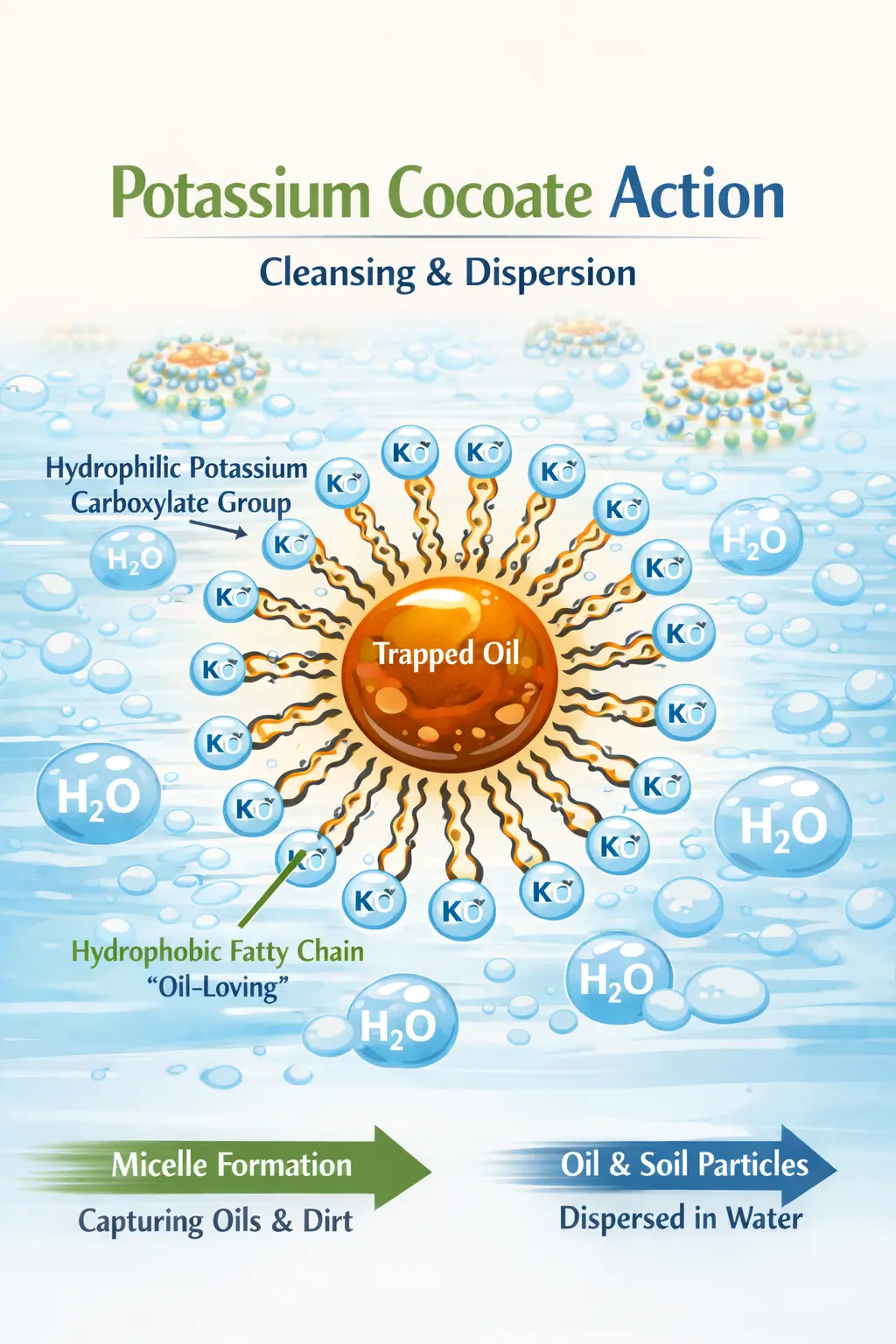
Chemically, it belongs to the class of fatty acid carboxylate salts, where the hydrophobic hydrocarbon chain interacts with oils and the hydrophilic potassium carboxylate group interacts with water. This dual structure defines its surfactant behavior.
Compared to sodium-based soaps such as Sodium Cocoate, the potassium variant exhibits greater water solubility and forms softer, more fluid systems. This difference is driven by ionic size and hydration behavior.
The ingredient is not a single molecule but a distribution of chain lengths, meaning its performance reflects the combined behavior of multiple fatty acid salts rather than a uniform compound.
Functional Role in Soap Systems
Potassium Cocoate functions as the primary cleansing agent within soap-based formulations. Its amphiphilic structure allows it to surround oil droplets, forming micelle-like structures that enable removal of hydrophobic residues during rinsing.
In comparison to solid bar systems, potassium-based soaps generate more soluble and fluid cleansing phases, which is why they are commonly used in liquid soap formats. The increased solubility reduces crystallization, preventing formation of rigid bar structures.
Foam generation is typically faster and more immediate due to the high proportion of shorter-chain fatty acids present in coconut-derived inputs. However, this foam tends to be lighter and less dense compared to longer-chain fatty acid systems.
At a system level, this ingredient defines:
- Cleansing strength: Driven by lauric and myristic acid fractions
- Lather behavior: Rapid formation with moderate stability
- Solubility: High, enabling liquid soap structures
- Viscosity: Lower intrinsic thickness compared to sodium soap systems
In observable terms, formulations containing this ingredient tend to appear as pourable liquids or gels rather than rigid bars, with faster rinse-off behavior and reduced residue formation.
Ingredient Interaction Logic
Potassium Cocoate does not function in isolation but operates within a multi-component formulation system where interactions determine final performance.
With water, it forms the primary continuous phase, dissolving readily and enabling surfactant mobility. This contrasts with sodium soaps that tend to form structured crystalline domains in lower water conditions.
Interaction with humectants such as Glycerin modifies moisture retention and influences the perceived feel of the formulation during use. These interactions affect how quickly water evaporates from the applied film.
In the presence of chelating agents like Tetrasodium EDTA, the system shows improved stability in hard water conditions by reducing interference from calcium and magnesium ions.
Fragrance systems are incorporated as secondary components, typically solubilized within the surfactant matrix. Their behavior depends on volatility and compatibility, as discussed in fragrance function in cosmetic formulation.
pH adjustment or stabilization may involve controlled use of alkaline or acidic components, maintaining the balance required for soap stability. For broader context, see pH in soap meaning.
These interactions collectively determine clarity, viscosity, foam structure, and rinsing efficiency, rather than any single ingredient acting independently.
Phase Behavior and Physical Structure
Potassium Cocoate forms highly soluble surfactant phases in aqueous systems, resulting in liquid or semi-liquid structures rather than solid crystalline matrices. This behavior is a direct consequence of the potassium ion, which promotes hydration and dispersion.
In solution, the ingredient organizes into micellar aggregates where hydrophobic fatty chains orient inward and hydrophilic carboxylate groups interact with the surrounding water phase. This structure enables continuous cleansing action during use.
Unlike sodium-based soaps, which can form rigid crystalline domains, potassium soap systems remain fluid across a wider concentration range. This prevents bar formation and instead supports liquid soap architectures.
Environmental conditions such as water content, temperature, and electrolyte concentration influence viscosity and clarity. Higher water content generally reduces structural resistance, leading to thinner formulations.
Observable effect: formulations remain pourable or gel-like, with rapid dissolution and consistent lather formation during use.
Comparison With Sodium-Based Soap Systems
| Feature | Potassium Cocoate | Sodium Cocoate |
|---|---|---|
| Alkali Type | Potassium-based | Sodium-based |
| Solubility | High | Moderate |
| Physical Form | Liquid / soft soap | Solid bar |
| Lather Behavior | Fast, light foam | Denser, more structured foam |
| Crystallization | Low tendency | High tendency |
This comparison illustrates how the choice of alkali determines the physical structure of soap systems, even when the fatty acid source remains the same.
Regulatory and Labeling Context
Potassium Cocoate is listed under standardized INCI nomenclature and is recognized as a soap ingredient in cosmetic and cleansing product labeling systems.
Its classification depends on product claims and intended use, as outlined in the soap regulatory classification guide. Products based on this ingredient are generally categorized as traditional soap systems rather than synthetic detergent formulations.
Because it is formed during saponification, the label reflects the final soap salt rather than the original oil source, aligning with international ingredient disclosure standards.
Common Misunderstanding
A frequent misconception is that Potassium Cocoate represents a synthetic additive or independent chemical ingredient. In reality, it is the direct result of transforming natural oil components through a chemical reaction.
Another misunderstanding is that liquid soaps are fundamentally different from solid soaps in composition. In practice, both systems rely on the same underlying chemistry, with the difference arising from the type of alkali used.
Understanding this distinction clarifies why ingredient names differ even when the source oil remains identical.
Formulation Limitations
Potassium Cocoate-based systems exhibit several inherent limitations related to their high solubility and structural characteristics.
- Low Structural Rigidity: Cannot form stable solid bars without additional structuring agents
- Viscosity Sensitivity: Thickness depends heavily on formulation adjustments
- Hard Water Interaction: Can form insoluble residues with mineral ions
- Alkaline Nature: Maintains high pH typical of soap systems
These limitations are typically managed through formulation strategies rather than changes to the core ingredient itself.
Summary of Findings
- Classification: Potassium Cocoate is a potassium fatty acid salt formed through saponification
- Function: Acts as the primary surfactant in liquid and soft soap systems
- Behavior: High solubility leads to fluid formulations and rapid lather formation
- System Role: Defines cleansing, foam behavior, and rinse performance
- Limitation: Structural softness limits use in solid soap formats