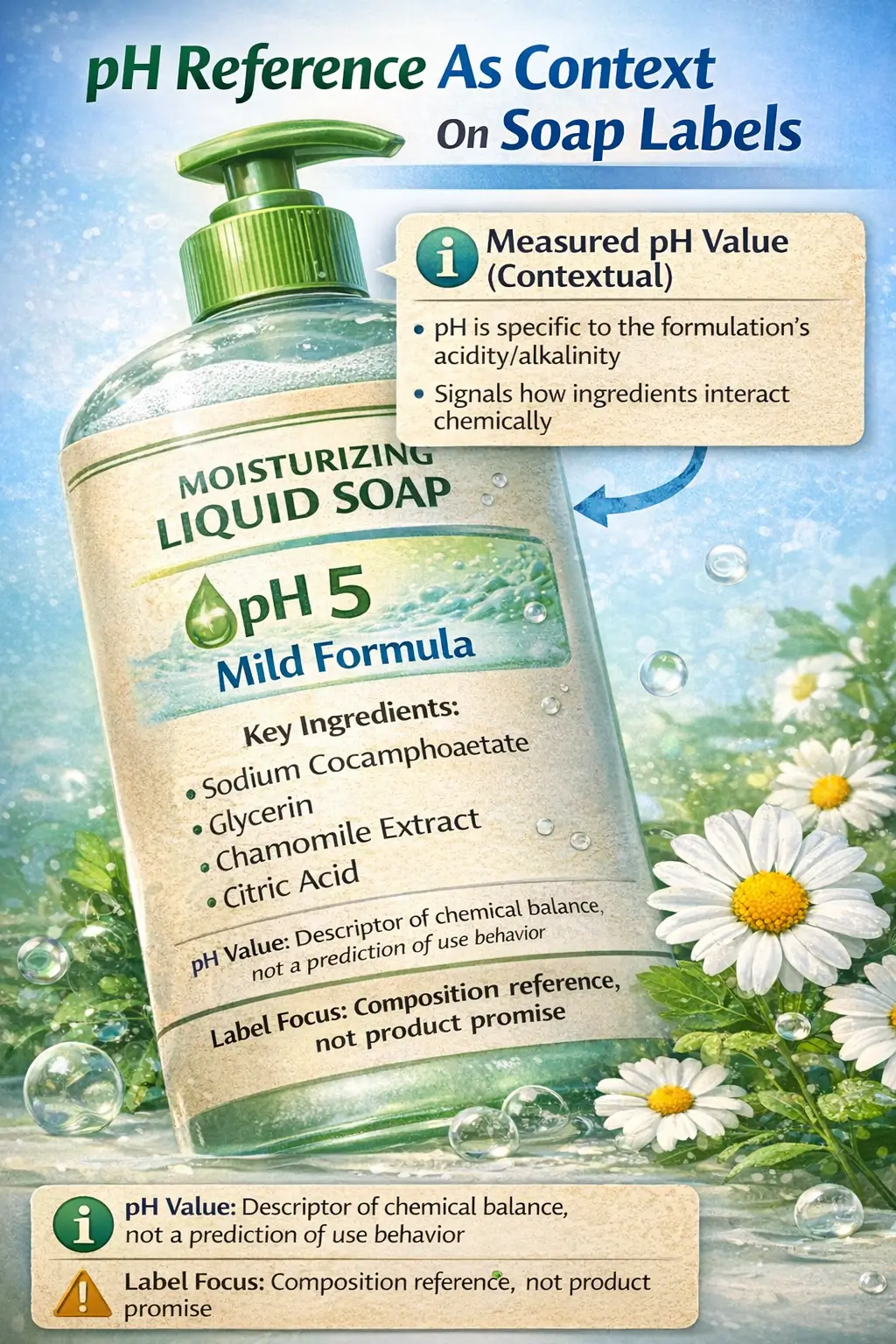
What pH Represents In Soap Formulations
pH describes the balance between acidity and alkalinity in an aqueous environment. In soap formulations, it reflects the chemical outcome of how fats, oils, and alkaline substances interact during production and in finished use conditions.
This value is not chosen in isolation. It emerges from formulation decisions such as ingredient selection, processing method, and intended product format, including choices specific to cold-process soap ingredients. As a result, pH should be understood as a consequence of formulation structure rather than a feature added for consumer-facing reasons.
pH also interacts with preservative systems and surfactant structure, a relationship discussed in why preservatives exist in formulations.
Because pH is a measurement taken under specific conditions, its meaning depends on context. A single number does not describe how a soap behaves across different water qualities, usage patterns, or dilution states.
Why pH Appears In Label And Marketing Conversations
pH enters label discussions largely because it is measurable, familiar, and easy to reference. Unlike many formulation characteristics, it can be expressed as a single value, which gives an impression of precision even when the surrounding context is complex.
In retail settings, particularly in pharmacies or personal care aisles, pH is sometimes mentioned to signal attentiveness to formulation science. Labels themselves, however, are not required to explain pH, nor do they standardize how such information should be presented.
Under Regulation (EC) No 1223/2009, Article 19 establishes how cosmetic ingredients must be listed using standardized nomenclature. The regulation governs ingredient disclosure but does not require pH values to be presented on packaging. This distinction explains why pH references are contextual rather than mandatory labeling elements.
This creates an interpretive gap. Consumers may assume that the presence or absence of pH information carries meaning beyond documentation, even though labeling frameworks treat pH as optional and contextual.
Common Misconceptions About pH In Soap
One frequent assumption is that pH functions as a quality marker. Readers often infer that a lower or higher value signals something inherently better or worse. Labels do not make this claim, and formulation practice does not support it as a universal rule.
Another assumption is that pH remains fixed across all conditions of use. In reality, pH is measured under defined circumstances. Water hardness, dilution, temperature, and contact time can all shift the effective environment in which a soap operates.
A subtler misunderstanding is that pH alone explains how a soap feels or performs. In practice, texture, surfactant choice, fatty acid profile, and formulation balance contribute alongside pH. Labels do not attempt to separate these effects.
What pH Does Not Explain On A Label
pH does not describe how ingredients interact with one another. Two soaps can share a similar pH while differing substantially in formulation structure and use experience.
pH also does not indicate how a soap behaves over time. Changes during storage, exposure to air, or repeated contact with water are not captured by a single measurement.
Labels omit this detail by design. Their role is to document composition and compliance, not to translate formulation dynamics into consumer guidance.
How pH Is Referenced Across Common Soap Formats
| Soap Format | Typical pH Context | What The pH Reflects | What The Label Does Not Convey |
|---|---|---|---|
| Traditional Bar Soap | Alkaline range | Outcome of saponification chemistry | How fatty acid composition shapes use experience |
| Liquid Soap | Alkaline to near-neutral | Balance between surfactants and stabilizers | Variability during dilution and rinsing |
| Syndet Cleansing Bars | Often lower than soap | Use of non-soap surfactant systems | Differences in cleansing mechanism |
This comparison shows why pH is discussed differently depending on product type, particularly when contrasting traditional soaps with syndet systems as outlined in soap vs syndet cleansers. The value reflects formulation pathways rather than performance promises, and labels avoid interpreting these differences.
Reading pH In Context Rather Than Isolation
When pH is mentioned on packaging or in product descriptions, it should be read as contextual information. It indicates how a formulation is structured, not how it should be judged.
This interpretive gap is similar to how antimicrobial references are treated on labels, as explained in soap cleansing vs antimicrobial action.
In European retail environments, pH references often coexist with other technical language. This can give the impression of precision without providing full explanatory context. Labels remain intentionally neutral, leaving interpretation to external sources.
Recognizing these limits helps explain why pH matters in formulation discussions while remaining an incomplete signal on its own.
What This Clarifies About pH And Labels
- Measured Outcome: pH reflects formulation chemistry, not an added feature.
- Context Dependent: The meaning of pH changes with format, use, and conditions.
- Label Limits: Ingredient labels do not explain how pH interacts with other formulation elements.
- Interpretive Caution: pH should be understood as one descriptor among many, not a conclusion.
Regulatory & Primary Sources
| Source | Authority | Relevance To This Article |
|---|---|---|
| Regulation (EC) No 1223/2009 – Article 19 | European Parliament & Council | Defines mandatory ingredient listing and labeling structure. |
| Regulation (EU) No 655/2013 | European Commission | Establishes common criteria for cosmetic claims and marketing communication. |
| INCI Naming & Labeling Framework | International cosmetic Ingredient Dictionary | Provides standardized nomenclature for ingredient disclosure. |