Introduction to Liquid Lye Soap
Liquid lye soap is a true soap created through the chemical reaction of triglyceride oils with an alkaline reagent, specifically potassium hydroxide(KOH), following ingredient roles and chemical principles outlined in the Soap Ingredients Guide. This reaction, known as saponification, converts fats into potassium salts of fatty acids, producing a water-soluble soap paste that can be diluted into a finished liquid formulation. Compared to solid bars (made with sodium hydroxide NaOH), liquid soap demonstrates different viscosity behavior, dilution characteristics, and ionic stability, making it a fundamentally distinct category within the broader framework described in the Liquid Soap Formulation Systems Guide.
In industrial and artisan production, liquid lye soap serves multiple domains including household cleaning, surface degreasing, fabric washing, and controlled specialty applications. This article analyzes production methodology, concentrations, dilution strategies, ingredient selection, chemical pathways, usage categories, and handling considerations using research-based and data-focused evaluation.
This guide fits within the wider classification of research-based Soap Guides covering formulation architecture and regulatory context.
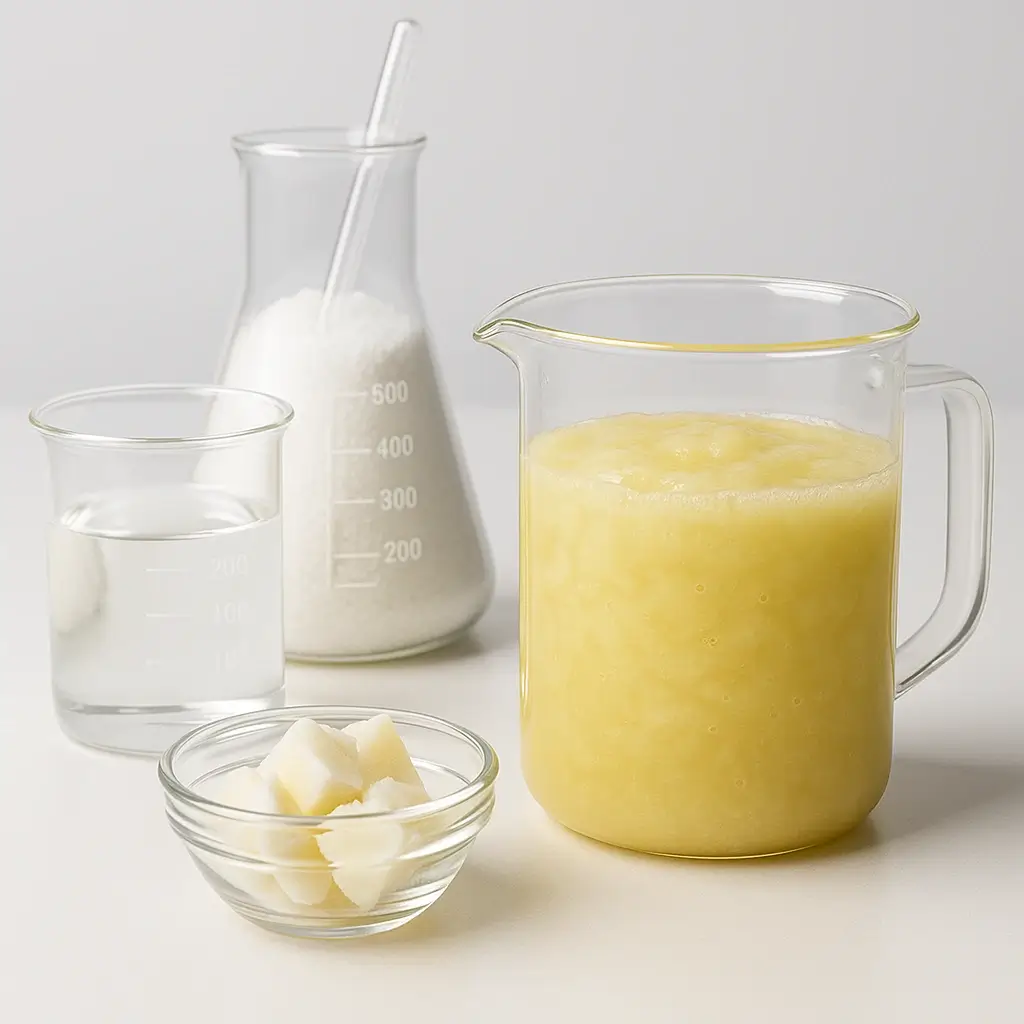
Chemical Foundation of Liquid Lye Soap
The defining reagent for liquid soap is potassium hydroxide (KOH). Its solubility characteristics and larger ionic radius produce a softer, more water-compatible soap compared to sodium hydroxide (NaOH), which creates rigid crystalline bar structures. Both bases function as lye, but their soap behavior diverges significantly.
For broader foundational context on soap alkalinity and skin interaction, see Skin Safety 101.
| Parameter | Potassium Hydroxide (KOH) | Sodium Hydroxide (NaOH) |
|---|---|---|
| Primary Usage | Liquid soap | Bar soap |
| Soap Texture Outcome | Gel / Liquid | Solid |
| Ionic Radius | 152 pm | 116 pm |
| Solubility in Water (25°C) | 121 g/100 g water | 111 g/100 g water |
| Typical pH of Final Soap (Diluted) | 9.0 – 10.5 | 9.0 – 11.0 |
The essential reaction can be expressed in simplified stoichiometric terms:
Triglyceride (oil) + KOH  →  Glycerol +
Potassium fatty acid salts (soap surfactants)
Fatty Acid Composition and Soap Properties
Oil selection influences cleansing strength, lather stability, viscosity, foaming behavior, and clarity. Fatty acid distribution determines the performance characteristics of the liquid soap product.
| Oil | Primary Fatty Acids | Typical Range % | Contribution to Soap |
|---|---|---|---|
| Coconut Oil | Lauric, Myristic | 45–52% | High cleansing, strong foam |
| Olive Oil | Oleic | 53–83% | Mildness, viscosity stabilization |
| Castor Oil | Ricinoleic | 82–89% | Lather stability, clarity |
| Sunflower Oil | Linoleic, Oleic | 48–75% | Conditioning, fluid texture |
| Palm Kernel Oil | Lauric | 42–55% | Hard foam profile |
Lye Concentration and Dilution Ratios
Lye concentration refers to the percentage of potassium hydroxide in the total solution consisting of KOH and water. This metric directly determines paste thickness, clarity, gel stability, and dilution performance.
| Concentration % (KOH to total solution) | Characteristics |
|---|---|
| 20–25% | Common for liquid soap paste; manageable thickening |
| 25–30% | Rapid saponification, increased heat, higher viscosity |
| 10–15% | Slower reaction, increased clarity, weaker paste |
Dilution Table for Finished Liquid Soap
| Soap Paste | Water | Result |
|---|---|---|
| 1 part | 0.75 parts | Very thick gel |
| 1 part | 1 part | Standard viscosity |
| 1 part | 1.5 parts | Thin liquid soap |
How To Make Liquid Lye Soap (Scientific Recipe)
The following formulation example demonstrates a controlled Sodium Hydroxide Liquid Soap Recipe adapted for potassium hydroxide substitution when full liquid performance is targeted. Ingredient weights must be measured precisely; volumetric estimation introduces error.
Sample Formula
| Ingredient | Weight (g) | Purpose |
|---|---|---|
| Coconut Oil | 400 g | Cleansing + lather |
| Olive Oil | 350 g | Viscosity + mildness |
| Castor Oil | 150 g | Foam stabilization |
| Total Oils | 900 g | - |
| KOH (90% purity) | 155 g | Saponification reagent |
| Water (for lye) | 310 g | Solvent |
Formula Ratio: KOH at 17.2% of oil weight; Water at 34.4% of oil weight
Procedure Summary
- Heat oils to 60–70°C (140–158°F).
- Dissolve KOH completely into water (never reverse order).
- Combine phases; blend until paste formation begins.
- Cook paste 2–3 hours until fully translucent gel forms.
- Dilute gradually using selected water ratio.
- Cool and rest 24–72 hours for clarity stabilization.
The paste is considered complete when it produces full clarity when diluted at a 1:1 test sample at room temperature. Excess cloudiness indicates incomplete saponification or oil imbalance.
Uses of Liquid Lye Soap
Liquid lye soap is applied across everyday cleaning, surface washing, and controlled specialty contexts depending on formulation strength and concentration profile, including limited skin-contact scenarios discussed in the lye soap for poison ivy guide.
- General household surface washing
- Fabric laundry and stain emulsification
- Commercial kitchen degreasing
- Workshop and automotive cleaning
- Controlled heavy-duty cleaning scenarios
Liquid Lye Soap as a Drain Cleaner Context
High-alkaline solutions serve as dissolving agents for fats via saponification of congealed grease deposits. Concentrated lye chemistry can break down fatty residues gradually. However, liquid lye soap formulations intended for routine cleaning differ from pure lye drain solutions in concentration, ionic strength, and heat generation capability.
| Type | Alkali Level | Behavior |
|---|---|---|
| Liquid Soap | Moderate | Surfactant cleaning |
| Drain Lye Solution | High | Rapid grease breakdown |
Scientific Handling and Material Considerations
- Introduce lye to water slowly while stirring to manage exothermic reaction intensity, a precaution consistent with the broader handling, benefit, and risk context discussed in the Lye Soap Safety, Benefits, Uses, and Risks Guide.
- Use alkali-resistant equipment such as stainless steel or heat-safe polypropylene.
- Avoid reactive metals such as aluminum due to hydrogen gas formation.
- Allow dilution and cooling stages to proceed gradually to avoid destabilization.
Summary of Technical Advantages and Limitations
| Metric | Liquid Lye Soap | Solid Lye Soap |
|---|---|---|
| Production Time | Longer; dilution phase | Shorter cure |
| Clarity Control | High sensitivity to composition | Lower complexity |
| Viscosity Flexibility | Variable | Fixed form |
| Application Range | Broad usage spectrum | Personal cleansing dominant |
Potassium Hydroxide vs. Sodium Hydroxide For Soapmaking
| Property | Potassium Hydroxide (KOH) | Sodium Hydroxide (NaOH) |
|---|---|---|
| Final Product Form | Liquid, easily dilutable | Solid bar or firm paste |
| Water Solubility | High - forms fluid potassium soaps | Low - forms crystalline sodium soaps |
| Typical Use | Liquid hand soap, dish soap, cleaners | Bar soap, laundry bars, cleaners |
| Common Concentration | 25%–33% lye concentration | 28%–40% lye concentration |
| Viscosity Behavior | Viscous fluid depending on dilution | Hard or semi-solid even when diluted |
| Clarity Characteristics | Transparent with proper dilution | Opaque or pearly depending on formula |
Common Oil Profiles for Liquid Soapmaking
| Oil | Primary Fatty Acids | Contribution to Liquid Soap | Typical Inclusion Range |
|---|---|---|---|
| Coconut Oil | Lauric (45–52%), Myristic (16–21%) | High cleansing, strong lather, degreasing | 20%–80% |
| Olive Oil | Oleic (55–83%) | Conditioning, mild lather, clarity stability | 10%–70% |
| Castor Oil | Ricinoleic (85–95%) | Boosts viscosity, stabilizes lather | 5%–15% |
| Rapeseed / Canola Oil | Oleic (56–65%), Linoleic (15–25%) | Soft feel, economical balance oil | 10%–40% |
| Sunflower Oil (HO) | Oleic (>80%) | Improves clarity, light texture | 5%–30% |
References
- Pavia, D. L., Lampman, G. M., & Kriz, G. S. (Organic Chemistry Laboratory Techniques). Wiley Reference
- PubChem – Potassium Hydroxide (KOH). PubChem KOH Data
- PubChem – Sodium Hydroxide (NaOH). PubChem NaOH Data