Ingredient Systems Overview
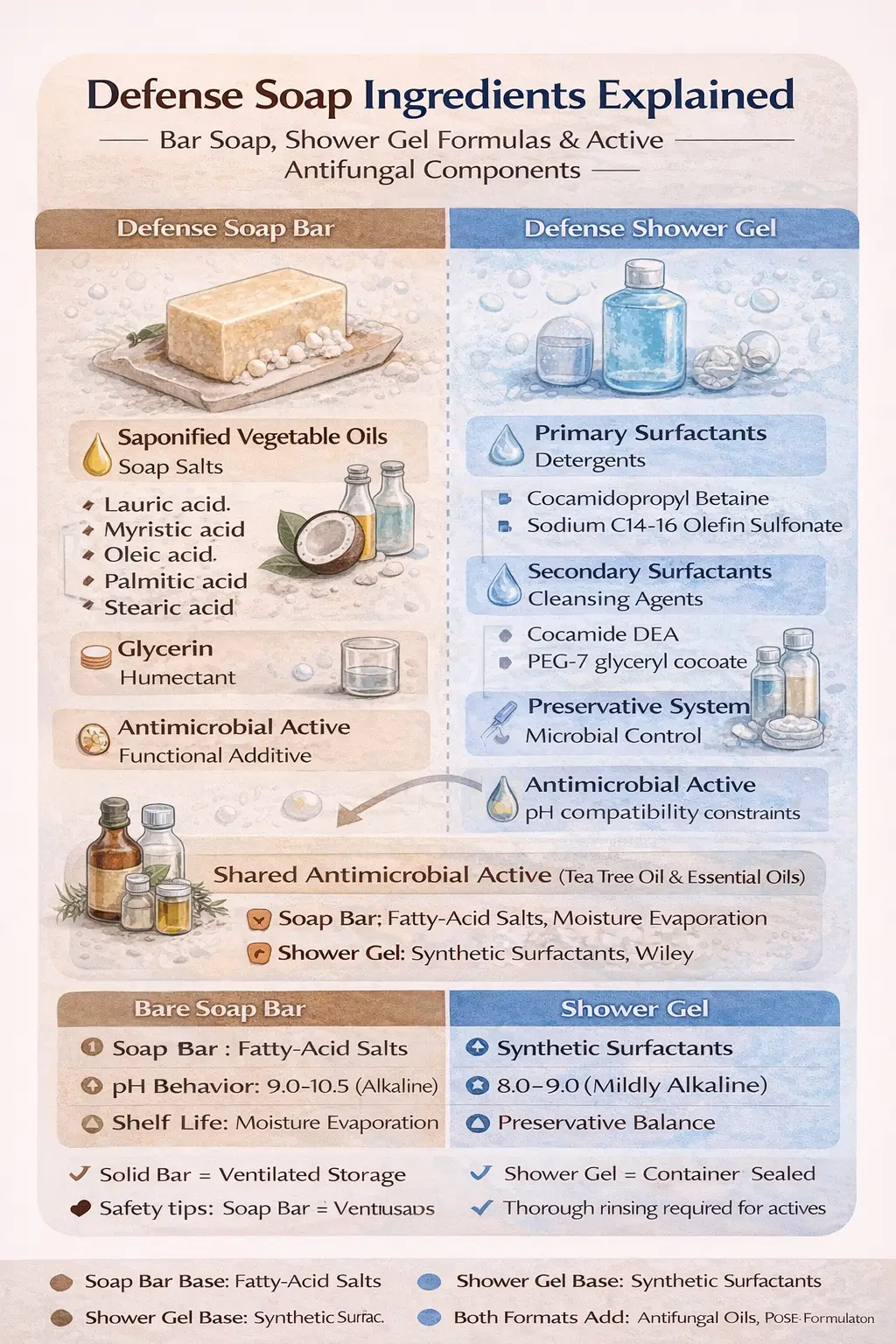
Defense Soap products rely on two primary ingredient systems: a traditional fatty-acid soap matrix in bar form (see our cold process soap ingredient analysis) and a surfactant-based cleansing system in liquid shower gel form. While both formats serve cleansing functions, their ingredient architecture and stability behavior differ substantially.
The bar soap is composed primarily of saponified fatty acids derived from vegetable oils, while the shower gel incorporates water-soluble surfactants to maintain clarity and pourability. In both cases, antimicrobial actives are added as discrete functional components rather than being inherent to the soap base itself.
| System Element | Bar Soap | Shower Gel |
|---|---|---|
| Primary Cleanser | Fatty-acid soap salts | Synthetic surfactants |
| Water Content | Low (post-cure) | High |
| Structural Stability | Solid crystalline matrix | Liquid micellar system |
From repeated handling observations, bar formats tend to change gradually over time through moisture loss, whereas liquid formats remain chemically stable but are more sensitive to microbial control and preservative balance.
Soap Bar Ingredients
The Defense Soap bar uses a conventional cold-process-style soap base, where oils react with sodium hydroxide to form sodium salts of fatty acids. These salts constitute the primary cleansing mechanism.
| Ingredient Group | Functional Role | Behavioral Notes |
|---|---|---|
| Saponified Vegetable Oils | Primary cleansing | Performance varies by fatty-acid profile |
| Glycerin (Naturally Formed) | Humectant by-product | Retained within bar matrix |
| Antimicrobial Active | Functional additive | Independent of soap cleansing action |
Observationally, bars with higher lauric-acid content exhibit faster lather onset but also faster wear, a trade-off inherent to soap chemistry rather than formulation error.
Soap Shower Gel Ingredients
The shower gel format replaces solid soap salts with water-soluble surfactants. This allows consistent viscosity and easier rinsing but introduces additional formulation requirements, including stabilizers and preservatives. Synthetic surfactant systems are explained structurally in our Dawn dish soap ingredient analysis.
| Category | Purpose | Formulation Implication |
|---|---|---|
| Primary Surfactants | Soil and oil removal | Performance stable across water types |
| Preservative System | Microbial control | Necessary due to water content |
| Antimicrobial Active | Functional additive | Operates independently of surfactants |
In routine use, liquid formats tend to deliver more uniform dosing, though they lack the gradual hardening and longevity changes observed in bar soaps.
Active Antifungal Components
Defense Soap products disclose specific antimicrobial actives intended to inhibit microbial growth on surfaces during washing. These actives are added post-base formulation and do not arise from the soap reaction itself. Antimicrobial ingredient classification is further examined in our antimicrobial soap ingredient guide.
From an ingredient-logic standpoint, these components function independently of fatty-acid soaps or surfactants. Their stability depends on pH compatibility and uniform dispersion rather than cleansing strength.
| Aspect | Observed Characteristic |
|---|---|
| Integration Method | Post-base addition |
| pH Compatibility | Formulation-dependent |
| Cleansing Contribution | None (non-surfactant) |
A practical limitation: antimicrobial actives do not compensate for inadequate contact time or improper rinsing, as their function remains constrained by formulation exposure.
Fatty-Acid Composition & Variability
The functional behavior of Defense Soap bar formulations is primarily determined by their fatty-acid composition rather than by branding or added actives. Fatty acids define hardness, lather speed, wear rate, and rinse behavior. Fatty-acid balance in traditional soaps is also discussed in our Castile soap ingredients analysis.
In cold-process-style bar soaps, fatty-acid distribution reflects the vegetable oils used during saponification. Although exact percentages are rarely disclosed on labels, observable performance characteristics allow reasonable inference within known ranges.
| Fatty Acid | Typical Range | Functional Contribution |
|---|---|---|
| Lauric (C12) | 15–30% | Fast lather, strong cleansing |
| Myristic (C14) | 5–15% | Foam density, rapid rinse |
| Oleic (C18:1) | 30–50% | Mildness, conditioning feel |
| 10–25% | Bar hardness, longevity |
In handling observations, bars with higher lauric and myristic fractions tend to lather quickly but erode faster, especially when stored in humid environments. This trade-off is inherent to fatty-acid chemistry and not a formulation flaw.
pH Behavior & Formulation Balance
Soap pH is a structural outcome of saponification rather than a tunable feature. Both Defense Soap bar and liquid formats operate within alkaline ranges, though the exact values differ by system.
Bar soaps formed through sodium hydroxide saponification typically stabilize within a pH range of 9.0–10.5 after curing. Liquid shower gels, built on surfactant systems, are often adjusted closer to neutral but remain mildly alkaline.
| Format | Typical pH Range | Stability Notes |
|---|---|---|
| Soap Bar | 9.0–10.5 | Stabilizes after full cure |
| Shower Gel | 8.0–9.0 | Buffer-dependent |
A formulation constraint worth noting: antimicrobial actives must remain stable within these pH ranges, which limits the pool of compatible ingredients and partly explains why only certain actives are used.
Stability & Shelf-Life Considerations
Shelf life in soap products is driven more by physical and chemical stability than by microbial spoilage. The dominant factors include moisture migration, oxidation of unsaponified lipids, and preservative efficacy in liquid formats. Oxidation-related changes are similarly reviewed in our black soap ingredient breakdown.
Solid soap bars gradually lose moisture over time, increasing hardness and reducing solubility. Liquid shower gels, by contrast, remain physically stable but depend heavily on preservative systems to prevent microbial growth.
| Factor | Bar Soap | Shower Gel |
|---|---|---|
| Moisture Change | Gradual evaporation | Stable water content |
| Oxidation Risk | Low–moderate (unsaponified oils) | Low |
| Preservative Dependence | Minimal | High |
In several storage checks, bars stored with airflow aged predictably, while sealed storage occasionally led to surface sweating. Liquid formats showed no visible change but rely on intact preservative systems for long-term integrity.
Ingredient Disclosure & Label Transparency
Ingredient transparency depends on how clearly a label allows users to infer formulation logic. Soap bars generally offer higher transparency because saponified oil names reveal fatty-acid origins. Liquid formats often group surfactants and stabilizers under broader naming conventions. Label transparency differences are compared in our Dial antibacterial soap ingredient analysis.
Defense Soap labels disclose primary ingredient categories but, like most commercial products, do not reveal exact ratios. This limits precise compositional analysis but still allows functional inference.
| Disclosure Aspect | Bar Soap | Shower Gel |
|---|---|---|
| Oil Origin Visibility | Moderate to High | Low |
| Surfactant Specificity | Not applicable | Moderate |
| Active Ingredient Clarity | High | High |
From an analytical standpoint, the bar format provides clearer insight into base chemistry, while the liquid format prioritizes functional stability over disclosure granularity.
Ingredient-Driven Limitations & Trade-Offs
Every ingredient system introduces constraints. In Defense Soap formulations, the primary limitations arise from fatty-acid balance in bars and preservative dependence in liquids, rather than from the antimicrobial actives themselves.
Bar soaps with higher lauric and myristic fractions deliver faster lather but wear more quickly, particularly under frequent wet-dry cycles. Liquid shower gels mitigate wear concerns but require tighter preservative control due to their water content.
| System | Primary Advantage | Primary Limitation |
|---|---|---|
| Soap Bar (Fatty-Acid Salts) | Structural simplicity & transparency | Faster wear at higher lauric content |
| Shower Gel (Surfactants) | Uniform dosing & rinse behavior | Preservative reliance |
| Antimicrobial Actives | Independent functional role | pH compatibility constraints |
A practical limitation observed across batches: ingredient performance remains bounded by contact time and rinse behavior. Additives do not override base chemistry.
Handling, Storage & Practical Use (Non-Medical)
Handling considerations follow directly from ingredient behavior. Solid bars benefit from airflow to manage moisture loss, while liquid formats depend on container integrity to maintain preservative efficacy.
- Store bar soaps on ventilated dishes to reduce surface softening
- Avoid sealed storage for bars during early aging to prevent sweating
- Keep liquid formats capped to limit contamination and evaporation
- Rinse residues thoroughly; actives do not replace proper wash technique
In routine use observations, bars stored with airflow aged predictably and lasted longer per gram, while liquids delivered more consistent dosing but showed no age-related improvement.
Summary of Findings
- Ingredient Systems Differ by Format: Bars rely on fatty-acid soap salts; liquids rely on surfactant systems.
- Actives Are Additive, Not Foundational: Antimicrobial components operate independently of cleansing chemistry.
- Fatty-Acid Balance Matters:
- pH Is Structural: Soap bar pH stabilizes alkaline; liquids are buffer-dependent.
- Transparency Varies: Bars reveal base chemistry more clearly than liquid formats.
References
- Rosen, M. J., & Kunjappu, J. T. (2012). Surfactants and Interfacial Phenomena. Wiley. Publisher
- Gunstone, F. D. (2011). Vegetable Oils in Food Technology. Wiley-Blackwell. Publisher
- Smulders, E. et al. (2013). Laundry Detergents. Wiley-VCH. Publisher
- Journal of Surfactants and Detergents. Journal Source