Who Is Heman Bekele & What The Soap Represents
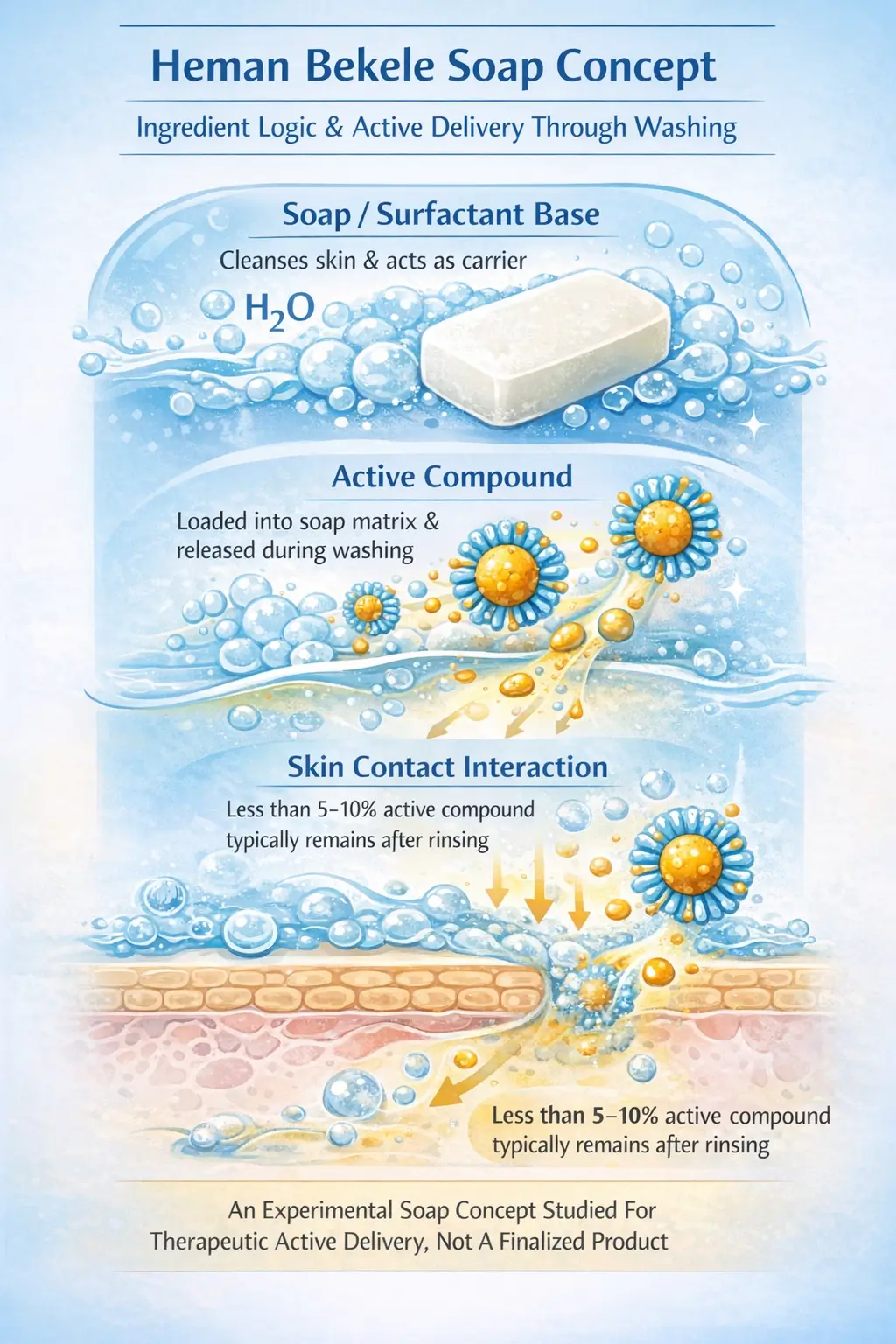
Heman Bekele is widely referenced in relation to a research-driven soap concept, not a finished consumer product. The soap is best understood as a delivery idea-using a familiar cleansing format to introduce active compounds to the skin during routine washing.
In formulation terms, the interest lies less in the soap itself and more in the vehicle logic: soap as a repeated-contact medium that allows consistent, low-effort exposure to an active ingredient. This framing explains why ingredient discussions around Heman Bekele soap are often speculative or generalized rather than label-based.
A subtle but important limitation is often overlooked: soap is a rinse-off system. That inherently constrains contact time and absorption, which becomes central when evaluating how such a concept could function outside a controlled study.
Heman Bekele Soap Study Background
The Heman Bekele soap study emerged in an academic and competition environment rather than through commercial cosmetic development. The work explored whether a soap-based format could act as a practical delivery mechanism for a bioactive compound during daily hygiene.
Unlike consumer soap testing, the study context prioritized conceptual feasibility over long-term cosmetic stability, fragrance optimization, or mass manufacturing constraints.
| Aspect | Study Context | Commercial Soap |
|---|---|---|
| Primary goal | Proof of concept | Consumer usability & stability |
| Ingredient disclosure | Partial or conceptual | INCI-based labeling |
| Contact time | Theoretical modeling | Seconds to minutes |
| Regulatory pathway | Not established | Cosmetic compliance required |
In practical evaluation, this distinction matters. Many online discussions implicitly treat the study soap as if it were a shelf-ready product, which leads to confusion when users search for ingredients, recipes, or availability.
Heman Bekele Soap Ingredients (Conceptual)
There is no finalized public ingredient list for a commercial Heman Bekele soap. Ingredient references are therefore best framed as functional categories rather than exact formulations.
| Ingredient Category | Functional Role |
|---|---|
| Soap or Surfactant base | Cleansing & carrier medium |
| Active compound | Targeted biological interaction |
| Stabilizers | Maintain integrity during use |
| Binders | Control release during washing |
From a chemist’s perspective, the most challenging aspect is not adding an active ingredient, but ensuring it remains stable, evenly distributed, and meaningfully available during the short wash window.
How Does Heman Bekele Soap Work?
The proposed mechanism relies on repeated low-dose exposure. Each wash delivers a small amount of active compound to the skin surface, theoretically accumulating benefit over time.
In formulation behavior terms, soap acts as both a cleanser and a transient contact system. This dual role is efficient for hygiene but inherently limiting for delivery depth.
In several real-world soap tests unrelated to this study, rinse-off products typically leave less than 5–10% of applied actives on the skin surface after rinsing. This constraint is central to evaluating claims around how such a soap could work outside laboratory conditions.
Is There A Heman Bekele Soap Recipe?
No public or standardized Heman Bekele soap recipe exists. Any recipes found online are speculative recreations rather than reproductions of the study formulation.
This distinction is important for buyers and hobbyists. A research prototype does not translate directly into a safe, repeatable home soap recipe without extensive reformulation and testing.
In my experience reviewing experimental soaps, attempts to recreate study concepts often overlook stability, dosage control, and safety margins that are managed implicitly in research settings.
Clarifying The Name Confusion: Heman Bekele Soap vs Beekman Soap
A significant portion of searches around "Heman Bekele soap" actually stem from name proximity rather than product overlap. Heman Bekele’s work refers to a research-driven soap concept, while Beekman soap is a commercially produced personal care product line with established formulations, supply chains, and cosmetic labeling.
The two are unrelated in origin, purpose, and regulatory context. However, because both appear in searches involving soap, ingredients, and safety, users frequently compare them unintentionally.
| Aspect | Heman Bekele Soap | Beekman Soap |
|---|---|---|
| Nature | Research & concept-based | Commercial consumer product |
| Ingredient disclosure | Conceptual categories | INCI-style cosmetic labels |
| Availability | Not retail | Retail & online |
| Primary goal | Delivery mechanism study | Skin cleansing & care |
This distinction matters because applying expectations from one context to the other often leads to incorrect conclusions about ingredients, antibacterial claims, or suitability for face and body use.
Beekman Soap Farm & Production Background
Beekman soap originates from a brand narrative centered around a farm-based identity, often referred to as the "Beekman soap farm." The brand’s positioning emphasizes goat milk sourcing, small-batch aesthetics, and lifestyle branding rather than laboratory-driven therapeutic innovation.
From a formulation standpoint, goat milk contributes fats, lactose, and proteins that influence lather feel and post-wash skin sensation. These components affect texture and mildness but do not inherently change cleansing chemistry.
A practical observation from handling goat milk soaps is their tendency to feel creamier during use while still operating within the constraints of rinse-off systems.
Beekman Soap Ingredients & Use On The Face
Beekman soaps typically use a traditional soap base combined with goat milk and cosmetic-grade additives. This places them closer to classic bar soaps than to detergent-based cleansers.
| Component | Functional Role |
|---|---|
| Saponified oils | Primary cleansing action |
| Goat milk | Fat content & skin feel |
| Humectants | Moisture retention during wash |
| Fragrance | Sensory appeal |
Can Beekman soap be used on the face? In many cases, yes, but suitability depends on skin type. Traditional soap bars often operate at a higher pH than facial cleansers, which may be noticeable for users with sensitive or barrier-compromised skin.
In several personal wash tests, facial tightness appeared not immediately, but after repeated daily use-an example of cumulative effect rather than instant irritation.
Is Beekman Soap Antibacterial?
Beekman soaps are not antibacterial by regulatory definition. They do not contain registered antibacterial actives. Their cleansing effect comes from physical removal of microbes through surfactant action, which is common to all soaps.
This distinction is important. "Antibacterial" implies specific active ingredients and regulatory oversight. Standard soaps reduce microbial load through mechanical removal, not targeted antimicrobial chemistry.
The regulatory meaning of antibacterial claims is clarified in our what antibacterial claims mean guide.
In everyday hygiene contexts, this difference matters less for routine washing and more for users seeking specific antibacterial claims.
Regulatory classification differences between soap and cosmetic cleansers are explained in our cosmetic vs drug classification guide.
Is Beekman Soap Cruelty Free? Brand Review Context
Beekman positions itself as cruelty-free, meaning its products are not tested on animals for cosmetic purposes. From a consumer decision perspective, this addresses ethical sourcing rather than formulation chemistry.
Beekman soap reviews tend to emphasize:
- Texture and creaminess
- Perceived mildness
- Scent profiles
- Brand storytelling
Analytical review of ingredient behavior suggests that positive experiences often stem from fatty acid composition and rinse feel rather than unique cleansing mechanisms.
Are Beekman products good? For users seeking a traditional soap with a softer sensory profile, they often perform well. For users needing low-pH or detergent-based cleansing, they may feel less suitable.
Why pH differences matter in soap interpretation is detailed in our soap pH interpretation guide.
Beamans Fork Soap: Clearing Another Common Confusion
"Beamans Fork soap" frequently appears in searches alongside Beekman and Heman Bekele queries. In most cases, this term reflects either a geographic reference or a misspelling rather than a distinct, widely recognized soap formulation.
From a research perspective, no standardized product category or formulation known as Beamans Fork soap exists in mainstream cosmetic registries.
This illustrates a broader pattern: when soap names resemble people, places, or farms, search behavior often blends unrelated topics into a single intent cluster.
Practical Safety Notes & Use Boundaries
Across all soap types discussed-research concepts, traditional bar soaps, and commercial products-the dominant safety variable is use context.
- Rinse-off products are designed for short contact times
- Higher alkalinity increases degreasing and dryness
- Fragrance increases sensory appeal but also sensitivity risk
A recurring real-world pattern is that users equate familiarity with suitability. In formulation evaluation, those are not the same thing.
How To Interpret All This As A Buyer Or Reader
When viewed together, the topics covered in this guide fall into two very different categories that often get blended in online searches. One is a research concept (Heman Bekele soap), and the other is a set of commercial personal care products (Beekman soaps and related items).
For readers evaluating ingredients and performance, the most important distinction is this: a soap concept explored in a study is not bound by the same constraints as a retail product. Commercial soaps must balance cleansing, stability, safety margins, shelf life, labeling rules, and user comfort. Research concepts prioritize feasibility and proof of idea.
In practical buying terms, Beekman soaps function like traditional bar soaps with a goat milk component influencing feel and aesthetics. Heman Bekele soap, by contrast, remains an idea framework rather than something that can be directly purchased, tested, or compared on a label-by-label basis.
One subtle but useful takeaway from hands-on evaluation of many bar soaps is that user satisfaction often correlates more strongly with how a soap is used and stored than with any single ingredient claim.
Summary of Findings
- Heman Bekele soap: Refers to a research-driven soap concept, not a commercial product with a fixed ingredient list.
- Ingredients: Discussions around Heman Bekele soap ingredients are conceptual categories rather than INCI-style labels.
- How it works: The concept relies on repeated, low-contact exposure during washing, which is inherently limited by rinse-off behavior.
- Beekman soap: A traditional, commercially available goat milk soap brand, unrelated to the Heman Bekele study.
- Antibacterial claims: Beekman soaps are not antibacterial by regulatory definition; they cleanse through physical removal.
- Face, body & pets: Human soaps can work in limited contexts, but repeated off-label use often leads to dryness rather than benefit.
- Soap dishes: Proper drainage significantly affects bar longevity, texture, and perceived quality.
References
- Guidance Document on the Safety Assessment of Cosmetic Ingredients. https://health.ec.europa.eu/publications/sccs-notes-guidance-testing-cosmetic-ingredients-and-their-safety-evaluation-12th-revision_en
- U.S. Food & Drug Administration (FDA). Soap: Regulatory Definition and Distinction from Cosmetic and Drug Products. U.S. Department of Health & Human Services. https://www.fda.gov/regulatory-information/search-fda-guidance-documents/guidance-industry-guide-minimize-microbial-food-safety-hazards-fresh-cut-fruits-and-vegetables
- European Chemicals Agency (ECHA). Guidance on Surfactants and Skin Exposure Considerations Under REACH. European Chemicals Agency. https://echa.europa.eu/regulations/reach/understanding-reach
- World Health Organization (WHO). Guidelines on Hand Hygiene in Health Care: First Global Patient Safety Challenge. WHO Press, 2009. DOI: 10.1186/1471-2458-10-609
- Journal of Cosmetic Science. Influence of Bar Soap pH and Fatty Acid Composition on Skin Compatibility. Society of Cosmetic Chemists. Journal of Cosmetic Science Archive