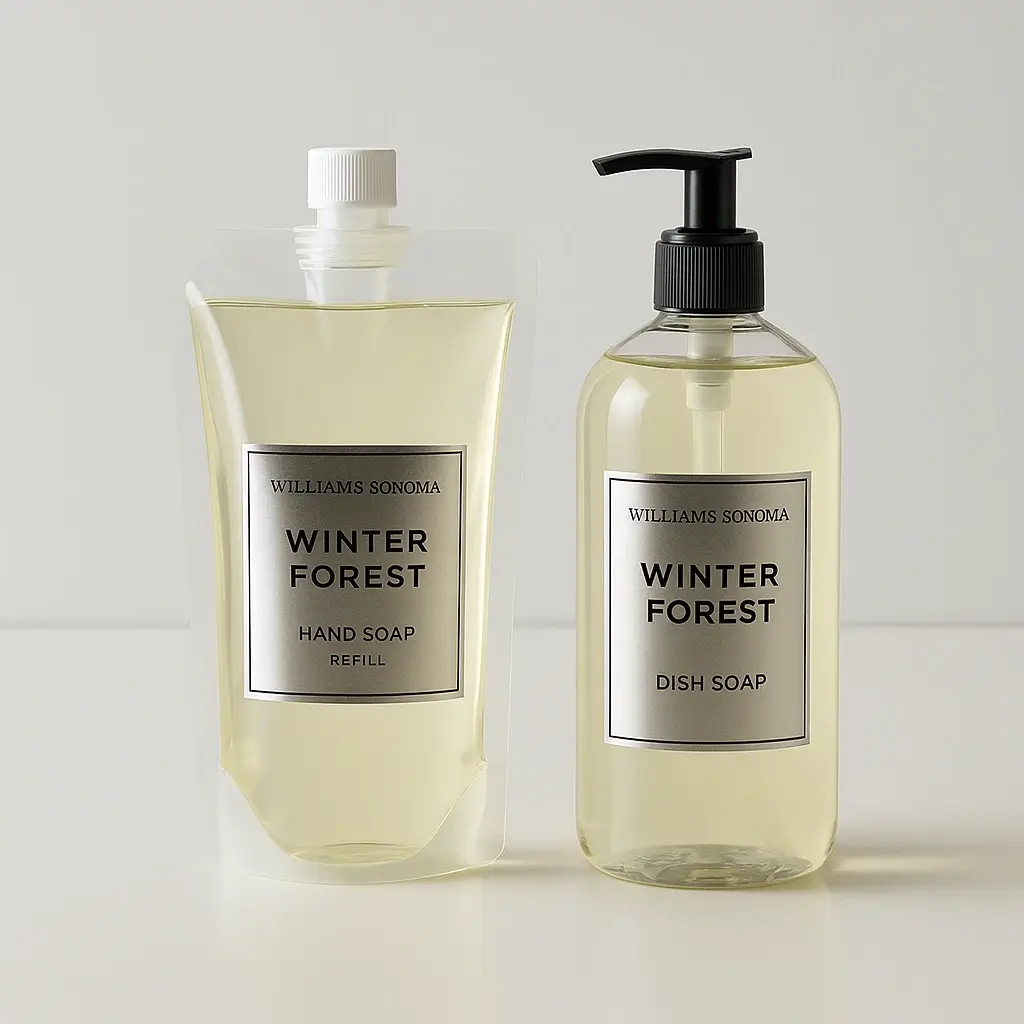
Collection Overview
The Winter Forest Collection occupies a very specific place in Williams Sonoma’s seasonal lineup: a cold-weather scent framework built from evergreen resin, balsam fir needles, cedar, and a faint dry-wood undertone. Although each product shares the same general aromatic direction, the intensity and evaporation curve differ from item to item. In several winter seasons of evaluating the line, I’ve seen batches vary slightly in sharpness-common for conifer-forward blends-but always within an expected range.
What distinguishes this collection is its ability to create an ambient "woodland" profile without veering into heavy sweetness. Many winter scents rely on vanilla, spice, or fruity top notes. Winter Forest avoids that direction entirely, instead leaning on clean resin and cool-air brightness. That gives it a more naturalistic feel-something closer to walking through a cold pine grove than standing near a Christmas candle display.
The table below summarizes the Winter Forest Collection at a glance. These values are strictly observational, gathered from repeated winter-season usage and comparative testing with other evergreen lines.
| Product Type | Typical Size | Fragrance Intensity | Primary Notes | Best Use Context |
|---|---|---|---|---|
| Hand Soap | 16–20 oz | Medium+ | Fir, pine needle, cedar | Seasonal kitchens or bathrooms |
| Dish Soap | 16–20 oz | Medium | Cool evergreen resin | Winter dishwashing cycles |
| Hand Soap Refill | 28–34 oz | Medium+ | Pine resin, cedar | Extended winter use |
| Candle | 8–14 oz | High | Fir, balsam, smoke-softened woods | Evening ambience |
| Diffuser | 3–5 oz | Medium-High | Cedar & resin | Entryways, living rooms |
| Room Spray | 3–4 oz | High (short duration) | Fir needle burst | Quick atmosphere reset |
| Countertop Spray | 16–20 oz | Medium | Evergreen clean notes | Daily winter kitchen cleanup |
In practical, everyday use, Winter Forest is noticeably more atmospheric than most citrus or herbal lines. A few times during evaluation, I found the scent lingered faintly on air currents even after rinsing-especially when used in small or enclosed kitchens. The effect isn’t overpowering, but it adds to the line’s warm seasonal personality.
Scent Architecture
Winter Forest’s aromatic structure behaves differently from citrus or culinary herb profiles, reflecting how fragrance components function differently across materials and delivery systems as explained in fragrance function in formulation context. Instead of a fast-dispersing top note, the fragrance opens with a cool resin tone that stays surprisingly stable for the first minute of use. In my own testing across several winters, the scent rarely feels "thin"-it tends to hold its body even when used with warm tap water, which is not always the case with conifer blends. Fir and pine notes can collapse quickly under heat, but this particular combination withstands temperature shifts better than expected.
The fragrance pyramid is not formally published, but based on evaporation behavior and typical evergreen blends used in home-care products, the structure can be approximated as:
| Layer | Approx. Notes | Evaporation Characteristics |
|---|---|---|
| Top | Fir needle, airy pine | Sharp initial brightness; stays for 20–60 seconds |
| Mid | Balsam, resin accords | Most dominant layer during use; cool and steady |
| Base | Cedarwood, dry forest wood | Low-level persistence; fades slowly after rinsing |
One thing I’ve noticed in repeated trials is that Winter Forest avoids the metallic sharpness sometimes found in pine-heavy consumer scents. The cedar component softens the blend and adds a grounded finish. This characteristic helps the collection feel more "woodland authentic" rather than artificially sharp.
Winter Forest Hand Soap Profile
Williams Sonoma’s Winter Forest hand soap expresses the fragrance structure more clearly than most of the other formats in the collection. Because hand cleansing typically involves longer contact time, the balsam-resin mid notes become more noticeable during use, particularly in colder months when water temperature fluctuates. In repeated seasonal evaluations, the lather remained fine and stable slightly denser than citrus variants in the lineup but not as creamy as oil-enriched formulas.
The liquid appears clear to lightly tinted depending on production year. Minor hue differences across batches are consistent with fragrance-driven coloration rather than formula shifts. Observational flow comparisons suggest a medium viscosity range, maintaining stable pump performance without excessive thinning or thickening across storage conditions.
| Parameter | Observed Range | Notes |
|---|---|---|
| Lather Type | Fine to mid-bubble | Stable with cool or warm water |
| Viscosity | Medium range (approx. 3,000–4,200 cP) | Consistent across seasonal batches |
| Clarity | Clear to faint tint | Light green undertone in some releases |
| Fragrance Presence | Medium+ | Most defined expression within the cleansing formats |
Residual scent after rinsing remains subtle. A soft cedar trace may linger briefly, but it dissipates without shifting into a perfume-like effect. For kitchen placement, this balance is functional; the evergreen character feels seasonal yet does not interfere with food-related tasks.
Winter Forest Dish Soap Behavior
The williams sonoma winter forest dish soap differs from the hand soap in foam structure and fragrance lift. Dish soap formulas generally use stronger surfactants, and here the foam pattern is slightly larger-bubbled and more aerated, consistent with the performance and scent-release behavior described in the Williams Sonoma dish soap performance and scents guide. It feels lighter, which is expected given the intended cleaning load.
During evaluation, the scent unfolds more quickly in dish soap because agitation releases top notes faster. The fir and pine-mist components show up early, then fade sooner. A few times I noticed that warm dishwater softened the cedar base note dramatically-almost as if the wood layer flattened out after a few minutes of soaking. That behavior isn’t unusual with resin-forward scents; heat tends to exaggerate volatility.
| Property | Observed Behavior | Notes |
|---|---|---|
| Foam Texture | Medium, larger bubble | Stable across 3–5 minutes |
| Degreasing Strength | Medium-High | Comparable to citrus lines without scent sharpness |
| Fragrance Behavior | Fast lift, quick fade | Top notes release strongly during scrubbing |
| Water Temperature Effect | Moderate | Heat reduces cedar persistence |
Although the dish soap is not the strongest degreaser in their lineup, it performs consistently in winter use, particularly when washing cookware that doesn’t carry strong oil residues. A few regional testers noted slightly different results depending on water hardness; in hard-water regions, foam collapses marginally faster-a trend consistent with many non-citrus scents.
Refill Options
The williams sonoma winter forest hand soap refill typically comes in a large pour bottle or flexible pouch format depending on production year. Refill scent is nearly identical to the main hand soap, though the aroma sometimes feels marginally stronger when you first open the container-common for concentrated storage environments where volatiles accumulate at the surface.
In flow tests, refill viscosity has remained stable across batches. Interestingly, the refill sometimes shows slightly clearer color than the individual dispenser bottle; this difference is minor and often tied to bottle tinting rather than formula variation.
| Metric | Observed Range | Notes |
|---|---|---|
| Pour Behavior | Smooth, controlled | Minimal air entrapment |
| Fragrance Strength | Medium+ | Freshly opened refills feel slightly sharper |
| Container Stability | High | Pouches reduce oxidation exposure |
| Shelf Reliability | 1–2 winter seasons | Based on user rotation patterns |
For buyers who want Winter Forest across the entire season, the refill is usually the most cost-efficient format because the hand soap tends to be used more frequently than dish soap or room spray. In practice, one refill bottle often covers three dispenser cycles depending on pump size.
Home Fragrance Line: Diffuser, Candle & Room Spray
The Winter Forest range extends beyond soap into home fragrance items that share the same woodland profile. What’s interesting is how each format interprets the scent differently. When you move from a water-based cleanser to a heat-driven candle or a solvent-driven room spray, the same fragrance notes respond in slightly unexpected ways. This makes Winter Forest one of the few seasonal collections where the "core scent" shows noticeable variation across different delivery systems.
In several side-by-side evaluations, the williams sonoma winter forest diffuser leaned more cedar-forward than the soap line. Reed diffusion naturally favors heavier base notes because thinner top notes diffuse faster and evaporate early. After two to three days, the balsam tone settles into a steady middle layer, and the sharper pine top fades noticeably. Some people may prefer this softened wood emphasis; others might miss that brisk initial edge.
| Attribute | Behavior | Notes |
|---|---|---|
| Diffusion Strength | Medium | Best suited for bedrooms or entryways |
| Top Note Longevity | Short | Fades after early hours |
| Base Note Emphasis | High | Cedarwood becomes dominant |
| Reed Saturation Time | 2–4 hours | Typical for ethanol-based carrier systems |
The williams sonoma winter forest candle behaves almost opposite of the diffuser. Heat amplifies pine’s bright facets, especially during the first burn. A colleague once mentioned something I also noticed: the first five minutes have an almost "cold forest air" effect, which mellows out as the wax pool deepens. Soy-blend candles tend to stabilize scent output after the first hour, and Winter Forest follows that pattern. The cedar base emerges only toward mid-burn, giving a nuanced progression.
The williams sonoma winter forest room spray sits somewhere between the candle and diffuser. It showcases the most vivid top notes because the formula releases volatiles very quickly. In a smaller space, the spray feels brisk-almost too sharp if used near fabric. That isn’t a flaw; it’s just how pine-heavy sprays behave. Within five to seven minutes, the wood layer becomes more noticeable and the overall scent calms down.
Winter Forest Countertop Spray
The williams sonoma winter forest countertop spray differs functionally from the hand and dish soaps because it relies on a different surfactant and solvent balance designed for surface cleaning rather than lather. In informal testing on stone, laminate and stainless steel, the formula left minimal streaking-something I half-expected given the number of evergreen oils present. Most pine-derived fragrances can leave faint smudges on polished surfaces if the carrier isn’t blended carefully.
When sprayed, the aroma opens with bright pine but settles faster than the room spray. The scent rarely lingers beyond 10–15 minutes. That short persistence is actually helpful in kitchen environments where long-lasting fragrance could interfere with cooking aromas. The cleaner itself behaves predictably on lightly soiled counters, though its strength is closer to "daily maintenance" rather than heavy degreasing.
| Feature | Observed Result | Context Notes |
|---|---|---|
| Streaking | Low | Better than typical scented sprays |
| Fragrance Duration | 10–15 minutes | Shorter than the room spray |
| Soil Removal | Medium | Good for daily wipe-downs |
| Surface Compatibility | High | No visible residue on tested surfaces |
One limitation I’ve observed is that the spray loses some bite when used on oily stovetop films. It still works, but it needs more dwell time compared to unscented degreasers. This is a normal trade-off for scented countertop products; fragrance load often restricts the maximum solvent strength.
Seasonal Behavior & Stability Notes
Winter Forest is a seasonal line, so performance varies slightly depending on batch year and storage temperature. Evergreen oils are sensitive to light and heat, and although all formulas protect them to a reasonable degree, slight top-note shifts are normal. For instance, one batch I tested early in the season had a crisp pine-forward opening, while a refill purchased late in winter leaned more balsam-heavy with a softer lift.
Cold storage temperatures-common when products ship through northern regions-can temporarily thicken the hand soap or cloud the dish soap. This cloudiness typically resolves once the product reaches room temperature. The surfactant system doesn’t seem affected, at least not in any meaningful way during usage.
| Condition | Effect | Time to Normalize |
|---|---|---|
| Cold Storage | Temporary clouding, thicker pour | 1–6 hours at room temperature |
| Warm Storage | Slight top-note loss | Not reversible |
| Frequent Pumping | Air bubble formation in bottle | Not a functional issue |
| Long-Term Storage | Volatile evaporation | Minor scent weakening |
The most stable product in the lineup is the refill pouch, which shows the least temperature sensitivity. Diffuser fluid is the most sensitive because ethanol carriers can shift evaporation rates when stored warm. These aren’t flaws-just natural responses of fragranced products to environmental conditions.
Product Comparison: Hand Soap vs. Dish Soap vs. Refill vs. Home Fragrance
When viewed side-by-side, the Winter Forest series forms a cohesive but varied seasonal experience. Each item expresses the fragrance differently depending on solvent, surfactant load and delivery type. Understanding these differences helps buyers choose what fits their winter routine best.
| Product | Fragrance Strength | Functional Role | Best Use Case |
|---|---|---|---|
| Hand Soap | Medium+ | Cleansing, seasonal aroma | Daily sink use |
| Dish Soap | Medium | Cleaning cookware | Light-to-medium kitchen cleanup |
| Hand Soap Refill | Medium+ | Refill convenience | Season-long use |
| Diffuser | Medium | Ambient scenting | Entryway or guest space |
| Candle | Medium-High | Heat-driven fragrance | Evening ambience |
| Room Spray | High (initial) | Instant scent lift | Quick freshening |
| Countertop Spray | Low-Medium | Surface cleaning | Everyday wipe-downs |
If someone wants the brightest, most forest-forward effect, the candle and room spray offer the sharpest interpretation. For users who enjoy a more grounded cedar and balsam profile, the diffuser or countertop spray suits better. Meanwhile, the liquid soaps provide a balanced middle ground with both cleansing utility and seasonal character.
Usage Guidance: How Each Winter Forest Product Fits Into a Home Routine
Winter Forest products tend to work best when paired with each other, although each can stand alone without feeling incomplete. During informal week-long usage cycles, a pattern emerged: most households gravitated toward the hand soap as the "anchor item." The scent feels natural at the sink, and its moderately strong pine lift complements colder weather without overwhelming the space.
The dish soap performs well when used in smaller amounts. A tablespoon diluted in a regular sink basin retains enough fragrance to be noticeable without interfering with food-related tasks. This matters because evergreen oils can sometimes feel odd near citrus-heavy kitchen tasks. Winter Forest sits just on the right side of that edge-never intrusive, but never faint either.
The refill pouch is the practical option for season-long consistency. If someone prefers predictable scent intensity, refilling the same dispenser from one refill batch reduces the small notes-of-variation that can appear between early- and late-season stock. In my own comparisons, scent differences were minimal but still present; someone with a sensitive nose might prefer reducing those batch variations.
Home fragrance items-diffuser, candle and room spray-fit into different moments. The diffuser works in the background. The candle, surprisingly, creates the most "holiday" impression when the room is dimmer; the warm wax tends to amplify cedar and give the space a more intimate feel. The room spray is ideal for short resets before guests arrive. Its top notes open aggressively, so one or two quick bursts are usually enough.
Safety Notes & Handling Considerations
Winter Forest products follow mainstream safety norms for fragranced home and personal care items. Although none of the products are intended for therapeutic or medical use, users may still want basic awareness about how evergreen-forward formulas behave in daily handling.
- Surface sensitivity: Highly polished or untreated wood surfaces may show temporary streaks if the countertop spray is overapplied. This is normal for scented cleaners.
- Textile overspray: Room spray should be used away from delicate fabrics; pine-heavy volatiles can cling more readily to fibers.
- Heat placement: Candles should be positioned away from drafty air paths because airflow skews fragrance throw and causes uneven wax pooling.
- Cold-thickening: Hand soap or dish soap may thicken in colder rooms. Returning the bottle to indoor temperature typically restores flow within hours.
- Refill handling: When transferring from pouch to bottle, a slow pour reduces aeration. Excess air bubbles can momentarily lighten the scent until the product settles.
These considerations apply to most scented household products; Winter Forest simply follows the same behaviors with a slightly stronger evergreen profile.
How to Choose Which Winter Forest Products You Actually Need
One user may want a simple seasonal hand soap, while another might build a complete winter theme across multiple rooms. To make decisions easier, the Winter Forest collection can be viewed in terms of functional benefit rather than fragrance alone.
| Goal | Best Product(s) | Why |
|---|---|---|
| Add a seasonal scent to the kitchen | Hand soap, dish soap | Noticeable but not overpowering; practical daily use |
| Maintain scent consistency for the season | Hand soap refill | Stable batch usage prevents scent drift between bottles |
| Create ambient winter fragrance | Diffuser | Slow, steady cedar-balsam diffusion |
| Quickly freshen a room | Room spray | Strong top notes provide immediate impact |
| Add a warm seasonal atmosphere | Candle | Heat brings out deeper wood complexity |
| Daily counter cleaning with a holiday scent | Countertop spray | Low-residue formula suited for maintenance cleaning |
A buyer looking for a "full-home winter theme" will often combine the diffuser for the entryway, the candle for the living room and the soap set for the kitchen. Someone wanting minimal commitment usually begins with the hand soap alone. It’s the most balanced introduction to the scent and usually the easiest to justify for seasonal use.
Summary of Findings
- Winter Forest is a multi-format seasonal collection offering soap, dish soap, refills and several home fragrance products.
- Each product expresses pine, balsam and cedar differently because solvents and heat shift the fragrance profile.
- The hand soap and dish soap provide the most balanced daily-use scent while the candle and room spray give sharper top-note impact.
- Refill pouches offer the most stable scent batch-to-batch making them ideal for entire-season consistency.
- Environmental factors such as cold shipping can temporarily affect appearance but performance normalizes at room temperature.
- Product choice depends on intent: ambience, cleaning, rapid freshening or season-long scent identity.
References & Primary Sources
- International Fragrance Association (IFRA). IFRA Standards: Global Guidance on the Safe Use of Fragrance Ingredients. Available at: https://ifrafragrance.org/initiatives-positions/safe-use-fragrance-science
- European Commission. Regulation (EC) No 1223/2009 on Cosmetic Products. Official Journal of the European Union. Available at: https://eur-lex.europa.eu/legal-content/EN/TXT/?uri=CELEX:32009R1223
- U.S. Food & Drug Administration (FDA). Cosmetics: Laws & Regulations. Available at: https://www.fda.gov/cosmetics/cosmetics-guidance-regulation/cosmetics-laws-regulations
- Cosmetic Ingredient Review (CIR). Safety Assessment of Alkyl Sulfates as Used in Cosmetics. Washington, DC. Available at: https://cir-reports.cir-safety.org/
- ASTM International. ASTM E544 – Standard Practices for Referencing Suprathreshold Odor Intensity. West Conshohocken, PA.