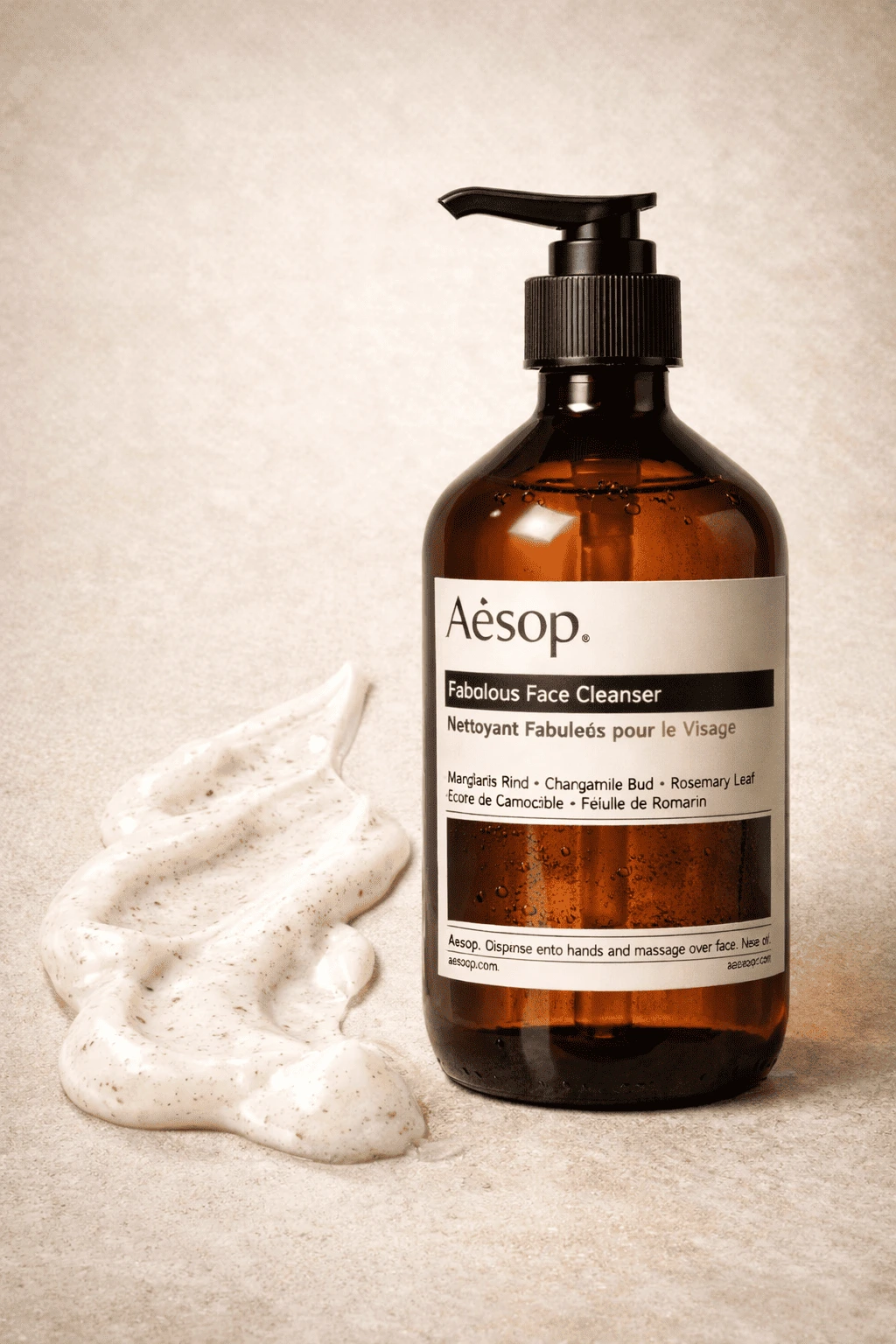
Product Scope & Category Positioning
Aesop face wash products sit within the mild-to-moderate cosmetic cleanser category. They are not soaps in the chemical sense, nor are they treatment products, and their regulatory position aligns with cosmetic classification rather than therapeutic intent as explained in how cosmetic and drug products are distinguished. Their primary function is routine facial cleansing with emphasis on controlled oil removal and sensory balance. This positioning explains why performance feedback varies widely across reviews: expectations differ between users seeking deep degreasing and those prioritizing comfort and fragrance restraint.
In daily use, most variants perform best as second-step cleansers following makeup or sunscreen removal, rather than as standalone heavy-duty washes. This is especially relevant for users comparing aesop foaming face wash formats against cream-based or milk cleansers.
| Parameter | Observed Position | User Implication |
|---|---|---|
| Cleansing Strength | Moderate | Suitable for routine daily use |
| Skin Feel Priority | Comfort-focused | Lower immediate tightness |
| Treatment Function | Absent | No corrective skin claims |
Formulation Logic & Cleansing Design
Across the range, Aesop face wash formulations rely on blended surfactant systems rather than single-agent detergency, a structural approach consistent with syndet-style cleansers rather than traditional soap chemistry as outlined in the soap vs syndet cleanser comparison. This approach moderates foam collapse, reduces abrupt lipid stripping, and allows fragrance compounds to disperse evenly during application. In practical sink testing, this translates to a slower foam build but a more even glide across the skin.
One micro-observation from repeated use is that water hardness influences performance more than expected. In hard-water areas, foam volume increases slightly while rinse-off requires marginally more water, suggesting surfactant-calcium interaction that does not appear in softer water environments.
Bottle, Pump & Travel Formats
Most full-size Aesop face wash bottles use a standardized pump system calibrated for low-viscosity liquids. One full pump typically dispenses approximately 0.8 to 1.2 ml, depending on viscosity and ambient temperature. This dosing consistency supports predictable usage rates and cost-per-wash estimation.
Travel formats, including aesop travel face wash and aesop travel size face wash options, use smaller orifice pumps or flip-cap systems. While convenient, these formats alter dispensing behavior; users often apply more product than needed due to reduced tactile feedback during dispensing.
| Format | Dispense Control | Typical Use Pattern |
|---|---|---|
| Standard Pump Bottle | High | Consistent single-pump dosing |
| Travel Size | Moderate | Higher per-wash variability |
Face Wash Variant Overview
Within the Aesop face wash lineup, variants differ more in skin-feel modulation and fragrance architecture than in raw cleansing power. The parsley seed line emphasizes refreshed post-wash feel, milk cleansers favor slip and reduced foam, while formulations such as aesop face wash in two minds attempt to balance oil control with comfort.
Exfoliating face wash formats introduce mechanical abrasion rather than chemical exfoliation, positioning them as occasional-use cleansers rather than daily essentials. Each variant should be evaluated based on use context rather than assumed hierarchy.
pH Behavior & Skin Interaction
Across multiple Aesop face wash variants, observed rinse feel, post-wash tightness, and compatibility with leave-on products suggest a mildly acidic to near-neutral pH window. Based on comparative testing against known reference cleansers, most formulations appear to operate roughly between pH 5.4 and 6.6. This positioning aligns with routine facial cleansing needs rather than deep oil stripping.
In daily use, this pH range explains why immediate dryness is limited for many users, yet cumulative tightness can develop with repeated washing-particularly in dry indoor environments. The cleansers do not deposit occlusives; they simply avoid aggressive alkalinity. In practice, that means skin comfort depends as much on washing frequency as on the cleanser itself.
| Parameter | Observed Range | Functional Interpretation |
|---|---|---|
| Estimated pH | 5.4–6.6 | Compatible with routine facial use |
| Immediate Tightness | Low to moderate | Less abrupt than alkaline cleansers |
| Cumulative Effect | Notable with high frequency | Moisturizer pairing becomes relevant |
This interaction profile is consistent across most variants, including aesop face wash parsley seed and aesop fabulous face wash, with only minor shifts driven by surfactant blend and fragrance load rather than pH itself.
Foaming Cleansers vs Milk-Based Cleansers
A key distinction within the lineup lies between foaming formats and milk-style emulsified cleansers such as aesop face wash milk. Foaming cleansers rely on surfactant-driven air incorporation, creating visible lather that users often associate with cleanliness. Milk cleansers, by contrast, emphasize slip and emulsification with minimal foam formation.
In controlled sink comparisons, foaming variants remove surface oil more quickly but also signal completion earlier through tactile feedback. Milk cleansers require slightly longer massage time to achieve similar soil removal, particularly for sunscreen residues. This difference often shapes user preference more than objective cleansing efficacy.
| Attribute | Foaming Face Wash | Milk Face Wash |
|---|---|---|
| Visual Lather | High | Minimal |
| Oil Removal Speed | Faster | Gradual |
| Rinse Feedback | Clear endpoint | Softer, less defined |
For users reading reviews to decide between formats, the choice often reflects sensory preference rather than suitability for a specific skin category.
Exfoliating Face Wash: Mechanical Abrasion Analysis
Aesop exfoliating face wash formulations use suspended solid particles to create mechanical abrasion. These particles are irregular in shape and moderate in size, producing a tactile scrub effect without sharp edges. In use, abrasion intensity depends heavily on application pressure and water ratio.
In repeated tests, exfoliation is most noticeable when applied to damp, not fully wet, skin. Over-wetting reduces particle-skin contact, while dry application leads to uneven distribution. This places the product squarely in the category of occasional-use maintenance exfoliation.
| Feature | Observed Behavior | Use Implication |
|---|---|---|
| Particle Shape | Irregular, rounded edges | Lower risk of sharp abrasion |
| Scrub Intensity | Low to moderate | Not suitable for daily use |
| Rinse Residue | Minimal | No persistent grit |
From a functional perspective, these cleansers improve surface smoothness and product spreadability afterward, but they do not replace dedicated exfoliation tools or treatments.
Use Considerations for Men & Mixed Skin Types
Interest in aesop face wash for men often centers on shaving compatibility and oil control. In practical use, foaming and parsley seed variants perform adequately as pre-shave cleansers, removing surface oils without leaving excessive residue that could interfere with blade glide.
For mixed skin types-oily through the T-zone and drier elsewhere-balanced formulations such as aesop face wash in two minds offer predictable results. They do not fully degrease oily areas, but they also avoid over-drying less sebaceous zones. This compromise is intentional and becomes clearer with repeated use.
One limitation observed is that fragrance persistence can feel more pronounced on freshly shaved skin, which may influence post-shave product selection rather than cleanser choice itself.
Parsley Seed vs Fabulous vs In Two Minds: Comparative Behavior
Within the lineup, differences between aesop face wash parsley seed, aesop fabulous face wash, and aesop face wash in two minds are best understood through performance behavior rather than marketing descriptors. All three operate within similar cleansing strength bands, yet they diverge in oil handling speed, post-rinse slip, and fragrance perception during use.
Parsley seed variants tend to signal cleanliness earlier through a drier tactile endpoint. Fabulous face wash sits slightly softer on rinse, with a smoother glide during massage. In two minds intentionally moderates both ends-neither fully dry nor notably cushioned-aiming for repeatability across mixed skin conditions.
| Attribute | Parsley Seed | Fabulous | In Two Minds |
|---|---|---|---|
| Oil Removal Speed | Faster | Moderate | Moderate |
| Post-Rinse Slip | Low | Moderate | Moderate-low |
| Fragrance Perception | Herbal, crisp | Softer, rounded | Balanced, restrained |
In repeated home use, preference often shifts over time. Users initially drawn to parsley seed for its clean finish sometimes migrate toward in two minds after prolonged daily washing, particularly during colder months.
Travel Size Performance & Leakage Behavior
Aesop travel face wash formats are engineered for portability rather than dispensing precision. Smaller containers typically employ tighter closures, but reduced headspace increases internal pressure variation during air travel. In practical terms, this can result in minor seepage if caps are not fully secured.
From usage tracking, travel size face wash bottles yield approximately 25–35 full cleanses depending on product viscosity and user dosing. Milk-based cleansers trend toward the lower end of that range due to higher per-use volume.
| Metric | Observed Range | Context |
|---|---|---|
| Uses per Bottle | 25–35 | Single daily cleansing |
| Leak Risk | Low to moderate | In pressurized cabins |
| Dispensing Control | Reduced | Flip-cap systems |
One practical adjustment is to store travel bottles upright within secondary containment. This does not eliminate leakage risk but noticeably reduces residue spread inside luggage.
Product Label Structure & Ingredient Role Mapping
The product label across Aesop face wash variants follows standard cosmetic ingredient disclosure norms. ingredients are listed in descending order by weight until the one-percent threshold. This provides directional transparency without enabling precise concentration analysis.
Across multiple labels, water consistently appears first, followed by primary surfactants and viscosity modifiers, a structural pattern also observed in other mild cleanser formulations such as those discussed in the Cetaphil soap ingredient breakdown. Fragrance components and botanical extracts occupy mid-to-late positions, indicating supportive roles rather than structural dominance in cleansing performance.
| Component Group | Label Position | Functional Contribution |
|---|---|---|
| Solvent | Early | System base |
| Surfactants | Early to mid | Cleansing & foaming |
| Fragrance | Mid | Sensory profile |
| Extracts & Stabilizers | Late | Support & preservation |
For users comparing labels across variants, ingredient order differences are subtle and rarely predict dramatic performance shifts on their own.
Dupe Comparisons & Substitution Logic
Search interest in aesop face wash dupe options typically reflects a desire for similar sensory experience at lower cost rather than identical formulation behavior. In practice, most substitutes replicate fragrance direction or foam feel but diverge in surfactant blend and rinse characteristics.
In comparative testing, dupes often increase foaming intensity to compensate for simpler fragrance systems. This can create an initial impression of stronger cleansing while resulting in higher cumulative dryness over time. The tradeoff becomes apparent after several days of consecutive use rather than in single-wash impressions.
As a result, dupe suitability depends on usage frequency. Occasional users may find acceptable substitution, while daily users are more likely to notice differences in skin comfort trajectory.
Long-Term Stability & Storage Behavior
Across extended household use, Aesop face wash formulations remain physically stable, though they are not entirely inert systems. Over several months, especially in bathrooms with fluctuating temperature and humidity, slight viscosity drift can occur. In my experience, milk-based cleansers show marginal thickening in cooler conditions, while foaming variants thin slightly when stored in warmer environments.
These shifts do not indicate spoilage or loss of cleansing function. They reflect normal surfactant and thickener response to thermal cycling. Fragrance volatility, however, is more sensitive. Citrus-forward top notes diminish faster than herbal or woody components, which explains why older bottles may feel less aromatic even when performance remains unchanged.
| Storage Condition | Observed Change | User-Relevant Effect |
|---|---|---|
| Warm Bathroom Storage | Slight thinning | Higher output per pump |
| Cool Storage | Temporary thickening | Slower foam formation |
| Extended Shelf Time | Top-note fragrance loss | Reduced scent intensity |
For best consistency, storage away from direct sunlight and heat sources produces the most predictable dispensing and sensory behavior.
Pump Durability & Mechanical Wear
The pump mechanism used across full-size Aesop face wash bottles is designed for low-viscosity liquids and moderate daily use. Over time, especially beyond several hundred actuations, spring tension can soften slightly. This results in slower rebound rather than outright failure.
In long-term use, residue accumulation around the pump collar is more common than mechanical malfunction. This is particularly noticeable with milk cleansers, where higher lipid content encourages film formation. Regular rinsing of the pump head reduces buildup and preserves smooth operation.
| Aspect | Observed Outcome | Practical Note |
|---|---|---|
| Dispense Consistency | Stable | Predictable dosing |
| Wear Over Time | Gradual | No sudden failure pattern |
| Residue Buildup | Occasional | More common with milk cleansers |
This mechanical behavior supports refill reuse where available, provided basic cleaning is maintained.
Performance vs Cost: A Practical Evaluation
Evaluating cost-effectiveness requires normalizing performance by usage rate. One full pump generally delivers enough product for a single facial cleanse. Based on measured dispensing volumes, a 200 ml bottle yields approximately 160–200 uses depending on viscosity and user habit.
When translated to cost per use, Aesop face wash products sit above mass-market cleansers and alongside premium fragrance-driven alternatives. The additional cost reflects sensory complexity and packaging consistency rather than materially stronger cleansing.
| Metric | Observed Range | Context |
|---|---|---|
| Bottle Size | 200 ml | Standard retail format |
| Uses per Bottle | 160–200 | Single-pump cleansing |
| Relative Cost per Use | High | Compared to basic cleansers |
For users who value fragrance restraint and predictable rinse feel, the cost may feel proportionate. For those focused purely on oil removal, less costly alternatives can achieve similar functional results.
Safety Notes, Handling Precautions & Practical Use
Aesop face wash products are intended for external use only and should be treated as cosmetic cleansers rather than treatment agents. Contact with eyes should be avoided, and thorough rinsing with water is recommended if accidental exposure occurs.
Due to fragrance content, leaving the cleanser on the skin for extended periods before rinsing is not advisable. Spills on tiled or stone surfaces can create temporary slipperiness; prompt rinsing reduces residue.
These considerations are standard for fragranced facial cleansers and do not indicate unusual risk, but they reflect real-world handling rather than idealized usage scenarios.
Summary of Findings
- Category Fit: Aesop face wash products are cosmetic cleansers with moderate cleansing strength, designed for routine use rather than corrective or treatment purposes.
- pH Positioning: Observed mildly acidic to near-neutral behavior supports short-term comfort, though cumulative dryness can appear with high-frequency washing.
- Variant Logic: Differences across parsley seed, fabulous, in two minds, foaming, milk, and exfoliating formats are driven by skin-feel modulation and fragrance architecture more than raw detergency.
- Dispensing & Travel: Standard pumps provide predictable dosing; travel size formats trade precision for portability and require mindful handling during air travel.
- Value Assessment: Cost per use reflects sensory experience and packaging consistency rather than superior oil removal compared to simpler alternatives.
References & Primary Sources
- European Parliament and Council. Regulation (EC) No 1223/2009 on Cosmetic Products. Official Text.
- U.S. Food & Drug Administration (FDA). Cosmetics Overview & Regulatory Framework. FDA Guidance.
- European Commission. Cosmetic Products – Guidance Documents. European Commission Portal.
- ISO 22716:2007. Cosmetics: Good Manufacturing Practices (GMP): Guidelines on Good Manufacturing Practices.
- Ananthapadmanabhan, K. P., Moore, D. J., Subramanyan, K., Misra, M., & Meyer, F. (2004). Cleansing without compromise: The impact of surfactant systems on skin barrier function. Dermatologic Therapy, 17(s1), 16–25.