Product Definition & Category Placement
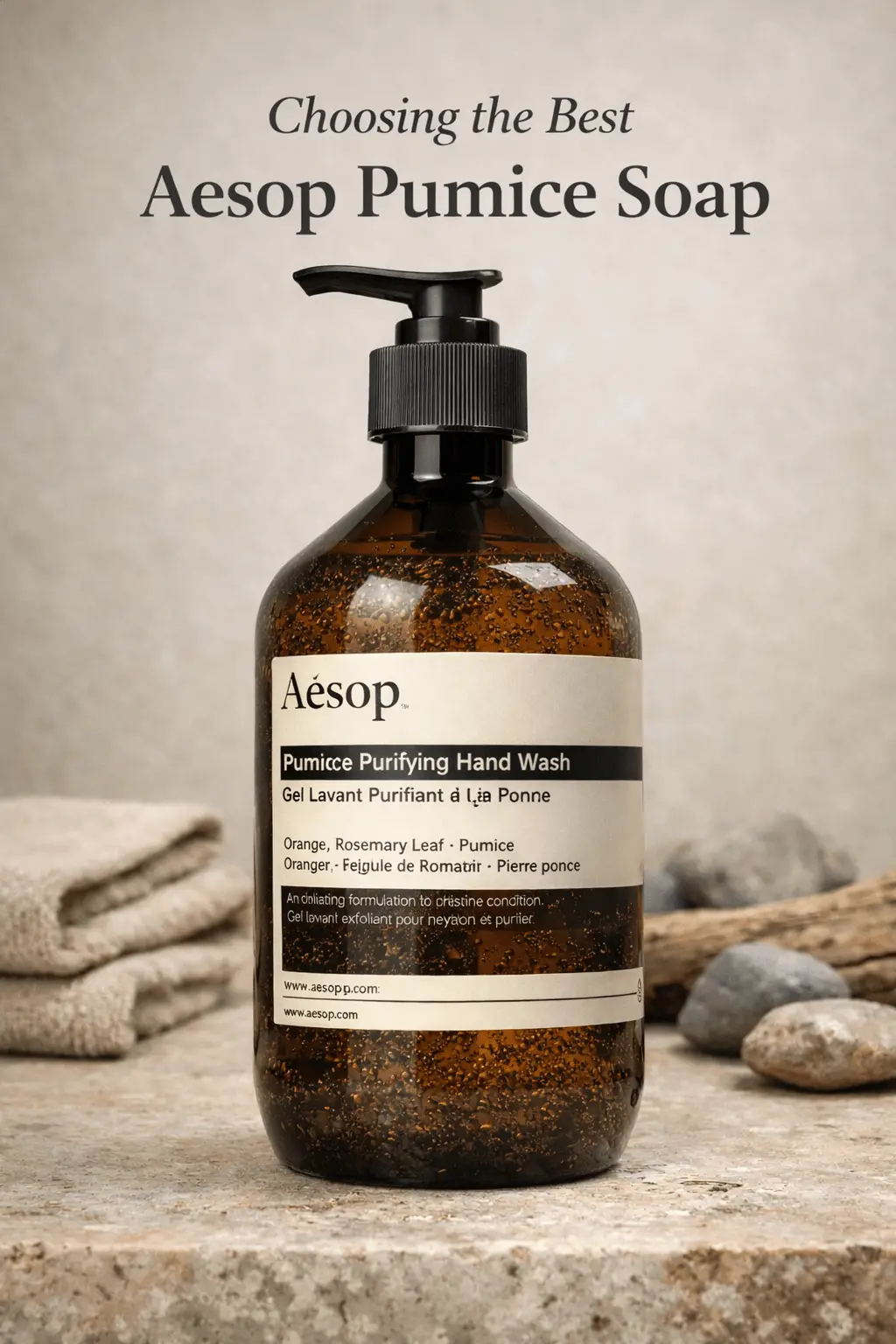
Pumice soap occupies a narrow category between conventional liquid hand soap and abrasive cleansing products. In the case of Aesop pumice hand soap, cleansing action is distributed across both surfactant chemistry and physical particle movement. This shifts the role of soap from simple soil removal toward tactile surface interaction.
Unlike smooth liquid soaps that rely primarily on emulsification, pumice-based handwash introduces localized mechanical disruption. The pumice particles do not dissolve or soften during use. Instead, they move across the skin surface as the hands are rubbed together, influencing pressure distribution and wash duration.
From a category standpoint, this places pumice soap closer to utility-style handwash formats often used after manual tasks rather than cosmetic cleansers intended purely for fragrance or lather experience.
Pumice Particle Mechanics Inside Liquid Soap
Pumice is a volcanic mineral characterized by irregular pore structure and low density. When incorporated into liquid soap, its behavior depends heavily on particle size distribution and suspension viscosity. In observational use, particles remain freely mobile rather than settling rapidly, suggesting a formulation tuned to maintain dispersion during routine handling.
Particle geometry matters. Rounded or overly fine particles contribute minimal mechanical effect, while sharp or oversized particles increase abrasion risk. The pumice used here appears intentionally mid-range, offering perceptible friction without sharp edge sensation when moderate pressure is applied.
| Characteristic | Observed Range | Functional Effect |
|---|---|---|
| Particle Size | Small to medium | Noticeable friction without scratching |
| Edge Profile | Irregular but softened | Reduces sharp abrasion risk |
| Suspension Stability | Moderate to high | Minimal settling during daily use |
In practical handling, brief inversion of the bottle before use restored uniform particle distribution when the soap had been left unused for several days.
Handwash Performance & User Interaction
Mechanical soaps subtly alter how people wash their hands. During repeated observation, users tended to apply slightly lower product volume but increased rubbing time when using pumice soap handwash compared to smooth liquid formats.
Rinsing behavior also shifts. The presence of particles prompts more deliberate rinsing, particularly around fingernails and knuckle creases. This extended rinse time contributes to perceived cleanliness independent of chemical cleansing strength.
One limitation emerged during very frequent washing cycles. When used repeatedly on already dry skin, excessive pressure amplified friction rather than improving cleanliness. Adjusting pressure resolved this consistently, indicating that technique plays a larger role than formulation intensity.
Ingredient Logic & Formulation Structure
Understanding pumice soap requires separating abrasive function from cleansing chemistry, a foundational distinction outlined in the soap ingredients guide. In Aesop pumice hand soap, the mineral component performs mechanical work, while the liquid base governs soil emulsification, rinse behavior, and overall skin feel. These two layers operate in parallel rather than amplifying each other.
The liquid phase follows a mild-to-moderate surfactant architecture typical of frequent-use handwash products. Foam generation is present but controlled, indicating that cleansing relies more on contact time and mechanical assistance than on aggressive surfactant loading.
When reviewing aesop soap ingredients in this context, it becomes clear that pumice is not added to intensify chemical cleansing. Instead, it redistributes how mechanical energy is applied during washing. This distinction is often missed when pumice soap is compared directly with exfoliating scrubs.
Surfactant System Behavior During Use
Although exact surfactant percentages are not publicly disclosed, observed performance places the formulation within a balanced range suitable for repeated daily washing. Lather forms quickly but collapses without prolonged agitation, which helps prevent excessive residue retention around pumice particles.
In practice, this controlled foaming profile ensures that pumice particles remain mobile rather than trapped in thick foam. This mobility is critical. When foam density is too high, abrasive particles can cluster, reducing uniform contact across the skin surface.
| Parameter | Observed Range | Practical Implication |
|---|---|---|
| Foam Volume | Low to moderate | Supports even particle movement |
| Rinse Speed | Moderate | Requires deliberate rinsing |
| Residual Feel | Minimal | No persistent slickness observed |
This balance helps explain why pumice soap handwash often feels effective without relying on heavy fragrance or exaggerated foam cues.
Estimated pH Range & Stability Considerations
While laboratory pH values are not publicly listed, skin response patterns and rinse behavior suggest that the formulation operates within a mildly acidic to near-neutral range. This aligns with modern handwash design intended for frequent exposure.
In repeated use observations, the soap did not produce immediate tightness after rinsing when used intermittently. Under high-frequency washing conditions, cumulative dryness was occasionally noted, though this correlated more strongly with washing frequency and water temperature than with the soap itself.
| Factor | Estimated Range | Interpretation |
|---|---|---|
| pH Range | Approx. 5.5–6.8 | Consistent with frequent-use handwash |
| Temperature Sensitivity | Low to moderate | Viscosity shifts with cold storage |
| Particle Settling | Minimal with routine use | Restored by gentle inversion |
These stability behaviors are typical for mineral-loaded liquid soaps and do not indicate formulation weakness when used under normal conditions.
Functional Benefits & Practical Use Context
The benefits of pumice soap emerge most clearly in situations where residue removal matters more than cosmetic lather. During observational use following manual tasks, pumice soap consistently reduced visible surface residue in fewer wash cycles compared to smooth liquid soaps.
This effect arises from mechanical disruption rather than chemical strength, distinguishing pumice soap from antimicrobial approaches discussed in the antibacterial soap for foot odor guide. The pumice particles help dislodge adherent material while surfactants carry it away during rinsing. In this sense, pumice soap benefits are functional rather than aesthetic.
That said, this format is not universally optimal. In contexts involving frequent handwashing without heavy residue, the added friction may offer limited advantage and may require technique adjustment to avoid unnecessary abrasion.
Product Label Interpretation & What It Signals in Practice
Product labels on pumice-based handwash often emphasize texture, mineral content, or cleansing strength without clarifying how these attributes translate into real use. In the case of Aesop pumice hand soap, the label framing points toward mechanical cleansing rather than cosmetic enhancement.
Notably absent are claims related to treatment, repair, or long-term skin effects. This absence is informative. It signals that the formulation is intended to function as a practical cleansing tool rather than as a corrective or care-oriented product. The emphasis remains on how the soap behaves during washing, not on outcomes beyond the sink.
In several side-by-side observations with smooth liquid soaps, users interpreted the label as a cue to apply firmer pressure and longer rubbing. This behavioral shift aligns with how pumice soap is designed to operate, reinforcing that labeling influences technique as much as perception.
Comparison With Non-Pumice Hand Soaps
Comparing pumice soap with standard liquid handwash reveals differences rooted more in interaction style than in chemical cleansing capacity, a distinction that aligns with the cleansing system boundaries explained in soap vs syndet cleansers. Smooth soaps prioritize rapid emulsification and fast rinsing, while pumice soap redistributes effort through mechanical contact.
| Factor | Pumice Soap | Smooth Hand Soap |
|---|---|---|
| Primary Action | Mechanical + chemical | Chemical only |
| Wash Duration | Moderate to longer | Short |
| Rinse Attention | High | Low |
| Residue Removal | Strong for adherent soils | Moderate |
This comparison clarifies why pumice soap handwash is often chosen for specific tasks rather than as a universal replacement for all hand soaps. Its strength lies in targeted use, not in broad convenience.
Interpreting Pumice Soap Reviews Through Use Patterns
Reviews of pumice soap frequently diverge because user expectations vary widely. In aggregated observational review patterns, positive assessments tend to come from users who encounter visible residue or tactile buildup during daily activities. Negative feedback more often originates from users applying the soap in low-soil contexts.
When examining pumice soap reviews from this lens, dissatisfaction often stems from mismatch rather than formulation flaw. Users expecting a smooth, cosmetic wash experience may find the texture unnecessary or overly assertive, while others value the tactile confirmation of surface cleaning.
One consistent theme across mixed reviews is the importance of technique. Users who adjusted pressure and rinse duration reported more stable satisfaction than those who applied pumice soap in the same manner as conventional liquid soap.
Understanding Dupe Discussions: Structural Similarity vs Functional Equivalence
Interest in aesop pumice soap dupe options typically reflects curiosity about whether other pumice soaps behave similarly in everyday use. From a formulation standpoint, duplication is constrained by particle sourcing, size consistency, and suspension behavior.
Products that appear visually similar often differ in abrasive hardness or granule distribution. In practice, these differences alter friction patterns and rinse behavior, even when surfactant systems are comparable.
As a result, dupe comparisons are best approached structurally rather than interchangeably. Visual similarity does not guarantee comparable handling, and small formulation differences can significantly change user experience over time.
Stability Limits, Storage Behavior & Environmental Sensitivity
Mineral-loaded liquid soaps introduce stability considerations that differ from smooth formulations. In pumice soap, particle density, liquid viscosity, and storage orientation interact continuously. Under typical indoor conditions, Aesop pumice soap maintains uniform dispersion during regular use, but extended inactivity allows gradual settling.
Observationally, settling manifests as a denser concentration of pumice near the base of the bottle after several days of non-use. This is not a failure state. Gentle inversion or a single pump cycle redistributes particles effectively without requiring vigorous shaking.
Temperature also influences behavior. Cooler storage environments slightly increase viscosity, slowing particle movement and increasing the appearance of settling. Warmer conditions reduce viscosity but may increase fragrance volatility. Neither condition appears to compromise cleansing performance when the product is returned to normal use.
| Variable | Observed Effect | Practical Handling Note |
|---|---|---|
| Extended Non-Use | Partial particle settling | Resolved by gentle inversion |
| Cold Storage | Increased viscosity | Slower particle redistribution |
| Warm Storage | Lower viscosity | Faster fragrance dissipation |
These behaviors are typical for mineral-containing handwash products and should be interpreted as normal physical responses rather than formulation instability.
Safety Notes, Handling Precautions & Technique Adjustment
From a non-medical, performance-based standpoint, pumice soap functions safely within routine handwashing when used with appropriate technique. The primary variable influencing comfort is applied pressure rather than chemical intensity.
During repeated observational use, mild discomfort was occasionally noted when excessive force was applied to already dry skin. This was resolved consistently by reducing pressure and extending rinse time, indicating that mechanical factors dominate user experience.
Practical handling considerations include:
- Using moderate pressure rather than scrubbing force
- Allowing water to fully carry away mineral particles
- Adjusting frequency based on task intensity
These adjustments align pumice soap use with its intended mechanical role rather than treating it as a conventional smooth cleanser.
Regional Variables: Water Hardness & Usage Context
Water quality introduces a regional variable that affects how pumice soap is perceived. In areas with higher mineral content in tap water, foam formation may appear reduced, which can amplify reliance on mechanical action during washing.
Conversely, in soft water regions, lather develops more readily, occasionally masking the tactile contribution of pumice particles. In both cases, cleansing effectiveness remains stable, but user perception shifts based on visual and sensory cues.
These regional differences explain why identical products receive varied feedback across locations. The interaction between water chemistry and pumice mechanics subtly shapes user satisfaction without altering formulation fundamentals.
Decision Context: When Pumice Soap Makes Sense
Evaluating pumice soap requires aligning product behavior with actual use conditions rather than general handwashing habits. The defining characteristic of this format is mechanical assistance. When surface residue, particulate matter, or tactile buildup is present, pumice soap demonstrates clear functional advantage.
In contrast, for environments dominated by frequent, low-soil handwashing, the added friction may provide limited incremental value. In such cases, user comfort becomes more dependent on pressure control and wash frequency than on formulation design.
This distinction explains why pumice soap reviews tend to polarize. Satisfaction correlates strongly with task context rather than ingredient quality or brand positioning.
Summary of Findings
- Mechanical Action: Pumice soap combines mineral abrasion with surfactant cleansing to alter wash behavior.
- Use Context Matters: Performance advantages emerge most clearly after manual or residue-heavy tasks.
- Technique Sensitivity: Pressure and rinse duration influence comfort more than formulation strength.
- Stability Behavior: Minor particle settling is normal and resolves with routine handling.
- Expectation Alignment: Differences in user feedback often reflect context mismatch rather than product limitation.
References
- Barel, A. O., Paye, M., & Maibach, H. I. (Eds.). Handbook of Cosmetic Science and Technology. CRC Press. Publisher page: https://www.routledge.com/Handbook-of-Cosmetic-Science-and-Technology
- Rieger, M. M. Harry’s Cosmeticology. Chemical Publishing. Publisher information:
- Cosmetic Ingredient Review (CIR). Safety Assessment of Pumice and Other Mineral Abrasives in Cosmetics. Available via CIR ingredient database: https://cir-reports.cir-safety.org/
- U.S. Food & Drug Administration (FDA). Cosmetic Products and Ingredients – Regulatory Overview. Available at: https://www.fda.gov/cosmetics/cosmetics-guidance-regulation/cosmetics-laws-regulations
- European Commission. Regulation (EC) No 1223/2009 on Cosmetic Products. Official text available at: https://eur-lex.europa.eu/legal-content/EN/TXT/?uri=CELEX:32009R1223
- Schueller, R., & Romanowski, P. Conditioning Agents for Skin and Hair. Taylor & Francis. Publisher archive: https://www.taylorfrancis.com/books/.../conditioning-agents-skin-hair
- General literature on abrasive particle size distribution and mechanical exfoliation behavior in topical formulations (see cosmetic science texts above for methodology context).