Definition and System Identity
Bleach Activators are functional additives used in detergent systems that react with peroxide sources to generate more reactive oxygen species, enabling effective stain oxidation under moderate or low temperature conditions.
They belong to a class of organic compounds that do not clean surfaces directly but modify the behavior of oxygen-releasing agents within the formulation.
In practical formulation systems, they work alongside compounds such as oxygen bleach additives, enhancing the efficiency of oxidative cleaning reactions.
This page is part of the ingredient library, a structured research system that examines how ingredients behave inside real detergent formulation systems rather than in isolation.
Quick Facts
| Property | Description |
|---|---|
| Ingredient Type | Functional additive |
| Chemical Class | Organic peroxide activators |
| Functional Role | Peroxide activation and oxidation enhancement |
| Ionic Nature | Nonionic organic compounds |
| Typical Use Context | Laundry detergents, powdered cleaning systems |
| Operational Condition | Activated in aqueous environment |
| Activation Mechanism | Reacts with hydrogen peroxide to form peroxy acids |
| Reactive Species Generated | Peroxy acids with higher oxidation potential than hydrogen peroxide |
| Primary Function in System | Enables effective bleaching at lower temperatures |
| Temperature Efficiency | Improves oxidation performance in low to moderate temperature washes |
| Dependency on Peroxide Source | Requires oxygen bleach source (e.g., sodium percarbonate) for activation |
| Stain Target Profile | Effective on oxidizable stains such as food dyes, tea, coffee, and wine |
| pH Sensitivity | Performs optimally in alkaline detergent systems |
| Kinetic Behavior | Accelerates rate of oxidation reactions in wash cycle |
| Interaction with Surfactants | Works alongside surfactants which disperse and remove oxidized residues |
| Compatibility with Builders | Compatible; alkaline builders support activation efficiency |
| Decomposition Pathway | Converts to peroxy acid and corresponding organic by-products |
| Residue Behavior | Breaks down into water-soluble and low-residue compounds |
| Formulation Limitation | Sensitive to moisture; premature reaction reduces effectiveness |
| System Role | Enhances oxidative cleaning without contributing direct surface activity |
Why This Ingredient Appears on Labels
Bleach activators appear on ingredient labels because they are included to improve the performance of oxygen-based bleaching systems within cleaning formulations.
Their presence indicates that the formulation contains a mechanism designed to enhance stain oxidation, particularly under conditions where peroxide alone may show limited activity.
On ingredient lists, they are disclosed as part of the additive system rather than the primary cleaning structure, which is typically governed by surfactant systems.
The way such components are listed follows standardized labeling logic explained in the ingredient list interpretation guide, where ingredients reflect formulation inclusion rather than performance hierarchy.
In observable terms, their inclusion often corresponds to improved stain removal consistency across different washing temperatures, particularly in systems where oxidative processes are required.
Chemical Identity and Classification
Bleach activators are typically organic compounds such as tetraacetylethylenediamine, commonly abbreviated as TAED, which belong to a class of peroxide-reactive additives used in detergent systems.
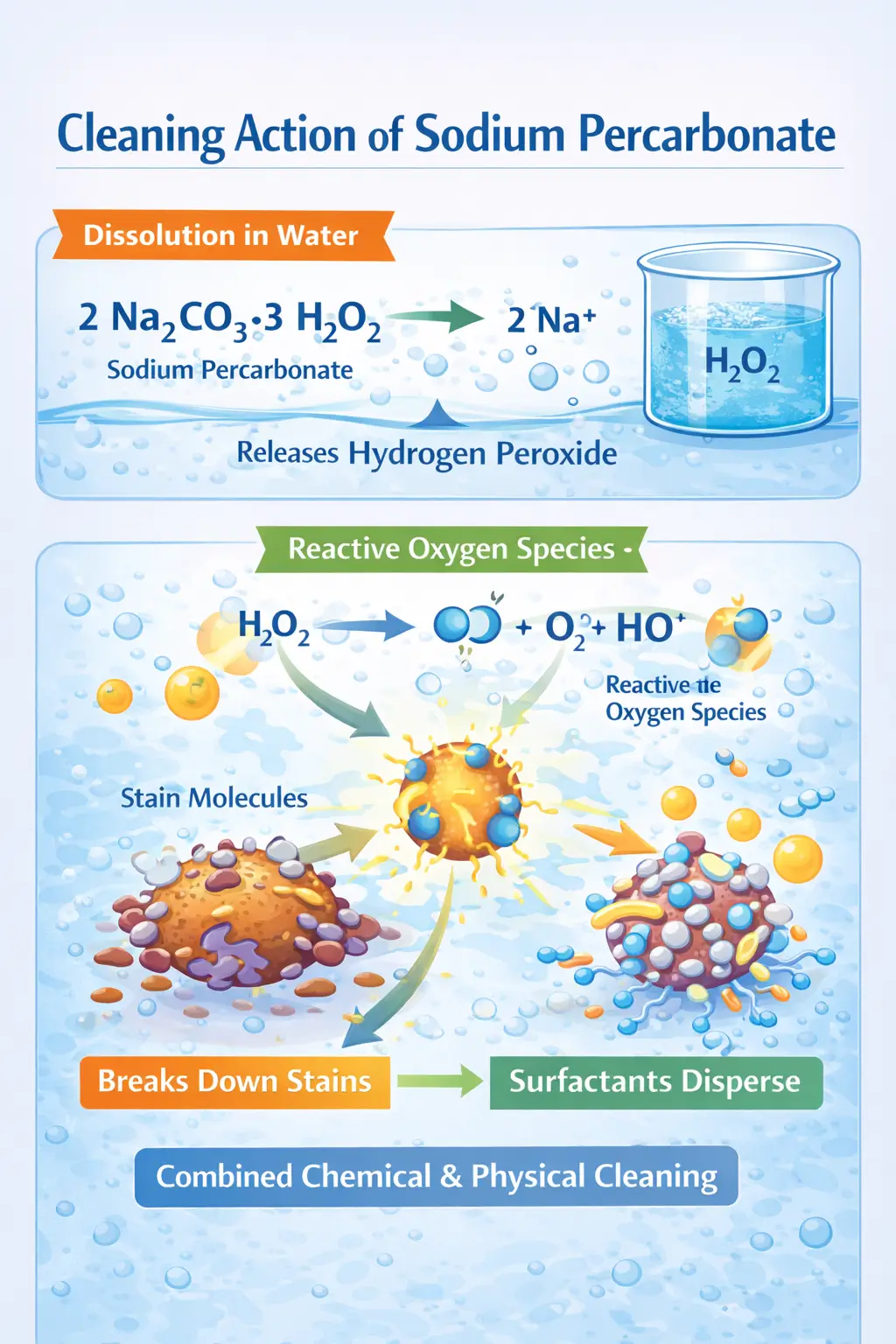
Their structure allows them to react with hydrogen peroxide released from compounds such as sodium percarbonate, forming more reactive peroxy species capable of faster oxidation.
Unlike inorganic bleaching agents, these compounds do not release oxygen directly. Instead, they transform existing peroxide into a more active form, enabling efficient reaction under moderate conditions.
They are generally nonionic and function within the aqueous phase of the formulation, where they participate in chemical transformation rather than surface interaction.
This classification distinguishes them clearly from nonionic surfactants and other surface-active ingredients, which operate through interfacial mechanisms rather than chemical activation.
Functional Role in Detergent Systems
The primary role of bleach activators is to enhance the efficiency of oxygen-based bleaching systems by converting hydrogen peroxide into more reactive intermediates.
This reaction enables oxidation to occur at lower temperatures than would be possible with peroxide alone, improving performance in modern washing conditions where high-temperature cycles are less common.
In formulation terms, they extend the functional range of oxygen bleaching systems rather than acting as independent cleaning agents.
- Peroxide activation: transformation of hydrogen peroxide into more reactive species
- Low temperature efficiency: enables oxidation under mild conditions
- System enhancement: supports oxidative cleaning alongside surfactants
Within a complete detergent formulation system, this results in a dual cleaning mechanism where surfactants remove bulk soils while oxidation targets residual stains.
In practical observation, this combined mechanism can lead to improved removal of persistent stains that are not fully addressed by surfactant action alone.
Ingredient Interaction Logic
Bleach activators operate within a network of interacting components, where their effectiveness depends on coordinated behavior with other ingredients.
Interaction with Peroxide Sources
Their primary interaction occurs with hydrogen peroxide generated in situ from compounds such as oxygen-releasing additives.
This reaction produces activated oxygen species capable of more efficient stain oxidation, particularly under conditions where peroxide alone would react slowly.
Interaction with Water Phase
Water provides the medium for dissolution and reaction. Both peroxide release and activation occur in the aqueous phase, making water availability essential for functionality.
Without sufficient hydration, the interaction between activator and peroxide cannot proceed effectively.
Interaction with Surfactants
Surfactants facilitate soil removal and improve contact between the aqueous phase and stained surfaces.
Systems containing anionic surfactants or nonionic wetting agents enhance the accessibility of stains to oxidative reactions.
Interaction with Alkaline Environment
Alkalinity influences both peroxide stability and reaction pathways. Conditions maintained by alkaline agents support the formation of reactive oxygen species.
This environment ensures that activation reactions proceed efficiently within the washing cycle.
Interaction with Organic Additives
Fragrance and other organic components may undergo interaction with oxidative species, affecting their stability and perception.
These effects are part of broader formulation considerations discussed in fragrance system behavior.
Taken together, these interactions show that bleach activators do not function independently but operate as part of a coordinated chemical system involving oxidation, surfactant action and environmental conditions.
Phase Behavior and Physical Characteristics
Bleach activators are typically incorporated into detergent formulations in solid form, where they remain stable under dry storage conditions and become active only upon contact with water.
In the dry state, they coexist with peroxide sources such as sodium percarbonate without significant interaction, allowing stable formulation of powdered systems.
Upon dissolution in water, both components enter the aqueous phase, where activation reactions begin and reactive oxygen species are generated.
Moisture Sensitivity
Although relatively stable in dry conditions, exposure to moisture can initiate premature reactions between activator and peroxide, potentially reducing formulation efficiency over time.
This requires controlled storage and packaging conditions to maintain product stability.
Temperature Influence
Temperature affects the rate of activation reactions. Bleach activators are specifically designed to enable oxidation at lower temperatures compared to peroxide alone.
This characteristic supports modern washing conditions where lower temperature cycles are commonly used.
Solubility and Reaction Environment
Once dissolved, activators participate in homogeneous reactions within the aqueous phase rather than forming structured aggregates like surfactants.
Their function depends on chemical transformation processes occurring throughout the solution rather than at interfaces.
Comparison With Oxygen Bleach Systems
The role of bleach activators becomes clearer when compared with peroxide systems operating without activation.
| Feature | Peroxide Alone | Peroxide + Activator |
|---|---|---|
| Reaction Speed | Slower | Faster |
| Temperature Requirement | Higher | Lower |
| Oxidation Efficiency | Moderate | Enhanced |
| System Complexity | Simpler | More complex |
| Typical Use | Basic cleaning systems | Advanced detergent formulations |
This comparison highlights that bleach activators function as performance modifiers, extending the effectiveness of oxygen bleaching systems rather than replacing them.
Regulatory Context
Bleach activators are regulated within general chemical and detergent frameworks, where their use is evaluated based on formulation context and environmental interaction.
They are not classified as standalone cleaning agents but as components of additive systems used to enhance performance of existing formulation mechanisms.
When present in cleaning products, their classification follows broader regulatory frameworks discussed in the cosmetic and chemical classification systems.
Their appearance on labels follows standard disclosure practices explained in the ingredient list interpretation guide.
Regulatory evaluation focuses on how these compounds behave within complete formulations rather than in isolation.
Common Misunderstanding
A common misconception is that bleach activators function as independent cleaning agents capable of removing stains on their own.
In reality, they require the presence of peroxide sources to operate. Without hydrogen peroxide, activation reactions cannot occur.
Another misunderstanding is that higher peroxide concentration alone can replace the need for activators. In practice, activation chemistry enables efficient oxidation under conditions where peroxide alone may be less effective.
These distinctions reflect the broader difference between chemical transformation and physical soil removal, as discussed in the cleansing mechanism explanation.
Structural and Formulation Limitations
Despite their advantages, bleach activators introduce additional complexity into detergent formulations that must be managed carefully.
- Dependence on peroxide: require hydrogen peroxide sources to function effectively.
- Moisture sensitivity: premature interaction with peroxide may reduce formulation stability.
- Compatibility considerations: reactive species may interact with other formulation components.
- Formulation complexity: require balanced system design to achieve consistent performance.
These limitations emphasize that bleach activators operate as part of a coordinated formulation system rather than standalone ingredients.
Formulation References Using This Ingredient
Summary of Findings
- Classification: Bleach activators are organic additives used in detergent systems.
- Functional Role: They enhance oxidation by activating hydrogen peroxide.
- Interaction Logic: Their performance depends on interaction with peroxide sources, surfactants and alkaline conditions.
- System Behavior: They enable efficient oxidation under lower temperature conditions.
- Limitations: Require careful formulation and depend on peroxide availability.