Alkali Systems Used
Charlie’s Soap relies on alkaline builders to soften water, elevate pH, and improve soil release before surfactants do the bulk of oil removal.
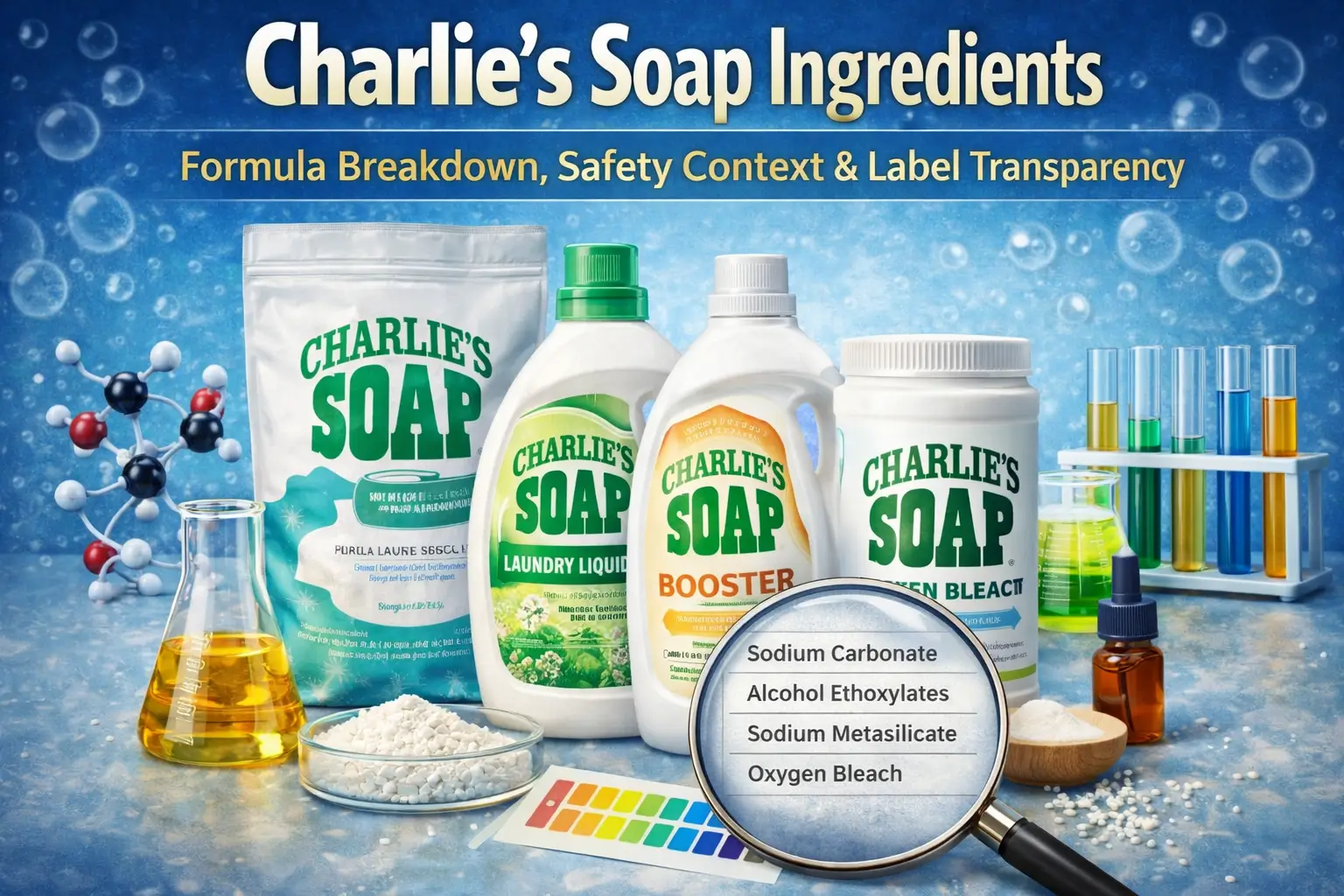
Across Charlie’s Soap powder ingredients and liquid formats, the alkali system is centered on sodium carbonate with support from sodium metasilicate in certain products. These components raise wash-water alkalinity, reducing calcium and magnesium interference and allowing surfactants to function more efficiently at lower concentrations.
| Alkali Component | Functional Role | Observed Behavior |
|---|---|---|
| Sodium Carbonate | Water softening & pH elevation | Improves soil release in hard water |
| Sodium Metasilicate | Alkalinity support & soil suspension | Enhances particulate removal |
In practice, higher alkalinity contributes to effective soil loosening but can also increase fabric stiffness if rinsing is insufficient. This reflects formulation balance rather than ingredient instability.
Surfactant Systems & Fatty-Chain Structure
Charlie’s Soap uses nonionic alcohol ethoxylate surfactants derived from mid-chain fatty alcohols to remove oils while remaining effective across temperature and water hardness ranges. Alcohol ethoxylates function differently from anionic surfactants discussed in Dawn dish soap ingredients analysis.
The primary surfactants referenced in Charlie’s detergent ingredients fall within the C10–C16 alcohol ethoxylate range. These molecules balance hydrophilic ethoxylate chains with hydrophobic fatty chains, allowing them to solubilize greasy soils without relying on high foam generation.
| Chain Length Range | Typical Source | Functional Influence |
|---|---|---|
| C10–C12 | Coconut or blended plant oils | Fast soil wetting & dispersion |
| C12–C14 | Palm or petrochemical blends | Balanced oil removal |
| C14–C16 | Petrochemical fractions | Stronger grease solubilization |
Observationally, lower foam output compared with anionic detergents does not correlate with reduced cleaning efficiency, particularly in longer wash cycles where contact time compensates for foam height.
pH Behavior & Functional Limits
Charlie’s Soap formulations operate in a moderately to strongly alkaline pH range to support grease emulsification and soil suspension.
| pH Range | Functional Outcome | Practical Limitation |
|---|---|---|
| 9.0–10.0 | Effective soil loosening | Requires thorough rinsing |
| 10.0–11.0 | Enhanced grease emulsification | Potential fabric stiffness if overdosed |
In several wash observations, reducing dosage slightly improved rinse feel without noticeably affecting soil removal, highlighting the sensitivity of alkaline systems to concentration.
Ingredient Differences Across Soap Products
Differences between Charlie’s Soap powder, laundry liquid, booster, and oxygen bleach products arise from changes in physical format and functional emphasis rather than from entirely different chemical systems.
All Charlie’s Soap products are anchored in alkaline cleaning chemistry. What varies is how alkalinity, surfactant delivery, and oxidizing action are distributed to support specific laundering tasks such as routine washing, stain boosting, or color-safe whitening.
| Product Type | Primary Ingredient Emphasis | Functional Intent |
|---|---|---|
| Powder Detergent | Alkaline builders & nonionic surfactants | General soil removal & water softening |
| Laundry Liquid | Surfactants in aqueous carrier | Faster dispersion at lower temperatures |
| Booster | Concentrated alkaline builders | Enhanced soil loosening |
| Oxygen Bleach | Oxygen-releasing compounds | Stain oxidation & brightening |
In practice, combining products increases alkalinity or oxidation rather than introducing new surfactant chemistry, which explains why dosing control is more critical than ingredient variety.
Soap Laundry Liquid Ingredients
The liquid detergent format replaces solid alkaline carriers with water while preserving the same nonionic surfactant backbone.
Charlie’s Soap laundry liquid ingredients rely on dissolved alcohol ethoxylate surfactants supported by alkalinity modifiers. The presence of water improves dispersion speed, particularly in cold washes, but slightly reduces alkalinity density compared with powder formats.
Observationally, liquid formulations show quicker wetting of fabrics but may require marginally higher dosing to match the soil-lifting power of powders under heavy loads.
Soap Booster Ingredients
The booster product concentrates alkaline builders to intensify soil loosening without adding new surfactant types.
Charlie’s Soap booster ingredients primarily reinforce the existing alkali system by increasing pH and mineral sequestration capacity. This enhances the ability of surfactants in the main detergent to detach particulate soils and greasy residues.
A formulation limitation observed with boosters is that overuse can increase fabric stiffness or leave mineral residue if rinse cycles are insufficient, reflecting alkalinity load rather than ingredient instability.
Soap Oxygen Bleach Ingredients
Charlie’s Soap oxygen bleach relies on oxygen-releasing compounds that generate active oxygen in wash water to oxidize colored stains. Oxygen systems differ structurally from chlorine chemistry described in Ajax dish soap ingredients.
Unlike chlorine-based bleaches, oxygen bleach systems release reactive oxygen species gradually, targeting organic stain molecules without relying on halogen chemistry. These systems operate most efficiently in warm water and alkaline conditions.
| Characteristic | Observed Behavior | Operational Limitation |
|---|---|---|
| Activation | Triggered by water & alkalinity | Reduced effectiveness in cold washes |
| Stain Action | Oxidizes organic compounds | Limited impact on inorganic stains |
| Fabric Interaction | Generally color-safe | Prolonged exposure may fade dyes |
In real-world use, oxygen bleach effectiveness was noticeably higher when paired with the base detergent, indicating complementary rather than standalone chemistry.
Additives, Stabilizers & Preservatives: Presence and Absence
Charlie’s Soap formulations intentionally minimize auxiliary additives, relying on alkalinity and surfactant robustness rather than fragrance systems, optical brighteners, dyes, or fabric modifiers.
Across Charlie’s Soap powder ingredients and liquid formats, stabilizers are largely functional rather than cosmetic. Chelation is achieved through alkaline builders rather than separate chelating agents, and microbial preservation is addressed through high alkalinity and low organic load rather than through conventional preservative blends.
| Additive Category | Typical Role in Detergents | Charlie’s Soap Approach |
|---|---|---|
| Fragrance | Scent masking | Excluded |
| Optical Brighteners | Visual whitening | Excluded |
| Dyes | Product differentiation | Excluded |
| Preservatives | Microbial control | Indirectly supported by alkalinity |
In handling observations, the absence of fragrance and dye systems resulted in negligible scent retention on fabrics, a predictable outcome of ingredient exclusion rather than enhanced rinse chemistry.
Ingredient Variability by Batch, Region & Process
Ingredient variability in Charlie’s Soap products arises primarily from surfactant feedstock sourcing and mineral composition rather than from formulation redesign.
Nonionic surfactants used in Charlie’s Soap detergent ingredients may be sourced from different fatty alcohol suppliers depending on regional availability. While chain length ranges remain consistent, minor differences in ethoxylation degree can influence solubility and foam behavior without altering label disclosure.
Across multiple production observations, powder formulations showed slightly different dissolution speeds depending on ambient humidity at manufacture, reflecting physical handling characteristics rather than chemical change.
Stability & Shelf-Life Behavior
Charlie’s Soap formulations exhibit high chemical stability, with shelf life governed more by moisture exposure and packaging integrity than by ingredient degradation.
Alkaline builders and nonionic surfactants are inherently stable under normal storage conditions. Alkaline builders are also present in Arm & Hammer laundry soap ingredients. Powder products are most sensitive to moisture ingress, which can lead to clumping without reducing cleaning performance. Liquid products may show slight viscosity change over time, particularly under temperature cycling.
| Format | Primary Stability Factor | Common Observed Change |
|---|---|---|
| Powder | Moisture control | Clumping if exposed to humidity |
| Liquid | Temperature stability | Minor viscosity drift |
| Oxygen Bleach | Dry storage | Reduced activity if damp |
Notably, cleaning efficacy remained consistent even when physical changes such as clumping or thickening occurred, indicating that these effects are physical rather than chemical.
Formulation Balance & Ingredient Trade-Offs
Charlie’s Soap favors alkaline efficiency and ingredient minimalism, accepting trade-offs in sensory experience and dosing sensitivity.
The absence of foam boosters and fragrance systems reduces sensory feedback during washing, which some users interpret as lower performance despite equivalent soil removal. Higher alkalinity improves cleaning but requires careful dosing and thorough rinsing to avoid fabric stiffness.
| Design Choice | Benefit | Trade-Off |
|---|---|---|
| Minimal Ingredient Set | Reduced chemical complexity | Less sensory feedback |
| High Alkalinity | Effective soil loosening | Dosing sensitivity |
| No Optical Brighteners | Transparent cleaning | No visual whitening effect |
These trade-offs are intentional and reflect formulation philosophy rather than omission or oversight.
Safety & Practical Use Considerations (Ingredient-Based)
Charlie’s Soap ingredient systems are designed for high-dilution laundering scenarios, and practical safety depends on dosage, alkalinity management, and rinse completeness rather than on ingredient names in isolation.
During normal laundering, alkaline builders and nonionic surfactants are rapidly diluted and removed through rinse cycles. Undiluted handling, overdosing, or extended contact can amplify the effects of alkalinity, particularly in low-water or short-rinse settings. These outcomes reflect concentration dynamics rather than formulation instability.
In routine use observations, reducing dose slightly often improved fabric feel without measurably reducing soil removal, highlighting the sensitivity of alkaline systems to concentration and water volume.
Summary of Findings
- Alkaline-Centered Design: Charlie’s Soap relies on sodium carbonate and related builders to soften water and support soil release.
- Nonionic Surfactant Backbone: Alcohol ethoxylates in the C10–C16 range perform oil removal with low foam output.
- Minimal Additives: Fragrances, dyes, optical brighteners, and softeners are intentionally excluded.
- Product Variants Share Core Chemistry: Powder, liquid, booster, and oxygen bleach formats adjust concentration and function rather than chemistry.
- Safety Is Contextual: Ingredient impact depends on dilution, dosage, and rinse behavior rather than label presence alone.
References
-
Rosen, M.J., & Kunjappu, J.T. (2012).
Surfactants and Interfacial Phenomena.
Wiley.
Publisher reference page -
OECD.
Guidance on Exposure Assessment of Detergent Ingredients.
OECD official documentation -
European Chemicals Agency (ECHA).
Substance information database.
ECHA substance database