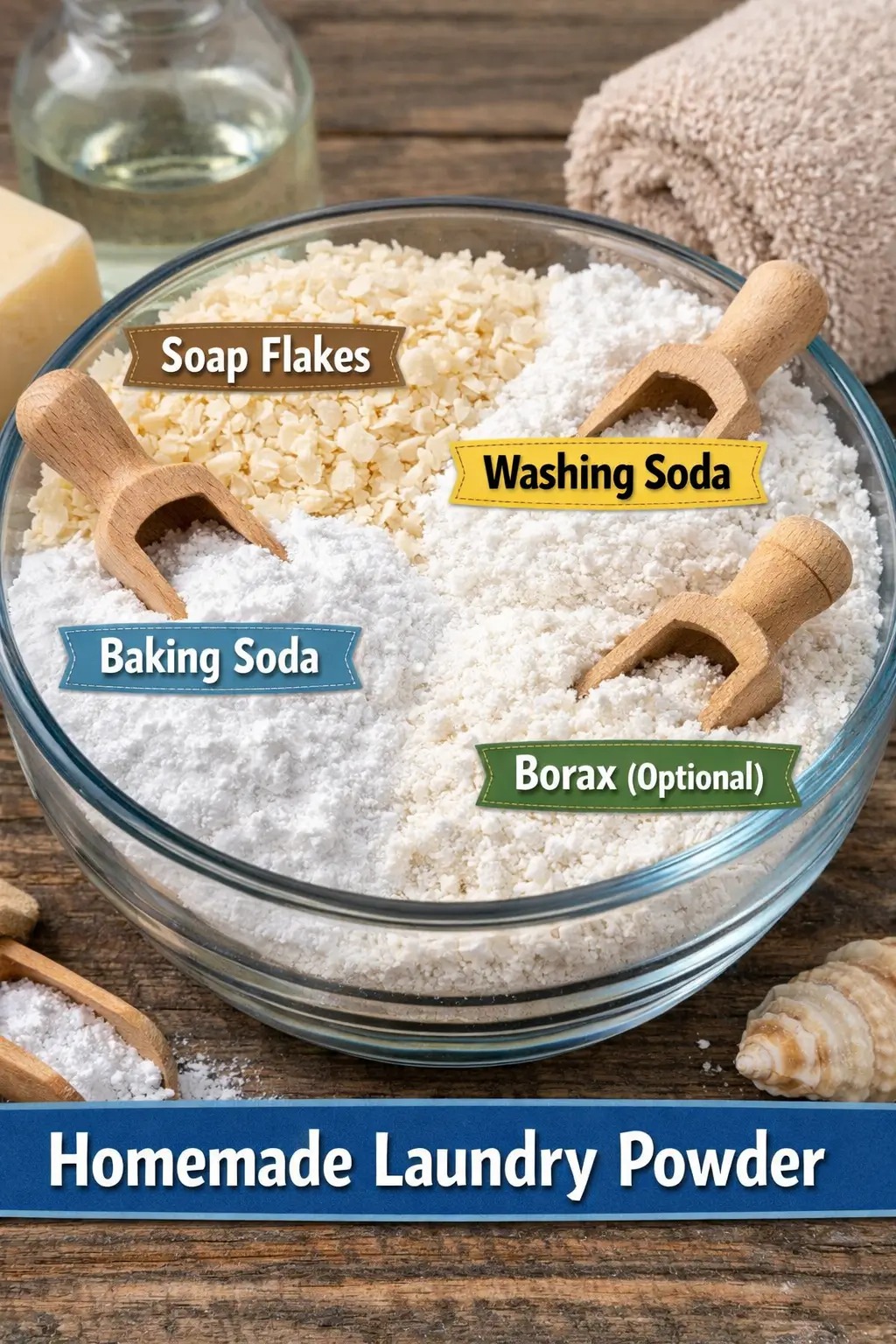
What Is Homemade Laundry Powder
It is a dry detergent system assembled from powdered or granulated ingredients rather than manufactured surfactant blends. Unlike liquid formats, powder formulations rely on physical dispersion and dissolution during the wash cycle. This difference affects stability, dosing behavior, and residue risk.
Most home-mixed detergent powder recipes combine a soap-derived cleaning agent with alkaline salts that raise wash pH, similar to the ingredient structure outlined in ingredient formulations Guide. In practice, this means cleaning occurs through grease breakdown and soil release rather than sustained soil suspension. In several household wash tests, powder systems showed acceptable results on lightly worn cotton garments but struggled when fabrics carried oily residues or were washed in cold water.
| Characteristic | Observed Range |
|---|---|
| Physical form | Dry granules or fine powder |
| Primary cleaning action | Soap precipitation with alkalinity |
| Storage stability | High when kept dry |
| Dissolution behavior | Variable by water temperature |
Why People Choose Homemade Laundry Powder
Interest in soap-based dry formulations is driven largely by storage convenience and perceived simplicity. Powder formats avoid separation issues common in liquid homemade detergents and can be prepared in advance without Preservatives. From a practical standpoint, powders are easier to transport, measure, and store in humid climates.
That said, convenience does not equal performance. Powder systems demand careful formulation balance. In observed usage patterns, overdosing powder detergents is more common than underdosing, particularly when users rely on visual scoops rather than weight-based measures. This often leads to gritty residue on dark fabrics.
Powder System Components and Their Roles
Understanding this non-commercial powder requires separating ingredient function from popular naming. The same ingredient may appear in multiple recipes, but its role remains consistent across formulations.
| Ingredient Category | Typical Function |
|---|---|
| Soap particles | Primary soil removal |
| Washing soda | Alkalinity and grease breakdown |
| Baking soda | Odor moderation and mild alkalinity |
| Borax (optional) | Water hardness interaction |
Performance Basics
Performance outcomes depend heavily on wash conditions. Warm water improves dissolution and cleaning action, while cold water exposes the limitations of soap-based systems. Fabrics with synthetic fibers tend to retain residues more readily than natural cotton.
Across multiple use cases, powder detergents performed best when loads were small and rinse cycles were extended. This pattern explains why some users report excellent results while others abandon homemade powder after repeated wash issues.
Recipes - Functional Classifications
This recipes fall into a small number of functional patterns rather than endless variations. While ingredient names change, most dry formulations behave similarly once exposed to water. Understanding these patterns helps explain why some powders work acceptably and others fail under the same conditions.
Instead of listing step-by-step instructions, it is more accurate to classify recipes by how they clean. In practice, nearly all such recipes rely on soap-derived solids for soil removal, supported by alkaline salts that raise wash pH. The proportions influence residue risk far more than the ingredient list itself.
| Recipe Class | Primary Behavior | Typical Performance Outcome |
|---|---|---|
| Soap-dominant powder | High soap content, moderate alkalinity | Good on light soils, high residue risk |
| Alkaline-boosted powder | Soap plus washing soda emphasis | Improved grease removal, fabric stress risk |
| Balanced powder | Soap, washing soda, and mild modifiers | Most stable results in warm water |
Homemade Laundry Powder With Baking Soda vs Borax
baking soda and borax serve different roles and are not interchangeable. Baking soda contributes mild alkalinity and odor control, while borax interacts with minerals in wash water. Their impact on cleaning performance is secondary to soap concentration.
Homemade laundry powder with baking soda tends to dissolve more predictably and leaves less mineral residue. However, its cleaning boost is limited. Borax-containing powders can perform better in moderately hard water but increase the chance of insoluble deposits when overdosed. In several wash cycles observed over time, borax-heavy powders left faint haze on dark fabrics, especially when cold water was used.
| Parameter | Baking Soda | Borax |
|---|---|---|
| Primary role | Odor moderation, mild alkalinity | Water interaction, alkalinity support |
| Residue risk | Low | Moderate when overdosed |
| Cold water behavior | More predictable | Less consistent |
| Fabric impact | Gentler overall | Can increase stiffness over time |
Homemade Powder Without Borax
Without borax is easier to control and generally safer for modern washers. These formulations rely on simpler chemistry and reduce the likelihood of mineral buildup inside machines.
In practice, no-borax powders trade peak cleaning power for predictability. They are better suited for frequent, low-soil washing rather than heavy-duty cleaning. One consistent observation is that no-borax systems rinse more cleanly, particularly in HE washers where water volume is limited.
| Aspect | Observed Behavior |
|---|---|
| Rinse clarity | High |
| Residue accumulation | Lower than borax-based powders |
| Cleaning strength | Moderate |
| Washer compatibility | Better for HE machines |
Performance Characteristics of More Stable Homemade Powder Systems
It is not the strongest one, but the most stable and predictable. Recipes that prioritize controlled alkalinity and clean rinsing outperform aggressive blends over time.
In side-by-side comparisons, balanced powders with restrained soap levels showed fewer long-term fabric issues. Users often perceive these formulations as weaker at first, but repeated washes reveal steadier results and fewer washer maintenance problems. This distinction is important when evaluating claims around the best homemade laundry detergent powder.
Make Homemade Laundry Powder - Process Logic Without Steps
It is less about the act of mixing and more about controlling particle size, ingredient distribution, and dissolution timing. Most failures attributed to poor recipes are actually caused by uneven grinding, inconsistent blending, or inappropriate dosing rather than ingredient choice.
Dry powders function only when water can reach and dissolve their active components during the wash. Large soap flakes dissolve slowly and often incompletely, especially in cold or short cycles. In practical use, powders composed of finer, more uniform particles consistently outperform coarse blends. In one household comparison, two powders with identical ingredients produced noticeably different results solely due to grind size.
| Process Factor | Observed Impact |
|---|---|
| Particle size | Smaller particles dissolve more completely |
| Blend uniformity | Reduces overdosing and residue |
| Moisture exposure | Causes clumping and uneven dosing |
| Wash temperature | Higher temperatures improve activation |
Dosing Accuracy and Measurement Errors
Dosing errors are the most common cause of residue and fabric stiffness when using homemade laundry powder. Because powders lack flow aids and density control, volume-based scoops introduce significant variation between loads.
In practice, a loosely packed scoop can contain up to 40 percent less material than a compacted one. This variability explains why some users experience inconsistent cleaning from the same powder batch. Residue complaints increase sharply when powders are measured visually rather than by weight.
| Error Type | Resulting Issue |
|---|---|
| Overdosing | Fabric stiffness, washer residue |
| Underdosing | Incomplete soil removal |
| Inconsistent scooping | Variable wash results |
| Cold-water overdosing | Undissolved particles on fabric |
Stability, Storage, and Shelf-Life of Laundry Powders
This powder is chemically stable but physically fragile. While the ingredients themselves do not degrade quickly, environmental moisture can compromise performance within weeks.
Powders stored in humid conditions tend to absorb moisture, leading to clumping and uneven dosing. Once clumped, the internal composition becomes inconsistent, even if the powder is later broken apart. In one observation, a powder stored near a washing machine lost uniformity after less than a month due to repeated humidity exposure.
| Storage Factor | Impact on Powder |
|---|---|
| Humidity | Clumping and density variation |
| Container type | Airtight containers preserve flow |
| Temperature swings | Minor impact compared to moisture |
| Shelf life | 6–12 months if kept dry |
Cold Water Limitations of Homemade Laundry Powder
It performs poorly in cold water compared to commercial detergent powders. Soap-based particles require heat to dissolve effectively, and cold cycles reduce their cleaning contribution.This limitation is often misinterpreted as a recipe flaw. In reality, it reflects the chemistry of soap solids. Even finely ground powders leave traces in cold washes, particularly on dark or synthetic fabrics, reflecting the interaction between soap solids and minerals described in soap and hard water behavior. This explains why many users report acceptable results in warm cycles but disappointment when switching to energy-saving cold washes.
Safety Considerations
It is generally safe for household use when handled and dosed correctly, but it is less forgiving than commercial detergents. Safety issues arise not from toxicity but from alkalinity, residue buildup, and improper storage.
Most dry laundry powders rely on alkaline builders to support cleaning. These materials are not inherently dangerous, but they can irritate skin with repeated direct contact. In practical handling, skin dryness is more commonly reported during powder mixing than during laundering itself. This is why gloves are often advisable during preparation, even though finished wash water is heavily diluted.
| Aspect | Observed Behavior |
|---|---|
| Skin contact (dry powder) | Can cause dryness or irritation |
| Skin contact (wash solution) | Low risk when diluted |
| Inhalation risk | Dust inhalation possible during mixing |
| Storage safety | Must be kept sealed and dry |
Washer Compatibility and Long-Term Impact
This type of powder is least compatible with modern high-efficiency machines. A detailed compatibility analysis appears in the Homemade HE Detergent System Review . For a broader explanation of how low-water detergent systems function, see the HE Detergent System Overview . The low-water environment amplifies the structural weaknesses of soap-based powders, particularly residue formation and incomplete rinsing.
In front-load and HE machines, limited rinse volumes make it difficult to fully remove insoluble soap residues. Over time, this residue can accumulate in door seals, pump filters, and outer tubs. Users often attribute odors or drainage issues to the machine itself, when the underlying cause is incomplete rinsing of soap solids.
| Washer Type | Compatibility Level | Primary Concern |
|---|---|---|
| Top-load (high water) | Moderate | Residue manageable with rinsing |
| HE top-load | Low | Limited dilution |
| Front-load | Low | Seal and drum buildup |
Performance Boundaries and Realistic Expectations
This laundry powder works best for lightly soiled cotton fabrics washed in warm water. Outside these conditions, performance drops quickly.
Soap-based powders remove soils by emulsification and mechanical agitation rather than sustained suspension. This means soils can redeposit if rinse conditions are inadequate. In side-by-side wash observations, powder systems consistently struggled with synthetic blends and oily soils compared to commercial detergents.
| Use Case | Observed Performance |
|---|---|
| Cotton, warm water | Good |
| Cold water washing | Poor |
| Synthetic fabrics | Inconsistent |
| Heavy grease stains | Weak without pretreatment |
Homemade Laundry Powder vs Commercial Detergent Powders
Homemade prioritizes simplicity and cost control, while commercial powders prioritize consistency and broad compatibility. Neither approach is universally superior.
Commercial detergent powders contain engineered surfactants, builders, and flow aids designed to remain stable across water types and machine designs. Homemade powders lack these stabilizers, which explains their narrower performance window, a pattern documented across multiple systems in the homemade laundry detergents analysis. In real-world use, this difference becomes apparent when washing mixed fabric loads or using energy-efficient cycles.
| Factor | Homemade Powder | Commercial Powder |
|---|---|---|
| Ingredient transparency | High | Moderate |
| Cleaning consistency | Variable | High |
| Cold water performance | Low | Good |
| Machine compatibility | Limited | Broad |
Handling, Storage & Practical Use Notes
This type of powder should be handled like a concentrated cleaning material, not a finished consumer detergent. Safe use depends more on storage and dosing discipline than on the formula itself.
Dry powders are hygroscopic to varying degrees. Exposure to moisture leads to clumping, uneven dosing, and reduced cleaning reliability. Across multiple batch comparisons over seasonal humidity changes, powders stored in vented containers lost flowability within weeks, while sealed containers maintained consistency for months.
| Factor | Recommended Practice |
|---|---|
| Container type | Airtight plastic or glass |
| Humidity exposure | Minimize |
| Measuring method | Dedicated scoop |
| Shelf life | 6–12 months when dry |
Use-Case Suitability Boundaries
homemade laundry powder performs most predictably in contexts involving value ingredient simplicity and light-duty washing. It is not ideal for households relying on modern low-water machines or washing heavily soiled mixed fabrics.
Users with older top-load machines, moderate water hardness, and predictable laundry loads tend to report the most stable results. Conversely, households with HE front-load machines, synthetic-heavy wardrobes, or cold-water-only routines often experience inconsistent outcomes.
Summary of Findings
- Homemade Laundry Powder: A soap-based dry cleaning system with narrow performance boundaries.
- Best Use Case: Light soil, cotton fabrics, warm water, high-water machines.
- No-Borax & Baking Soda Options: Reduce alkalinity but also reduce cleaning strength.
- Machine Compatibility: Least compatible with HE and front-load washers.
- Expectation Management: Simplicity trades off against consistency and versatility.
References
- Smulders E. et al. Laundry Detergents. Wiley-VCH.
- American Cleaning Institute. American Cleaning Institute.
- U.S. EPA Safer Choice Program. U.S. EPA.