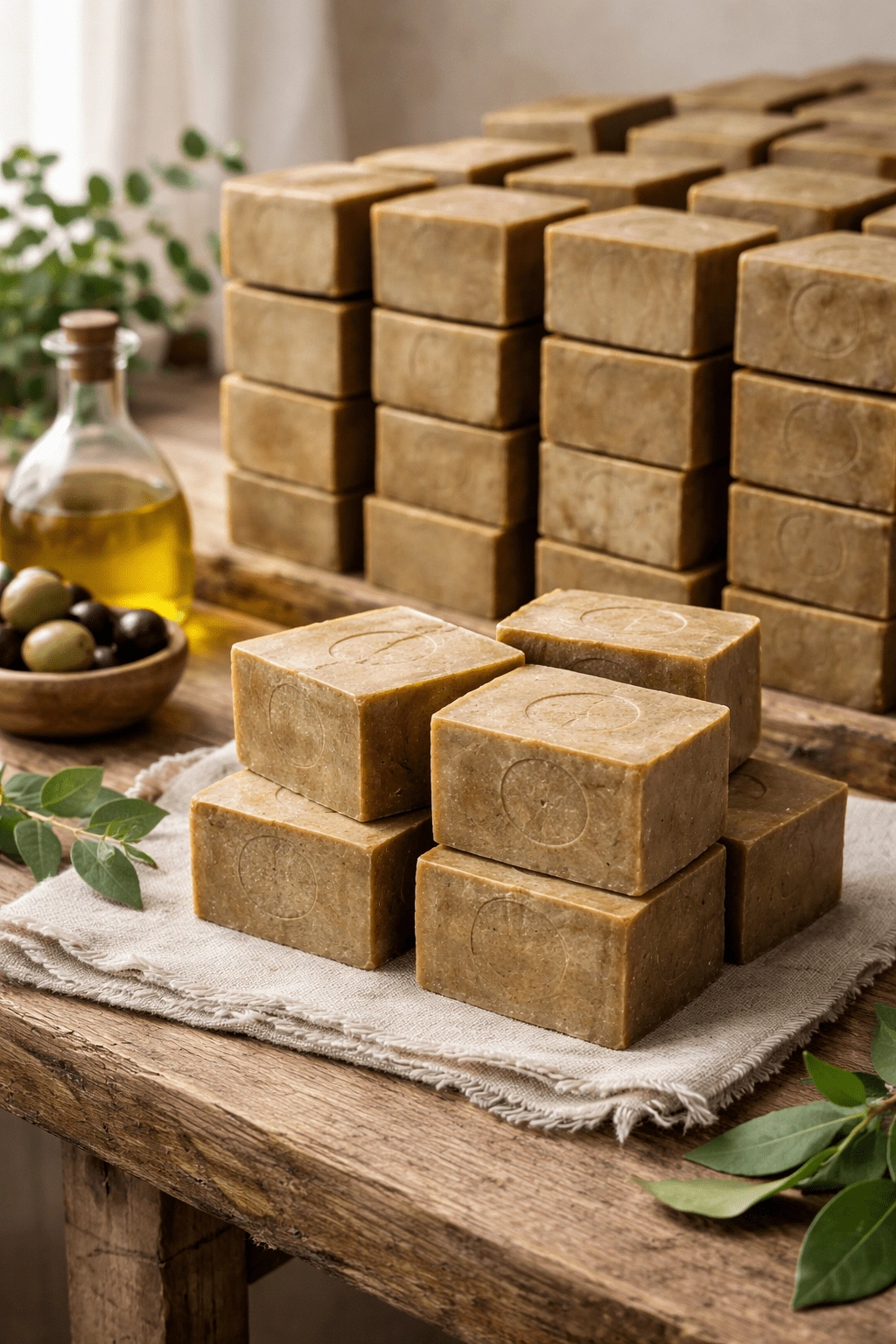
Historical & Cultural Context Of Aleppo Soap
Aleppo soap, also known as savon d'Alep, is widely regarded as one of the oldest solid soaps still produced today. Its origins trace back many centuries in the Levant, where olive cultivation and laurel harvesting shaped local cleansing traditions long before industrial soapmaking emerged.
Unlike modern soaps designed for uniformity and rapid production, traditional Aleppo soap developed around seasonal availability and extended curing. This historical constraint directly influences how the soap behaves today: density, hardness, and longevity are not accidental qualities, but structural outcomes of slow water evaporation and oil saponification.
In my experience handling cured Aleppo soap bars, the weight-to-size ratio alone signals how differently these soaps are built. They feel compact, almost stone-like when fully aged, a physical trait that modern mass-produced bars rarely replicate.
Traditional Aleppo Soap Production Process
Authentic Aleppo soap follows a cold-to-warm process that relies on large open kettles rather than closed reactors. Olive oil is cooked with an alkaline solution until saponification completes, after which laurel oil is added near the end of the process to preserve its characteristics.
Once poured, the soap mixture is leveled, cut by hand or frame, and stacked into tall ventilated towers for curing. This curing phase commonly lasts between 6 and 12 months, during which moisture content gradually drops and the soap hardens.
| Stage | Duration | Functional Outcome |
|---|---|---|
| Oil Cooking | Several hours | Complete saponification |
| Pouring & Cutting | 1–2 days | Initial shape formation |
| Curing | 6–12 months | Hardness, stability, longevity |
A subtle but important observation: bars cured for shorter periods often feel softer and dissolve faster, even ifingredient lists appear identical. Cure time is a performance variable that labels rarely disclose clearly.
Core Aleppo Soap Ingredients & Functional Roles
Aleppo soap ingredients are intentionally minimal. At its simplest, traditional Aleppo soap contains olive oil, laurel oil, water, and an alkaline agent consumed during saponification. The functional behavior of the soap depends largely on the ratio between olive and laurel oils, a relationship examined in detail in the olive oil–dominant Aleppo soap analysis.
| Ingredient | Typical Percentage Range | Functional Contribution |
|---|---|---|
| Olive Oil | 60–90% | Base cleansing, mildness, bar longevity |
| Laurel Oil | 5–40% | Cleansing strength, aroma, firmness |
| Water | Evaporates during curing | Processing medium |
One common misconception is that higher laurel oil automatically means a better soap, a belief examined further in the benefits and side-effects analysis. In practice, higher percentages increase cleansing strength, but they also reduce softness and can amplify dryness if used frequently.
Aleppo Soap Laurel Oil Percentage Explained (5%–40%)
Laurel oil percentage is the single most influential variable in Aleppo soap performance. It directly alters cleansing strength, surface feel, aroma intensity, and long-term tolerance. Despite this, many buyers interpret laurel percentage as a linear quality scale, which often leads to mismatched expectations.
In formulation terms, olive oil provides the structural backbone of the bar, while laurel oil acts as a functional modifier. As laurel content increases, the soap becomes more assertive in oil removal, firmer in texture, and more aromatic. The trade-off is reduced softness during repeated use.
| Laurel Oil % | Cleansing Strength | Bar Hardness | Daily Use Tolerance | Typical Use Pattern |
|---|---|---|---|---|
| 5–10% | Low–Moderate | Medium | High | General body & face use |
| 20% | Moderate | Medium–High | Moderate | Mixed skin, alternating use |
| 30% | Moderate–High | High | Selective | Targeted cleansing |
| 40% | High | Very High | Low | Occasional or specific needs |
In several usage cycles, soaps at 30% laurel oil felt notably more efficient but required shorter contact time. At 40%, the bar becomes functionally closer to a cleansing treatment step rather than a daily soap.
Aleppo Soap Smell, Texture & Sensory Profile
Aleppo soap smell is often misunderstood. It is not a fragrance in the conventional sense, but a direct result of laurel oil content and long curing. Freshly cut bars tend to smell sharper and greener, while fully cured soaps develop a softer, drier aroma.
Higher laurel oil percentages intensify the herbal, slightly medicinal scent. This aroma fades gradually with exposure to air, which is why older bars often smell milder than newly purchased ones.
| Characteristic | Low Laurel (≤10%) | Medium Laurel (20–30%) | High Laurel (40%) |
|---|---|---|---|
| Aroma Intensity | Subtle, olive-forward | Herbal, balanced | Strong, laurel-dominant |
| Bar Texture | Smooth | Dense | Very compact |
| Lather Feel | Soft, low foam | Controlled, creamy | Minimal, direct |
One practical observation: users sensitive to scent often tolerate low-laurel bars better, even though the ingredient list is technically simpler. Sensory response matters as much as formulation.
Authentic Aleppo Soap vs Non-Traditional Variants
Authentic Aleppo soap follows a narrow definition: olive oil base, laurel oil addition, long curing, and minimal ingredient intervention. Products labeled "Aleppo-style" or "inspired" often diverge in ways that materially affect performance.
Common deviations include added fragrances, shortened curing, or the inclusion of additional oils to soften texture. These changes are not inherently negative, but they shift the soap away from traditional behavior.
| Indicator | Traditional Aleppo Soap | Modified Variants |
|---|---|---|
| Ingredient Count | Very limited | Extended lists |
| Curing Duration | 6–12 months | Weeks to months |
| Bar Color | Brown exterior, green interior | Uniform color |
| Density | High | Variable |
A personal handling note: authentic bars tend to sound almost ceramic when tapped together. Softer bars usually indicate either low cure time or formulation changes.
Aleppo Soap Bar vs Liquid Aleppo Soap
Aleppo soap is traditionally a solid bar, but liquid adaptations have become more common. These liquid versions reinterpret the formula rather than replicate traditional structure.
Liquid Aleppo soap typically relies on diluted soap paste and stabilizers to maintain pourability. This changes lather behavior, shelf stability, and often reduces the impact of long curing.
| Aspect | Aleppo Soap Bar | Liquid Aleppo Soap |
|---|---|---|
| Curing Influence | Critical | Minimal |
| Longevity | Very high | Moderate |
| Texture Control | Natural | Adjusted |
| Traditional Alignment | High | Low–Moderate |
Liquid formats may suit convenience-oriented users, but they should not be evaluated as direct equivalents to traditional Aleppo soap bars.
Aleppo Soap For Face Use: Behavior, Limits & Practical Fit
Aleppo face soap behaves differently from modern facial cleansers, largely because it is a true soap rather than a surfactant-based wash, a distinction explored in the soap versus syndet cleanser comparison. On facial skin, this distinction matters more than ingredient simplicity alone. The soap cleans efficiently, but its interaction depends on laurel oil percentage, contact time, and follow-up care.
In short, low to moderate laurel formulations (5–20%) tend to be better tolerated on the face. Higher laurel content increases oil removal, which can feel effective initially but less forgiving with frequent use.
| Laurel Oil % | Facial Tolerance | After-Rinse Feel | Recommended Frequency |
|---|---|---|---|
| 5–10% | High | Soft, balanced | Daily |
| 20% | Moderate | Clean, slightly taut | Once daily or alternate days |
| 30–40% | Low | Very clean, dry | Occasional only |
A small but practical observation: when used on the face, Aleppo soap performs better with brief lathering rather than prolonged massage. Shorter contact reduces tightness without compromising cleansing.
Aleppo Soap & Acne-Prone Skin: Performance-Based View
The question "is Aleppo soap good for acne" appears frequently, but it is often framed in medical terms that the soap itself does not support. From a performance standpoint, Aleppo soap can reduce surface oil and remove buildup effectively.
In several observational use cycles, soaps with moderate laurel content improved the feel of congested skin by reducing residue and shine. However, overuse or high-laurel variants sometimes increased dryness, which can create new comfort issues.
| Usage Pattern | Observed Effect | Limitation |
|---|---|---|
| Low Laurel, Short Contact | Cleaner surface feel | Requires moisturization |
| High Laurel, Frequent Use | Strong oil removal | Increased tightness |
In practical terms, Aleppo soap works best as a cleansing step, not as a solution in itself. Results depend heavily on moderation and follow-up care.
Aleppo Soap For Hair: Cleansing Power & Adjustment Period
Aleppo soap for hair is one of its most debated uses. As a true soap, it interacts with scalp oils and hard water differently than modern shampoos.
In early use, hair often feels heavier or coated. This effect typically diminishes over time as users adjust rinsing technique or alternate with other cleansing methods. Laurel content again plays a central role: higher percentages remove oil more aggressively, while lower percentages feel gentler but may leave residue in hard water.
| Laurel % | Scalp Cleanliness | Hair Feel After Drying | Adjustment Time |
|---|---|---|---|
| 5–10% | Moderate | Soft, sometimes flat | Short |
| 20–30% | High | Clean, slightly dry | Moderate |
| 40% | Very High | Dry, squeaky | Long |
A real-use note: hair performance varies dramatically with water hardness, a behavior explained in the soap and hard water interaction guide. In softer water, Aleppo soap rinses cleaner and feels more manageable.
Aleppo Soap For Sensitive Skin: When It Works & When It Doesn’t
Aleppo soap for sensitive skin is often recommended because of its minimal ingredient list. While simplicity reduces exposure to additives, soap chemistry itself can still challenge sensitive skin if misused.
Lower laurel formulations are generally better tolerated, especially when paired with immediate moisturizing. High-laurel bars, despite being "natural," can overwhelm sensitive skin through excessive oil removal.
| Laurel % | Tolerance Level | Recommended Use |
|---|---|---|
| ≤10% | High | Regular use possible |
| 20% | Moderate | Alternate days |
| ≥30% | Low | Avoid or limit |
A consistent pattern: users with sensitive skin who report positive experiences tend to reduce contact time rather than switching products entirely.
Aleppo Soap Before And After: Realistic Expectations
Aleppo soap before and after comparisons are often described in dramatic terms, but real-world changes are usually gradual. Most differences relate to surface feel, oil balance, and how the skin responds to fewer added ingredients.
In the first week, many users notice increased dryness or tightness. By the second or third week, this often stabilizes if usage frequency and laurel percentage are appropriate.
| Time Frame | Common Observation |
|---|---|
| Days 1–5 | Tightness, learning curve |
| Week 2 | More balanced feel |
| Week 3+ | Stable response if suited |
One limitation to acknowledge: Aleppo soap does not suit every skin or hair type, and discontinuation is sometimes the most rational outcome.
Is Aleppo Soap Antibacterial? A Functional Clarification
The question "is Aleppo soap antibacterial" appears frequently, often framed as a yes-or-no claim. From a formulation and performance perspective, Aleppo soap does not function as an antibacterial product in the regulated sense. It does not contain added antibacterial agents, nor is it designed to meet disinfectant performance standards.
What Aleppo soap does provide is effective physical cleansing. As a true soap, it removes surface debris, oils, and microorganisms through mechanical action and rinsing. This distinction matters: removal is not the same as targeted antibacterial activity.
| Aspect | Aleppo Soap | Antibacterial Products |
|---|---|---|
| Primary Mechanism | Physical removal | Chemical inhibition |
| Added Actives | None | Present |
| Regulatory Claims | Not applicable | Required |
Laurel oil does contribute to the soap’s assertiveness, but its role is best understood as enhancing cleansing strength, not as delivering a medicinal or antibacterial effect.
Aleppo Soap Side Effects & Common Misuse Patterns
Aleppo soap side effects are rarely intrinsic to the soap itself. In most observed cases, discomfort arises from mismatched laurel percentage, excessive frequency, or prolonged contact time.
The most common side effect is dryness, often linked to alkaline cleansing patterns explained in the soap pH behavior guide, particularly with higher laurel oil formulations. This dryness often appears first around thinner skin areas such as the cheeks, temples, or scalp edges.
| Observation | Likely Cause | Adjustment Strategy |
|---|---|---|
| Tightness after rinsing | High laurel %, long contact | Reduce time or % |
| Flaky feel | Overuse | Lower frequency |
| Dull hair texture | Hard water interaction | Alternate cleansing |
A practical insight: users who treat Aleppo soap like a modern gel cleanser tend to report more issues than those who adapt technique.
Aleppo Soap vs Castile Soap: Technical & Practical Differences
Aleppo soap vs Castile soap comparisons are common, as both are olive-oil-based traditional soaps. Despite shared roots, their behavior diverges due to differences in oil composition and curing.
Castile soap is typically made from olive oil alone, sometimes diluted into liquid form. Aleppo soap adds laurel oil, increasing cleansing strength and firmness.
| Feature | Aleppo Soap | Castile Soap |
|---|---|---|
| Base Oils | Olive + laurel | Olive only |
| Cleansing Strength | Adjustable via laurel % | Mild |
| Bar Hardness | High (long cure) | Moderate |
| Hair Use | Variable, water-dependent | Often easier rinse |
In practical use, Castile soap often feels gentler out of the box, while Aleppo soap offers more tuning flexibility through laurel content. Neither is universally superior; they serve different usage preferences.
Product Labels, Claims & Buyer Interpretation
Aleppo soap labels often emphasize terms like "authentic," "organic," or specific laurel oil percentages. These descriptors are useful but incomplete without context about curing duration and production method.
A bar labeled "Aleppo soap 30% laurel oil" can still vary widely in performance depending on cure time. Two soaps with identical percentages may behave differently if one has cured for three months and the other for a year.
| Label Element | What It Indicates | What It Misses |
|---|---|---|
| Laurel % | Cleansing strength trend | Actual harshness level |
| Organic Claim | Source of oils | Final bar behavior |
| Authentic | Traditional intent | Quality consistency |
A restrained buyer mindset helps: treat labels as directional cues, not guarantees of personal suitability.
How To Use Aleppo Soap: Practical, Non-Medical Guidance
Aleppo soap performs best when used with restraint and intention. Unlike modern cleansers designed for extended lathering, this soap benefits from short contact time and thorough rinsing. Small adjustments in technique often matter more than changing the bar itself.
| Use Area | Method | Contact Time | Notes |
|---|---|---|---|
| Face | Light lather in hands, apply briefly | 10–20 seconds | Prefer ≤20% laurel oil |
| Body | Direct bar or washcloth | 20–40 seconds | Adjust frequency by dryness |
| Hair | Occasional use, full rinse | Short | Water hardness sensitive |
One practical observation from repeated use: letting the bar dry completely between uses significantly extends lifespan and improves consistency of lather over time.
Choosing Aleppo Soap: Functional Comparison Framework
Selecting Aleppo soap works best when framed as matching cleansing strength to actual use patterns rather than chasing maximum laurel percentages. The table below consolidates functional differences to support realistic selection.
| User Priority | Recommended Laurel % | Form Factor | Caution |
|---|---|---|---|
| Daily face use | 5–10% | Bar | Avoid prolonged contact |
| General body cleansing | 10–20% | Bar | Monitor dryness |
| Occasional deep cleansing | 30–40% | Bar | Not daily |
| Convenience & dispensing | Variable | Liquid | Less traditional behavior |
A restrained conclusion: higher laurel oil does not equal higher quality for most users. Fit and frequency determine satisfaction more reliably.
Summary of Findings
- Traditional Structure: Aleppo soap is a cured olive-and-laurel oil soap with behavior shaped by long aging.
- Laurel Percentage Matters: 30%–40% bars cleanse strongly but are not suited to frequent use.
- Technique Over Claims: Contact time and frequency influence comfort more than labels.
- Not Antibacterial: Cleans by physical removal, not targeted antimicrobial action.
- Not Universal: Aleppo soap suits many routines, but discontinuation is sometimes the right outcome.
References
- Journal of Surfactants and Detergents – Traditional Soap Chemistry
- International Journal of Cosmetic Science – Soap pH & Skin Interaction
- European Commission CosIng Database – Ingredient Profiles
- Regulation (EC) No 1223/2009 – Cosmetic Product Framework