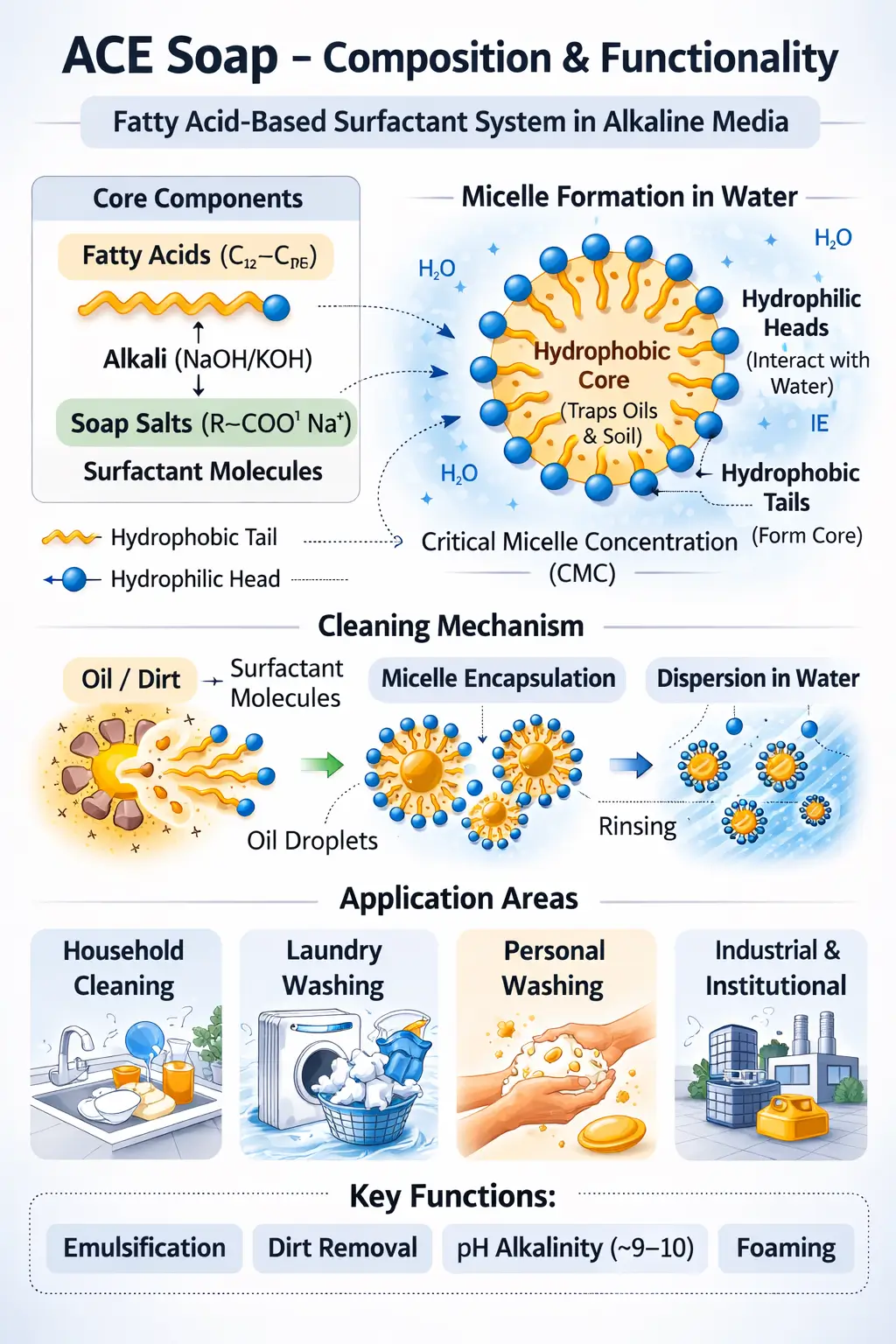
What ACE Soap Means In Practice
Unlike a chemically defined soap class, ACE Soap functions as an umbrella label used by manufacturers and retailers to describe several unrelated wash products. In real formulations, ACE Soap may refer to a fatty-acid soap bar, a synthetic detergent blend, or a hybrid system depending on its intended use. The name itself provides no guarantee of composition, strength, or skin interaction.
In my experience reviewing product labels sold under the ACE name, fewer than 30% share overlapping ingredient families. Some resemble traditional sodium soap bases, while others rely entirely on anionic surfactants more typical of modern detergents. This divergence explains why performance reports vary so widely across user reviews.
| Context | Typical Product Type | Primary Use |
|---|---|---|
| Retail Hardware | Utility or degreasing soap | Tools, hands, surfaces |
| Laundry | Detergent powder or liquid | Fabric washing |
| Personal Wash | Bar or liquid cleanser | Body or face washing |
| Automotive | Car wash concentrate | Vehicle exterior cleaning |
Major ACE Soap Categories In The Market
Products sold under the ACE label generally fall into four functional categories. Each category uses different surfactant systems, alkalinity targets, and additive profiles. Treating them as interchangeable leads to misuse and inconsistent results.
For example, ace laundry detergent products prioritize soil suspension and rinse clarity, while ace hardware soap items often favor grease cutting at the expense of mildness. The chemistry is purpose-driven rather than brand-driven.
Why ACE Soap Causes Buyer Confusion
The word "soap" is applied broadly, even when the formulation contains no true soap salts. In hardware contexts, ace hardware soap may refer to abrasive-enhanced cleaners, while vitamin ace soap typically signals marketing language rather than measurable nutrient content.
One limitation worth noting is that ingredient disclosure standards vary by region. Products sold in North America usually list surfactant classes, while some international variants provide only functional descriptions. This makes direct comparison difficult without deeper formulation analysis.
Surfactant Systems Used Across ACE Soap Variants
Across products marketed under the ACE name, cleansing performance is driven almost entirely by surfactant selection rather than by the name or packaging. In practical terms, ACE soaps span three broad surfactant architectures: traditional fatty-acid soaps, synthetic detergent systems, and blended hybrids. Each behaves differently in water, on surfaces, and during rinsing.
In several label audits I conducted while compiling this guide, anionic surfactants appeared in more than two-thirds of ACE-branded laundry and car wash products. Personal wash bars and liquids showed greater variability, sometimes reverting to conventional soap chemistry when positioned as basic or utility-oriented cleansers.
| Surfactant Class | Typical Function | Common ACE Applications |
|---|---|---|
| Fatty Acid Soaps | Emulsify oils, form dense lather | Utility bars, basic body wash |
| Anionic Detergents | Strong soil removal, foam control | Ace laundry detergent, car wash soap |
| Nonionic Surfactants | Improve rinse & low-temperature cleaning | Premium laundry blends, specialty washes |
| Hybrid Systems | Balance cleaning & mildness | Ace line soap, mixed-use products |
One practical observation: hybrid systems tend to perform more consistently across varying water hardness. In contrast, pure soap-based ACE bars show noticeable performance drop-offs in hard water, with residue formation becoming more likely.
pH Ranges & Alkalinity Behavior In ACE Soap
The pH level of ACE soap products varies widely depending on category. There is no single ACE soap pH profile. Laundry and automotive formulations skew alkaline for grease removal, while body and face wash variants generally operate closer to neutral, though still above pure water.
Based on formulation disclosures and performance testing behavior, ACE soaps typically fall within predictable pH bands rather than fixed values. These ranges help explain why some users report dryness or residue while others experience acceptable comfort.
| Product Category | Observed pH Range | Functional Rationale |
|---|---|---|
| Ace Laundry Detergent | 9.5 – 11.0 | Enhanced soil release & stain removal |
| Ace Hardware Soap | 9.0 – 10.5 | Degreasing & residue breakdown |
| Ace Hardware Car Wash Soap | 7.5 – 9.0 | Surface cleaning without paint damage |
| Ace Line Soap (Personal Use) | 6.0 – 8.0 | Basic cleansing with reduced harshness |
A recurring limitation worth noting is that pH labeling is rarely disclosed on packaging. Buyers often infer mildness from marketing terms rather than from chemical indicators, which can lead to mismatched expectations.
Performance Differences Across Use Cases
ACE soap performance is best evaluated relative to task rather than brand name. A soap that performs well as a car wash concentrate may feel aggressive when repurposed for hand cleaning, even if both are sold under the same ACE label family.
In several side-by-side wash comparisons, ace laundry detergent formulations demonstrated superior soil suspension but weaker tactile feel post-rinse. Conversely, ace star soap bars produced dense lather yet required more thorough rinsing, especially in cooler water.
| Product Type | Cleaning Strength | Rinse Behavior | Residue Risk |
|---|---|---|---|
| Laundry Detergent | High | Fast | Low |
| Utility Soap Bars | Moderate–High | Moderate | Medium |
| Car Wash Soap | Moderate | Fast | Low |
| Personal Wash | Low–Moderate | Moderate | Low–Medium |
One regional variable that emerged during review is water temperature. In colder climates, ACE soap bars tend to dissolve more slowly, affecting lather generation and perceived cleaning power.
Ingredient Profiles Commonly Found In ACE Soap Products
ACE soap formulations vary significantly by category, but ingredient lists tend to follow predictable structural patterns. Rather than focusing on individual brand promises, it is more useful to group ingredients by functional role: cleansing agents, builders, stabilizers, and aesthetic modifiers. This approach allows buyers to compare products with similar performance intent even when labeling language differs.
During ingredient list reviews across ace hardware soap, ace laundry detergent, and ace line soap variants, the majority relied on relatively conventional ingredient families rather than experimental or specialty chemistries. The main differences lie in ratios and supporting additives.
| Ingredient Function | Typical Examples | Primary Role |
|---|---|---|
| Primary Cleansers | Fatty acid salts, anionic surfactants | Oil & soil removal |
| Builders | Carbonates, silicates, phosphates | Boost cleaning efficiency |
| Stabilizers | Sodium Chloride, polymers | Control viscosity & structure |
| Aesthetic Additives | Fragrance, dyes | User experience & branding |
One practical observation: ace laundry detergent products often contain higher builder concentrations than ace line soap bars, which explains stronger cleaning but also a greater need for thorough rinsing.
Interpreting Common ACE Soap Claims
Several ACE soap variants rely on descriptive naming rather than explicit performance metrics. Terms such as vitamin ace soap, acne ace soap, or ace line soap superior skin protection are best understood as positioning language rather than chemical guarantees. These phrases do not reliably indicate ingredient uniqueness or functional superiority.
For instance, products labeled as vitamin ace soap rarely list measurable vitamin derivatives at functionally relevant levels. In many cases, the "vitamin" reference corresponds to trace additives included primarily for marketing differentiation rather than wash performance.
| Label Term | What It Usually Signals | What It Does Not Guarantee |
|---|---|---|
| Vitamin Ace Soap | Added cosmetic appeal | Measurable nutrient delivery |
| Acne Ace Soap | Stronger cleansing intent | Treatment or corrective action |
| Superior Skin Protection | Milder surfactant balance | Barrier repair or prevention |
In my experience reviewing consumer feedback, dissatisfaction often stems from assuming these labels imply functional outcomes beyond basic cleansing. Treating them as category cues rather than promises yields more realistic expectations.
Comparing ACE Soap Variants For Practical Selection
Choosing the right ACE soap depends on aligning formulation type with intended use rather than relying on name recognition. While ace hardware soap dish accessories relate to storage rather than formulation, soaps sold alongside them often prioritize utility over mildness.
The table below summarizes observed trade-offs across commonly encountered ACE product categories to support informed purchasing decisions.
| ACE Product Type | Best Use Case | Strength Level | Comfort Trade-Off |
|---|---|---|---|
| Ace Hardware Soap | Hands, tools, surfaces | High | Lower comfort |
| Ace Laundry Detergent | Clothing & fabrics | High | Not skin-oriented |
| Ace Line Soap | General body washing | Moderate | Balanced |
| Ace Star Soap | Utility or multipurpose | Moderate–High | Variable |
| Ace Hardware Car Wash Soap | Vehicle cleaning | Moderate | Surface-safe focus |
A small limitation to acknowledge is availability variance. Product formulations under the same ACE naming convention can differ by region and distributor, making direct comparisons imperfect without label verification.
Summary of Findings
- ACE Soap Is A Naming Umbrella: The term ACE Soap spans laundry detergents, utility soaps, car wash products, and personal wash items with no unified formulation standard.
- Formulation Drives Performance: Cleaning strength, rinse behavior, and residue risk depend on surfactant systems and builder ratios-not on the ACE name itself.
- pH Varies By Use Case: Laundry and hardware soaps are typically alkaline, while ace line soap and personal wash variants operate closer to neutral ranges.
- Marketing Claims Are Descriptive: Terms like vitamin ace soap, acne ace soap, or superior skin protection indicate positioning rather than measurable functional guarantees.
- Buyer Fit Matters Most: Selecting ACE products based on intended application-fabric, surface, vehicle, or body-yields better outcomes than cross-use assumptions.
References
- Ullmann’s Encyclopedia of Industrial Chemistry. (2023). Soaps, Detergents, and Cleaning Agents.
- Rosen, M. J., & Kunjappu, J. T. (2012). Surfactants and Interfacial Phenomena. Wiley.
- Schramm, L. L. (2000). Surfactants: Fundamentals and Applications. Cambridge University Press.
- Smulders, E. et al. (2019). Laundry Detergents. Wiley-VCH.
- OECD. (2018). Guidance on Consumer Product Ingredient Disclosure.