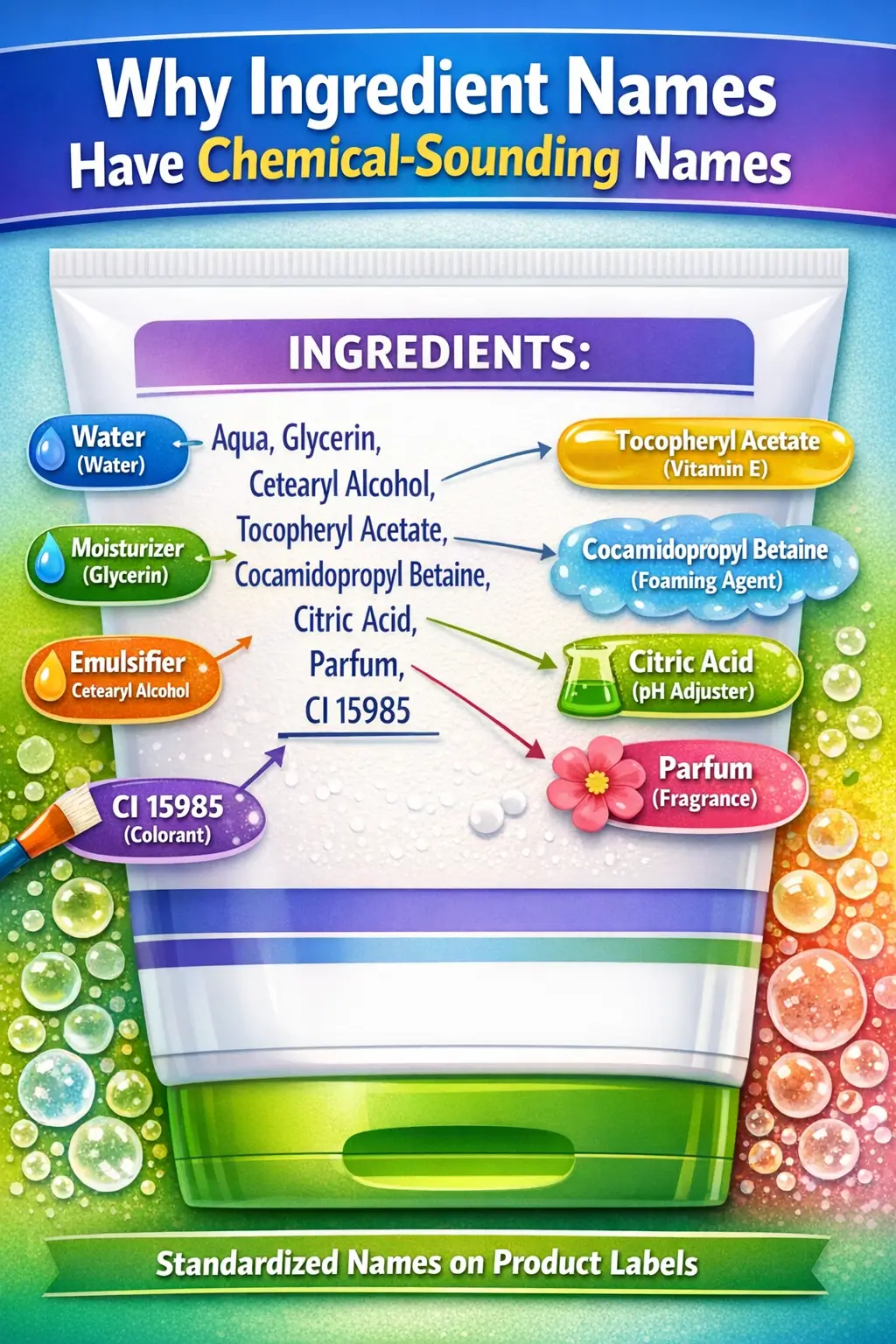
Precision Over Familiarity
The primary reason ingredient names appear chemical is that labels are designed to eliminate ambiguity. A name on a label must identify a substance in a way that remains consistent across languages, markets, and regulatory systems. Familiar or everyday names often fail to do this reliably.
For example, a single plant-derived material may be known by several common names depending on country, language, or trade usage. A standardized chemical or INCI name collapses those variations into one reference point. This choice favors traceability over approachability.
This can feel counterintuitive to consumers. A name that looks technical is often assumed to indicate complexity or artificiality. In reality, the formality of the name usually reflects documentation requirements rather than how the ingredient was sourced or processed.
Why Common Names Are Avoided
Common names are avoided on labels because they are imprecise, which is why broader reference material such as a soap ingredients guide is often needed to interpret what those names represent in practice, particularly when reviewing branded formulations such as the Zum soap ingredient breakdown or detailed listings like Charlie’s Soap ingredient composition. Terms such as oil, extract, or essence can describe a wide range of materials with very different compositions. Without further qualification, they do not provide enough information for regulators, suppliers, or auditors.
This is especially relevant in the European market, where products circulate across borders. A name that seems clear in one language may be misleading or incomplete in another. Standardized naming systems reduce that risk by anchoring labels to agreed definitions rather than cultural familiarity.
There is a practical consequence to this approach. Labels become less conversational and more technical, even when the ingredient itself is widely used or historically familiar. The unfamiliarity lies in the naming convention, not necessarily in the substance.
Chemical-Sounding vs Chemical
A frequent misunderstanding is that a chemical-sounding name indicates a synthetic or harsh substance, a confusion explored further in natural vs synthetic ingredients on labels. This assumption does not hold up when examined closely. All substances, whether derived from plants, minerals, or laboratory processes, can be described using chemical terminology.
The difference lies in representation, not category. Chemical naming describes structure or composition. It does not encode value judgments about origin, quality, or suitability. Two ingredients with very different names may behave similarly in a formulation, while two with similar-sounding names may not.
This distinction is rarely made explicit on labels. Regulations assume that names serve identification purposes only. Interpretation is left to the reader, which is where confusion often begins.
Formal Label Names And Common References
One source of confusion is the gap between how substances are named on labels and how they are referred to in everyday language. Formal ingredient names are designed to identify substances precisely, while common references often describe familiarity, origin, or historical use. These two naming approaches serve different purposes and are not interchangeable.
| Label Name | Common Reference | Why The Label Uses This Name |
|---|---|---|
| Sodium Chloride | Salt | Identifies the ionic compound in a standardized way, avoiding ambiguity across food, cosmetic, and industrial contexts. |
| Tocopherol | Vitamin E | Specifies the chemical form used in formulations, which may differ from dietary or supplement classifications. |
| Citric Acid | Citrus-derived acid | Describes functional acidity regulation rather than source material, which can vary by manufacturing process. |
| Glycerin | Glycerol | Uses the internationally recognized chemical name to ensure consistency across regulatory systems. |
| Cocamidopropyl Betaine | Coconut-derived surfactant | Indicates molecular structure and surfactant class rather than agricultural origin alone. |
These naming choices are not intended to simplify interpretation for consumers. They exist to ensure that the same substance is identified consistently across markets, languages, and regulatory frameworks. Familiar references may feel more approachable, but they often lack the precision required for labeling standards.
Why Standardized Naming Systems Exist
Ingredient names on European labels are shaped by standardized naming systems designed to reduce confusion across borders. The most visible of these is the INCI system, which assigns a single, fixed name to each recognized ingredient regardless of where it is sold or manufactured.
Under Regulation (EC) No 1223/2009, Article 19 requires cosmetic products to list ingredients using standardized nomenclature (INCI) in descending order of weight. This requirement governs how substances are identified on labels. The regulation mandates consistent naming for traceability and compliance, not familiarity or interpretive clarity.
This standardization solves a practical problem. Without it, the same substance could appear under different names in different countries, making comparison and oversight difficult. A standardized name allows regulators, suppliers, and manufacturers to speak the same language, even when consumers do not.
From a reader’s perspective, this can feel like over-formalization. The benefit is consistency rather than readability. Labels are optimized for traceability and verification first, and for interpretability only secondarily.
Natural Origin And Naming Format Are Separate Issues
Another common assumption is that natural ingredients should have natural-sounding names. In practice, origin and naming format are separate considerations. A material derived from a plant may still be listed under a name that reflects its chemical structure or processing stage.
This separation exists because origin alone does not uniquely identify a substance. Many materials can be derived from similar sources yet behave very differently once processed. Naming conventions focus on what the ingredient is at the point of use, not where it began.
As a result, a name that looks synthetic may still describe a material with a long history of use in food, soap, or personal care products. The unfamiliarity lies in the label language, not necessarily in the ingredient itself.
Where Labels Stop Explaining
Labels are not designed to explain why a naming system was chosen or how a reader should feel about it. Their role ends at identification. They do not provide background on chemistry conventions, regulatory history, or alternative naming options that were considered.
This creates a boundary that labels cannot cross without becoming interpretive. Explaining why a name sounds technical would require context, and context introduces judgment. Regulatory frameworks generally avoid that territory to maintain neutrality.
The limitation is structural rather than intentional. Labels communicate compliance, not education. Expecting them to resolve discomfort with unfamiliar language places demands on them they were never meant to meet.
Why Discomfort With Chemical Names Is Common
Discomfort often arises not from the ingredients themselves, but from the gap between everyday language and regulatory language. Most consumers rarely encounter formal chemical naming outside of labels, so the visual and linguistic contrast is sharp.
In everyday contexts, familiar materials are described by function or tradition. On labels, the same materials are described by identity. This shift can feel impersonal, even when nothing about the formulation has changed.
Over time, repeated exposure tends to reduce this friction. Consumers who regularly read labels often become more comfortable distinguishing between unfamiliar naming and unfamiliar substances. The learning curve exists, but it is not insurmountable.
Summary of Findings
- Names Prioritize Precision: Ingredient names sound chemical because they are designed to identify substances consistently across languages and markets.
- Origin And Naming Are Separate: A technical name does not indicate whether an ingredient is natural, synthetic, simple, or complex.
- Labels Have Clear Limits: Labels stop at identification and do not attempt to explain naming conventions or address reader discomfort.
- Familiarity Takes Time: Confusion often reflects unfamiliar language rather than unfamiliar ingredients.
Regulatory & Primary Sources
| Source | Authority | Relevance To This Article |
|---|---|---|
| Regulation (EC) No 1223/2009 – Article 19 | European Parliament & Council | Defines mandatory ingredient listing using standardized nomenclature (INCI). |
| Cosmetic Ingredient Naming Conventions (INCI System) | International Cosmetic Ingredient Dictionary | Establishes globally harmonized naming for cosmetic substances. |
| EU Market Surveillance & Labeling Guidance | European Commission | Clarifies identification requirements for consumer transparency. |