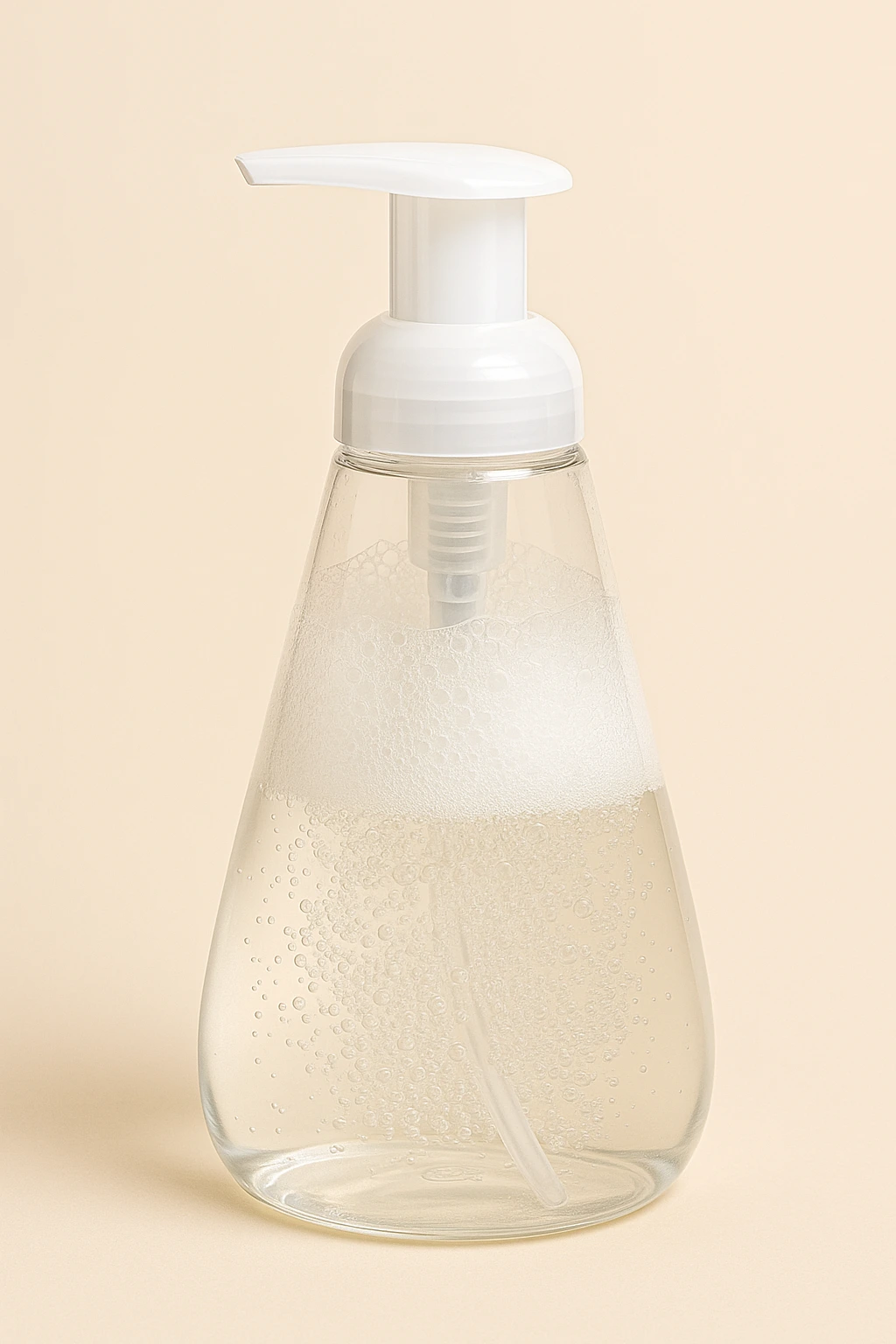
Understanding Method Foam Technology
Method foaming systems operate on a mechanical aeration mechanism rather than pressurized gas. The liquid inside the bottle is essentially a dilute surfactant mixture-usually between 8% and 12% total active surfactants-with the remainder being water, solvents, chelators, and humectants. When the pump head pulls liquid through a mesh plate, air is forced into the mixture at a 4:1 to 6:1 air-to-liquid ratio, producing a stable foam without propellants. Because of this, the viscosity target is intentionally low, averaging 1.0–1.3 cP, which is close to plain water.
Mechanical foam pumps require predictable fluid behavior. Therefore, the formulation avoids heavy thickeners such as high-molecular-weight celluloses. Instead, small amounts of polymeric stabilizers may be added (often below 0.3%), helping to maintain bubble retention time between 7 and 12 seconds on average before collapse. This ensures a consistent foam structure suitable for quick hand coverage.
| Parameter | Typical Range | Function |
|---|---|---|
| Air–Liquid Ratio | 4:1 to 6:1 | Determines foam density |
| Viscosity | 1.0–1.3 cP | Ensures proper pump flow |
| Surfactant Actives | 8–12% | Primary cleansing components |
| Bubble Retention | 7–12 seconds | Stability before collapse |
Ingredient Composition
This formulation generally follow a consistent structural formula: water, mild anionic or amphoteric surfactants, solvent systems for fragrance solubility, natural-derived emollients, and chelators for water hardness management. While individual scent variants differ, typical ingredient categories remain the same. The relative percentages listed below are generalized approximations from industry-standard foaming soap analysis, not brand-specific claims. Water hardness interactions are examined in detail in our soap residue and hard water guide.
| Component Category | Approx. Percentage | Chemical Purpose |
|---|---|---|
| Water | 65–75% | Primary solvent |
| Surfactants | 8–12% | Cleansing and foam formation |
| Solvents (e.g., ethanol, glycols) | 1–5% | Helps dissolve fragrance materials |
| Humectants | 1–3% | Reduces dryness sensation |
| Fragrance Blend | 0.2–1% | Aromatic profile |
| Plant Oils / Conditioners | 0.1–1% | Soft sensory finish |
| Chelators (e.g., tetrasodium glutamate diacetate) | 0.05–0.2% | Hard-water performance stability |
| Preservatives | 0.1–0.3% | Microbial control |
The surfactant system commonly contains a mild anionic paired with an amphoteric to improve foam stability. For example, a typical combination might include sodium lauryl sulfate in small concentrations balanced with Cocamidopropyl Betaine, generating a gentler cleansing profile through mixed micelle formation. These mixed micelles often exhibit reduced irritation potential, particularly in dilute foaming systems where surfactant aggregation numbers may fall between 50 and 80.
Surfactant Functionality
Surfactants in foaming hand soap perform several roles simultaneously: reducing surface tension, supporting air entrapment during pump actuation, and positioning themselves at the water–air interface to stabilize foam lamella. In Method-style formulations, the blend typically uses amphoteric surfactants as the backbone because amphoterics provide consistent foaming even when diluted extensively. Their zwitterionic nature allows them to maintain activity across a wide pH span of roughly 4.5 to 9.0. For a broader technical explanation of surfactant system design, see our liquid soap formulation systems guide.
The balance between anionic and amphoteric surfactants directly influences foam morphology. Anionic surfactants generate smaller, more numerous bubbles due to their stronger repulsive charge, whereas amphoterics create slightly larger bubbles that prolong collapse time. A 60:40 amphoteric-to-anionic ratio is often ideal for mechanical pumps because it yields foam that feels airy but remains coherent during hand rubbing.
| Surfactant Type | Typical Inclusion Range | Functional Notes |
|---|---|---|
| Anionic | 2–5% | Strong detergency and fine-bubble foam |
| Amphoteric | 5–8% | Stabilizes foam and reduces irritation potential |
| Nonionic | 0–3% | Boosts solubilization and fragrance clarity |
Because foaming soaps rely on physical foam generation rather than chemical thickening, viscosity contributions from surfactants must remain predictable. Certain nonionic surfactants can thicken at higher ratios, so they are typically kept low. The chosen system must also tolerate fragrance oils without destabilizing micelles. This is particularly important when producing variants like sweet water, grapefruit, or raspberry vanilla, which contain aromatic molecules with different polarities and solubility profiles.
Scent Variations
This formulation is available in several aromatic profiles derived from blended fragrance accords. The primary cleansing agents remain consistent across all versions, but the aromatic molecules differ, influencing volatility, solubility, and even foam stability. Some fragrances contain hydrophobic terpenes requiring slight formulation tweaks to ensure uniform dispersion.
Sea mineral versions often include fresh, marine-forward accords made from aldehydic materials and ozonic aromatics. Orange ginger varieties rely on limonene, gingerols, and warm citrus notes. Sweet, fruity combinations such as raspberry vanilla employ esters that provide roundness and perceived smoothness when lathering. Pink grapefruit and lavender are based on classic fragrance chemistry-lavender pulling from linalool and linalyl acetate, while grapefruit typically uses nootkatone derivatives.
| Scent Variant | Primary Aroma Materials | Aromatic Characteristics |
|---|---|---|
| Sea Minerals | Aldehydes, ozonic molecules | Fresh, marine, slightly metallic |
| Orange Ginger | Limonene, gingerols | Citrus warmth with spice |
| Lavender | Linalool, linalyl acetate | Floral with herbal notes |
| Grapefruit / Pink Grapefruit | Nootkatone, citrus terpenes | Crisp, bright citrus |
| Raspberry Vanilla | Berry esters, vanillin | Sweet and creamy |
| Sweet Water | Aquatic accords, light florals | Clean and soft |
Scent selection also affects how the surfactant system interacts with aromatic compounds. Hydrophobic terpenes may partition into micelles, altering micelle radius by a few nanometers. This can slightly modify foam height, typically within a ±5% range. Formulators adjust solubilizers and co-surfactants to maintain consistency without changing the cleansing character.
Refill Formulations
Refill versions of foaming hand soap follow the same general formulation principles but are packaged in higher-volume containers typically 828–1000 mL a format examined in more detail in the Method foaming hand soap refill guide. The goal is to maintain identical performance when transferred into a foam pump bottle. Refill packaging often uses low-density polyethylene or similar materials for flexibility, durability, and chemical compatibility with surfactants and fragrances.
Lavender, grapefruit, sweet water, raspberry vanilla, and pink grapefruit refills rely on matching aromatic profiles to maintain consistency with non-refill bottles. To achieve this, fragrance load percentages are kept consistent, but solubilizer ratios may be modified slightly to accommodate storage stability in larger containers. Temperature fluctuations during transport can influence fragrance solubility, so stabilizers are included to keep clarity uniform down to around 10°C.
| Attribute | Standard Bottle | Refill Pack |
|---|---|---|
| Volume | 250–300 mL | 828–1000 mL |
| Viscosity | 1.0–1.3 cP | 1.0–1.4 cP |
| Surfactant Consistency | Uniform | Uniform |
| Fragrance Stability | High | High with modified solubilizers |
Refill systems benefit from lower packaging waste because they use less plastic per milliliter of product delivered. The ratio of packaging weight to product weight decreases by approximately 25–35% when switching from individual bottles to refills.
Packaging Materials
Foaming hand soap relies on specific packaging characteristics to maintain performance. The bottle must pull liquid upward without resistance, meaning the internal geometry must be free of narrow constrictions. Clear PET is commonly used for regular bottles due to its optical clarity, while some lines use aluminum shells for aesthetics or durability. Aluminum versions require interior linings to prevent interaction between metal surfaces and fragrance components, which could otherwise cause oxidation.
The pump hardware contains a spring, mesh plate, piston chamber, and air channel. Stainless steel or coated steel springs resist corrosion from surfactants. The mesh plate hole size-typically around 100–200 microns-determines bubble diameter. A slightly smaller mesh increases foam density but can raise the chance of clogging if the formulation contains undissolved particulates or crystallizing fragrance components.
| Component | Material | Reason for Use |
|---|---|---|
| Bottle (Clear) | PET | Clarity and chemical compatibility |
| Bottle (Metal Line) | Aluminum with liner | Durability and design |
| Pump Spring | Stainless steel | Corrosion resistance |
| Mesh Plate | Plastic with micro-holes | Foam generation |
Packaging design directly influences refill compatibility. Pumps typically last for 3,000–5,000 actuations. This corresponds to 8–12 refill cycles depending on user frequency.
Safety And Usage
Foaming hand soap performance depends on predictable dilution strength, pump mechanics, and proper storage conditions. Fluctuations in temperature, prolonged exposure to sunlight, or contamination from external water sources can affect consistency over time. Because foam pumps aerate the liquid, introducing water into the bottle may alter the air–liquid ratio and reduce performance. The best practice is to refill bottles only with equivalent formulations rather than thicker or gel-based products.
Regarding antimicrobial activity, most foaming hand soaps of this style are formulated for general cleansing rather than targeted antibacterial properties. They rely on surfactant-mediated removal of debris rather than active antimicrobial compounds. This means the cleansing mechanism is primarily physical and chemical rather than medicinal. The pH range of 6.5–7.5 is mild and aligns with typical surfactant-based removal processes. For a deeper understanding of pH behavior in cleansing systems, review our liquid lye soap analysis.
Stability data from industry-standard testing shows that mildly alkaline or neutral foaming systems remain clear for 12–18 months when stored between 15°C and 28°C. Below 10°C, fragrance components may crystallize temporarily but typically redissolve at standard room temperatures. Above 35°C, preservatives and fragrance materials may degrade more quickly, shortening the aesthetic shelf life, even though the formulation remains functional.
| Factor | Typical Range | Notes |
|---|---|---|
| Recommended Storage Temp | 15–28°C | Maintains clarity and fragrance stability |
| pH | 6.5–7.5 | Mild for surfactant-based cleansing |
| Pump Lifespan | 3,000–5,000 actuations | Varies by spring and mesh construction |
| Shelf Life | 12–18 months | Affected by temperature and light |
Product Overview
This section provides a concise technical summary of the foaming system as a complete product family. The base formulation is a low-viscosity surfactant system engineered for mechanical foam pumps, and the product line includes multiple scent variations and refill options. All versions operate on the same underlying chemistry, differing mainly in fragrance composition and packaging format.
| Attribute | Details |
|---|---|
| Product Type | Low-viscosity foaming hand soap for mechanical pump dispensers |
| Primary Surfactant System | Anionic–amphoteric blend designed for stable foam generation |
| Typical pH Range | 6.5–7.5 |
| Viscosity | ~1.0–1.3 cP |
| Standard Bottle Size | Approximately 300 mL |
| Refill Sizes | 828 mL to 1 L depending on variant |
| Available Packaging Types | PET bottle line and aluminum bottle line |
| Intended Usage | General cleansing through surfactant-based soil removal |
All Scent Variants and Their Profiles
The range includes multiple aromatic profiles created from distinct fragrance accords. While the cleansing system remains consistent across the line, each variant uses a specific selection of aromatic molecules and solubilizers to achieve its characteristic scent.
| Variant | Scent Style | Key Aroma Components | Refill Available | Packaging Type |
|---|---|---|---|---|
| Sea Minerals | Fresh, marine | Aldehydes, ozonic notes | Yes | PET |
| Orange Ginger | Warm citrus | Limonene, gingerols | Yes | PET |
| Lavender | Floral herbal | Linalool, linalyl acetate | Yes | PET |
| Pink Grapefruit | Crisp citrus | Nootkatone, citrus terpenes | Yes | PET |
| Raspberry Vanilla | Sweet creamy | Fruit esters, vanillin | Yes | PET |
| Sweet Water | Clean aquatic | Aquatic floral accords | Yes | PET |
| Aluminum Line | Neutral to soft scents | Varies | N/A | Aluminum (lined) |
Package Sizes and Refill Formats
The Method foaming hand soap line includes several bottle and refill sizes designed to provide consistent pump performance across formats. The formulation is maintained across both standard and refill packaging to ensure stable foam generation when transferred into compatible dispensers.
| Format | Typical Volume | Notes |
|---|---|---|
| Standard Bottle | Approximately 300 mL | Compatible with mechanical foam pumps |
| Refill Pack | 828–1000 mL | Designed for direct transfer into foam pump bottles |
| Aluminum Bottle Line | ~350 mL | Uses an interior liner for fragrance compatibility |
Performance Summary
The performance of Method Foaming Hand Soap depends primarily on its low-viscosity surfactant system, which is engineered for rapid foam formation and even hand coverage. The foam produced is typically lightweight with moderate stability, matching the expected behavior of mechanical pump formulations.
- Foam Quality: Produces a light, aerated foam with consistent bubble size due to balanced surfactant interactions.
- Rinse Behavior: The low-viscosity structure allows quick dispersion and rinses cleanly under running water.
- Fragrance Persistence: Scent retention varies by variant, with citrus-forward profiles dispersing more rapidly than creamy or floral ones.
- Pump Compatibility: Formulated specifically for mechanical foam pumps with no additional dilution required.
Summary of Findings
- Foam Generation: Created through mechanical aeration using a 4:1–6:1 air-to-liquid ratio.
- Surfactant Balance: Uses a blend of anionic and amphoteric agents for mild, stable foam.
- Scent Variations: Differences arise from adjusted fragrance blends rather than changed detergency.
- Refill Stability: Refill packs match bottle formulas but may adjust solubilizers for large-volume storage.
- Aluminum Packaging: Requires protective liners to prevent fragrance–metal interaction.
- Safety Profile: Designed for general cleansing rather than antibacterial action.
References
- Rosen, M. J., & Kunjappu, J. T. (2012). Surfactants and Interfacial Phenomena. Wiley. Publisher Link
- Cross, J. (2020). Handbook of Detergents. CRC Press.
- Löbbecke, B. (2018). Cosmetic Fragrance Chemistry: Stability and Formulation Considerations. Journal of Cosmetic Science.
- Zhou, H., & Sun, D. (2019). Foam Stability Mechanisms in Surfactant Systems. Advances in Colloid Science.
- International Fragrance Association (IFRA) Standards, 2024 Edition.