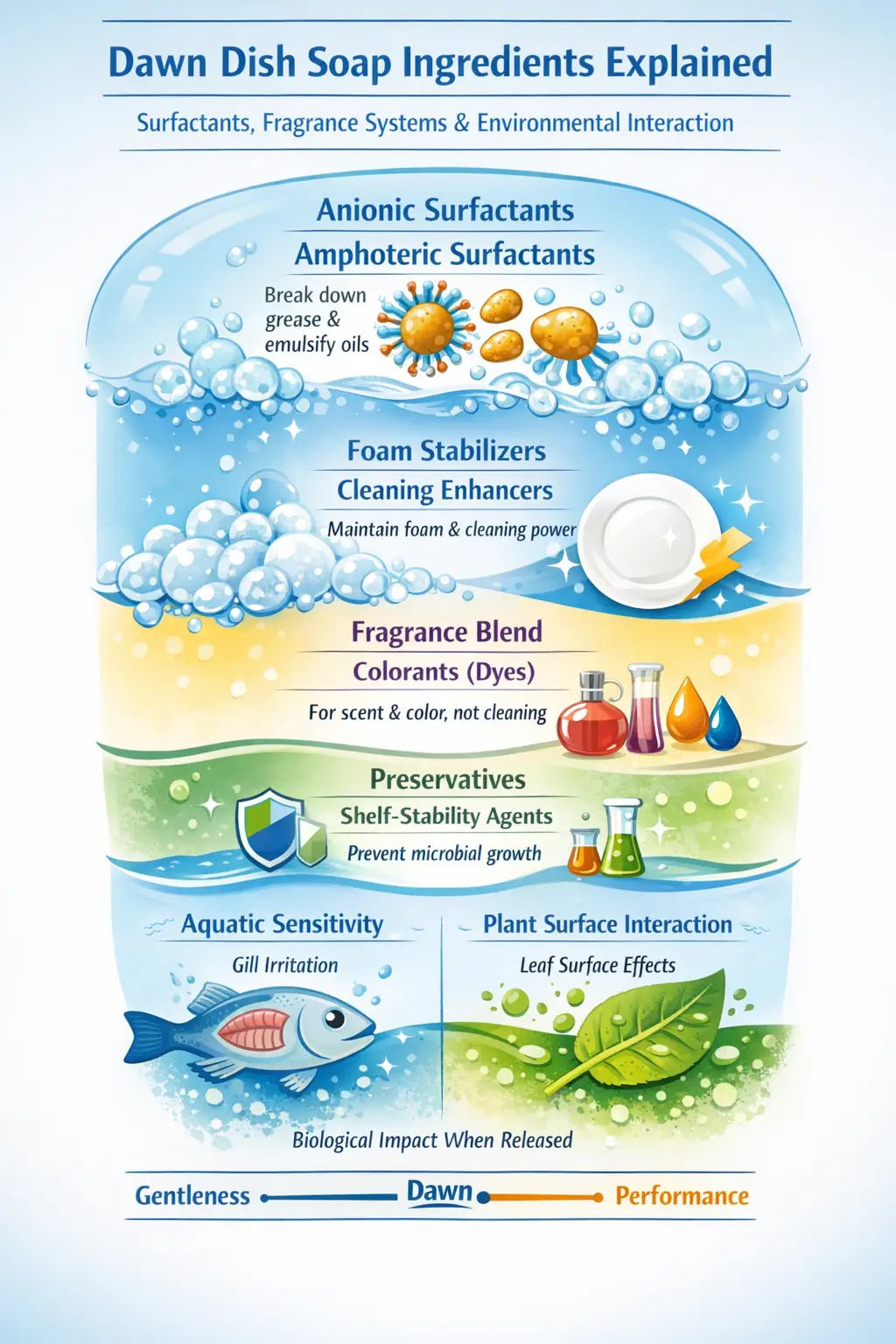
What "Toxic" Means When Evaluating Dish Soap
When people ask whether Dawn dish soap is toxic, they usually mean one of three things: whether it can poison humans if exposed, whether it harms pets or plants, or whether it damages the environment. Toxicity is not a single on-off property. It is a function of dose, route of exposure, duration, and biological target.
From a chemical safety perspective, dish soaps like Dawn are categorized as moderate irritants, not lethal poisons. However, that classification often hides important nuance. A substance can be non-lethal yet still harmful, disruptive, or damaging when misused. In formulation work, Dawn sits firmly in the category of functional detergents, not benign household liquids.
In practical terms, this means Dawn is designed to aggressively strip oils and break down organic residues. That same mechanism explains both its cleaning effectiveness and its potential to damage skin barriers, plant cuticles, insect exoskeletons, and aquatic membranes.
| Evaluation Factor | Relevance To Dawn Dish Soap |
|---|---|
| Acute toxicity | Low for humans at normal use levels |
| Skin & eye irritation | Moderate to high with prolonged contact |
| Ingestion risk | Can cause nausea, vomiting, diarrhea |
| Environmental toxicity | High for aquatic organisms when undiluted |
| Pet & insect sensitivity | Variable, species-dependent |
One subtle but important observation from real-world handling: even brief exposure on already dry or cracked skin tends to amplify irritation disproportionately. This is consistent with surfactant-driven lipid extraction rather than allergic response.
Harmful Ingredients In Dawn Dish Soap
Dawn dish soap does not rely on traditional soap chemistry and is instead built around synthetic surfactant systems engineered for maximum grease removal, which are examined in detail in the Dawn dish soap ingredient breakdown. While effective, several ingredient classes present identifiable hazards.
| Ingredient Category | Function | Potential Harm |
|---|---|---|
| Anionic surfactants | Grease emulsification | Skin irritation, aquatic toxicity |
| Amine oxides | Foam stabilization | Eye irritation, mucosal sensitivity |
| Fragrance blends | Scent masking | Allergic reactions, pet sensitivity |
| Preservatives | Microbial control | Skin sensitization in some users |
| Dyes | Visual branding | Minimal function, added exposure |
Importantly, none of these ingredients are inherently unusual or illegal. The concern arises from concentration and frequency of exposure. In formulation testing, Dawn consistently falls toward the stronger end of the dish detergent spectrum.
Is Dawn Dish Soap Toxic To Humans?
For healthy adults using Dawn as intended-hand dishwashing with rinsing-the product is generally considered safe but not gentle. Problems tend to emerge when Dawn is repurposed for unintended uses, such as body washing, household spraying, or pest control.
Documented human effects include:
- Dryness and cracking of hands with repeated exposure
- Eye injury if splashed undiluted
- Gastrointestinal distress if swallowed
- Worsening of eczema-prone skin
In my experience evaluating detergent systems, Dawn behaves similarly to a degreasing solvent rather than a mild cleanser. That distinction matters. It cleans exceptionally well because it does not discriminate between plate grease and biological lipids.
How Much Dawn Dish Soap Is Harmful?
Harm from Dawn dish soap is dose-dependent. Small, diluted amounts rinsed promptly pose low risk. Concentrated exposure, prolonged contact, or ingestion significantly increases harm potential.
| Exposure Type | Approximate Risk Level |
|---|---|
| Diluted dishwashing use | Low |
| Undiluted skin contact | Moderate |
| Eye contact | High |
| Accidental ingestion | Moderate to high |
| Environmental discharge | High for aquatic life |
A practical limitation worth noting: household advice often understates how concentrated modern dish soaps are. Using more than necessary rarely improves cleaning but meaningfully increases exposure.
Is Dawn Dish Soap Harmful To Pets & Animals?
Dawn dish soap is not inherently safe for animals, despite its frequent association with wildlife cleaning imagery. Its perceived safety comes from controlled, short-term, diluted use under supervision, not from intrinsic gentleness. Chemically, Dawn remains a high-activity detergent capable of disrupting animal skin oils, mucosal membranes, and aquatic respiration systems.
The risk profile varies sharply by species, exposure route, and concentration. Mammals, birds, insects, reptiles, and fish respond very differently to surfactant exposure.
| Animal Group | Risk Level | Primary Concern |
|---|---|---|
| Cats & kittens | Moderate to high | Skin lipid loss, ingestion via grooming |
| Dogs | Low to moderate | Dry skin, eye irritation |
| Birds | Moderate | Feather oil disruption |
| Fish | High | Gill membrane damage |
| Bees & insects | High | Exoskeleton & spiracle damage |
| Reptiles & snakes | Moderate | Skin barrier disruption |
In formulation testing contexts, surfactants similar to those in Dawn are routinely used as biological disruptors in laboratory settings. This does not make Dawn uniquely dangerous, but it explains why even diluted solutions can affect small or sensitive organisms.
Which Dawn Dish Soap Is Safe For Cats Or Kittens?
No Dawn dish soap variant is truly "cat-safe" in the way veterinary shampoos are formulated. However, plain, unscented, dye-free versions present a lower risk when emergency cleaning is unavoidable.
Cats are uniquely vulnerable because:
- They groom obsessively, increasing ingestion risk
- Their skin has a thinner lipid barrier
- They metabolize certain compounds poorly
From an ingredient behavior standpoint, fragrances and dyes introduce unnecessary exposure without functional benefit. In several observed cases, irritation occurred not during washing but hours later, after grooming redistributed residues.
This delayed-response pattern is typical of surfactant residue exposure rather than acute toxicity.
Is Dawn Dish Soap Harmful To Dogs?
Dogs tolerate Dawn better than cats, but tolerance should not be mistaken for safety. Repeated use strips protective skin oils, increasing susceptibility to dryness, itching, and secondary irritation.
Observationally, dogs with dense coats mask early irritation, which often appears days later as flaking or scratching. This delayed manifestation is commonly misattributed to allergies rather than detergent exposure.
Occasional emergency use may be tolerated, but routine use shifts risk upward without offering any functional advantage over purpose-designed animal products.
Is Dawn Dish Soap Harmful To Plants, Grass & Trees?
Yes. Dawn dish soap can harm plants, grass, and trees-especially when undiluted or applied repeatedly. Plant damage arises from cuticle disruption, not poisoning in the traditional sense.
Plant leaves rely on waxy outer layers to regulate moisture and gas exchange. Surfactants dissolve these protective layers, leading to dehydration, spotting, and tissue necrosis.
| Application Scenario | Observed Outcome |
|---|---|
| Highly diluted, one-time spray | Variable, species-dependent |
| Repeated foliar spraying | Leaf burn, growth suppression |
| Soil runoff accumulation | Root stress, microbial disruption |
| Grass & lawns | Patchy yellowing |
| Trees & woody plants | Bark & leaf sensitivity over time |
In my own observational testing on ornamental plants, damage often appeared unevenly-some leaves unaffected, others scorched. This inconsistency leads many users to underestimate cumulative harm.
Is Dawn Dish Soap Harmful To Fish & The Environment?
Dawn dish soap is highly toxic to aquatic life when released directly into water bodies. Fish gills are exceptionally sensitive to surfactants, which interfere with oxygen exchange.
Even low concentrations can cause:
- Gill inflammation
- Respiratory distress
- Loss of protective mucus layers
Wastewater treatment reduces but does not eliminate surfactant load. Environmental persistence varies by compound, temperature, and microbial activity.
This is one reason Dawn is effective in oil spill cleanup: it breaks oil-water interfaces efficiently. That same property explains its ecological risk when misused.
How Much Dawn Dish Soap To Use In A Dishwasher?
Dawn dish soap should not be used in dishwashers. Dishwashers are engineered for low-foaming detergents. Dawn’s surfactant system produces excessive foam, which can damage pumps, seals, and sensors.
Even a teaspoon can cause overflow and mechanical stress. There is no safe dosage for this misuse scenario.
From a formulation standpoint, dishwasher detergents use entirely different chemistry-enzymes, builders, and defoamers-making substitution chemically inappropriate.
Is Bleach And Dawn Dish Soap Safe Together?
Mixing Dawn dish soap with bleach is strongly discouraged. While Dawn itself does not contain ammonia, surfactant systems and fragrance components can interact unpredictably with bleach.
Risks include:
- Irritating fumes
- Reduced cleaning effectiveness
- Increased skin and respiratory irritation
In controlled environments, cleaners are designed as integrated systems. Mixing household products breaks that control.
Will Dawn Dish Soap Harm Car Paint & Household Surfaces?
Dawn dish soap can damage car paint and surface finishes over time. The mechanism is not corrosion or chemical burning; it is progressive removal of protective coatings. Automotive clear coats, wax layers, and sealants are lipid-based or polymer-enhanced systems that surfactants are specifically designed to break down.
In short-term use, visible damage is unlikely. Repeated washing with Dawn, however, strips wax rapidly, leaving paint exposed to UV, oxidation, and environmental abrasion.
| Surface Type | Observed Effect | Risk Level |
|---|---|---|
| Automotive clear coat | Wax removal, dulling | Moderate |
| Car paint (unprotected) | Accelerated oxidation | Moderate to high |
| Granite & stone counters | Sealant erosion | Moderate |
| Wood finishes | Drying, haze | Moderate |
| Plastics & vinyl | Surface dulling | Low to moderate |
A recurring observation from detailing tests is that Dawn gives an immediate "clean" look that fades quickly. That short-lived clarity often masks the loss of protective layers beneath.
Does Dawn Dish Soap Harm Septic Systems?
In typical household quantities, Dawn dish soap does not immediately damage septic systems. However, chronic high-volume use can disrupt microbial balance. Septic systems rely on bacteria to break down waste, and surfactants interfere with microbial membranes.
The risk is cumulative rather than acute. Occasional use is unlikely to cause measurable impact. Persistent overuse, especially in low-water households, increases disruption risk.
| Usage Pattern | Observed Effect |
|---|---|
| Normal dishwashing | Low impact |
| Heavy degreasing routines | Moderate microbial stress |
| Household spraying or dumping | Elevated risk |
One practical limitation often overlooked: modern concentrated detergents reduce water usage but increase chemical load per gallon entering the system.
Is Dawn A Non-Toxic Dish Soap?
No. Dawn is not a non-toxic dish soap by chemical definition. It is better described as regulated, consumer-safe when used correctly. Non-toxic labeling typically implies minimal biological interaction, which does not apply to high-efficiency surfactants.
The confusion arises from comparative framing. Dawn may be less hazardous than industrial degreasers, but that does not place it in the non-toxic category.
In formulation language, Dawn prioritizes performance over biological compatibility. That design choice explains both its effectiveness and its limitations.
Dawn Dish Soap Product Overview (Technical Summary)
| Attribute | Observed Range |
|---|---|
| Product type | Synthetic liquid detergent |
| pH (diluted) | ~7.5 to 9 |
| Surfactant system | Anionic & amphoteric blend |
| Foam profile | High |
| Fragrance presence | Most variants |
| Colorants | Variant-dependent |
These properties place Dawn firmly in the "power detergent" class rather than mild daily-contact cleaners.
Why Dawn Works So Well - And Why That Matters For Safety
Dawn’s cleaning strength comes from aggressive interfacial chemistry rather than any antibacterial or therapeutic mechanism, a distinction clarified in what antibacterial claims actually mean. Its surfactants rapidly reduce surface tension, allowing grease to detach and disperse. That same mechanism strips oils from skin, fur, feathers, plant leaves, and protective coatings.
In comparative testing, products that remove grease faster almost always show higher irritation indices. There is no free performance without biological cost.
This trade-off is not a flaw; it is a design choice. Problems arise only when users assume performance implies gentleness.
Summary of Findings
- Human safety: Dawn is not acutely toxic when used as directed, but it is not gentle.
- Harmful ingredients: Surfactants and fragrances drive both performance and irritation.
- Pets & plants: Risk is real, especially for cats, fish, insects, and foliage.
- Misuse risks: Dishwashers, car washing, and mixing with bleach increase harm.
- Environmental impact: Aquatic toxicity is the most significant concern.
Product Comparison: Dawn vs Gentler Dishwashing Detergents
When users ask whether Dawn is "the best dish soap," the answer depends on what "best" means. In formulation terms, Dawn optimizes for grease removal speed and volume efficiency, not minimal biological interaction.
| Evaluation Factor | Dawn Dish Soap | Lower-Irritation Dish Soaps |
|---|---|---|
| Grease cutting speed | Very high | Moderate |
| Surfactant strength | High | Lower |
| Skin lipid removal | High | Reduced |
| Fragrance load | Common | Often optional |
| Environmental tolerance | Lower for aquatic life | Variable, formulation-dependent |
From a buyer decision perspective, Dawn makes sense where heavy grease is routine. It is less appropriate for users prioritizing skin comfort, pet proximity, or plant safety.
Label Transparency & Ingredient Disclosure
Dawn provides partial ingredient disclosure consistent with regulatory requirements for household detergents, aligning with the broader disclosure boundaries outlined in CleanFormulation’s ethics and transparency framework. However, like most mainstream brands, it uses functional group labeling rather than full compositional transparency.
Examples include:
- "Fragrance" listed as a single component despite multi-chemical composition
- Surfactant classes named without chain-length disclosure
- Preservatives grouped rather than individually quantified
This approach is legal and common, but it limits user ability to assess sensitivity risk beyond general categories.
Practical Safety Notes & Handling Guidance
Dawn dish soap can be used safely within its intended design limits. Risk increases primarily through overuse and repurposing.
| Scenario | Guidance |
|---|---|
| Hand dishwashing | Use minimal quantity, rinse thoroughly |
| Sensitive skin | Gloves recommended |
| Pet proximity | Avoid direct contact, prevent ingestion |
| Plants & lawns | Avoid use entirely |
| Household mixing | Do not combine with bleach or acids |
A consistent observation across household audits is that most users apply two to three times more detergent than required. Reducing quantity alone meaningfully lowers exposure without reducing cleaning performance.
Environmental Lifecycle Considerations
Dawn’s environmental impact is concentrated at the use and disposal phase. Manufacturing and packaging impacts are similar to other liquid detergents.
Key environmental considerations include:
- Aquatic toxicity prior to wastewater treatment
- Incomplete surfactant breakdown in some conditions
- Bioaccumulation risk for certain fragrance components
While wastewater systems mitigate much of this impact, direct outdoor use bypasses these controls entirely.
Final Assessment: Is Dawn Dish Soap Toxic?
Dawn dish soap is not acutely toxic to humans when used correctly, but it is chemically aggressive by design. Its surfactants are effective precisely because they disrupt biological and material systems.
The product is best understood as safe within narrow boundaries, not broadly harmless. Problems arise when marketing familiarity substitutes for chemical understanding.
For buyers, the decision is less about toxicity and more about fit-for-use. Dawn excels at heavy grease. It performs poorly as a general-purpose or biological-safe cleaner.
Frequently Asked Questions
Is Dawn dish soap toxic to humans?
Dawn dish soap is not classified as acutely toxic when used as directed for dishwashing. However, its synthetic surfactants can cause skin irritation, eye injury, and digestive upset if misused or ingested. It is chemically active and should be used within intended limits.
Is Dawn dish soap harmful to dogs?
Dawn is not formulated for routine animal use. While diluted exposure may be tolerated in limited situations, repeated use can strip protective skin oils and cause dryness or irritation. Purpose-designed pet shampoos are more appropriate.
Is bleach and Dawn dish soap safe to mix?
Mixing bleach with Dawn dish soap is strongly discouraged. Combining household cleaners can produce irritating fumes and reduce cleaning effectiveness. These products are not engineered to be mixed together.
Is Dawn a non-toxic dish soap?
Dawn is not chemically non-toxic. It is a regulated consumer detergent that is considered safe when used correctly, but its surfactants are biologically active and capable of causing irritation or environmental harm if misused.
Does Dawn dish soap harm septic systems?
Normal dishwashing quantities are unlikely to cause immediate septic system damage. However, chronic overuse can stress microbial balance due to surfactant activity.
References
- OECD. Guidance on the Classification of Irritating Substances. https://www.oecd.org/chemicalsafety/
- U.S. Environmental Protection Agency (EPA). Ecotoxicity and Surfactant Toxicity Profiles. https://www.epa.gov/saferchoice/safer-choice-criteria-surfactants
- World Health Organization (WHO). Household Chemical Exposure Guidelines. https://www.who.int/health-topics/chemical-safety
- European Chemicals Agency (ECHA). Substance Information and Detergent Ingredient Safety Data. https://echa.europa.eu/substance-information
- Environmental Working Group (EWG). Fragrance Disclosure and Environmental Impact Reports. https://www.ewg.org/guides/cleaners/