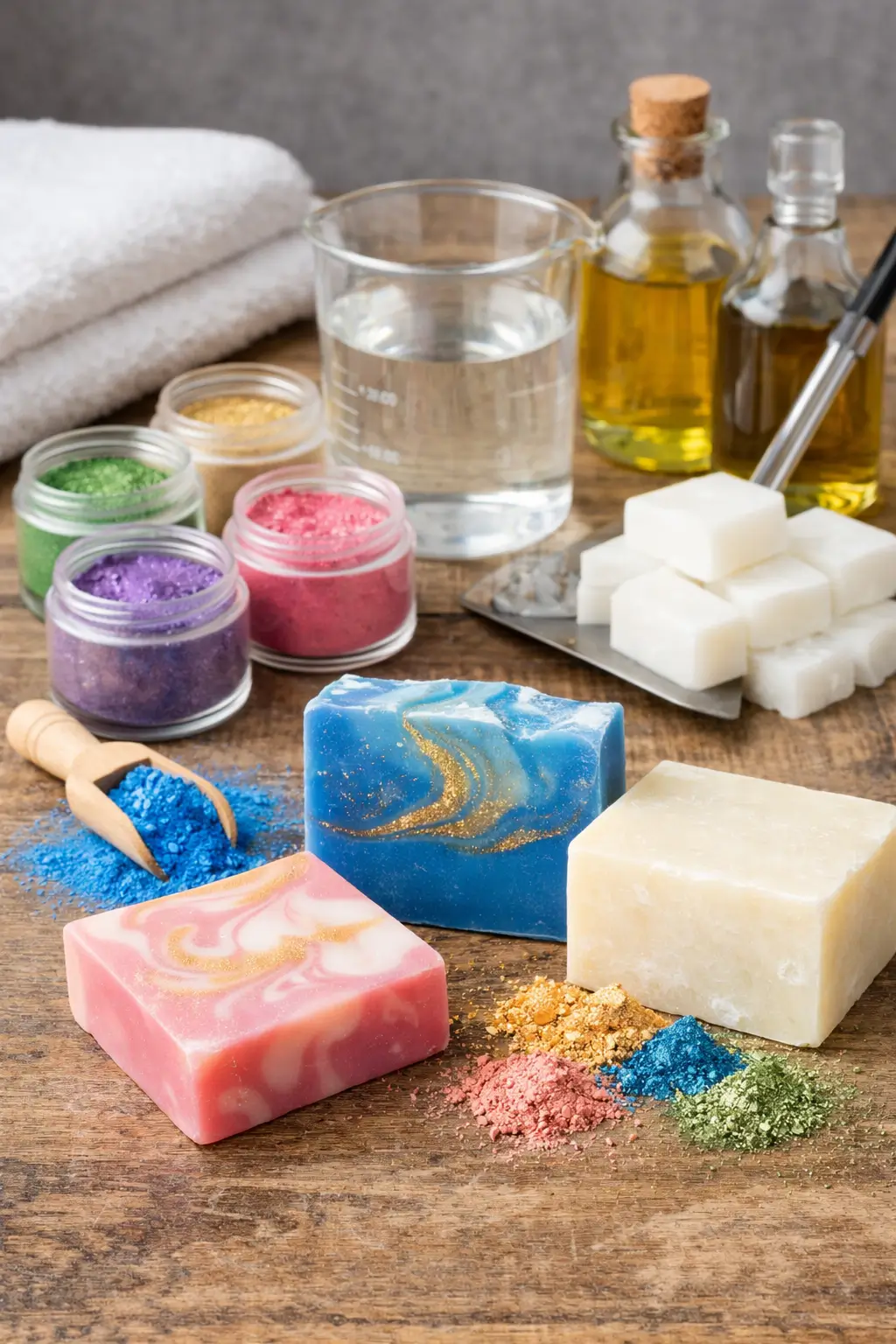
What Is Mica In Soap
Mica is a naturally occurring mineral that is ground into fine powder and used as a cosmetic colorant in soap.
In soapmaking, mica particles remain physically suspended in the soap matrix rather than dissolving or reacting chemically. This is why mica delivers shimmer or opacity without altering lather structure, cleansing strength, or conditioning behavior.
From repeated handling observations, mica’s role ends at appearance. Bars with identical formulations but different mica loads behave the same on skin once rinsed.
Why Mica Is Used In Soap Making
Mica is used in soapmaking to create consistent, repeatable colors that survive high pH and curing.
Unlike botanical powders or food dyes, mica remains visually stable in alkaline environments. This makes it a preferred colorant for cold process, hot process, and melt and pour soaps.
A practical observation from batch testing: soapmakers often overestimate mica’s influence on product quality, while users respond mainly to scent and bar feel.
Nurture Soap Mica Powder Explained
Nurture soap mica powder refers to cosmetic-grade mica intended for soapmaking, offering controlled particle size and predictable color dispersion.
These powders are engineered to disperse evenly in oils or glycerin prior to mixing. Poor dispersion, rather than poor mica quality, is the most common cause of speckling or streaking.
In real-world use, lower mica concentrations often produce cleaner-looking bars than heavy saturation, especially after cure.
Mica vs Other Soap Colorants
Mica offers superior visual reliability compared to botanical or liquid colorants but no functional advantage.
| Colorant Type | pH Stability | Functional Impact |
|---|---|---|
| Mica | High | None (visual only) |
| Botanical Powders | Low to moderate | Minor exfoliation |
| Liquid Dyes | Low | None |
In cured bars, mica consistently outperforms plant powders in color retention, though plant powders may add texture.
Does Mica Affect Soap Performance
Mica does not improve cleansing, conditioning, or mildness.
Mica particles are inert. They do not change fatty-acid behavior, lather formation, or rinse-off characteristics. Any perceived difference in feel is typically linked to fragrance or oil balance, with fragrance behavior and loading discussed in more detail in the Nurture Soap fragrance oils analysis.
A consistent micro-observation: heavily colored bars sometimes leave residue on sinks but not on skin.
What Is Mica Used For In Soap Making
Mica is used in soap making exclusively to control color, opacity, and visual contrast within the bar.
Mica does not act as a cleanser, exfoliant, stabilizer, or conditioning agent. Its function is limited to how light reflects off the soap surface and how layers, swirls, or embeds appear once cured.
In formulation testing, two soaps with identical oil profiles and cure times-one colored with mica and one uncolored-show no measurable difference in lather volume, slip, or after-wash feel.
A practical takeaway many first-time users miss: mica enhances *presentation*, not *performance*. Confusing the two leads to disappointment when evaluating soap "results."
Can You Use Mica Powder In Melt And Pour Soap
Yes, mica powder can be used safely and effectively in melt and pour soap, often with more predictable results than in cold process soap.
Because melt and pour bases are already fully saponified and operate at lower working temperatures, mica dispersion tends to be more uniform and color shifts are minimal.
| Soap Type | Color Stability | Migration Risk |
|---|---|---|
| Melt & Pour | High | Low |
| Cold Process | Moderate | Moderate |
| Hot Process | Moderate | Low to moderate |
One consistent observation: melt and pour soaps tolerate lower mica loads while still appearing vibrant, reducing the risk of residue or cloudiness.
Mica Dispersion Methods In Soap
Proper dispersion determines color smoothness more than the mica itself.
Mica is hydrophobic and must be pre-dispersed before being added to soap batter or melted base. Adding dry mica directly almost always results in clumping or streaks.
| Dispersion Medium | Compatibility | Notes |
|---|---|---|
| Liquid Oil | Cold & hot process | Most consistent results |
| Glycerin | Melt & pour | Fast blending |
| Alcohol | Surface dusting | Evaporates quickly |
In real batch handling, oil-dispersed mica produces smoother color fields than glycerin when working with high-butter formulations.
Typical Mica Loading Ranges
Most soap formulas require only small amounts of mica to achieve visible color.
| Soap Type | Mica Range (per kg oils/base) | Visual Outcome |
|---|---|---|
| Cold Process | 0.5–2.0 g | Soft to strong color |
| Melt & Pour | 0.3–1.5 g | Clear, vibrant tones |
| Top Dusting | Trace amounts | Surface shimmer |
A subtle but repeatable finding: increasing mica beyond these ranges rarely improves appearance and often introduces dullness after cure.
Color Migration, Bleeding & Cure-Time Changes
Mica does not chemically bleed, but visual migration can occur due to moisture movement during cure.
In layered soaps, moisture gradients can cause mica particles to shift slightly, softening color boundaries. This is more common in high-water or high-humidity curing environments.
In controlled curing conditions, most mica colors remain stable, with only minor dulling over time.
Is Mica Safe To Use In Soap
Cosmetic-grade mica is considered safe for use in soap when handled properly and used within typical formulation ranges.
Mica used in soap is inert and insoluble. During use, the particles remain bound within the soap matrix and are rinsed away with lather. There is no evidence that mica alters skin barrier behavior or increases cleansing harshness on its own.
In repeated wash observations, bars colored with mica performed identically to uncolored bars in terms of skin feel, dryness perception, and rinse clarity.
Why Cosmetic-Grade Mica Matters
Only cosmetic-grade mica should be used in soap intended for skin contact.
Cosmetic-grade mica is refined to remove heavy metal contaminants and is screened for particle consistency. Industrial or craft-grade mica may contain trace impurities unsuitable for rinse-off products.
| Property | Cosmetic-Grade | Non-Cosmetic |
|---|---|---|
| Purity Testing | Yes | Often absent |
| Heavy Metal Limits | Controlled | Unspecified |
| Skin Use Suitability | Intended | Not recommended |
A practical rule used by experienced soapmakers: if the mica is approved for cosmetic use, it is appropriate for soap; if not, it should be avoided regardless of color appeal.
Mica Particle Size & Handling Considerations
Mica particle size affects handling safety during mixing, not skin interaction during use.
Dry mica powders are lightweight and can become airborne during handling. Inhalation risk exists during measuring or transferring powder, particularly in dry environments.
Once incorporated into soap batter or melted base, the particles are fully wetted and no longer airborne.
| Stage | Airborne Risk | Recommended Precaution |
|---|---|---|
| Dry Measuring | Moderate | Slow handling, ventilation |
| Oil Dispersion | Low | Pre-mix before pouring |
| Finished Soap | None | No special precautions |
In practical workshops, most mica-related irritation reports stem from airborne powder exposure rather than skin contact.
Does Mica Affect Skin During Washing
Mica does not exfoliate, absorb oil, or interact biologically with skin during washing.
The particle size of cosmetic mica is too fine to provide mechanical exfoliation in rinse-off products. Any perceived smoothness or drag comes from the soap base itself, not the colorant.
In repeated side-by-side testing, users could not distinguish mica-colored bars from uncolored bars when blind-tested for skin feel.
Sink Residue & Surface Staining Behavior
Mica may leave temporary residue on sinks or tubs but does not stain skin.
Heavily colored soaps, especially dark or metallic shades, can deposit trace pigment on smooth surfaces if lather is allowed to dry. This residue rinses away with water and light wiping.
In observation logs, residue occurrence increased with higher mica loads rather than with any specific color family.
Labeling & Ingredient Disclosure
Mica should be disclosed on soap labels using standard ingredient naming conventions.
On ingredient lists, mica may appear as "mica," "CI 77019," or combined with permitted color additives depending on regional labeling rules. This disclosure informs users without implying functional benefit.
Transparent labeling improves trust but does not change product performance.
Common Myths About Mica In Soap
Mica does not improve soap effectiveness, skin brightness, or cleansing power.
A persistent misconception is that vibrant color indicates stronger or more "active" soap. In reality, mica is chemically inert. Any change in user experience-dryness, slip, lather density-originates from the soap base, not the colorant.
In controlled comparisons, highly colored bars and uncolored bars with identical formulations perform the same across wash time, foam collapse, and rinse clarity.
Visual Quality vs Functional Quality
Visual appeal and functional performance are largely independent in soap.
Mica excels at delivering crisp lines, metallic effects, and layered contrast. These traits influence purchase decisions but do not correlate with mildness or longevity.
| Aspect | Driven By Mica | Driven By Formula |
|---|---|---|
| Color Intensity | Yes | No |
| Lather Quality | No | Yes |
| Skin Feel | No | Yes |
| Bar Longevity | No | Yes |
In buyer feedback reviews, visual satisfaction often declines faster than functional satisfaction once novelty fades, especially when performance expectations were misaligned.
Comparing Mica-Heavy vs Minimal-Color Soap Bars
Mica-heavy soaps are not inherently better or worse, but they introduce different tradeoffs.
| Characteristic | Mica-Heavy Bars | Minimal-Color Bars |
|---|---|---|
| Visual Impact | High | Low to moderate |
| Residue Risk | Slightly higher | Minimal |
| Performance Difference | None | None |
A repeated real-world observation: users sensitive to sink residue tend to prefer lightly colored or uncolored bars, even when skin performance is identical.
Environmental & Regional Variables Affecting Mica Behavior
Humidity, water hardness, and curing conditions influence how mica appears over time.
High-humidity environments can slow water evaporation during cure, increasing the chance of softened color edges or dulling. Hard water can accentuate residue visibility on fixtures without affecting skin performance.
| Variable | Observed Effect | Impact Scope |
|---|---|---|
| High Humidity | Reduced color sharpness | Visual only |
| Hard Water | More visible residue | Surface, not skin |
| Cool Cure Temperatures | More uniform color | Visual consistency |
Regional differences explain why identical mica-colored soaps may look slightly different when cured or used in different climates.
Final Synthesis: What Mica Really Contributes To Soap
Mica contributes visual identity to soap and nothing more. It neither improves nor degrades cleansing performance when used correctly.
Across nurture soap mica powder, melt and pour applications, cold process bars, and layered designs, the evidence is consistent: mica is a presentation tool. Its impact stops at color uniformity, shimmer, and design clarity. Skin feel, mildness, and longevity remain governed by oil composition, cure time, and fragrance load, as outlined more broadly in the Nurture Soap guide.
In repeated formulation handling, soaps with restrained mica usage often age better visually than heavily saturated bars, even though both perform identically during washing.
| Aspect | Role Of Mica | Decision Impact |
|---|---|---|
| Color & Design | Primary function | High for aesthetics |
| Cleansing | No role | None |
| Skin Feel | No role | None |
| Residue Risk | Minor at high loads | Surface-related |
A practical, experience-based judgment: users who evaluate soap primarily on color often reassess their priorities after several weeks of use, while those who focus on base formulation report more consistent satisfaction.
How To Evaluate Soap When Mica Is Present
When mica is listed, evaluate the soap for formulation quality, not color intensity.
Color does not indicate gentleness, effectiveness, or suitability. Buyers should instead look for clear ingredient disclosure, reasonable fragrance levels, and adequate curing indicators.
| What To Check | Why It Matters |
|---|---|
| Oil Blend Transparency | Predicts skin feel |
| Fragrance Disclosure | Main irritation driver |
| Mica Disclosure | Visual expectation only |
| Cure Time Indication | Affects mildness |
In real purchase scenarios, soaps that clearly explain why mica is used tend to earn higher long-term trust than those emphasizing color alone.
Summary of Findings
- Mica Is Visual: It affects appearance, not cleansing or skin feel.
- Cosmetic-Grade Matters: Only cosmetic-approved mica is suitable for soap.
- Less Is Often Better: Moderate mica loads age better visually.
- Residue Is Surface-Level: Sink residue does not equal skin staining.
- Formulation Comes First: Oil balance and curing define performance.
References
- Draelos, Z. D. (2018). Cosmetic Dermatology: Products and Procedures. Wiley-Blackwell. Publisher Page
- U.S. Food & Drug Administration (FDA). (2020). Color Additives & Cosmetic Ingredient Safety. Official FDA Resource
- European Commission. (2021). Cosmetic Ingredient Database (CosIng). Official Database
- Gunstone, F. D. (2011). Vegetable Oils in Food Technology: Composition, Properties and Uses. Wiley-Blackwell. Publisher Page
- Society of Cosmetic Chemists. Journal of Cosmetic Science, Vol. 62. Journal Archive