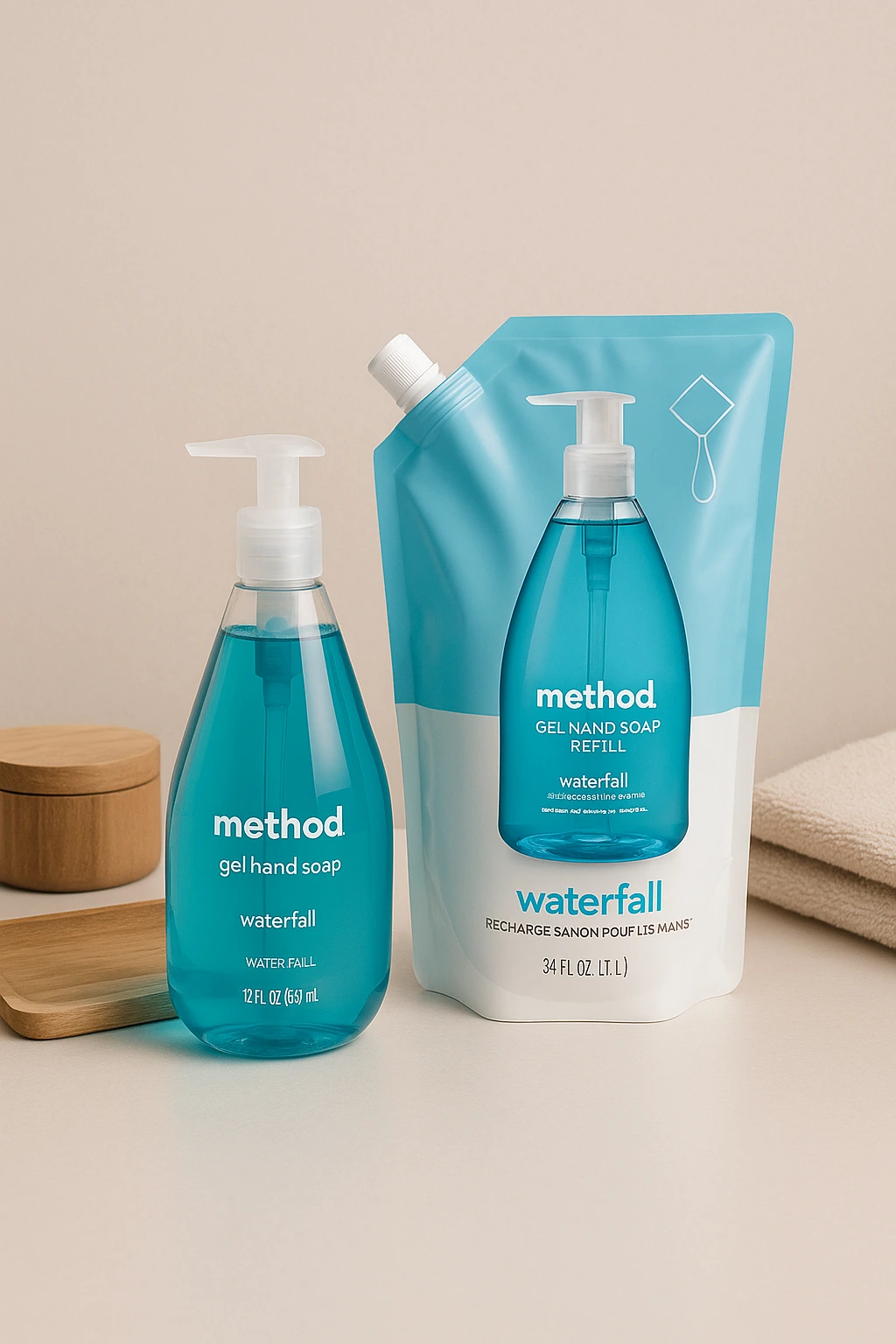
Refills And Packaging
Method distributes gel hand soap in several pack formats: retail bottles (250–500 mL), multi-packs, and larger refill pouches (1–3 L). Refill options typically carry specific scent labels-e.g., Method Gel Hand Soap Refill Sea Minerals, Vetiver Amber refill, Sweet Water refill, Waterfall refill, Pink Grapefruit refill, and Free & Clear refill for fragrance-free needs.
Packaging materials influence product stability and carbon footprint. Refill pouches generally use multi-layer laminates for barrier properties; aluminum bottles are offered as a premium, reusable vessel option that improves recyclability when used repeatedly. Typical refill-to-bottle transfer practices and recommended filling tolerances are summarized in the table below.
| Refill Format | Common Volume | Recommended Bottle Fill Tolerance | Notes |
|---|---|---|---|
| Pouch Refill | 1 L - 3 L | ±2% by volume | Multi-layer laminate; often sealed with spout for pump filling |
| Retail Bottle | 250 mL - 500 mL | ±1.5% by volume | Pre-measured consumer packaging; recyclable or refillable |
| Aluminum Bottle (Reusable) | 300 mL - 500 mL | ±1% by volume | Corrosion-resistant lining usually present; improves reuse lifecycle |
Refill labels such as Method Gel Hand Soap Refill Free Clear and Method Gel Hand Soap Refill Unscented are designed to meet users who require minimal fragrance or sensitivity-friendly formulations. For kitchen-specific applications, the Method Kitchen Gel Hand Soap variants emphasize grease-cutting surfactants and fragrance notes appropriate for food-prep environments.
Scents And Variants
Key scent families in the gel line rely on characteristic fragrance building blocks. Below are the common commercial variants and a short chemical summary of their expected aroma profile and functional implications during use.
Vetiver Amber
Vetiver Amber mixes low-volatility vetiver accords (rich in vetiverol-type molecules) with amber fixatives. This combination results in long persistence on skin and packaging scent stability. The label Method Gel Hand Soap Refill Vetiver Amber denotes the refill format of this profile.
Sweet Water / Waterfall
Sweet Water and Waterfall profiles use light aldehydes, citrus top notes, and aquatic musk bases. They tend to be top-note dominant with faster evaporation during rinsing-examples include Sweet Water and Waterfall.
Sea Minerals
Sea Minerals adds mineral aldehydes and ozonic molecules to create a marine impression. It’s commonly offered as Refill Sea Minerals.
Pink Grapefruit
Pink Grapefruit is top-note heavy with limonene-rich citrus fractions and is available in refill form as Pink Grapefruit.
Free & Clear / Unscented
Free & Clear and Unscented variants minimize or eliminate fragrance molecules-sold as Free Clear and Unscented to reduce allergenic fragrance exposures.
Ingredients And Composition
Gel hand soaps are engineered as water-continuous systems where surfactants, thickeners, chelants, preservatives, and fragrance operate together. Method’s gel formulas typically emphasize plant-derived surfactants and mild amphoteric co-surfactants. The table below summarizes common functional groups and typical concentration ranges found in modern gel hand soap formulas.
| Functional Group | Representative ingredients | Typical Inclusion Range (%) | Purpose |
|---|---|---|---|
| Anionic Surfactants | Sodium Laureth Sulfate (SLES), Sodium Coco-Sulfate | 5–12% | Primary cleansing and foam generation |
| Amphoteric Surfactants | Cocamidopropyl Betaine | 1–6% | Foam boosting; reduces irritation |
| Non-Ionic / Mild Surfactants | Decyl Glucoside, Lauryl Glucoside | 1–6% | Enhances mildness and skin compatibility |
| Thickeners | Salt (NaCl), Xanthan Gum, Carbomer | 0.2–3% | Controls viscosity and dosing for pumps |
| Humectants & Emollients | Glycerin, Propanediol | 1–6% | Skin hydration and after-feel |
| Preservatives | Phenoxyethanol, Ethylhexylglycerin | 0.3–1% | Prevents microbial growth in the product |
| Fragrance | Fragrance Oil / Essential Oil Blends | 0.2–1.5% | Scent identity and volatility profile |
| pH Adjusters / Chelators | Citric Acid, EDTA | 0.05–0.5% | Stabilize preservative activity and clarity |
These ranges reflect typical modern formulations and may shift by scent variant (e.g., Pink Grapefruit may use a slightly higher volatile-fragrance fraction). The Method Gel Hand Soap Vetiver Amber SKU will show a higher proportion of low-volatility fixatives in the fragrance fraction compared with Sweet Water or Pink Grapefruit.
For a system-level explanation of liquid surfactant design, see our
liquid soap formulation systems guide.
pH And Formulation Behavior
Gel hand soaps are commonly formulated to a mildly acidic to near-neutral pH range to balance skin compatibility and preservative efficacy. Typical pH bands are listed below.
| Product Type | Typical pH Range | Rationale |
|---|---|---|
| Standard Gel Hand Soap | 5.5–7.0 | Balances mildness and preservative performance |
| Free & Clear / Unscented | 5.2–6.8 | Optimized for reduced irritation potential |
| Kitchen Gel Hand Soap | 6.0–7.5 | May lean slightly higher for improved grease removal |
Surfactant selection directly affects micelle structure and rinse behavior. Anionic surfactants such as SLES form micelles at lower concentrations, while glucoside-based non-ionics contribute to stable foams in hard water conditions. The combination of amphoteric surfactants reduces interaction with skin proteins, lowering irritation metrics in repeat-wash scenarios. A broader discussion of pH behavior in cleansing products appears in our liquid soap pH analysis.
Compatibility And Refill Fit
Refill compatibility is a practical concern for consumers using rigid bottles, aluminum vessels, or built-in dispensers. Refill spout dimensions, viscosity, and surfactant composition determine whether a refill will flow and dose correctly.
Most Method refill pouches are designed to be poured or spouted into Method-brand bottles or generic dispenser bottles with similar neck dimensions. Vetiver Amber and Sea Minerals typically have matched viscosity to standard consumer bottles, while bulk refills for commercial dispensers may be more concentrated and require a dilution ratio.
| Refill Type | Viscosity (mPa·s) | Suggested Dilution For Concentrated Refill | Notes |
|---|---|---|---|
| Retail Refill (ready-to-use) | 3,000–6,000 | None | Direct pour into consumer bottles |
| Commercial Concentrate | 8,000–15,000 | 1:3 to 1:5 (concentrate:water) | Requires calibrated dispenser or dilution station |
| Aluminum Bottle Refill | 3,000–6,000 | None | Use lined aluminum bottles to prevent metal interaction |
Usage Patterns And Dosing
Gel hand soaps are designed for measured dosing through manual pumps or wall-mounted dispensers. Dosing behavior depends on viscosity, surfactant concentration, pump geometry, and user pressure. Understanding actual delivered volume helps evaluate product longevity and refill requirements across households or commercial facilities.
Typical Dosing Volumes
- Manual consumer pump: 0.9–1.4 mL per pump
- Commercial dispenser pump: 0.7–1.1 mL per pump
- Foaming dispenser (if converted): 0.3–0.6 mL liquid which becomes aerated foam
Consumers using the Method Gel Hand Soap Sweet Water or Sea Minerals variants generally require only one pump for standard handwashing because the surfactant blend creates a dense lather structure that spreads efficiently with water.
Wash Frequency And Consumption Rates
Estimated consumption for typical households (assuming 1–1.3 mL/pump):
| Household Size | Avg. Washes/Day | Daily Soap Volume (mL) | Monthly Usage (L) |
|---|---|---|---|
| 1–2 persons | 10–18 | 10–25 | 0.30–0.75 |
| 3–4 persons | 20–35 | 20–46 | 0.60–1.38 |
| 5–6 persons | 30–55 | 30–72 | 0.90–2.15 |
These estimates indicate that a 1–3 L refill-such as Waterfall or Pink Grapefruit-satisfies a multi-person household for weeks to months depending on pump efficiency and wash frequency.
Performance And Stability
Gel hand soap performance is determined primarily by micelle formation, surfactant synergy, preservative stability, and fragrance volatility. Method’s formulations generally follow standard liquid-soap rheology: medium viscosity, high clarity for scented variants, and controlled bubble size distribution for consistent lather.
Lather Structure
Anionic surfactants supply most of the lather volume, while betaine and glucosides contribute to stability. Representative foam parameters include:
- Bubble diameter: 80–250 µm (dependent on water hardness)
- Foam persistence half-life: 65–95 seconds
- Lather spread efficiency: High, due to low-viscosity micelle layer
Clarity And Phase Stability
Clarity is a key visual characteristic. Formulations are designed to avoid phase separation within typical temperature ranges:
| Temperature Range | Expected Stability | Notes |
|---|---|---|
| 5–30°C | Stable | No expected clouding or phase shift |
| 0–5°C | Possible temporary clouding | Reversible upon warming |
| 30–50°C | Stable | May thin slightly due to reduced viscosity |
Scent Longevity
Scent persistence varies by fragrance architecture. Low-molecular-weight top notes like citrus volatiles in Pink Grapefruit dissipate rapidly in warm water, whereas dense molecules in Vetiver Amber persist longer during and after rinsing.
Kitchen-Use Performance
The Method Kitchen Gel Hand Soap formulations often include surfactants optimized for cutting oily residues on cookware and food preparation surfaces that contact the user’s hands. They may have higher grease-solubilizing potential compared to purely cosmetic variants like Sweet Water and Sea Minerals.
Antibacterial Function
The question of whether these gel hand soaps show antibacterial behavior is common. The formulations do not typically include antimicrobial actives such as benzalkonium chloride or chloroxylenol. Instead, cleansing performance comes from mechanical handwashing and surfactant-driven disruption of soils and surface debris.
Therefore, variants labeled simply as hand soap-such as Sweet Water, Sea Minerals, Pink Grapefruit, Vetiver Amber, or Free & Clear-are not regarded as antibacterial unless explicitly stated by the manufacturer. From a formulation standpoint, they operate as standard cleansing gels rather than antimicrobial agents.
This applies equally to questions around is Method Gel Hand Wash antibacterial or Method Gel Hand Wash antibacterial. Their functional identity lies in cleansing, foam formation, and fragrance release-not antibacterial classification. General cleansing versus antimicrobial classification is discussed further in our Skin Safety 101.
Reviews And Perception
Across various sources, user impressions highlight aspects such as scent strength, clarity, lathering behavior, and bottle-pump functionality. These patterns help interpret how formulation choices translate into daily use.
Positive Themes
- Scent profiles like Vetiver Amber and Sweet Water are often described as balanced and clean.
- Gel viscosity works well with consumer pumps and refill bottles.
- Clarity and color stability remain consistent over time.
- Refill pouches reduce plastic use and offer cost efficiency.
Critical Themes
- Citrus scents such as Pink Grapefruit may dissipate quickly in warm water.
- Higher-viscosity refills can pour slowly if bottles have narrow openings.
- Unscented and Free & Clear variants may feel plain to users preferring noticeable fragrances.
These patterns reflect typical expectations for surfactant-based gel soaps and are consistent with known material behaviors such as top-note volatility and viscosity-driven flow characteristics.
Method Gel Hand Soap Vs Foaming Soap - Technical Comparison
This table summarizes material, dosing, and performance differences between gel hand soap (ready-to-use liquids sold in consumer bottles and refill pouches) and foaming soap (pre-aerated formulations or diluted gel used in foaming dispensers).
| Characteristic | Gel Hand Soap (Method - Typical) | Foaming Soap (Pre-Foamed / Dispenser Diluted) |
|---|---|---|
| Primary Form | Water-continuous liquid, medium viscosity (3,000–6,000 mPa·s) | Low-viscosity solution designed for air-mix dispensers (300–1,500 mPa·s) |
| Typical Surfactant Concentration (Active) | ~6–12% anionic + 1–6% amphoteric/non-ionic | ~1.5–4% surfactant (pre-diluted/foamed), depends on dilution ratio |
| Dispensed Volume Per Use | 0.9–1.4 mL (single pump) | 0.3–0.6 mL liquid equivalent (expanded to larger foam volume) |
| Perceived Lather | Viscous, spreadable lather; better for hand-spread cleansing | Light, airy foam that covers quickly and rinses fast |
| Refill Format | Retail bottles (250–500 mL), refill pouches (1–3 L), lined aluminum bottles | Foam-specific cartridges or diluted gel in foam-capable dispensers |
| Recommended Pump Type | Standard piston pump with 1 mL stroke | Foam dispenser with air-mix head (creates stable foam at 1:3–1:6 liquid:air) |
| Viscosity Impact On Dispensing | Higher viscosity needs wider dispense or slow pour spout for refills | Low viscosity required for reliable foaming; concentrated gels must be diluted to avoid clogging |
| Water Usage & Rinse Time | Standard rinse (5–10 seconds) - surfactant micelles rinse efficiently | Often shorter rinse perceived because foam drains and disperses quickly; actual surfactant mass similar after use |
| pH Range | Typically 5.5–7.0 (mild acidic-to-neutral) | Typically 5.5–7.0 when diluted appropriately |
| Preservative Needs | Moderate (0.3–1% typical phenoxyethanol/ethylhexylglycerin) | Moderate; water-rich foams require robust preservation, especially in open cartridges |
| Antibacterial Classification | Not antibacterial unless specific actives are added (e.g., BAC) - most retail gels are cleansing only | Same: foamed formats are not inherently antibacterial unless labeled and formulated with approved antimicrobials |
| Use-Case Strengths | Good for kitchen grease removal (if formulated), tactile rinsing, and scent longevity | Ideal for high-traffic washrooms, perceived economy (less liquid dispensed), and quick coverage |
| Typical Dilution For Foaming From Gel | N/A (ready-to-use) | 1:3 to 1:6 (gel:water) depending on gel concentration and desired foam density |
| Storage & Temperature Sensitivity | Stable 5–30°C; high-viscosity gels may thin slightly at >30°C | Foam concentrates diluted on-site are more sensitive to microbial contamination if left open |
| Environmental/Refill Considerations | Refill pouches reduce single-use plastic; aluminum bottles improve recyclability if reused | Foam cartridges often single-use; diluted gel refills can also reduce waste if reusable cartridges used |
Summary of Findings
- Standard Cleansing Formula: The gel hand soap line is built around a plant-derived surfactant blend that prioritizes routine cleansing performance rather than antibacterial action. No antimicrobial actives are included unless clearly labeled by the manufacturer.
- Refill System Improves Practicality: Large refill pouches-across scents such as Sweet Water, Vetiver Amber, Sea Minerals, Waterfall, Pink Grapefruit, and Free & Clear-offer predictable viscosity, stable clarity, and extended household coverage when transferred into compatible bottles or aluminum containers.
- Scent Behavior Depends On Volatility: Citrus and aquatic profiles (e.g., Sweet Water, Sea Minerals, Pink Grapefruit) disperse rapidly due to lightweight aromatic molecules, while deeper structures like Vetiver Amber exhibit longer persistence because of lower-volatility fixatives.
- Consistent pH And Surfactant Design: Most variants fall within a mildly acidic-to-neutral pH range (5.5–7.0), optimizing skin compatibility, micelle formation, and preservative performance across home and kitchen-use applications.
- Stable Performance Across Dispensers: The gel viscosity (3,000–6,000 mPa·s) suits standard pump bottles, refillable aluminum containers, and many third-party dispensers without dilution-except in the case of commercial concentrates that require calibrated mixing.
- Household Consumption Predictable: Average dosing of 0.9–1.4 mL per pump means that households of 3–4 members typically use 0.6–1.4 liters monthly, making 1–3 L refills practical for long-term use.
References
- Rao, J., & Shao, Z. (2021). Surfactant structure–performance relationships in personal care formulations. Journal of Surfactants and Detergents, 24(3), 355–370. Journal Source
- Klammer, H., & Friedrich, C. (2020). Effect of water hardness on surfactant micelle behavior. Colloids and Interfaces, 4(2), 28. Journal Source
- European Chemicals Agency (ECHA). Surfactants: Biodegradability requirements and safety classifications. (Accessed 2025). ECHA Regulatory Portal
- Packaging Europe. (2022). Oxygen transmission rates in recyclable materials: A comparative analysis. Industry Analysis Source
- United States Environmental Protection Agency (EPA). (2024). Consumer cleaning products: Environmental impact and surfactant degradation profiles. EPA Safer Choice Program