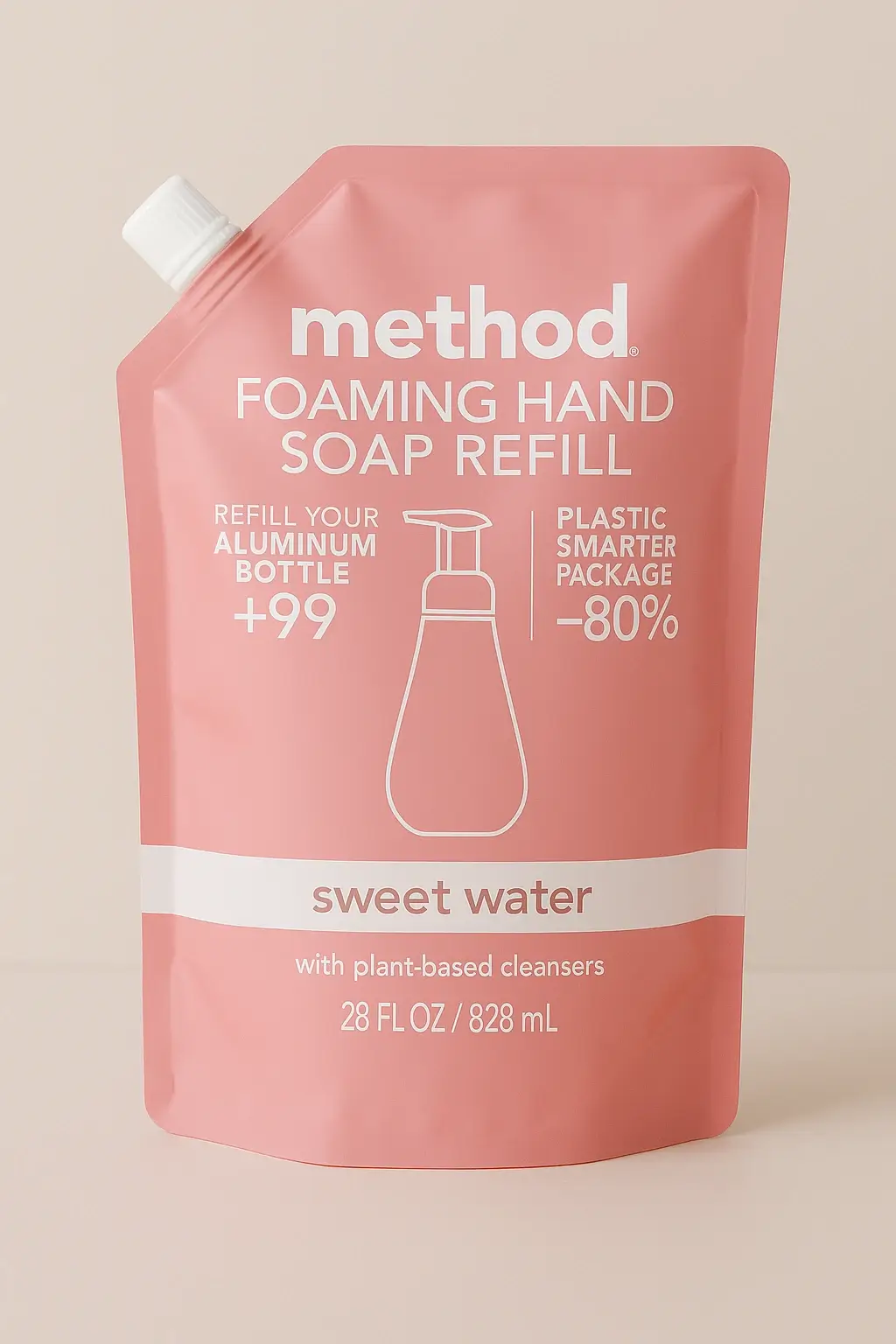
Product Overview
The refill system fall into the category of low-viscosity, water-based surfactant formulations designed specifically for foaming dispensers. Unlike gel soaps, these refills rely on a dilution-friendly surfactant structure that generates stable foam when mixed with air through a pump mechanism, contrasting with the higher-viscosity systems examined in the Method gel hand soap guide. The product line includes multiple scent families such as sweet water, sea minerals, orange ginger, pink grapefruit, eucalyptus, green tea, and coconut water, along with unscented and plant-forward options like free and clear. The brand also offers aluminum refill formats and bulk packaging intended to reduce plastic waste.
From a formulation perspective, these refills use mild anionic and amphoteric surfactants, typically in the 5–12% active range after dilution inside the pump mechanism. Supporting ingredients like humectants, chelators, stabilizers, and preservatives maintain clarity, foam stability, and shelf-life consistency. pH ranges commonly fall between 5.5 and 7.5, helping reduce irritation potential while maintaining surfactant effectiveness. A broader discussion of pH behavior in cleansing products appears in our liquid soap pH analysis.
| Parameter | Typical Range / Value | Notes |
|---|---|---|
| Product Type | Foaming hand soap refill | Low-viscosity solution designed for foaming pumps |
| Typical Active Surfactant Level | 5–12% (pre-pump) | Foam created through air mixing, not viscosity |
| Primary Surfactants | Anionic + amphoteric | Commonly includes sodium lauryl sulfate alternatives |
| pH Range | 5.5–7.5 | Balanced for mildness and surfactant activity |
| Refill Volumes | 28 oz, 28 fl oz, bulk pouches, aluminum formats | Varies by scent and packaging line |
| Packaging Materials | HDPE bottles, recyclable pouches, aluminum bottles | Reduce packaging weight and material waste |
| Scent Families | Floral, aquatic, citrus, herbal, unscented | Includes sweet water, grapefruit, sea minerals, lavender |
| Biodegradability | Formula designed for high biodegradability | Plant-based surfactants support breakdown |
For general non-medical skin interaction principles, see Skin Safety 101
.How It Works
Foaming hand soaps function through mechanical aeration, not viscosity. The pump combines the liquid formulation with air through a mesh or fine screen, producing foam with a typical air-to-liquid ratio between 4:1 and 12:1. This means that only around 8–20% of each pump output is actual liquid; the rest is air. This design allows users to feel higher volume with less product, lowering average consumption per wash.
The performance of refills depends on the interplay between surfactant concentration, surface tension reduction, humectant levels, and stabilizing additives. Surfactants must lower surface tension enough to allow bubble formation but remain mild to avoid stripping too much skin oil. Common amphoteric surfactants (e.g., Cocamidopropyl Betaine) help stabilize foam, while anionic surfactants provide cleansing power.
| Factor | Typical Range | Impact on Foam |
|---|---|---|
| Air-to-Liquid Ratio | 4:1 to 12:1 | Higher ratios produce lighter, airy foam |
| Surfactant Concentration | 5–12% | Controls bubble formation and cleansing power |
| Humectant Level | 1–4% | Affects glide, skin feel, and moisture retention |
| pH | 5.5–7.5 | Supports mildness and reduces irritation risk |
| Temperature Sensitivity | 5–30°C | Foam stability decreases significantly below 5°C |
Variants Overview
The refill family includes extensive scent and packaging options. Some formulations emphasize freshness (waterfall, sea minerals), while others emphasize warmth (vanilla, sandalwood, vetiver amber). Citrus-driven profiles like pink grapefruit and orange ginger tend to perform well in open-air environments due to their volatile top notes. Floral profiles such as violet lavender and French lavender rely more on linalool and related aromatic components. Free and clear versions remove fragrance entirely, reducing potential sensitizer exposure.
Packaging variants include classic 28 oz bottles, flexible refill pouches, aluminum-based refill containers, bulk options designed for multi-bathroom use, and recyclable bottle systems. Each format interacts differently with oxygen exposure, storage stability, and transportation weight.
| Variant | Primary Scent Notes | Format Options | Aromatic Strength |
|---|---|---|---|
| Sweet Water | Fresh, clean, aquatic | 28 oz bottle, pouches | Medium |
| Sea Minerals | Marine, ozonic, cool | Bottle, pouch | Light–Medium |
| Pink Grapefruit / Grapefruit | Citrus, bright, acidic | Bottle, pouch, bulk | High |
| Coconut Water | Soft, creamy, dilute tropical | Bottle, pouch | Light |
| Waterfall | Clean, airy blue scent | Bottle | Medium |
| Eucalyptus | Herbal, fresh, camphor | Bottle, pouch | High |
| French Lavender / Violet Lavender | Floral, herbaceous | Bottle, pouch | Medium–High |
| Vanilla / Raspberry Vanilla | Sweet, warm, creamy | Bottle | Medium |
| Vetiver Amber | Woody, earthy, warm | Bottle | Medium–High |
| Unscented / Free and Clear | No fragrance | Bottle, pouch | None |
Refill Sizes & Packaging Differences
Refill formats play a significant role in both product handling and sustainability performance. Method offers several refill configurations ranging from standard 28 oz bottles to large-format bags, pouches, and aluminum refill containers. Each packaging type has different weight-to-product ratios, oxygen exposure considerations, durability factors, and recyclability outcomes.
Conventional 28 oz bottles provide structured rigidity and consistent shelf stability, while flexible refill bags reduce total material consumption by an estimated 60–80% depending on laminate thickness. Bulk refills cater to multi-sink environments, and aluminum refills support repeated reuse cycles with low oxygen permeability.
| Packaging Type | Typical Volume | Material | Recyclability | Notes |
|---|---|---|---|---|
| 28 oz / 28 fl oz Bottle | 28 oz | HDPE | High | Rigid, stable, widely recyclable |
| Refill Pouch | Varies | Plastic laminate | Low–Medium | Lightweight, reduced plastic usage |
| Refill Bag / Large Pouch | Bulk | Multi-layer film | Low | Designed for multi-bathroom replenishment |
| Aluminum Refill Container | Variable | Aluminum | High | Durable, reusable, low oxygen transfer |
| Bulk Refill Formats | Multi-liter | Plastic jug / bag-in-box | Medium | For high-volume usage environments |
Oxygen transmission rates (OTR) vary considerably by material. HDPE exhibits moderate OTR values, suitable for cleansing products containing mild surfactants and fragrance oils. Aluminum demonstrates extremely low OTR, which helps preserve volatile aromatic components. Flexible film pouches vary widely depending on laminate structure but generally offer adequate barrier protection for short-term storage.
Performance Characteristics
Performance in foaming soaps depends on the balance of cleansing efficiency, foam stability, bubble density, rinsing speed, and post-wash feel. Method formulations are designed to produce consistent foam texture across scent families using mild surfactant systems that emphasize skin compatibility without relying on heavy thickeners.
Foam density varies by surfactant ratio and water quality. Softer water tends to produce lighter, more voluminous foam, while hard water environments reduce bubble height and longevity due to the interaction between calcium/magnesium ions and anionic surfactants. Amphoteric surfactants mitigate this issue to some extent by stabilizing micelle structures.
| Performance Category | Typical Measurement | Observational Notes |
|---|---|---|
| Foam Density | 0.05–0.15 g/cm³ | Lighter foam at higher aeration ratios |
| Bubble Stability | 30–90 seconds | Affected by water hardness and surfactant type |
| Rinse Time | 2–5 seconds | Low viscosity accelerates rinse-off |
| Usage Per Pump | 0.2–0.4 mL liquid | Varies by dispenser mechanism |
| Waste Reduction (with refills) | 60–80% plastic reduction | Based on refill pouch vs. rigid bottle |
The consistency of Method’s performance can also be attributed to the balance between plant-derived surfactants and stabilizers such as Sodium Chloride or citric acid, which adjust viscosity and pH. Fragrance selection indirectly affects foam behavior because essential oils and aromatic compounds can alter micelle structure, although the effect is generally small in well-balanced formulations.
Ingredients Explained
While exact ingredient lists vary slightly across fragrance variants, the core structure remains consistent: water, mild surfactants, humectants, chelators, fragrances (unless unscented), preservatives, and acidity regulators. The surfactant blend typically includes plant-derived anionic and amphoteric agents chosen for mildness and foam profile.
Below is a generalized breakdown of the functional groups commonly found across refill lines, including sweeter/fruity fragrances (raspberry vanilla), floral variants (violet lavender, French lavender), herbal options (eucalyptus), warm notes (sandalwood, vanilla), and fragrance-free formulations (free and clear).
| Ingredient Category | Typical Compounds | Function |
|---|---|---|
| Surfactants (Primary Cleansers) | Anionic + amphoteric surfactants | Lower surface tension, remove oil and debris |
| Humectants | Glycerin, Sorbitol | Enhance skin feel, moisture retention |
| Chelators | Sodium citrate | Bind metal ions, stabilize formula |
| Preservatives | Phenoxyethanol, sodium benzoate | Prevent microbial growth |
| Acid/Base Regulators | Citric acid | Maintain optimal pH |
| Fragrance Components | Aroma compounds + essential oil fractions | Provide scent identity |
| Colorants | Varies | Provide visual differentiation |
The unscented and free and clear versions omit fragrance compounds entirely, reducing exposure to potential sensitizers such as limonene, linalool, and citronellol, which are naturally present in many botanical-derived fragrances. Free and clear formulas instead focus on maintaining mildness through simplified compositions. For a system-level explanation of liquid surfactant design, see our liquid soap formulation systems guide.
Packaging Analysis
Packaging influences sustainability outcomes, product stability, and overall user experience. Method’s refill options-particularly refill pouches, recyclable bottle systems, and aluminum-based solutions-each come with distinct environmental and performance characteristics.
Plastic pouches reduce material use significantly but rely on multilayer laminates that may limit recycling pathways in certain regions. Aluminum containers, on the other hand, demonstrate high durability, reusability, and near-zero oxygen permeation, which is beneficial for maintaining aromatic integrity. Traditional HDPE bottles remain reliable due to widespread recyclability and consistent barrier performance against surfactant degradation.
| Packaging | Material Reduction | Barrier Quality | Reusability | Overall Impact |
|---|---|---|---|---|
| HDPE Bottle | Baseline | Moderate | Low | High recyclability |
| Refill Pouch / Bag | 60–80% less material | Low–Medium | Low | Reduced resource usage |
| Aluminum Refill Container | Varies | High | High | Long-term reuse potential |
| Bulk Refill Formats | 30–50% less plastic | Medium | Medium | Optimized for multi-sink environments |
When evaluating environmental performance, the packaging-to-product ratio is crucial. Lightweight pouches typically offer the best material efficiency, while aluminum delivers high durability and protective performance for longer-term use. HDPE remains the most accessible option for practical recycling.
Product Comparison
Compare refills based on scent families, packaging formats, ingredient sensitivities, and performance behavior in different environments. Although all formulations follow a similar surfactant framework, fragrance compounds, stability additives, and packaging choices influence the user experience.
The following table provides a multi-parameter comparison across popular scents including sweet water, sea minerals, coconut water, orange ginger, pink grapefruit, eucalyptus, violet lavender, French lavender, vanilla, raspberry vanilla, ylang ylang, sandalwood, vetiver amber, green tea, and fragrance-free options. Foaming system mechanics are analyzed in detail in our Method foaming hand soap guide.
| Variant | Aroma Profile | Foam Texture | Aromatic Volatility | Ideal Usage Environment |
|---|---|---|---|---|
| Sweet Water | Clean, aquatic | Medium-density | Medium | Bathrooms, office sinks |
| Sea Minerals | Fresh, ozonic | Light | Low–Medium | Guest washrooms |
| Pink Grapefruit | Bright citrus | Airy | High | Kitchens, high-traffic sinks |
| Orange Ginger | Citrus-spice | Medium | High | Shared spaces |
| Coconut Water | Soft tropical | Light | Low | Personal sinks |
| Waterfall | Crisp fresh | Medium | Medium | General use |
| Eucalyptus | Herbal, cool | Medium | High | Gym sinks, utility sinks |
| French / Violet Lavender | Floral, herbal | Soft-medium | Medium | Evening-use washrooms |
| Vanilla / Raspberry Vanilla | Warm, sweet | Creamy-light | Low–Medium | Bedroom/bathroom sinks |
| Vetiver Amber | Earthy, woody | Medium | Medium | Low-light environments |
| Green Tea | Herbal, subtle | Light | Low | Relaxation spaces |
| Free and Clear / Unscented | No aroma | Medium | None | Fragrance-sensitive users |
Foam texture ranges widely across the line because aromatic oils, fragrance carriers, and top-note compounds influence micellar alignment when surfactants form air-filled structures. Variants containing citrus oils tend to feel lighter, while warm scents produce slightly richer foam because of their higher molecular-weight fragrance carriers.
Stability & Storage Behavior
Stability refers to the ability of a foaming hand soap formulation to maintain clarity, color consistency, viscosity, and fragrance integrity over time. Method refills generally perform well due to balanced surfactant/humectant ratios and controlled pH. However, stability can be affected by heat exposure, repeated oxygen contact, and storage in direct sunlight.
Temperature fluctuations can alter surfactant micelle size, causing short-term cloudiness in some variants. This is reversible once the product returns to ambient temperature. Fragrance-containing versions tend to be more sensitive to heat because aromatic compounds volatilize more quickly.
| Condition | Observed Effect | Approximate Timeframe |
|---|---|---|
| Direct Sunlight | Color fading, fragrance loss | 30–90 days |
| High Heat (>32°C) | Temporary cloudiness | Immediate to 24 hours |
| Cold Storage (<5°C) | Viscosity increase, bubble collapse | Immediate |
| Repeated Air Exposure | Fragrance evaporation | Days to weeks |
| Long-Term Storage | Slow degradation of aromatic compounds | 6–12 months |
Unscented and free and clear variants demonstrate the highest stability because they contain fewer volatile compounds. Citrus-forward versions such as grapefruit and orange ginger show the highest aromatic volatility, particularly under warm conditions.
Usage Considerations
Foaming hand soap refills function best when paired with a compatible foaming pump. Standard pumps incorporate a dual-chamber mechanism that blends air and liquid automatically. If viscosity increases due to cold storage, the pump may dispense unevenly until the formulation returns to room temperature.
The refill concentrate options require proper dilution. Many users dilute at ratios between 1:2 and 1:4 depending on foam output preference. Higher dilution produces lighter foam but increases usage efficiency. When using bulk formats, it is advisable to decant into smaller containers to reduce oxygen exposure and maintain aromatic integrity.
| Dilution Ratio | Foam Density | Usage Efficiency |
|---|---|---|
| 1:2 (Soap : Water) | High | Lower efficiency |
| 1:3 | Medium | Balanced |
| 1:4 | Light | High efficiency |
Water hardness affects performance. Hard water zones benefit from slightly lower dilution ratios to compensate for mineral interaction with anionic surfactants. Soft water zones support greater dilution levels while maintaining foam density.
Safety, Precautions, Uses & Functional Benefits
This compact section summarizes non-medical, chemistry-focused safety guidance, practical uses, and measurable functional benefits for Method foaming refills. Content is performance-oriented and refrains from medical or therapeutic claims.
Safety Notes
Method foaming hand soap refills are formulated within a gentle pH range (~5.5–7.5) and use mild surfactants and humectants. Typical hazards are the same as other concentrated surfactant solutions: eye irritation risk from direct contact, and ingestion hazards if consumed in large amounts. Use basic chemical-hygiene precautions when handling concentrates and bulk refills.
| Situation | Recommended Non-Medical Action |
|---|---|
| Skin Contact (normal use) | Rinse with water if excessive residue remains; discontinue use of any product that causes prolonged irritation. |
| Eye Contact | Rinse eyes with clean water immediately and continue flushing until residue is removed; avoid rubbing. |
| Ingestion | Do not induce vomiting; provide water and contact poison control or appropriate professional services if advised. |
| Storage | Store sealed in a cool, dark place (5–30°C) away from direct sunlight and out of reach of children and pets. |
| Disposal | Empty containers may be recycled where facilities exist; rinse small residuals to drain with running water if permitted by local regulations. |
Handling Precautions
- Use appropriate personal protective measures (gloves) when decanting bulk pouches to prevent spills and splashes.
- Avoid mixing concentrated surfactant refills with other household chemicals (e.g., bleach or strong acids) to prevent unintended reactions or off-gassing.
- When using concentrate formats, follow dilution guidance (typical ranges 1:2 to 1:4 soap:water) and test pump compatibility before large-scale deployment.
- Minimize prolonged air exposure when decanting-use small transfers and reseal pouches to preserve fragrance and reduce oxidation.
Practical Uses
Foaming refills are optimized for routine handwashing and multi-user environments where reduced product consumption and rapid rinsing are priorities. Preferred use cases include residential sinks, office restrooms, guest bathrooms, and multi-sink facilities that value reduced refill frequency.
| Use Case | Recommended Format | Rationale |
|---|---|---|
| Home Bathroom | 28 oz bottle or pouch | Balanced size for monthly turnover and scent longevity |
| Kitchen Sink | 28 oz bottle (citrus variants) | Bright citrus notes reduce perception of grease; high volatility aids quick scent dissipation |
| High-Traffic Public Sink | Bulk pouches or multi-liter jugs | Cost-effective, minimizes handling frequency |
| Fragrance-Sensitive Environments | Free and Clear / Unscented | Removes potential aromatic sensitizers |
Functional Benefits
Key performance advantages are measurable and formulation-driven:
- Lower Product Use Per Wash: Typical pump output is ~0.2–0.4 mL liquid, enabled by air-to-liquid ratios (~4:1–12:1), improving usage efficiency.
- Faster Rinse: Low-viscosity foams rinse in ~2–5 seconds, reducing water use per wash.
- Improved Perceived Volume: Aerated foam provides a high-volume sensory experience while using less active ingredient.
- Environmental Gains: Refill pouches can reduce packaging material by roughly 60–80% compared to rigid bottles (packaging-to-product ratio).
- Compatibility: Plant-derived surfactant systems are broadly compatible with common foaming pump mechanisms when diluted to recommended ratios.
These notes are intended to inform product handling and selection from a chemistry and performance perspective. They do not constitute medical advice. For clinical concerns or unusual reactions, consult a qualified health professional.
Environmental Behavior
Method formulations emphasize biodegradability. Plant-derived surfactants break down more readily under aerobic conditions, supported by chelators and stabilizers that reduce environmental buildup potential. Packaging formats also influence overall environmental performance through material reduction and recyclability pathways.
Biodegradation rates vary depending on surfactant structure. Anionic surfactants break down more quickly under aerobic wastewater conditions than under anaerobic conditions. Amphoteric surfactants typically degrade efficiently across a range of environments.
Broader detergent environmental frameworks are outlined in our
Evidence & Sources documentation.
| Metric | Value or Range | Notes |
|---|---|---|
| Biodegradability | High | Plant-based surfactants |
| Packaging Material Savings | 60–80% (pouches) | Relative to HDPE |
| Oxygen Transmission (Aluminum) | Near-zero | Improves fragrance longevity |
| Recyclability (HDPE) | High | Most widely accepted material |
Summary of Findings
- Surfactant-driven formulations power Method foaming hand soap refills. These low-viscosity solutions rely on mechanical aeration rather than thickness to form foam.
- Refill formats significantly influence environmental impact and stability. Pouches reduce material usage, while aluminum offers superior oxygen protection.
- Scent families vary in volatility, foam texture, and long-term stability. Citrus variants evaporate faster, while unscented options provide the highest stability.
- Dilution ratios affect foam density and efficiency. Concentrates typically perform well at 1:3 or 1:4 ratios depending on water hardness.
- pH values typically range from 5.5 to 7.5. This contributes to mildness while maintaining effective cleansing properties.
- Bulk formats support multi-sink environments. Larger bags, jugs, and pouches preserve cost efficiency and reduce refill frequency.
- Biodegradability is generally high for plant-derived surfactant systems under aerobic wastewater conditions. Environmental performance is influenced by both formula and packaging selection.
Note: These dilution ranges reflect general foaming dispenser practices and are not manufacturer-specific instructions.
References
- Rao, J., & Shao, Z. (2021). Surfactant structure–performance relationships in personal care formulations. Journal of Surfactants and Detergents, 24(3), 355–370. Journal Source
- Klammer, H., & Friedrich, C. (2020). Effect of water hardness on surfactant micelle behavior. Colloids and Interfaces, 4(2), 28. Journal Source
- European Chemicals Agency (ECHA). Surfactants: Biodegradability requirements and safety classifications. (Accessed 2025). ECHA Regulatory Portal
- Packaging Europe. (2022). Oxygen transmission rates in recyclable materials: A comparative analysis. Industry Analysis Source
- United States Environmental Protection Agency (EPA). (2024). Consumer cleaning products: Environmental impact and surfactant degradation profiles. EPA Safer Choice Program